An informed consent form is a short document, or an information screen, that tells a potential participant what your study is, what taking part involves, that it is voluntary, how their data is handled and who to contact, so they can agree or decline knowingly. It is not the same as ethics approval. Below is an annotated fictional example for a low-risk student survey or interview.
If you are writing a final-year project, UniDraft can help you organise your confirmed methods, checked sources and supervisor instructions into an editable Word document, including the methodology section that explains how participants were informed. Start your project document. UniDraft does not approve your study, write real consent records or replace your institution's review. This is general guidance, not legal advice.
Consent, ethics approval and organisational permission are three different things
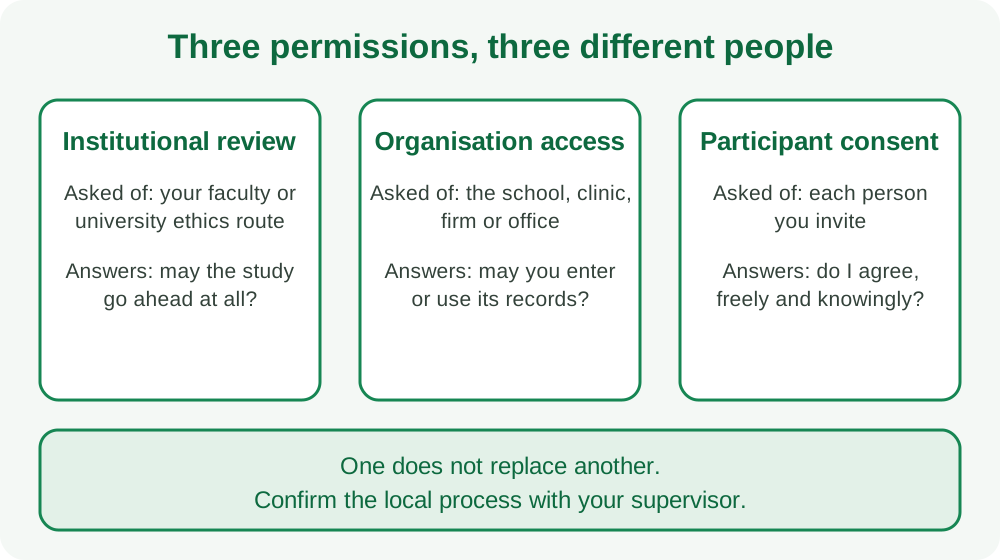
Students often say "I got consent" when they mean one of three separate things. Mixing them up is one of the quickest ways to have your methodology chapter questioned at defence.
| Permission | Who gives it | What it answers |
|---|---|---|
| Ethics approval or clearance | Your faculty, university or other review body | May this study proceed as planned? |
| Organisational permission | The school, hospital, firm or office involved | May you approach its people or use its records? |
| Informed consent | Each participant | Do I agree to take part, knowing what it involves? |
Real Nigerian institutions treat the first one as a formal step. The Faculty of Biological Sciences at the University of Nigeria, Nsukka, for example, states on its ethics page that students need ethics clearance before running a study involving human participants or non-public data, that work involving participants must wait until approval is granted, and that in group projects one member is designated to apply. It also describes a typed application form and a clearance fee (UNN Biological Sciences). That is one faculty's rule. Yours may differ, and the fee and process on any page can change, so ask your own department.
The University of Ibadan's College of Medicine publishes guidelines for ethical review of protocols which say that consent forms should be on institutional or departmental letterhead, that extra detail can sit in a separate participant information document, that each participant copy should show the ethics committee approval number and approval period, and that student projects need a supervisor's attestation (UI ethics review guidelines). Those guidelines also say protocols are reviewed against the Nigerian National Code for Health Research Ethics. That is a health-research setting; a Marketing or Education survey may sit under a different route. The point for you is the pattern: approval comes first, and the approval details can end up printed on the form itself.
If your supervisor has not told you which route applies, the useful question is: "Which ethics or project-review process does our department use for student studies with participants, and where do I get the form?" Our research ethics checklist covers that preparation stage; this post concentrates on the form itself.
What goes into a consent form or information sheet?
An online survey information sheet published by RMIT University (Australia), a well-structured template, runs through these headings: introduction, purpose, what participation involves, other relevant information, voluntariness, benefits, risks, withdrawal, results, information and confidentiality, organisation and funding, ethics review, contacts and complaints (RMIT survey template). It is written for a funded university study, so a first-degree project will usually be much shorter, but the same questions sit underneath.
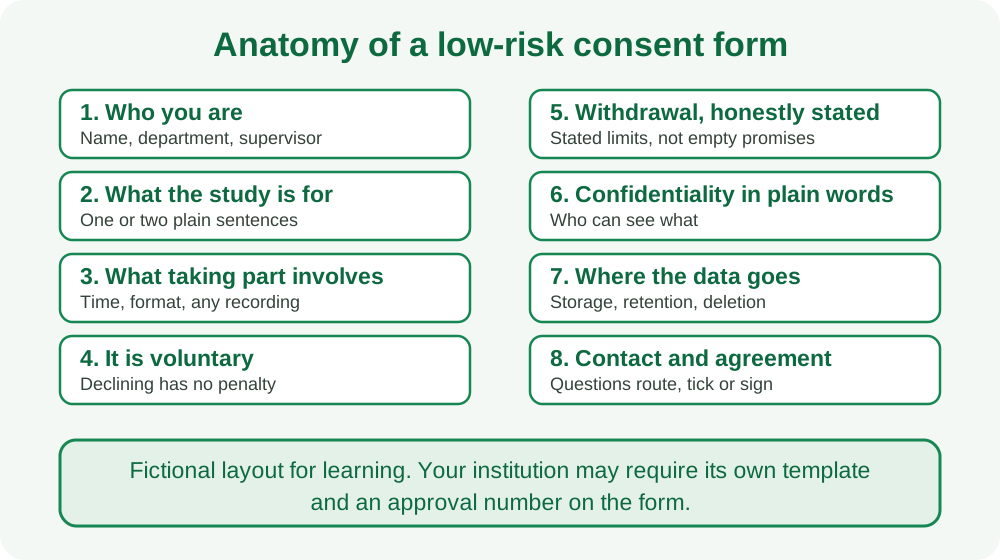
A student version can be boiled down to eight elements:
- Who you are. Your name, department, level and supervisor.
- What the study is for. One or two plain sentences, not your whole objective list.
- What taking part involves. Time needed, format (questionnaire, interview, recording), and any follow-up.
- That it is voluntary. Saying no or stopping has no penalty.
- How withdrawal actually works. Be accurate about limits.
- How confidentiality is handled. Who can see responses.
- Where the data goes. Storage, retention and deletion.
- How to ask questions, and how to agree. A contact route and a tick, signature or equivalent.
Annotated sample: a fictional student survey
The study below is invented. The name, department, supervisor, topic and email address are made up for illustration, so replace every detail and do not paste this into a real project as if it were approved. The notes in italics explain why each part is there.
PARTICIPANT INFORMATION SHEET AND CONSENT
Title of study: Study habits of second-year students at a fictional university
Researcher: Amina Example, 400-level student, Department of Education (fictional) Supervisor: Dr. B. Sample, Department of Education (fictional)
Annotation: name the person responsible and the person who supervises them. Participants should know a real, reachable adult is accountable.
1. Why am I being asked? You are being invited because you are a second-year student in the faculty. About 100 students will be invited.
Annotation: say why this person, in one sentence. Do not hide the real selection reason.
2. What is the study for? I am studying how second-year students plan their reading time. The results will form part of my final-year project and may be discussed with my supervisor and examiners.
Annotation: say where the findings will go. If you may present or share them later, say that now; do not add it after collection.
3. What will taking part involve? You will complete an online questionnaire of about 15 questions, which should take around 10 minutes. You do not have to answer any question you prefer to skip.
Annotation: state the time honestly. Test the form yourself, or with a friend, and quote what you found rather than guessing low.
4. Do I have to take part? No. Taking part is voluntary. If you decline, or stop, nothing will happen to your grades or your standing in the department. Your lecturers will not be told who did or did not take part.
Annotation: if you are recruiting classmates or juniors, think about pressure. A request made in front of the class can feel like an order. Ask your supervisor how invitations should be sent.
5. Can I change my mind? You can stop at any point before you submit the questionnaire by closing the page. This questionnaire does not record your name, so once you submit, I will not be able to find your answers to remove them.
Annotation: this is the honest wording for an anonymous form. If instead you collect names or emails, the arrangement differs and the sentence must change. Never promise "withdraw at any time" if you could not actually find and delete the response.
The RMIT template makes the same distinction: it says that for anonymous surveys responses cannot be withdrawn after submission because they cannot be traced back to the participant (RMIT survey template).
6. Will my answers be kept confidential? The questionnaire does not ask for your name, matric number or email address. Only I and my supervisor will see the individual responses. In my report I will present results as group summaries and will not describe any individual.
Annotation: check the real tool settings before writing "no email address". Some survey tools collect emails or other identifiers by default. Our Google Forms guide walks through delivery checks.
7. What happens to the data? Responses will be stored in a password-protected account that only I can access. Following my department's rules, I will delete the raw responses after [period set by the department].
Annotation: leave the retention period for your institution to specify. Do not invent a number. If you do not know the rule, that is a supervisor question.
8. Who can I ask? If you have questions, contact me at [email protected] or my supervisor Dr. Sample at [supervisor contact]. This study has been reviewed under [name of review process and reference, if one exists].
Annotation: put an approval reference here only if you really hold one. If your institution requires the number and approval period on participant copies, as the UI guidelines describe for their process, add them exactly as given. Never invent a number.
Consent ☐ I have read and understood this information and agree to take part.
Annotation: for an online survey, some institutions accept "continuing means you agree"; others require a tick-box. For interviews, a signed or recorded agreement is common. Ask which your department accepts.
How to adapt it for interviews
An interview adds things a questionnaire does not have. You need to say whether you will record audio, who will transcribe it, whether you may quote the person (and whether quotes will carry a name, a pseudonym or a role), and how long the recording will be kept. The "withdrawal" paragraph also changes: with a named or identifiable interview, you can usually remove a person's data, provided you say up to what point, for example before you start analysis. Our interview guide post covers the questions themselves, and the focus group guide covers why group settings limit what you can promise about confidentiality: you can control what you do with the recording, but not what other people in the room repeat afterwards.
What not to write in a consent form
- Overpromises. "Your answers are completely anonymous" is wrong if you collect email addresses, voices or distinctive job titles. Use "confidential" only if you can explain who has access.
- Pressure. "Your lecturer wants everyone to fill this" is not voluntary.
- Vague scope. "For academic purposes" hides whether you might publish, present or share the data.
- Fake approvals. Writing "approved by the ethics committee" without a real approval is a serious integrity problem, not a formatting slip.
- Legal-sounding filler. Long paragraphs of legal language do not make a form more valid; a participant who cannot understand it has not given informed consent.
- Borrowed text. Forms copied from another country carry that country's regulators, phone numbers and law.
Special cases: where you stop and ask your institution
For a short, low-risk survey of adults about a non-sensitive topic, the sample above shows the typical shape. The situations below change the picture, and they are the point where you should stop writing your own procedure and get guidance.
| Situation | Why it is different | What to do |
|---|---|---|
| Minors (under 18) | Participants may need a parent's or guardian's permission as well as their own agreement, often called assent | Do not recruit until your institution tells you the route. The UI guidelines mention an assent form for studies involving children. |
| Patients or health information | Health research is the area the National Code for Health Research Ethics governs, and review is typically formal | Go through the faculty or hospital ethics committee. Do not collect clinical records informally. |
| Your workplace or SIWES placement | The employer controls the setting, and staff may feel unable to refuse | Ask your supervisor and the organisation before collecting data from colleagues or using company records. |
| Sensitive topics (abuse, illness, illegal behaviour, trauma) | Questions can distress people or expose them to harm | Seek specific advice, including how to refer a distressed participant. |
| Your own classmates, juniors or people you grade | A power relationship can undermine free choice | Ask how recruitment should be handled. |
| Recording, photographs, identifiable quotes | More ways for a person to be identified | State exactly what you will record and publish, and get agreement for it specifically. |
This table is a prompt for questions, not a rule list. Your institution's requirements come first, and your supervisor can say whether your project falls into one of these categories.
Where the consent process goes in your project
Your methodology chapter should describe what really happened: who was invited, how they were informed, how agreement was recorded, and what review or permission you held. Our methodology chapter guide shows where this fits. Once the wording is settled, the formatter can help you check the layout of the finished document. If your project used a questionnaire, the questionnaire design guide is the natural companion, because the consent screen is effectively the first page of the instrument.
For the appendix, include a blank copy of the information sheet and consent form you actually used if your department allows it. Do not publish completed forms with names and signatures; our appendices guide explains the difference between a blank instrument and private records. For storage and who holds the data after submission, see the data management plan post.
Supervisor and defence questions to prepare for
- Which review or approval did your study go through, and can you show the reference where it is appropriate to do so?
- How did you make sure participation was voluntary?
- Why did you describe the data as anonymous (or confidential)? What does your tool actually record?
- What happened if someone wanted to withdraw?
- Where is the raw data now, and who has access?
- Did anyone under 18, or any vulnerable group, take part?
If you cannot answer one honestly, tell your supervisor now. Do not create retrospective approval, dates or signatures.
A short pre-collection checklist
- I know which ethics or project-review route my department uses, and I have it in writing.
- Any organisation I will approach has given the permission it needs to give.
- My information sheet uses plain language and says the study is voluntary.
- My withdrawal statement matches what I can actually do.
- I checked the survey tool for collected emails, IP addresses or other identifiers.
- I know where the data is stored and who can see it.
- My supervisor has seen the form before I send it to anyone.
When your real consent process and approvals are settled, start your project document so UniDraft can organise your confirmed methods, your checked sources and your supervisor's instructions into an editable Word draft. You supply the facts; check every statement about approval and consent against the records you actually hold.
Sources
Pages opened while researching this post:
- University of Nigeria, Nsukka, Faculty of Biological Sciences: ethics clearance page
- University of Ibadan College of Medicine: guidelines for ethical review of protocol
- RMIT University: participant information sheet template for online surveys
These show examples of how institutions structure ethics clearance and consent documents. They are not your institution's rules, and their fees and procedures may change. Confirm the current process with your own department.