
Qualitative research methods are ways of collecting and analysing non-numerical evidence, such as what people say, do or write, to understand experiences, meanings and processes. The main ones are interviews, focus groups, observation, document or content analysis and case studies. Choose by the shape of your research question, not by which method looks easiest.
UniDraft helps organise your confirmed method, checked sources and supervisor instructions into an editable Word document for your final-year project. You collect the evidence and do the analysis yourself; UniDraft does not interview anyone, code your transcripts or supply findings. This guide is the overview. It tells you when qualitative fits and which detailed guide to open next.
When does a qualitative approach fit your project?
Start with the verb in your research question. In their practical series on qualitative research, Korstjens and Moser contrast the quantitative "how many, how much, how often" with the qualitative "what", and even more "how and why". They also say the choice of design depends mainly on the research problem, the question and the knowledge you are seeking. That is a methods paper from health research, not a Nigerian department rule, but the logic travels well.
Qualitative work tends to fit when:
- you want people's own explanations, not their ticks in boxes
- the topic is new, sensitive or poorly measured, so you do not yet know which questions to ask
- you need to understand a process or a context, for example how a policy is applied in practice
- your evidence is already text, such as policy documents, newspaper pieces or student handbooks
It fits badly when your question is really about counts, averages or relationships between measured variables. A project asking "does X predict Y among 400 students?" needs a quantitative route; read choosing a research design before committing. If your problem needs both a pattern and an explanation, see the mixed-methods guide.
One more honest point. Some departments, especially in numerical or laboratory fields, may expect quantitative projects. Qualitative is a legitimate choice only where your supervisor accepts it for your question, so raise it early.
What is the difference between a method, an approach and an analysis?
Students often mix three decisions. Keeping them apart makes Chapter Three much easier to write.
| Decision | What it answers | Examples |
|---|---|---|
| Research approach or design | What kind of study is this? | Case study, ethnography, phenomenology, grounded theory |
| Data collection method | How do you gather the evidence? | Interviews, focus groups, observation, collecting documents |
| Analysis method | How do you turn evidence into findings? | Thematic analysis, content analysis |
Korstjens and Moser describe ethnography, phenomenology and grounded theory as the "big three" qualitative approaches: ethnography studies a group's culture, phenomenology explores lived experience, and grounded theory builds theory about social processes from observed data. Most undergraduate projects do not need to claim one of these in full. If you do name an approach, you are promising your reader its specific procedures, so be sure you can deliver them. A plain, honest "qualitative descriptive study using interviews and thematic analysis" is better than a grand label you cannot sustain.
Which qualitative method answers which question?
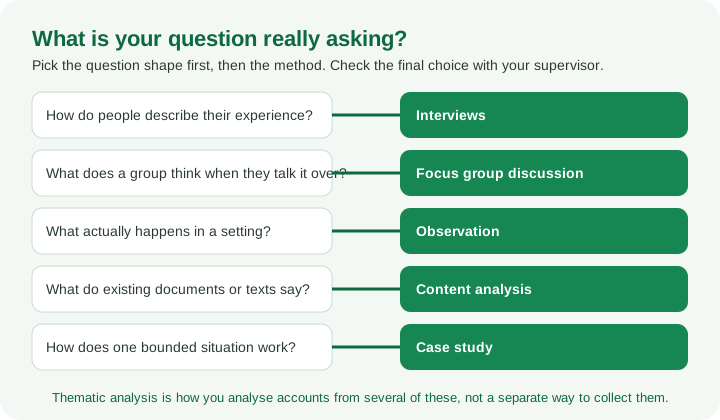
Use the figure as a first sort, then read the detailed guide for your choice. Here is how the main methods compare side by side.
| Method | Best when the question is about | Main strength | Main limit | Detailed guide |
|---|---|---|---|---|
| Individual interviews | Personal experience, reasons, decisions | Depth from each person | Time to arrange, record and transcribe | Interview guide |
| Focus group discussion | How a group talks about and negotiates a topic | Shows shared and conflicting views | Dominant voices; unsuitable for very private topics | Focus groups |
| Observation | What people actually do in a setting | Behaviour, not reported behaviour | Needs access and permission; your presence changes things | Observation checklist |
| Content analysis | Patterns in existing documents, media or messages | No participants to recruit | Only as good as the material you can lawfully use | Content analysis |
| Case study | One bounded situation in its context | Joins several kinds of evidence | Hard to define the case; limited claims beyond it | Case study |
Thematic analysis is the usual way to analyse interview, focus group and open-text material, and has its own step-by-step guide. Notice it is not in the "collect" column. Many students write "the method was thematic analysis" when they mean "I interviewed people", which leaves the data collection undescribed.
Interviews or focus groups?
Choose interviews when the topic is personal, when you want each person's reasoning without the influence of others, or when participants may be uncomfortable speaking in front of peers or lecturers. Choose a focus group when the interaction is itself informative, for example how students collectively talk about a campus service. Korstjens and Moser describe in-depth interviews as usually semi-structured and focus groups as run to a questioning route. Do not use a focus group merely to interview many people at once; you will get shallow, polite answers and a transcript that is hard to analyse.
Observation or interviews?
Interviews give you what people say they do. Observation gives you what you see. If your question is about practice, such as how a ward, workshop or classroom actually runs, observation may answer it more honestly. It is also the method with the most access and ethics issues, so plan permission with the people in charge before anything else.
Do you need a case study at all?
A case study is a design wrapped around other methods. If you can name the bounded case, explain why it was chosen and list the evidence sources you can reach, it may suit you. If you simply visited one organisation to distribute questionnaires, you have a site, not a case.
A fictional worked example: choosing a method
Here is an invented scenario to show the reasoning. It is not a real study.
Student: a Nigerian-university education student, imaginary, interested in how final-year students cope with supervisor feedback.
Draft question A: "How do students experience and respond to supervisor feedback on their draft chapters?" The verbs are experience and respond. This asks for personal accounts and reasoning, so semi-structured interviews fit, analysed thematically.
Draft question B: "How do students in a department discuss what makes feedback useful?" The interest is in shared talk, so a small number of focus groups could fit better, though sensitive comments about named lecturers would call for careful ground rules.
Draft question C: "What do department project handbooks say about how feedback is given?" The evidence is already written, so content analysis of permitted documents fits, with no participants at all.
Draft question D: "Do more than half of students receive feedback within two weeks?" This is a count. A questionnaire is the natural method; qualitative is the wrong tool.
Four questions about nearly the same topic, four different method decisions. That is the whole point of choosing by question shape. Tighten your own wording using the research questions and objectives guide before choosing.
How many participants do you need?
Qualitative sampling is not random. Korstjens and Moser describe purposive sampling, where you choose people who can speak to your question, and note that sample size depends on the richness of the data, the variety of participants, the research question, the collection method and the sampling strategy. Many writers describe collecting data until new data stop adding new analytical information, often called saturation. The same source gives tentative ranges that differ by approach, which is a reason not to treat any one figure as a rule.
Malterud and colleagues propose "information power" as an alternative idea: the more relevant information your sample holds for your aim, the fewer participants you need. Factors they name include the study aim, how specific the sample is, use of established theory, quality of dialogue and analysis strategy. I could open only summaries of that paper, so read it yourself if you want to cite it.
In practice, write a short justification instead of a magic number:
- Who can speak to this question, and why?
- How narrow is the question? A narrow question with a well-defined group usually needs less than a broad one.
- How rich will each conversation or document be?
- What can you realistically transcribe and analyse before your deadline?
Then ask your supervisor whether your department sets a minimum. If it does, follow it. For the other side of this topic, the sampling techniques guide covers the options and the questionnaire-side sample size guide shows why those formulas do not transfer here.
How do you show your qualitative project is trustworthy?
Quantitative projects talk about validity and reliability. Many qualitative writers use four criteria from Lincoln and Guba, which Korstjens and Moser summarise in a separate paper on trustworthiness:
- Credibility: are the findings plausible and true to what participants meant? Strategies include prolonged engagement, triangulation (more than one source, investigator or method) and member checks (returning interpretations to participants).
- Transferability: the reader, not you, decides whether findings fit another setting, so give thick description of the context and participants.
- Dependability: can someone follow how you reached your conclusions? Keep an audit trail.
- Confirmability: are interpretations grounded in the data rather than your preferences? The audit trail again, plus reflexivity.
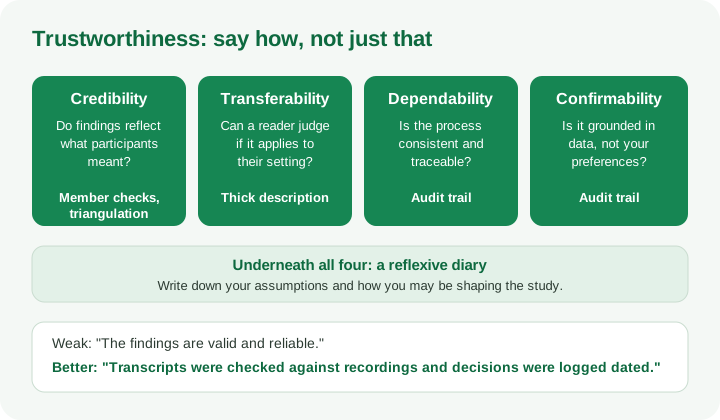
Reflexivity means reflecting on your own assumptions and relationship with participants and how they shape the study; a short reflexive diary is the usual tool. This matters in a student project because you are often researching your own campus, with peers or lecturers you know.
The practical lesson: do not just write "the instrument was valid and reliable" and move on. State what you did. For example: transcripts checked against recordings, a dated log of coding decisions, a second person reviewing a sample of codes with your supervisor's permission, and a limitations paragraph that is honest about one department, one semester and a small group. Some departments still expect the quantitative vocabulary, so ask which your supervisor prefers.
What ethics and data handling does qualitative work need?
Interviews, groups and observation put real people on record, and in a Nigerian campus setting the people involved may be easy to identify. Plan consent, privacy and storage before you collect anything, and follow your institution's ethics process if it has one. The research ethics and consent guide covers what to prepare. Recordings, transcripts and field notes are personal data. Decide where they are stored, who sees them and how you will remove names from the report. Never include participants' words in a way that exposes them just to make a quotation more vivid.
Common mistakes in qualitative projects
- Choosing qualitative because it seems easier. Transcribing and coding take long. Count the hours.
- Naming an approach you do not follow. Calling a study "grounded theory" or "phenomenology" without its procedures invites defence questions you cannot answer.
- Mixing up collection and analysis. "I used thematic analysis" does not say how you gathered data.
- Asking leading or yes/no questions. They produce thin answers; the interview guide shows how to avoid this.
- Using quotations as decoration. Each quote should support a finding you have stated, not stand alone.
- Claiming generalisation. Ten interviews from one department cannot speak for every Nigerian university. Describe the context and let readers judge transfer.
- Skipping the record. If you cannot show how you got from transcript to theme, your reader cannot trust it.
- Collecting before approval. Do not start data collection until your supervisor has agreed the design and any required ethics steps are done.
Questions your supervisor or panel may ask
Prepare short, honest answers to these before your proposal or defence; see also how to write your methodology chapter.
- Why is a qualitative approach appropriate for this question?
- Why interviews rather than a questionnaire (or the reverse)?
- How did you choose participants, and why that number?
- How do you know your interpretation is not just your opinion?
- What would a participant who disagreed say about your findings?
- What can and can't you claim beyond your sample?
A one-page planning checklist
Complete this with your supervisor before collection.
| Decision | What to write |
|---|---|
| Research question | One sentence, starting with what, how or why |
| Why qualitative | The reason a numerical design would not answer it |
| Collection method(s) | Interviews, groups, observation, documents, or a bounded case |
| Participants or material | Who or what, why them, and how you will reach them |
| Size justification | Reasons, not just a number; supervisor's view recorded |
| Analysis plan | Thematic or content analysis, steps and who checks |
| Trustworthiness steps | Which of the four criteria you will address and how |
| Ethics and data | Consent, anonymity, storage, permissions |
| Time budget | Hours for collection, transcription and coding |
When the design is settled, UniDraft can help you turn the confirmed plan, your actual findings and your supervisor's formatting instructions into an editable Word project document. Start your project document when you are ready. UniDraft does not run your analysis, and you remain responsible for checking every claim against your own evidence.
Where to go next
Pick the guide that matches your method. If you are still shaping the data plan, read data collection methods. If you are choosing between several designs, return to choosing a research design. Keep your supervisor's instructions as the final authority at every step, because departments differ on what they accept and expect. When you start citing the methods papers you read, UniDraft's free citation tool can help you format the references.
Sources
- Korstjens, I. and Moser, A. (2017), Series: Practical guidance to qualitative research. Part 2: Context, research questions and designs, European Journal of General Practice.
- Korstjens, I. and Moser, A. (2018), Series: Practical guidance to qualitative research. Part 3: Sampling, data collection and analysis, European Journal of General Practice.
- Korstjens, I. and Moser, A. (2018), Series: Practical guidance to qualitative research. Part 4: Trustworthiness and publishing, European Journal of General Practice.