A final year project problem statement says what is wrong or unknown, shows evidence that the problem exists, and identifies the part your study can realistically investigate. Place it where your confirmed instructions require it and connect it to your objectives and research questions. It is not a dramatic claim that nobody has ever studied your topic.
A topic description alone does not identify the specific uncertainty the study addresses. This guide shows how to tell the difference, how to build the statement from evidence, and how to keep the rest of your project pointed at it.
An evidence-backed problem gives the rest of your report a clear direction. UniDraft helps organise your confirmed problem, objectives, real work and instructions into an editable project document. Start your project document with UniDraft, then verify the supporting facts yourself. A convincing paragraph cannot replace missing evidence.
The short answer
- A problem statement is specific: it names a setting, a population and something that is missing, wrong or unresolved.
- It is evidenced: every factual claim traces to a source, a record or data you are allowed to use.
- It is narrow enough to study within your time, access and department's expectations.
- It leads to your objectives: read the last sentence, then read your objectives; they should feel like one line of thought.
- The heading ("Statement of the Problem", "Problem Statement", "Statement of Research Problem"), the length and the placement vary by department. Your department's project guide and your supervisor decide; if in doubt, ask.
Start with an observable problem
Compare “technology is changing education” with “the department introduced a mobile quiz tool, but has not established whether its students' quiz performance changed after adoption.” The first is a topic. The second identifies something that could be investigated. You would still need real departmental records, published research, or your own approved observations before treating that example as a fact about any actual department.
The University of Southern California's research writing guide makes the same distinction: a topic is something you want to understand, while a problem is something to be solved or explained. It also warns against circular reasoning, where the problem is just "there is no X" with no account of why the absence matters (see Sources). Your statement has to show why the gap matters, not only that something is missing.
Write down four things before drafting:
- Expected situation: What should be happening, according to a credible standard, documented process, or established finding?
- Observed situation: What does your verified evidence show instead? Name the setting and population.
- Knowledge or practice gap: What has not been adequately explained or tested in that setting?
- Consequence and response: Why does the gap matter, and what part can your project examine within its time and access limits?
Do not fill these slots with invented statistics. If you lack evidence for the observed situation, the next step is to find it or narrow your claim, not to make the prose sound more confident.
Where the problem statement sits in Chapter 1
Chapter 1 usually moves from wide to narrow: background of the study, then the statement of the problem, then aim and objectives, research questions or hypotheses, scope, significance, and definition of terms. Departments reorder or rename these, so follow yours. The USC guide describes the same movement as an inverted triangle, with general context first and a narrowing towards the specific gap.
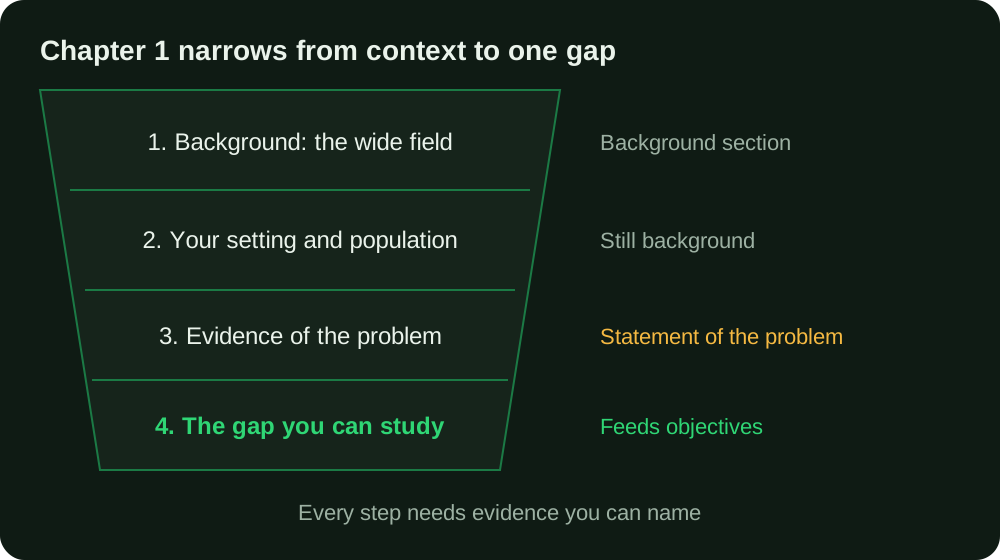
The background answers "what is this field or setting?" The problem statement answers "what specifically is unresolved here, and how do we know?" If you find yourself explaining what a term means, you are still in the background. The rest of the chapter is covered in our guide to writing the introduction of a final year project.
Five ways to find a genuine gap
A gap is not only "nobody has done this". Supervisors accept narrower, more honest gaps. Common ones:
| Type of gap | What it looks like | What you need to show |
|---|---|---|
| Population gap | Studies exist, but on a different group | Who was studied and how yours differs in ways that matter |
| Setting gap | Findings from elsewhere may not hold in your environment | Why context (infrastructure, policy, funding) could change the result |
| Method gap | Earlier work used one method only | What your method can reveal that theirs could not |
| Evidence gap | Studies disagree, or rest on weak evidence | The disagreement, stated fairly with sources |
| Practice gap | A documented process fails to do something | A record, policy or observation showing the failure |
The proposed gap should be supported by your literature review, so search properly before you claim one. The free citation finder helps locate candidate sources; open the publication and verify its details and claims before citing it.
A worked structure, not a paragraph to copy
Suppose a student has confirmed that a particular university department introduced an online booking process and has access to approved, anonymised usage records. A defensible structure could be:
The department introduced an online booking process to reduce missed appointments. Its approved records show [actual, verified pattern]. Previous studies discuss online booking in other settings, but the reviewed evidence does not establish which barriers affect this department's students. This study therefore examines [specific barriers] among [defined population] during [defined period].
Every bracket needs a fact or choice from the student's own project. If the records do not show a problem, the student should not claim they do. A software project might instead state a documented workflow limitation and define how a proposed system will be evaluated.
Before and after (illustrative only)
The example below is invented to show the difference in quality. It is not real data about any institution.
Weak: "Many students in Nigerian universities have problems with poor study habits, which affects their academic performance. This is a serious problem that needs to be solved. This study will therefore look at study habits."
What is wrong: no population, no evidence and no gap. "Many" and "serious" are unsupported, and "look at" is not something a method can answer.
Stronger (a template; every bracket must be filled from your own verified evidence): "Final-year students in [department, institution] are expected to submit a Chapter 3 draft by [date set in the department's guide]. [Verified evidence, such as a departmental record or a supervisor-approved observation, of how many missed it]. Published work on study habits has focused on [population or setting] and does not establish whether [specific habit] is associated with late submission among [your population]. This study therefore examines the association between [habit] and [outcome] among [defined group] in [period]."
The second version has an expected situation, an observed situation, a gap and a bounded response. Notice that every bracket is something you must actually establish.
Evidence: what counts and where to get it
A problem statement usually leans on some mix of these, depending on your discipline and access:
- Published research: journal articles and reports found through your library. Cite them properly, using the conventions in the references list guide.
- Official documents and policies: a regulator's guideline, a ministry report, a departmental handbook. Cite the document and its year.
- Institutional records: enrolment, attendance, incident or usage records. You need permission, and student data should be anonymised. Ask your supervisor what your department requires.
- Your own preliminary observation: a short pilot, site visit or documented interview, if your department allows it and you can describe how it was done.
What does not count: "everybody knows", a quote you cannot trace, a statistic from a social media post, or a number from a downloaded "sample project" whose original source you cannot find. If a fact matters to your argument and you cannot trace it, drop it or reword the claim so that it says only what you can support.
Make the objectives match the problem
Read the final sentence of your problem statement beside each objective. If the problem concerns appointment access but the objectives measure general satisfaction with campus technology, the project has drifted. A simple alignment table helps:
| Problem element | Matching objective or question |
|---|---|
| Unclear booking barriers | Identify the barriers reported by the defined student group |
| Unknown effect on missed appointments | Compare the verified appointment records over the approved period, if the study design allows it |
The method must also be capable of answering those questions. An interview can explore reasons students give; it cannot, by itself, establish a numerical change in appointment rates. Before promising an answer your data cannot provide, settle your research questions and objectives and check them against the methodology chapter.
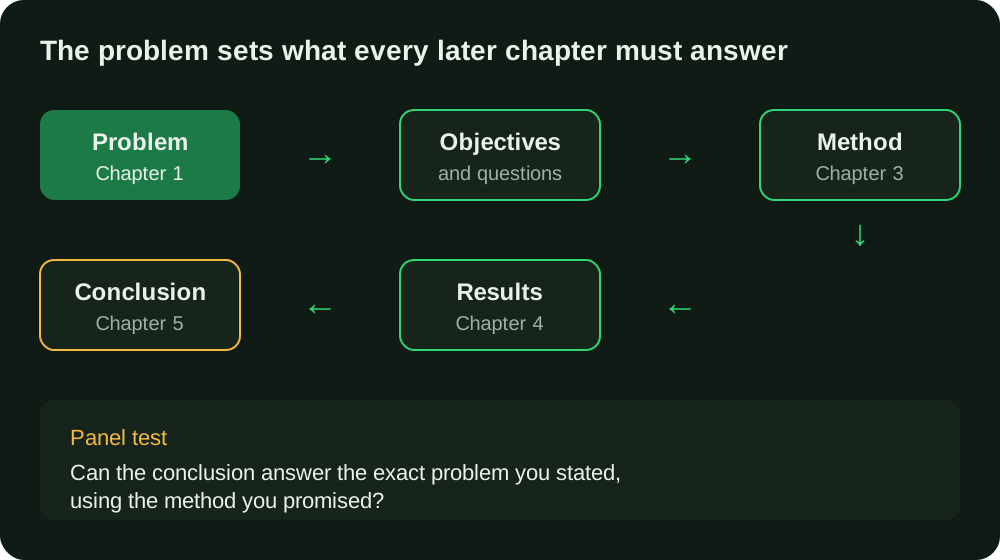
This chain is also what a defence panel tests. A common question is "what problem did your study solve?" If your results and conclusion do not answer the problem you stated, the panel will notice, so it helps to rehearse with common project defence questions. When you reach Chapter 5, the discussion and conclusion should return explicitly to the problem you opened with.
Variations by kind of project
The logic is the same everywhere; the evidence differs.
| Project type | What "problem" usually means | Typical evidence |
|---|---|---|
| Survey or social science | Unexplained pattern or unresolved disagreement in a defined population | Prior studies, official statistics, a documented observation |
| Software or engineering | A documented limitation of an existing process or system | Process description, measured delay or error, user requirements |
| Laboratory or experimental | An untested relationship or condition | Prior experiments, standards, a stated hypothesis |
| Education or health | A gap between recommended and observed practice | Guidelines, records, published evaluations |
Sample size, instruments and statistical tests follow from the problem, not the other way round. Once the problem is settled, you can work out how to calculate a sample size for a survey design.
Mistakes supervisors can spot quickly
- A claim without evidence: "Most Nigerian students struggle with this" needs a trustworthy source and a relevant population.
- A gap asserted without reading: "No study exists" is rarely justified by one search.
- A proposed solution disguised as a problem: "There is no app" matters only if you can show what the current process fails to do.
- A scope larger than the project: One department's data cannot establish a national conclusion.
- A mismatch with later chapters: Chapter 4 should answer the questions Chapter 1 raised, using the method described in Chapter 3.
- Background dressed as a problem: three pages of history with no unresolved question.
- Emotive wording: "alarming", "disastrous" and "rampant" need evidence, and often the sentence works better without them.
- Several problems at once: connected subquestions may be appropriate, but keep them within a coherent scope your method can address.
How to test your draft in ten minutes
- Underline every factual claim. Beside each, write its source. Any claim with no source gets one or gets cut.
- Circle the setting, population and period. If any is missing, add it.
- Write the gap in one sentence beginning "What is not known is...". If you cannot, you do not yet have a gap.
- Ask "so what?": would a reader see why this matters beyond your department's convenience?
- Read it beside your objectives, then beside your method. Fix whichever does not fit.
- Give it to a coursemate who does not know your topic. If they cannot say what you will study, it is still too vague.
If the trouble is the topic itself, the problem may be too broad to state. Work through how to choose a final year project topic, or use the free topic generator for narrower ideas. At proposal stage, a shorter version of the same statement is usually required; see how to write a final year project proposal.
Checklist before you submit Chapter 1
- The statement names a setting, a population and a period.
- Every factual claim has a source or a record you may cite.
- The gap is stated in narrow terms you can defend after a real search.
- The consequence (why it matters) is stated without exaggeration.
- Objectives and questions each answer part of the problem.
- The method in Chapter 3 can produce the evidence the questions need.
- Headings and layout follow your department's guide, checked against your handbook or the format guides.
- Your supervisor has seen and approved the wording.
Where UniDraft fits in
UniDraft cannot supply your evidence: the problem, its supporting facts and your results have to come from your actual work. What it does is build your written project as an editable Word document around your confirmed topic and results, applying project/supervisor instructions, student-confirmed guidelines, department patterns, university baselines and platform defaults in that order, and helping organise those connected sections for your review. When your supervisor sends corrections, you enter them, confirm the extracted changes, and a new version is produced while earlier versions are kept; check current included correction rounds before checkout. The free formatting checker tests an existing .docx for font, spacing and margin issues.
Sources
- University of Southern California Libraries: The Research Problem/Question, on clarity, significance, researchability, and circular reasoning in problem statements.
- University of Southern California Libraries: The Introduction, on narrowing from general context to a specific research gap.