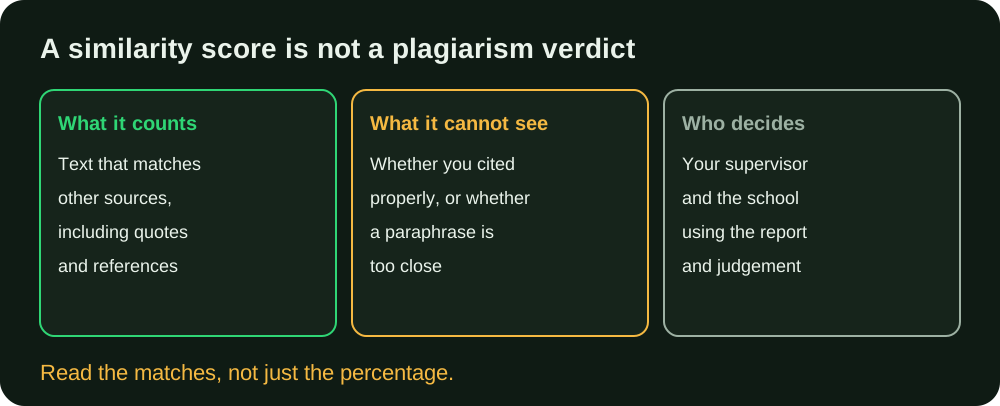
A similarity report identifies text matching sources available to the checking system. Its percentage is not a plagiarism verdict, and no threshold in this guide establishes that your project meets your department’s rule. Read the actual matches, check attribution and follow the current instructions for your submission.
This guide answers those questions without pretending to know your school's rule, because that rule belongs to your department and handbook. It also fits the larger picture of writing a final year project step by step: similarity is not a separate exercise at the end, it is the result of how you handled sources in every chapter.
Fixing source use is easier when your notes, citations and own findings remain traceable. UniDraft helps organise the material and instructions you confirm into an editable project document. Start your project documentation with UniDraft, then verify each citation and follow your institution’s AI-use policy. It does not run a similarity check or guarantee any score.
The short answer
- A similarity percentage measures how much of your text matches other texts. It does not measure whether you plagiarised.
- No single number is safe or unsafe across all schools. Your department or handbook sets the rule, if there is one. Ask for it in writing.
- A supervisor or panel reads the highlighted matches, not just the percentage.
- Real problems come from copied passages, close paraphrase without citation and reused past projects. Fix them in the writing, not by chasing a number.
- Write chapters from sources you have read and understood, cite as you go, and keep a record of where each idea came from.
What a similarity report actually is
Software such as Turnitin compares your document against a large collection of sources it can access, such as web pages, journals and previously submitted work, and highlights text that matches. It then reports a percentage that reflects how much of your text matched.
Turnitin's own explanation distinguishes matching text from a plagiarism decision. Proper quotations, references and common phrases can match. A person must review the context and attribution; the displayed percentage does not decide whether the work is acceptable.
That framing matters for your project. The software is a tool for finding matches. The decision about whether a match is a problem belongs to people.
One Nigerian policy as a worked example
The NOUN Policy on Plagiarism, approved 7 October 2024, requires a plagiarism declaration with projects, dissertations and theses, and describes similarity checking for theses and dissertations before moderation. Its section 7.1 mentions 30% within a particular warning provision about unacknowledged lifting; section 9.1 discusses an internal memo and a similarity figure of not more than 15%. Do not turn the warning provision into a general 30% acceptance ceiling. These passages have different contexts. Obtain the current instructions and interpretation for your programme rather than treating either figure as permission to copy.
This is one university's rule, not a national standard. If you are at another institution, your handbook or departmental project guideline is the document that counts. The project sample guide discusses the same policy in the context of using samples responsibly.
Why there is no safe number
Several things make a single threshold meaningless:
- Different sources and databases. Different systems compare against different collections. The same text can score differently on two platforms.
- Different settings. A report can include or exclude quotations, the bibliography and small matches. A project full of long quotations and a long reference list can score higher than a carefully written one with fewer.
- Different subjects. Some projects, such as those with many standard definitions, legal wording or standard procedures, naturally contain more phrases that appear elsewhere.
- Different institutions. Schools, faculties and departments make their own policies. Some set a maximum, some set a range that triggers a review and some set none.
- Different judgements. A score of 18 percent made of properly cited quotations may be fine. A score of 8 percent that is one copied page of a past project is not.
If someone tells you "the school accepts up to 20 percent", ask where it is written. If it is in your handbook, follow it. If it is only a rumour, treat it as unverified.
What can raise a score for honest reasons
Not every match is a sin. These are the usual honest causes:
- Direct quotations. Properly formatted and cited, they still match.
- References. Reference list entries match published records by design.
- Standard phrases. Names of institutions, laws, instruments, scales and statistical tests, and the titles of questionnaires.
- Definitions. A textbook definition you quote exactly will match, and may be better paraphrased with a citation.
- Template text. Departmental headings, declaration and certification wording.
- Your own earlier submissions. A proposal or an assignment that you submitted earlier and then reuse in the project.
- Questionnaire items adapted from a published instrument.
These can often be handled by good practice: paraphrase definitions in your own words with a citation, quote only when the exact wording matters, and acknowledge adapted instruments clearly.
What real plagiarism looks like in a project
Supervisors recognise the same patterns:
- Copied passages from the internet, a book or an article, with or without small changes.
- Close paraphrase. The same sentence structure and ideas with words swapped, no citation.
- Reused past projects. Chapters, tables or entire results lifted from an earlier student's work, sometimes with the topic's names changed.
- Citation without source. References listed that you never read, or that do not contain the claim.
- Invented or borrowed data. Results copied from another project and presented as your own survey. That is not only plagiarism, it is fabrication, and it must be addressed under the applicable institutional integrity process.
- Unacknowledged help. Chapters written by someone else and submitted as yours.
The consequences of failing a final year project are explained separately, but it is worth saying plainly: schools treat copied work and fabricated data as integrity issues, not just formatting problems, and the penalties are set by each institution.
How to read a similarity report properly
If your department gives you a report, or lets you check before submission, do not stop at the percentage. Work through the matches.
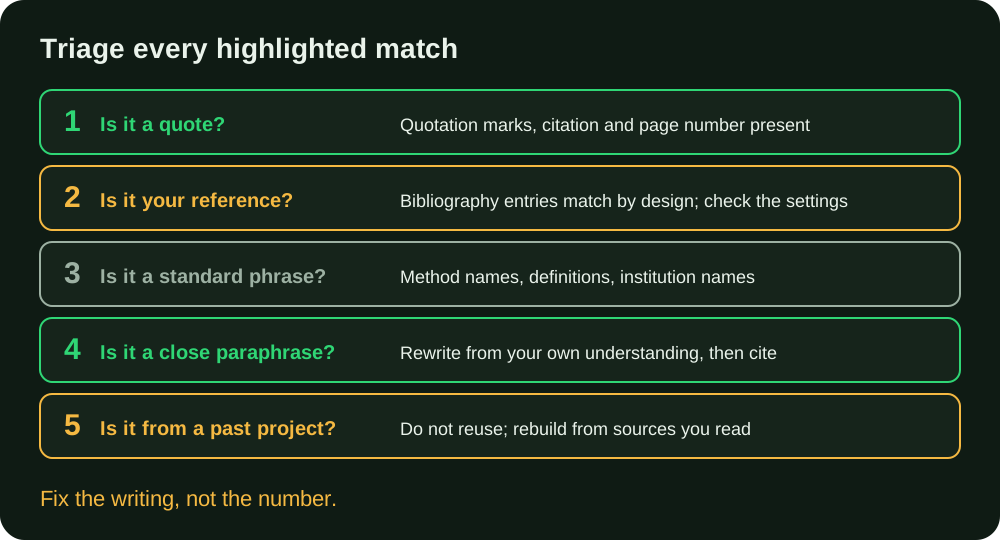
For each highlighted block, ask:
- Is it a quotation? Check for quotation marks, a citation and a page number. If not, add them or rewrite.
- Is it a reference entry? Fine if it is accurate. Check the entry against your referencing guide and the in-text citation rules.
- Is it a standard phrase? Names, instrument titles and standard terms are fine. Do not rewrite a statistical test's name to dodge a match.
- Is it a close paraphrase? Read the source again, put it away and write what you understand, then cite. If you cannot write it without looking, you do not understand it well enough yet.
- Is it from a past project or another student? This is the dangerous category. Remove it and rebuild the section from sources you have read.
Pay attention to where the matches cluster. One source accounting for a large share of your text suggests you leaned on it too heavily. Matches scattered across many sources, each small, often reflect common phrases and citations.
Keep a match-review record, not just a score screenshot
Use this original worksheet to preserve the evidence behind each decision. It is a practical review aid, not an institutional clearance form.
| Record | What to check or retain |
|---|---|
| Document version and report | Which exact draft was checked; date and available report identifier |
| Report context | Tool and visible exclusions/settings; record unknown settings as unknown |
| Location and matched source | Your page/section, highlighted passage and source record |
| Source-use check | Quotation, paraphrase, reference, standard term or possible uncredited reuse |
| Action and reason | Verify attribution, correct wording, investigate or ask for guidance |
| Review evidence | Corrected passage, citation check and revised version reference |
Fictional teaching example: a highlighted definition includes an author citation, but the sentence reproduces the source word for word without quotation formatting. The citation alone does not resolve the wording issue. Check the original, then either quote and locate it appropriately or write an accurate paraphrase with attribution. Record the change; no score reduction or supervisor acceptance is promised.
A matched source is a lead to investigate, not necessarily the original publication you should cite. Trace the claim to the source you actually read. If access to the report is unavailable, ask the person responsible for the check how to review the matches; a percentage sent in a message is insufficient for this worksheet.
Fixing the real problems the right way
When a section has a genuine overlap, the right fix is to write it again properly.
- Go back to the source. Read the passage, close the tab and write the point in your own words from memory, then check accuracy and add the citation.
- Combine sources. Compare sources only where their actual findings support the comparison, and cite both. Combining sources does not automatically make an unsupported conclusion original or accurate.
- Add your own analysis. In a literature review, group sources by theme and say what they mean for your study, rather than summarising one article per paragraph.
- Quote sparingly and precisely. Use quotation marks and page numbers, and keep quotes short.
- Cite as you write. Add the citation in the same sentence, not at the end of the chapter.
- Rebuild your own methods and results. Chapters that report what you did, your sample, your data and your tests should be yours by construction. If they overlap strongly with another project, something is wrong. The methodology guide shows how to describe your own design.
What does not help: swapping words with a thesaurus, running text through a paraphrasing tool, inserting invisible characters or changing fonts to confuse the software. These are bad faith, they often produce poor writing, and a supervisor reading the work will notice what the software missed.
Similarity and AI-generated text are different checks
Some schools now also run tools that claim to estimate whether text was machine-written. That is a different question from similarity, with a different kind of evidence and a different error pattern. A similarity report finds matches with existing texts. An AI-writing indicator estimates patterns under its own model and limitations; it does not establish authorship by itself. If you are worried about how your own authentic writing will be read, the guide on avoiding false AI-detection flags in academic writing explains why evidence of your own process, such as notes, drafts and data, matters more than any score. UniDraft does not claim to beat any detector, and you should be wary of any service that does.
Write so that similarity is not your problem
The best way to have a clean report is to write in a way that makes copying unnecessary.
- Keep a source log from day one. For each source, write the reference, the idea you took and the page.
- Take notes in your own words, not by pasting. Mark direct quotes as quotes in your notes.
- Draft from your notes, not from the source open next to you.
- Use your own data for Chapters 3 to 5. Your own results still need honest provenance, accurate reporting and citations for any borrowed methods or secondary data. Original work is not a guarantee of zero matching text.
- Keep reuse honest. If you build on your own proposal, paraphrase and update it, and follow your department's rule about reuse.
- Cite generously but meaningfully. Cite when you use an idea, not to decorate paragraphs.
- Check early. If your department allows a draft check, do it when Chapter 2 is done, not the night before submission.
A past project used as a source of unacknowledged text or data creates an integrity problem. Keep your own source, note and data trail from the start.
What to do if your score comes back high
- Do not panic and do not hide it. Read the report.
- Sort the matches using the triage above and mark which are quotes, references, standard phrases and real overlaps.
- Rewrite the real overlaps from the sources.
- Ask your supervisor how the department interprets the report and what it expects you to do.
- Keep versions. Save the original and the revised draft so you can show what changed.
- Resubmit within the rules. Some departments allow one resubmission; others do not. Ask.
If your supervisor sends comments after reading the report, managing final year project supervisor corrections explains how to track and close each one.
Defence angle
Plagiarism is as much about understanding as about words. A panel can test whether the work is yours by asking you to explain it. Be ready for questions such as:
- Explain this paragraph in your own words.
- Why did you choose this source, and what did it contribute?
- How did you collect this data and what did you do with it?
- What is the difference between these two authors' positions?
- Where did you adapt an instrument, and who developed the original?
The guide to common project defence questions shows how to prepare, and the habit of writing from understanding is what makes those answers easy.
Pre-submission checklist
- You know your department's written rule on similarity, or you have asked your supervisor for it.
- Every direct quotation has quotation marks, a citation and a page number.
- Definitions are paraphrased with citations unless the exact wording matters.
- Adapted questionnaires and instruments are acknowledged.
- Chapters 3 to 5 report your own design, data and analysis.
- No section was lifted or lightly edited from a past project.
- The reference list matches the in-text citations.
- You have read every highlighted match, not just the percentage.
- Formatting follows the institution's rules. The free formatting checker reads a .docx and flags mismatches.
Where UniDraft fits in
UniDraft builds the written project as an editable Word (.docx) document from the facts, data and sources you confirm, applying your supervisor's instructions, your department's format and your university's format, in that order of priority. It does not invent citations, results or approvals, it does not run or guarantee any similarity or AI-detection score, and it does not produce slides. Your supervisor decides what is acceptable. You still read your sources and supply your real data, because that is what protects you at the defence.
Sources
- National Open University of Nigeria: Policy on Plagiarism (PDF), approved 7 October 2024, rechecked 25 October 2026: declaration, checking and the distinct contexts of sections 7.1 and 9.1; not a national rule or blanket acceptance threshold.
- Turnitin: Does Turnitin check for plagiarism and what is a good Similarity score?, checked 25 October 2026: text matches need human review and no universally acceptable percentage is supplied.