Your in-text citation tells the reader whose idea or finding you are using and when it was published, so they can find the full entry in your reference list. In APA 7 it comes in two forms: parenthetical, (Surname, 2024), and narrative, Surname (2024). Use APA only if your department or supervisor requires it; the reference-list guide compares APA with IEEE and Harvard so you can confirm which one you are in.
All names, years and titles in this guide are format placeholders, not real studies. Replace them with details checked against sources you have actually read.
A clear argument needs citations that readers can trace. UniDraft helps organise your confirmed sources and research material into an editable project document using the instructions you supply. Start your project document with UniDraft, then check every author, year, quotation and reference against the original publication. Use the citation finder for source discovery, not as a substitute for reading.
The short answer
- Attribute borrowed ideas clearly. Use author-date citations without repeating them unnecessarily when a long paraphrase clearly continues the same source.
- Two authors: both names. Three or more: first author plus et al. APA 7 uses et al. from the first citation, unless it would make two sources indistinguishable.
- Quotations need a locator. Give a page number (
p. 14), or a paragraph, section or chapter when the source has no pages. Paraphrases usually need only author and year. - Match cited works to the reference list. Names and years must agree. Personal communications and your own research-participant quotations are exceptions explained below; do not add them as published reference entries.
- Cite what you read. If you only saw a study quoted in another paper, say so with "as cited in".
Whether your department uses APA 7 at all is a local decision. Check the project guideline or the university format guides first, then follow your supervisor's instruction if it differs.
Parenthetical or narrative: which fits your sentence?
Both forms carry the same information. The difference is emphasis. For a long paraphrase, keep the source clear without repeating the citation in every sentence. In repeated narrative mentions of the same work within one paragraph, APA can omit the year after the first mention when there is no ambiguity; parenthetical citations retain it. The APA in-text citation checklist warns against unnecessary repetition.
| Form | Illustrative pattern | When it reads naturally |
|---|---|---|
| Parenthetical | Measured differences were reported between the two groups (Surname, 2024). | The finding is the focus |
| Narrative | Surname (2024) reported measured differences between the two groups. | The researcher's work is the focus |
In a narrative citation the author is part of your sentence and only the year sits in brackets. In a parenthetical citation both go in brackets, separated by a comma, and the sentence's full stop comes after the closing bracket.
Choose either form according to the sentence; a literature review can use both. Use narrative forms when you are comparing what particular researchers found ("Surname (2024) found X, whereas Othername (2022) found Y") and parenthetical forms when you are stating an established point and want the sentence to stay yours. If every sentence begins with an author's name, the chapter reads like a list and your own argument disappears; the literature review guide shows how to organise sources by theme so the citations serve your argument.
Do not attach a citation to a claim the source does not support. "Several studies found..." requires you to have inspected those studies, not just a search snippet or an abstract.
One author, two authors, three or more, and group authors
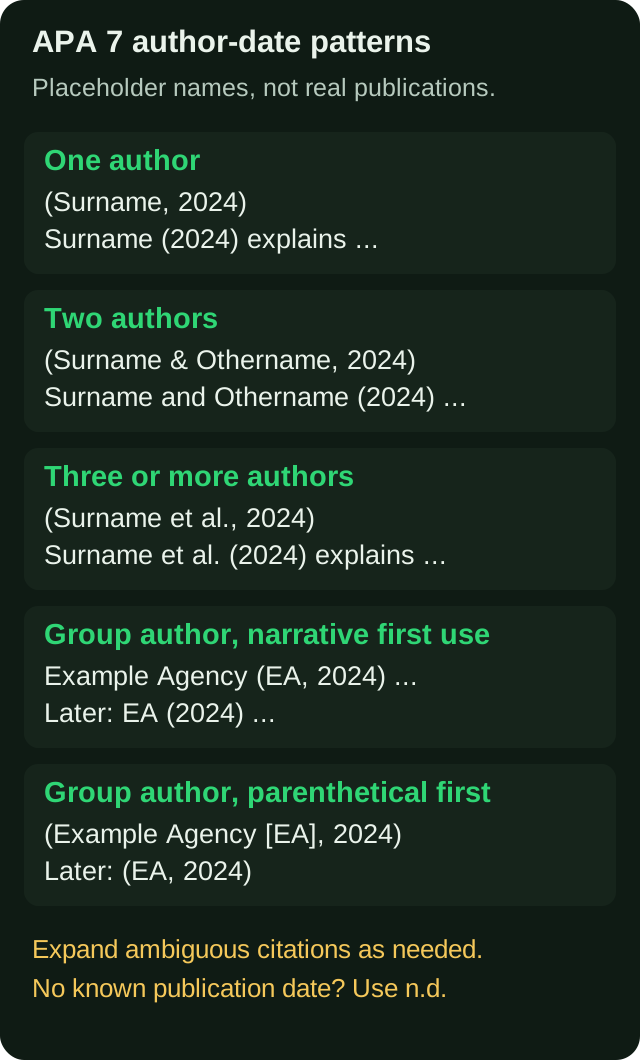
One author. Surname and year: (Surname, 2024) or Surname (2024). Leave out titles such as Dr or Prof., and suffixes such as Jr.
Two authors. Name both every time. Inside brackets use an ampersand, (Surname & Othername, 2024); in running text use "and", Surname and Othername (2024).
Three or more authors. APA 7 gives the first author's surname followed by "et al." from the first citation onwards: (Surname et al., 2024). Earlier APA editions listed several authors on first mention, so an example copied from an old thesis may not match the current rule. The exception is ambiguity: if two different sources by three or more authors would both shorten to "Surname et al., 2024", write out as many names as needed to separate them, then use et al. for the rest.
Group authors. When an organisation is the author, use its name. If it has a well-known abbreviation, give the full name and abbreviation in square brackets on first citation, then the abbreviation alone afterwards: (Full Organisation Name [ABBR], 2024), then (ABBR, 2024). Take the official name from the document itself. A website's brand name is not automatically the author of a report, so look for the named person or the organisation that issued it.
No author. Use the title (or its first few words) in place of the author. Use the title formatting appropriate to the reference type: italicise titles that are italicised in their reference entry, and use double quotation marks for non-italicised titles such as journal articles.
No date. Use n.d., as in (Surname, n.d.), rather than guessing a year. A date you guessed is a date you invented.
These patterns are explained in Purdue OWL's APA 7 author guide, and the switch to et al. from the first citation is listed among the changes in the 7th edition.
Several sources at once
When one claim rests on several sources, put them in a single set of brackets, ordered alphabetically by first author's surname (the same order as in your reference list) and separated by semicolons: (Adeyemi, 2022; Surname, 2024). This is a real convenience in the introduction and literature review, but it has a trap. Cite all and only the sources that actually support the claim. The number of citations is not evidence that you have read them; check what each contributes.
For several works by the same author, give the surname once and list the years in order: (Surname, 2019, 2022). When you cite two works by the same author from the same year, add lower-case letters after the year in both the text and the reference list, as in (Surname, 2024a) and (Surname, 2024b). The letters follow the order in which the entries appear in the reference list, so assign them once the list is settled.
Paraphrases and direct quotations
Paraphrase. State the source's idea in your own words and add author and year. Swapping a few words in the original sentence is not a paraphrase; it is copying with a citation stuck on, and it does not adequately restate the idea in your own words. A page or paragraph locator is optional for paraphrases, but useful when you cite a long book or report, because it lets your supervisor find the passage quickly.
Short quotation (under 40 words). Put it in double quotation marks inside your sentence and give the locator. The citation sits before the final full stop:
Surname (2024) described the approach as "a template sentence" (p. 14).
The approach was described as "a template sentence" (Surname, 2024, p. 14).
Block quotation (40 words or more). Drop the quotation marks, start on a new line, indent the whole block half an inch from the left margin, and keep the double spacing. Here the full stop comes after the quoted text and the citation follows it. USC's APA 7 block-quote guide sets out the layout. Use a block quotation only when its exact wording is important to the analysis and the length is justified by your assignment. Explain its relevance rather than using quotations in place of your argument.
Locators. Use p. for one page and pp. for a range: (Surname, 2024, pp. 14-15). When a source has no page numbers, such as many web pages, use a paragraph (para. 4), section heading or chapter instead. Do not invent a page number. Purdue OWL's in-text basics covers these alternatives.
A paraphrase still needs a citation. The idea belongs to its source even when the wording is yours.
Secondary sources: "as cited in"
Sometimes you meet a useful study only because another author describes it. The honest citation shows both:
Original Surname (2019, as cited in Surname, 2024) found ...
(Original Surname, 2019, as cited in Surname, 2024)
Only the source you read, Surname (2024) here, goes into your reference list. Treat this as a fallback. If a claim matters to your argument, track down the original and read it; a secondary citation tells your supervisor that you have not. Never cite the original as if you had read it, and never cite a source you know only from an AI summary or a search snippet.
Interviews, questionnaires and personal communication
Distinguish your own study data from published sources and personal communications.
- Your own research-participant quotations are study data. Do not give them reference-list entries or treat them as personal communications. Identify their role as study data without disclosing protected identities, and respect the consent and confidentiality arrangements. See APA's participant-quotation guidance.
- Emails, private messages and interviews you did outside the study are personal communications. They appear only in the text, with initials, surname and the exact date, for example
(A. Surname, personal communication, September 20, 2025), and are not listed in the references. USC's in-text citation guide gives the pattern. - Instruments you adapted. If your questionnaire scale or interview guide comes from a published study, cite the source in the methodology. The questionnaire design guide explains why adapting a validated instrument needs both a citation and a note on what you changed.
If you are unsure whether a conversation with a lecturer or an industry contact counts as evidence, ask your supervisor. Ethics and departmental practice vary.
Where citations belong across your chapters
Citations support different kinds of claims across the report; follow your actual chapter structure.
| Chapter | What citations do there | Typical mistake |
|---|---|---|
| Introduction | Support background claims and statistics | Unsourced "it is well known that" |
| Literature review | Show what is known and where the gap is | A list of summaries with no comparison |
| Methodology | Justify design, sampling, instruments | Method named but never justified |
| Results | Attribute external data or documentary evidence where used; identify your own observations | Failing to distinguish study evidence from outside findings |
| Discussion | Compare your findings with earlier work | Citing only sources that agree with you |
Start with the introduction. Background statistics such as enrolment figures or unemployment rates need an authoritative source and the year the figure was published; make the evidence behind each factual claim clear. When you reach the methodology chapter, cite the source for your sample-size formula, test or instrument, since "I used Yamane's formula" needs to point to a real reference.
Your results chapter reports the evidence your method produced. Source-based studies may need citations throughout the findings. If your guideline separates results and discussion, put comparisons with earlier studies in the discussion; cite the work behind each comparison.
Match each citation to a real reference
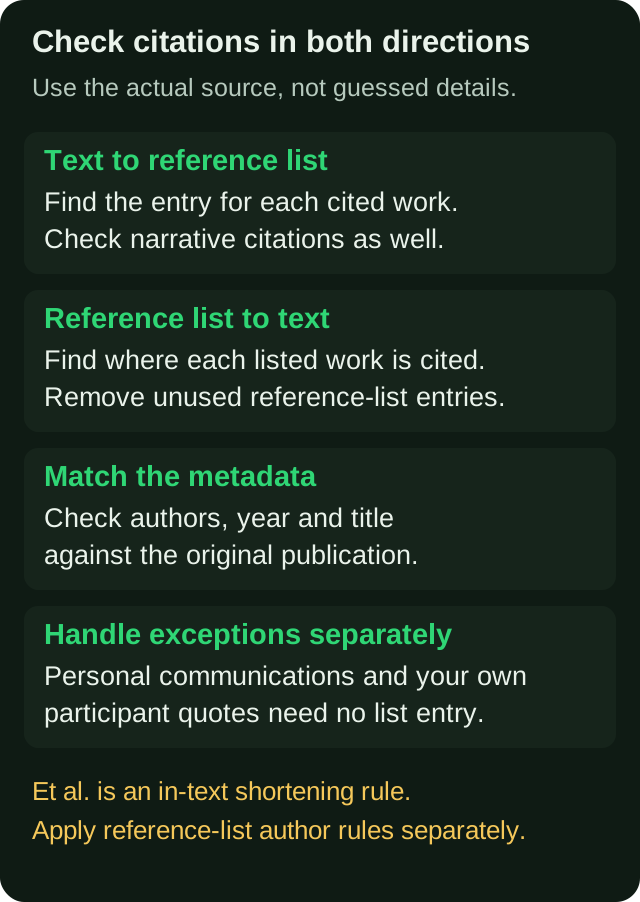
Before submission, do the check in two directions.
- Text to list. Search your document for every bracket that contains a year. For each citation to a retrievable work, find its reference-list entry. Check narrative citations too; a search for bracketed years alone will miss some citations.
- List to text. Read the reference list from the top and confirm each entry is actually cited somewhere in the report. Personal communications and study-participant quotations do not need reference entries. A reference list otherwise holds the works you cited; the reference list guide explains how that differs from a bibliography.
For each pair, compare the spelling of the surname, the year, the number of authors and the title against the original publication. Mismatches are common after a late edit: a year changes from 2023 to 2024 when you swap to the published version of a paper, but only one place is updated. Then check the source itself: read the passage, confirm the claim is really there, and confirm the paper exists. A fabricated or unread reference cannot be rescued by perfect punctuation.
The free citation finder helps you locate real, checkable papers in APA, IEEE or Harvard, and it is a good place to start if your searching so far has returned only snippets. It finds sources; you still have to read them.
Mistakes supervisors flag
- Author-year mismatch. "(Surname, 2021)" in the text, "Surname (2022)" in the list.
- Old et al. habits. Listing several names on first mention because a senior thesis did, when APA 7 wants "et al." at once.
- Ampersand in running text. "Surname & Othername (2024)" should read "Surname and Othername (2024)".
- Citation missing after a paraphrase because the sentence "sounded like your own".
- A quotation with no page number or suitable alternative locator, or an invented one.
- A whole paragraph with one citation at the end, so the reader cannot tell which sentences come from the source. Cite where the borrowed idea starts, and again when a new source takes over.
- Mixed styles: APA in Chapter 2, numbered IEEE brackets in Chapter 3. Pick one style and stay in it. The step-by-step project guide suggests confirming the style before you write anything.
- Citing an AI summary as a source. A model's suggestion is a lead to check, not a source. Verify published works against the source; handle personal communications and your own study data separately as explained above; the post on why AI-flavoured text gets flagged explains why unverifiable claims are the bigger risk.
A worked example: one paragraph, cited three ways
Here is a placeholder paragraph from a literature review. Every name and finding is invented to show the format, not to be copied.
Mobile-payment adoption among small traders is shaped by trust and cost
(Surname & Othername, 2023). Surname et al. (2022) reported that trust
mattered more than fees, whereas the Example Regulatory Agency
(ERA, 2021) emphasised access to agents. Later work qualified both views
(ERA, 2024; Surname et al., 2022).
What this paragraph shows: a two-author parenthetical citation with an ampersand; a narrative three-plus-author citation using et al.; a group author with its abbreviation defined on first use and shortened afterwards; and two sources in one bracket, alphabetical by first author's name as it appears in the list. The examples show placement and punctuation only; their findings are fictional. When you write yours, each name must belong to a paper you have read.
Pre-submission checklist
- My department or supervisor confirmed APA 7 (not IEEE or Harvard).
- Citations to retrievable works match reference entries, and vice versa; personal communications and study-participant quotations are handled separately.
- Sources with three or more authors use "et al." from the first mention; ambiguous ones are expanded.
- Every direct quotation has a page number or another locator, and long ones are set as block quotes.
- Semicolons separate multiple sources in one bracket, in alphabetical order.
- Same-author, same-year works carry a, b, c letters in both places.
- Undated sources say
n.d.; no invented years. - Secondary citations use "as cited in", and only the source I read is listed.
- I have opened and read every source I cite.
- Font, spacing, margins and page numbers are checked separately; see the notes on formatting a project for a Nigerian university.
The free formatting checker reads a .docx and compares its font, spacing and margins with a university's rules. It does not check your citations, so the checklist above is still your job.
Where UniDraft fits in
UniDraft builds your written project as an editable Word document around your confirmed topic and real results. Supervisor instructions and student-confirmed guidelines take priority over general departmental and university patterns. It cannot guarantee reference accuracy, acceptance or a grade. You supply confirmed sources and review citations, reference entries and supporting claims against the originals. When your supervisor sends corrections, you supply them, confirm the extracted changes, and a new version is produced while earlier versions are kept; managing project corrections walks through that workflow. A final-year project costs ₦20,000 one-off and includes three free supervisor-correction rounds.
Sources
- APA Style: Author-date citation system, including author counts, group abbreviations and repeated narrative citations.
- APA Style: Quotations from research participants, including confidentiality and reference-list treatment.
- APA Style: In-Text Citation Checklist (7th edition), the American Psychological Association's own checklist.
- Purdue OWL: In-text citations, the basics, for locators, quotations and paraphrases.
- Purdue OWL: In-text citations, author/authors, for one, two, three or more and group authors.
- Purdue OWL: Changes in the 7th edition, for et al. and participant quotations.
- USC Libraries: APA 7th in-text citations, for secondary sources, letters after years and personal communications.
- USC Libraries: APA 7th block quotes, for the 40-word rule and layout.