
Interview transcription means converting the audio of each research interview into written text, using one consistent convention, then checking it against the recording and removing details that identify participants. Decide the convention before your first interview, because every later step (coding, quoting, ethics) depends on it.
This is the step between collecting interviews and analysing them, and it is where many students lose marks quietly: inconsistent speaker labels, quotations that were "tidied" without saying so, or audio files left on a phone. UniDraft helps organise your confirmed methodology, checked sources and supervisor instructions into an editable Word document, so the way you recorded and transcribed is explained properly. Start your project document once your interviews are transcribed and checked. UniDraft does not transcribe your recordings or analyse them for you.
This post stays on the transcript itself. For writing the questions, see the interview guide article; for turning transcripts into themes, see the thematic analysis guide.
What should you settle before recording?
Most transcription problems start before the recorder is switched on. Settle these, in writing, with your supervisor:
- Is recording allowed at all? Your ethics approval or departmental process may only cover handwritten notes. Bath's research data guidance, for example, treats a switch from notes to recording as a change that needs approval, so do not improvise on the day. Bath guidance
- Does the consent wording mention recording? The participant should know that audio is captured, who will hear it, who may transcribe it, how it is stored and when it is deleted. The consent form sample shows where this fits, and the ethics and consent guide covers the wider process.
- Which device and where will files live? Use a device you control. Avoid leaving audio on a phone that backs up automatically to a cloud account you cannot manage. The Bath page warns against keeping sensitive recordings on unencrypted personal devices, even briefly.
- How will participants be named? Use a participant code (for example P01, P02) from the start, in file names as well as the transcript. Manchester's voice recording guidance advises not recording the interviewee's name where it can be avoided. Manchester guidance
- Who will transcribe? If you plan to let a friend or an outside typist help, that is another person hearing participants' voices. Your consent wording and approval need to allow it, and the helper needs to understand confidentiality.
Then test your set-up. Record a two-minute chat with a classmate in the room where you will interview, play it back, and check that both voices are audible. A recording you cannot hear is a data-collection failure, not a transcription problem.
How do you record an interview well?
Good audio saves hours later. A short checklist:
- Say the date, the participant code and the interview number at the start, then confirm the participant still agrees to be recorded.
- Sit close, in a quiet room, with the recorder on a stable surface rather than in your hand. Generators, fans and market noise are common problems; choose the room accordingly.
- Keep your own talking short. A transcript full of long interviewer speeches is hard to code.
- Keep brief notes about context (interruptions, a power cut, a visitor walking in) in a separate document, not mixed into the participant's words.
- Back up the file to the approved location as soon as you can, then remove the original from the device as agreed.
If a participant declines recording, respect that and use the approved alternative, such as notes written by you. Do not reconstruct a conversation from memory and present it as a word-for-word quotation.
Verbatim, clean verbatim or edited: which one?
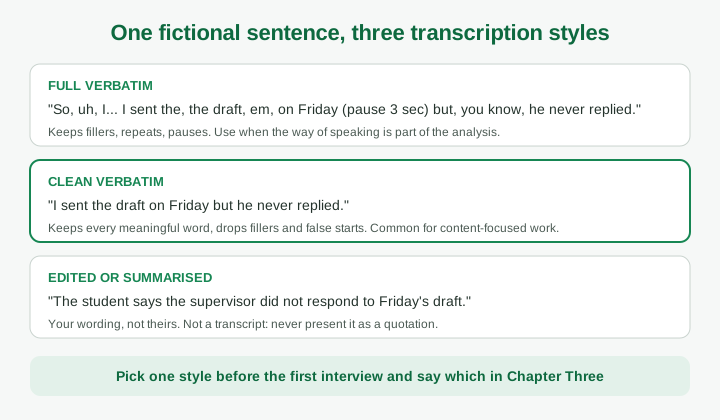
Transcripts come in styles, and the labels matter because examiners and supervisors will ask which you used.
Definition block.
| Style | What it keeps | When it fits |
|---|---|---|
| Full verbatim | Every utterance: fillers, repeats, false starts, pauses, laughter | The way something is said is part of the analysis |
| Clean verbatim | Every meaningful word; fillers and stutters removed | Analysis of content and themes |
| Edited or summarised | Your wording of the meaning | Notes or a summary, not a transcript |
ATLAS.ti's guide to clean transcription defines the two main styles in these terms and says the deciding factor is whether the extra speech elements matter to your research objectives. That is the right test for a student project too: if your question is about what participants said about, say, supervision feedback, clean verbatim is usually enough; if you are studying hesitation or the way a topic is avoided, keep the pauses. Whichever you pick, apply it to every transcript and name it in your methodology.
A caution on "cleaning". Removing "um" is different from correcting grammar or swapping a local expression for a formal one. If a participant says something grammatically unusual and you fix it, you have changed their evidence. The Oregon State oral history guide, which tidies tics and false starts, still says to keep the narrator's dialect and not to alter meaning. Oregon State guide
Which transcription conventions should you write down?
A convention is a short rule sheet. Write it once, keep it with your data, and follow it every time. A workable student version:
| Item | Example rule (adapt it) |
|---|---|
| Speaker labels | I: for interviewer, P01: for the participant, new line at each change of speaker |
| Header | Interview number, participant code, date, place type, recording length |
| Timestamps | A mark every few minutes in square brackets, for example [05:00], so you can find the audio again |
| Pauses | (pause) for a noticeable pause; do not time every one unless pauses are your data |
| Unclear speech | [unclear 00:12:40] rather than guessing |
| Laughter and sounds | [laughs], [phone rings], only where they affect meaning |
| Overlap and interruption | A dash at the cut-off and the next speaker starts a new line |
| Interviewer's notes | Kept separate from the participant's words |
| Anonymising | Replacement tags in brackets, such as [Supervisor A], [City], [Company X] |
| Spelling | Standard Nigerian or British spelling for ordinary words; keep dialect or local expressions as spoken |
The Oregon State guide recommends a header with narrator, interviewer, date, location and length, speaker initials and timestamps at regular intervals, which supports the structure above. None of this is a Nigerian requirement; your department may have its own template, so ask before you build yours.
How do you handle local languages and Pidgin?
Many Nigerian interviews move between English, Pidgin and a mother tongue within one answer. That is normal, and it is a methodological decision, not a typing problem. Options to discuss with your supervisor:
- Transcribe in the language spoken, then translate only the passages you quote. This keeps the original available and limits translation work.
- Transcribe and translate the whole interview. This is more work, but may be needed if a co-coder or examiner does not read the language.
- Keep code-switching as spoken, with an English gloss in brackets where needed, if the mixing is itself meaningful.
Whatever you choose, document it. The RECOUP translation session notes recommend that researchers be explicit about their translation choices, procedures and resources, and stress thinking about who translates and with what quality controls. They also note that the translator's language competence and cultural knowledge affect quality. RECOUP session notes
Practical rules:
- Keep the original wording next to the translation for any quotation you will use.
- Record who translated, whether they also checked the transcription and how disagreements were settled.
- Mark uncertain translations, for example [translation uncertain].
- Idioms rarely translate word for word. Where meaning, not wording, is what you translate, say so.
- A person who helps translate hears confidential material, so the same confidentiality expectations apply.
The sources I opened do not set a rule for exactly when to translate in relation to coding, so treat that as a design decision to agree with your supervisor and state in Chapter Three.
How do you anonymise a transcript?
Anonymising is not just deleting the participant's name. People are identified by combinations: the department, the unusual job, the small town, the named supervisor. Work through the transcript once for identifiers.
| Identifier | What to do |
|---|---|
| Names of people (participant, colleagues, lecturers) | Replace with a role tag: [Lecturer A], [Friend] |
| Organisation names | [Company X], [the hospital] |
| Places that narrow identity | Use a broader label: [a town in the state] |
| Dates and specific events | Generalise if they could identify someone |
| Rare roles or one-off events | Ask your supervisor whether the detail should be altered or left out of quotations |
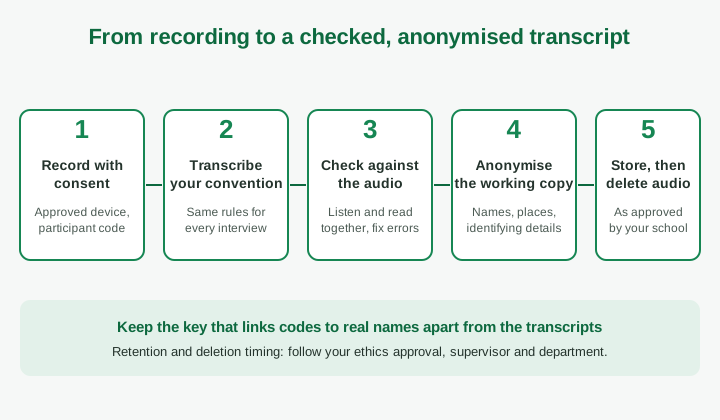
Manchester's guidance advises anonymising participants in transcripts unless they have explicitly consented to being identified, and keeping transcripts on secure institutional systems. Keep the list that links participant codes to real names in a different, protected place from the transcripts. If you promised confidentiality, check that your quotations cannot identify someone to people who know the setting. If participants agreed to be named, keep their agreement on file and follow what they actually agreed to.
Where do you store recordings, and when do you delete them?
The data management plan guide covers the full file inventory; for interviews, the audio is usually the most sensitive file you hold. The university guidance I opened points the same way:
- Move recordings promptly to the approved storage and remove other copies, including recycle bins (Bath).
- Transcribe in a secure setting and store transcripts on institutional systems rather than loose personal devices (Manchester).
- Where files must be temporarily held outside approved systems, use an encrypted device and move them as soon as possible (Manchester).
I did not find a retention period in the pages I opened that applies to a Nigerian undergraduate, so I will not give one. What to do instead: look at what your consent form promised, ask your supervisor or department what they require, and write the answer into your plan. Do not promise "I will delete everything after the exam" unless you will actually do it. If you promise deletion, record the date it happened.
A sensible default to propose to your supervisor, not a rule: transcribe soon after each interview, check and anonymise the transcript, then delete the audio at the point you promised, while keeping the anonymised transcripts and your code key as agreed for marking and later queries.
If a third party transcribes for you, tell participants in the consent process, and get a confidentiality commitment from the transcriber about who hears the audio, where it is kept and when it is destroyed. Do not upload confidential recordings to a free online transcription tool just because it is quick; that sends participants' voices to a company you have not told them about. Confirm that this processing is permitted before using any automatic tool, and treat its output as a draft to be corrected.
How long does transcription take?
Longer than most students plan for. One verifiable reference point: Oregon State's oral history guide gives a rule of thumb of eight hours of work per hour of interview recording to produce a clean, finalised transcript. That is an oral-history planning figure, not a law, and your own speed, audio quality and language mix will change it. Different guides give different ranges, which is itself the lesson: do not assume one hour of audio is one evening of typing.
Plan like this:
- Ask your supervisor how many interviews and how long each; multiply your guess by a generous factor.
- Transcribe the first interview, time yourself, then use your own figure for the rest.
- Add time for checking, anonymising and (if relevant) translating, which are separate jobs from typing.
- Put transcription dates into your project timetable, so analysis does not start with two interviews still on audio.
Because the time is real, ask whether you need full transcription of every minute. Your supervisor may accept partial transcription of relevant sections with a clear rule for choosing them, but that is a design decision to agree in advance and report honestly.
How do you check a transcript for accuracy?
A transcript is a draft until you have listened to the audio while reading it. Oregon State's guide recommends re-reading the transcript while listening to the recording and correcting errors, and also suggests considering whether the interviewee can review passages. If you plan to send transcripts back to participants, say so in the consent process and decide in advance how much editing by them you will accept.
A practical check:
- Listen at normal speed with the text in front of you, and fix every mismatch.
- Search for words that commonly go wrong: names of systems, drugs, acronyms, local place names, numbers.
- Re-check every passage you plan to quote word for word.
- Mark remaining doubts as [unclear] rather than guessing.
- Keep a version note: first draft, checked, anonymised.
Then move to coding. The thematic analysis guide explains how checked transcripts feed coding, and the qualitative methods overview helps if you are still choosing an approach.
For group discussions, labelling several speakers needs extra care; see the focus group guide.
What does a formatted transcript look like? (fictional excerpt)
This excerpt is invented to show layout. It is not real data, and the topic is illustrative.
Interview 03 | Participant P03 | Date: [date] | Setting: office, quiet | Length: 41:20 Convention: clean verbatim; [unclear] for inaudible; names replaced by tags.
I: Can you tell me how you handled the last round of corrections?
P03: I sent the draft on Friday [00:06:10] but [Supervisor A] never replied. So I went to the department, and the secretary said, "Come back Monday."
I: And what did you do over the weekend?
P03: I changed the references. Eh, the format was, the format was not what the department wanted. (pause) I was not sure, to be honest. [laughs]
I: Not sure about what?
P03: About the, [unclear 00:07:02], the margin. Somebody told me to use [Pidgin: "dem no dey check am"], that they don't really check it.
Notice what the excerpt does: speaker labels are consistent, the identity tag replaces the supervisor, a Pidgin phrase is kept as spoken with a gloss, doubt is marked as unclear rather than guessed, and the "um" and repeated words follow one stated rule. In the clean-verbatim style declared at the top, the repeated "the format was" would be dropped on the next pass; the excerpt keeps one repetition to show you need to apply your rule consistently, not partly.
How do you report transcription in Chapter Three?
Examiners rarely mark the transcript itself, but they will read how you made it. In your methodology chapter, state in a few sentences: how interviews were recorded and with what permission, the transcription style and convention, who transcribed, how accuracy was checked, how translation was handled, how identities were protected, and what happened to the audio. Put your convention sheet in the appendices only if the department asks for it, and do not append raw identifiable transcripts. For how your department wants the chapter laid out, use UniDraft's formatting pages or the formatter and follow your own department's brief.
Supervisor and defence questions to prepare for
- Why did you choose clean verbatim (or full verbatim) for this study?
- Did participants know they were being recorded, and where is that written?
- Who else heard the audio?
- How do you know the quotation is what the participant said?
- How did you handle the parts in Pidgin or a local language?
- Where is the audio now, and what did you promise about deleting it?
- Could a reader identify any participant from your quotations?
Common mistakes
- Choosing the transcript style after the interviews are done.
- "Improving" participants' grammar and then quoting it as verbatim.
- Leaving real names in file names, or keeping the code key beside the transcripts.
- Transcribing only the parts that support your argument and not saying so.
- Uploading confidential audio to a free online tool without permission.
- Promising to delete audio and then not doing it.
- Forgetting to leave time to transcribe.
A short checklist
- Recording permission and consent wording match what you will actually do.
- A one-page convention sheet exists and every transcript follows it.
- Each transcript has been checked against its audio.
- Identifiers are replaced and the code key is stored separately.
- Translation choices and translators are recorded.
- The audio storage and deletion plan matches your consent form.
- Chapter Three describes all of it honestly.
When the transcripts are done and your analysis is yours, UniDraft can help turn your confirmed methodology, checked sources and supervisor instructions into an editable project document. Start your project document.
Sources
Pages opened while preparing this guide. They are general or institutional guidance from other countries or fields, not Nigerian requirements; follow your own institution's rules.