Choose a Nursing or Public Health seminar topic by defining one question, the population or setting it concerns, and evidence you can actually examine. “Diabetes” is an area of interest; it still needs a focused task. Confirm whether the assignment asks for a literature review, a conceptual discussion or an original investigation before promising a method.
These 36 angles are original starting prompts, not approved titles, completed research or clinical instructions. They do not cover every specialty. Your assignment and supervisor's confirmed instructions determine the scope.
Still choosing your angle? Use UniDraft’s free topic generator to build a shortlist from your department and a course you enjoyed. Check each suggestion against accessible sources and the brief before committing.
Turn a care or public-health question into a report that keeps the population, evidence and limitations clear. UniDraft can help organise your confirmed topic, checked literature and supervisor instructions into an editable Word seminar document. Start your Nursing or Public Health seminar report, then review each health claim against the actual source and its date.
Match the topic to the assignment
A literature seminar can compare what publications say about a practice, measure or programme. It does not create new findings about patients or a local facility. If original work is required, agree the design, supervision, access and applicable ethics process before collection. A topic list supplies none of those permissions.
Use the general seminar topic-selection guide to check the evidence and boundaries. Do not judge suitability by a fixed search time, number of results or popularity of a disease name. Ask whether the relevant full publications can support the question you propose.
For health evidence, check both publication date and the period studied. Find out whether a guideline has been replaced and whether a paper's design addresses your question. Recent publication alone does not establish quality; an older study may still be relevant when its role and limits are clear.
Narrow the question without deciding the answer
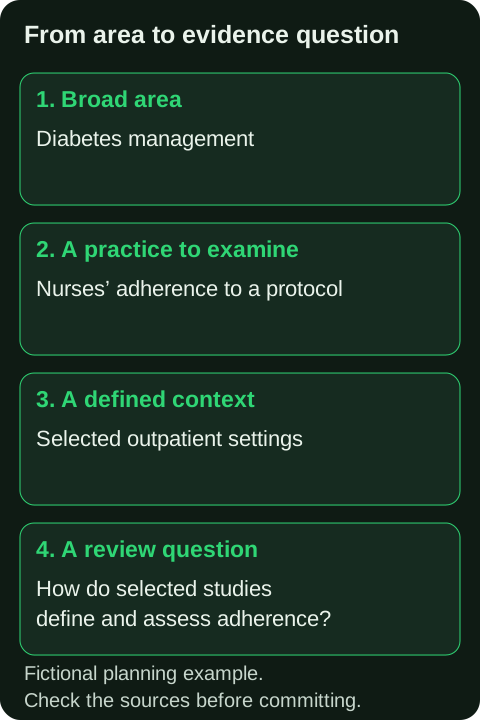
Fictional planning illustration — no patient data, study findings or approved title are supplied. “Diabetes management in Nigeria” could become a review question about how selected studies assess nurses' adherence to a defined foot-care protocol in specified outpatient settings. Before choosing the title, the student must locate those studies and check their definitions, settings and methods.
The narrower wording identifies what to investigate. It does not establish that suitable studies exist or that a protocol was followed in any hospital. Revise the question if the evidence cannot support the proposed comparison.
Use four prompts to make the scope visible
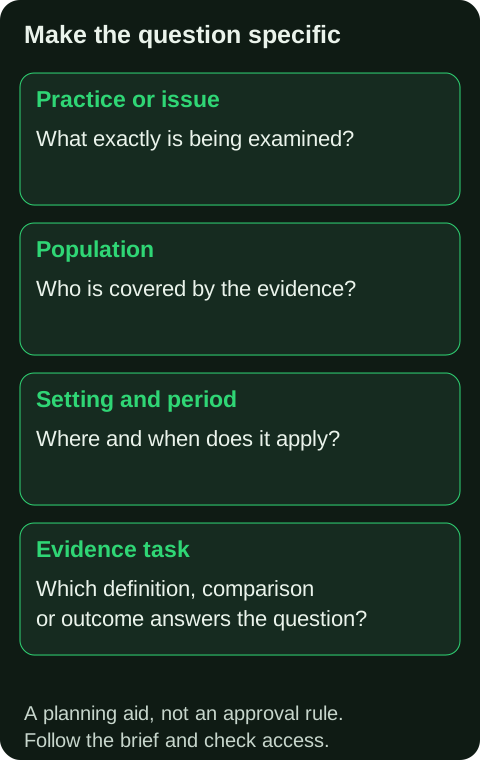
These prompts are a planning aid, not an approval formula:
- Practice or issue: What exactly will you examine, such as how studies measure hand-hygiene adherence?
- Population: Who is covered by the evidence: nurses, caregivers, patients or another defined group?
- Setting and period: Which facilities, communities or publication periods fit the question?
- Outcome or evidence task: Are you comparing definitions, reported barriers, measured outcomes or evaluation methods?
For a methods-focused review, the central task may be how publications define a measure rather than whether an intervention works. Explain the choices that matter to your actual question; do not fill slots merely to make the title longer.
Example angles for Nursing seminar topics
Use these as starting patterns, and swap in your own practice, population and setting. None is an approved topic.
Fundamentals and patient safety
- Hand hygiene compliance among nurses in hospital wards and factors discussed in selected studies.
- Barriers to the correct use of personal protective equipment by nursing staff.
- Falls prevention practices for elderly inpatients in low-resource wards.
- Pressure-ulcer prevention practices and nurse staffing levels.
Medical-surgical nursing
- Nurses' adherence to diabetic foot care protocols in outpatient clinics.
- Nursing role in blood pressure monitoring and control among hypertensive patients.
- Post-operative pain assessment practices by nurses after major abdominal surgery.
- Nursing interventions for pressure injury in bedridden stroke patients.
Maternal, newborn and child nursing
- Midwives' role in promoting exclusive breastfeeding in postnatal clinics.
- Nurses' knowledge of neonatal danger signs in primary health centres.
- Patient-education interventions and antenatal clinic attendance.
- Kangaroo mother care: nurses' knowledge, attitude and practice.
Community and mental health nursing
- Community health nurses' role in childhood immunisation follow-up.
- Nurses' attitudes towards patients with mental illness in general hospitals.
- Burnout and coping strategies among nurses in emergency units.
- Health education by nurses on hypertension in a defined community.
Nursing education, ethics and management
- Clinical learning environment and nursing students' experience in teaching hospitals.
- Nurse-patient communication barriers in multilingual settings.
- Ethical dilemmas in nursing practice, read against the profession's regulatory code of conduct.
- Nurse migration and workforce retention: what studies report.
Example angles for Public Health seminar topics
Maternal and child health
- Reported barriers to antenatal care attendance among women in a defined locality.
- Barriers to skilled birth attendance in rural communities.
- Community-level explanations investigated in studies of missed childhood vaccinations.
- Caregivers' knowledge of oral rehydration for childhood diarrhoea.
Infectious disease and outbreak control
- Community knowledge and preventive practices for Lassa fever in an affected state.
- Malaria prevention practices: bed-net use in a defined community.
- Infection prevention and control in primary health facilities during outbreaks.
- Stigma and treatment-seeking among people with tuberculosis.
Non-communicable diseases
- Awareness and screening uptake for hypertension among adults in urban markets.
- Lifestyle risk factors for diabetes among civil servants.
- Barriers to cervical cancer screening among women of reproductive age.
- Tobacco and alcohol use among secondary school students.
Health systems, environment and policy
- Access barriers to primary health care among a defined group, such as internally displaced persons.
- Household water, sanitation and hygiene practices and diarrhoeal disease.
- How studies assess the relationship between health workforce distribution and rural service delivery.
- Health insurance enrolment among informal-sector workers: what the evidence shows.
The common thread across both lists: name the specific practice or behaviour, the specific population and the specific setting. Not a whole disease, specialty or system.
Two fictional narrowing exercises
Example A: Nursing. A student interested in infection prevention could ask: “How do selected studies define and assess hand-hygiene adherence among nurses in hospital wards?” The first check is whether the studies provide a clear measure and comparable settings. The review should distinguish observed practice, self-reported practice and knowledge scores rather than treating them as the same outcome.
Example B: Public Health. A student interested in immunisation could ask: “Which barriers to completing a defined childhood vaccination schedule are reported in selected studies of caregivers?” Before adding “in Nigeria” or another place to the title, check the actual study locations, periods, schedule definitions and populations.
These are original teaching exercises. No study has been conducted for them, and no finding is supplied. A possible answer must emerge from the sources: do not announce that one factor is more important than another before examining the evidence.
Use source leads for the right purpose
These official pages can help identify background and professional context. They do not constitute a complete literature search or establish a result for your proposed population.
| Source lead | What to check | What it cannot establish by itself |
|---|---|---|
| WHO immunization coverage | The edition date, reference year, indicator and population behind any figure you consider using | Why a particular caregiver missed a vaccination or the coverage of your local community |
| WHO Lassa fever fact sheet | The dated overview and which statements are relevant to your literature question | Local knowledge, facility practice or the outcome of an intervention you have not evaluated |
| WHO hypertension fact sheet | Age group, study period, denominator and the source of any estimate | A measured prevalence or awareness rate among your own proposed participants |
| Nursing and Midwifery Council of Nigeria | The relevant professional code or programme document and its applicable version | Your department's seminar format or permission to access patient information |
Open and read the specific publication you intend to cite. A general overview can establish context; an empirical claim needs evidence appropriate to that claim. Keep global estimates distinct from Nigerian findings and a study's publication date distinct from when its data were collected. This guide supplies no treatment recommendation or clinical protocol.
Complete a source-and-claim worksheet
Use this original worksheet for the publications you actually read:
| Field | What to record |
|---|---|
| Source identity | Full verified citation, version and publication date |
| Question | What the authors examined, rather than what the title merely suggests |
| Population and setting | Who or what was studied, where and when |
| Design and measure | How the evidence was obtained and what the outcome means |
| Comparator | What was compared, if the design includes a comparison |
| Claim supported | A bounded paraphrase with its page, table or section |
| Limitation | Uncertainty, coverage or design limits relevant to your question |
| Relevance | How the source answers or complicates your seminar question |
A questionnaire about knowledge, an observation of practice and a patient outcome are different evidence types. Do not turn one into another in your summary. If studies measure different things, explain the difference before comparing their findings. Do not invent participants, quotations, results or references to fill the table.
The research-paper finding guide helps build the search, and the critical-reading worksheet helps assess the full publication. The free citation finder is a source-discovery aid; verify each publication and its bibliographic details yourself.
Test the proposal before committing
- Question: Can you state what the seminar will investigate without promising a result?
- Evidence: Can you obtain relevant full publications and explain their contribution?
- Scope: Do the practice, population, setting and period fit the task and available material?
- Method: Is this a review or an original investigation, according to the brief?
- Claim boundary: What will the proposed evidence be unable to establish?
- Permissions: If the assignment involves people or identifiable information, what access, consent and review requirements apply?
- Topic process: Does the department assign titles, require approval or restrict previously submitted titles? Follow the actual procedure.
These are checks, not a timed test or a validated appraisal instrument. If access or evidence is insufficient, revise the question with your supervisor. A larger result count does not fix an evidence mismatch.
Turn the question into a report and presentation
Organise the discussion around the review questions and objectives. Compare what the sources establish, where they disagree and which limitations matter. Use the seminar report structure guide under your own assignment instructions. Naming a theory or listing paper summaries does not replace a connected argument.
If a questionnaire or other original data collection is required, follow an agreed design rather than treating a topic prompt as an instrument. The questionnaire guide and research ethics guide can help you identify questions to discuss; they do not confer approval or recruit participants.
For presentation rehearsal, practise explaining why you selected the evidence, what its measures mean and what your conclusion cannot establish. The seminar-defence guide helps prepare those explanations. Keep a source or method limitation visible rather than inventing a stronger answer. Do not include identifiable patient stories or restricted records as convenient examples.
Where UniDraft fits in
Once your topic and evidence are confirmed, UniDraft helps organise the written seminar as an editable Word document. Your supervisor's instructions and student-confirmed guidelines take precedence over general department patterns and university baselines. You still need to read the sources and verify every health claim and quotation.
For corrections, supply the supervisor's comments, confirm the changes extracted and receive a new version while earlier versions are kept; see managing seminar report corrections. Check current pricing and included correction rounds in the document workflow before paying. UniDraft does not carry out clinical research, recruit patients, run statistical analysis, create slides or guarantee grades or topic approval.
Sources
- WHO: Immunization coverage — a dated background source to inspect, not evidence about a proposed local sample.
- WHO: Lassa fever — background source; this article supplies no clinical protocol.
- WHO: Hypertension — check the reference period, population and measure before citing an estimate.
- Nursing and Midwifery Council of Nigeria — professional standards and programme-document starting point; confirm the applicable document.