
Choose a banking and finance project topic by checking where the evidence will come from, who or what each observation represents, and whether you are allowed to reach it. A promising title is only a candidate until the data source, the banks or markets covered, the variable definitions and the time period survive a feasibility check.
UniDraft's free topic generator can help you build a starting shortlist. Test every suggestion against the checks below before it goes to your supervisor.
Once your question and method are agreed, UniDraft organises your confirmed banking and finance work, checked sources and supervisor instructions into an editable Word document. Start your project document when you are ready, and review every figure and claim yourself.
If you landed here from the accounting side, note that a banking and finance project fails differently. It rarely fails on the arithmetic. It fails because the data was not available at the frequency promised, the sample quietly changed halfway through the period, or the plan needed customer or staff access nobody had arranged. The Accounting project guide deals with reporting entities and statement fields; this one deals with the sources and limits that are specific to banks, regulators and markets.
What makes a banking and finance topic feasible?
A feasible topic has four things lined up. Missing any one of them is a reason to revise the title, not to hope it works out.
| Check | The question to answer | Typical way it fails |
|---|---|---|
| Source | Which document, database or person supplies each observation? | “Data from banks” with no named source |
| Unit | Is an observation a bank, a bank-year, a month, a trading day or a respondent? | Mixing monthly market data with annual bank data |
| Definition | How is each variable measured, and by whom? | Two sources define the same ratio differently |
| Access | Can you lawfully and practically reach the evidence before your deadline? | A plan that depends on interviews no bank has agreed to |
If you still need a general method for narrowing a broad area, the project topic selection guide covers interest, access, scope and supervision. This post applies those filters to banking and finance data.
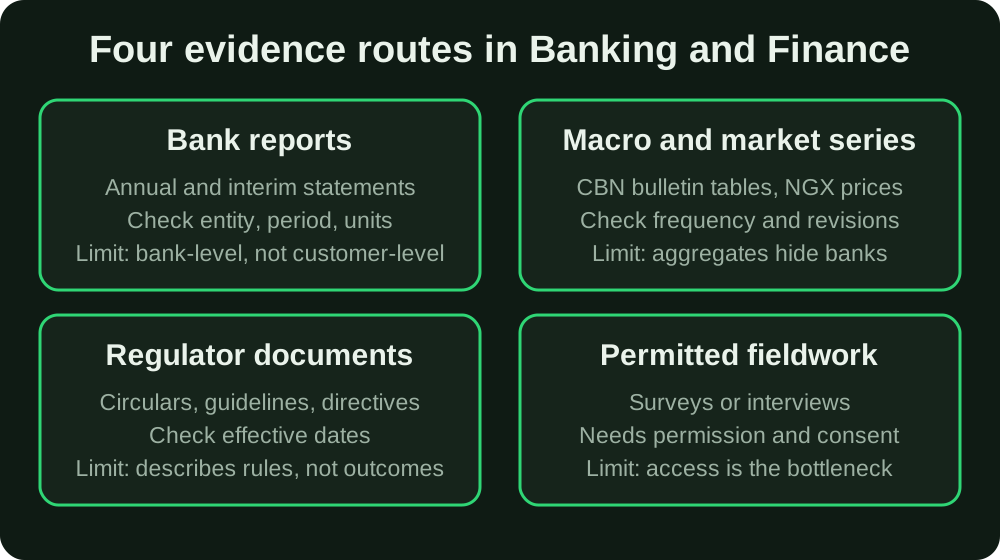
Which evidence route fits your question?
These are original planning directions, not approved titles or completed studies. Pick the route first; the title follows from what the route can support.
| Route | What must be available | A limit to keep visible |
|---|---|---|
| Bank report investigation | Annual or interim statements and notes for a defined set of banks and periods | Reports describe the bank, not individual customer behaviour |
| Macro or market series | A named series, its frequency, its start and end dates, and its definition | Aggregates can hide differences between banks |
| Regulator document analysis | The circulars, guidelines or directives you will examine, with dates | A rule on paper does not show how it worked in practice |
| Permitted fieldwork | Written permission, an instrument and suitable respondents | Access is the bottleneck, and a small sample limits what you can claim |
A desk-based route is not automatically weaker than fieldwork; it answers different questions. A study of how a policy change relates to bank-level figures needs documents and series. A study of how people experience a service needs respondents. Match the route to the claim you want to make, and use the research design guide to check that the design can support that claim.
Where does banking and finance data actually come from?
Name every source in your plan. These are the usual families, with what to verify before you rely on each.
Bank annual and interim reports
Banks publish financial statements on their own websites, and listed banks also file them through the exchange. A statement gives you a balance sheet, an income statement and notes. Check which entity the columns describe (a group or the bank alone), the reporting end date, the currency and scale printed beside the table, and whether a later report restates earlier figures. Open the actual document before promising a variable. The notes often hold the detail you need, such as loan classification or capital figures, and sometimes show that the item is not disclosed the way your title assumes.
Central Bank of Nigeria publications
The CBN publishes a Statistical Bulletin with sections on areas such as money and banking. Editions have appeared as annual and quarterly PDFs, and the Bank has also pointed users to an online statistics database for higher-frequency series. I could not confirm the current state of that database from where I looked, so check what is live today and which tables your period actually has. Read the explanatory notes for each edition: they describe definitions, and series can be revised, so a number you copy from one edition may differ from the same period in a later one. Record the edition, the table and the retrieval date for every figure.
Exchange data
For a question about listed banks, market data such as share prices, volumes and corporate disclosures comes from the Nigerian Exchange (NGX) and from filings by the companies themselves. Check whether prices are adjusted for corporate actions such as bonus issues or rights, whether a bank was suspended or delisted during your window, and whether a figure is a closing price, an average or a year-end value. A share-price study has a different unit from a financial-statement study even when it covers the same banks.
Regulator documents
Circulars, guidelines and directives are the raw material for questions about policy. Your evidence is the document and its effective date. Be careful with claims about effect: a directive tells you what the regulator required, while an outcome needs separate evidence.
Data you collect yourself
A questionnaire or interview study needs a population you can reach, an instrument you have tested and a consent process. The primary and secondary data guide explains the trade-off, and the data collection methods guide helps you choose a method that fits the question.
Can you use customer or bank-staff data?
This is where many banking projects go wrong, so deal with it before you write a title.
Bank customer records are confidential, and a bank is under no obligation to hand them to a student. Do not plan a project that depends on account-level, transaction-level or loan-file data unless the institution has agreed in writing and your department has cleared the design. Public reports cannot stand in for those records, and you should say so plainly in your limitations rather than implying you had access.
Nigeria's data protection law also matters if you collect personal data. The Nigeria Data Protection Act was signed on 12 June 2023 and replaced the earlier 2019 regulation, according to KPMG's overview of the Act. That overview is high level and does not set out the research provisions, so read the Act and any guidance your university issues, and ask your supervisor or research ethics contact how it applies to your design. Do not assume that surveying customers or staff of a named bank is cleared just because the questions seem harmless.
Practical rules for any fieldwork:
- Get permission in writing from the person who can give it, not from a friendly cashier.
- Collect the minimum personal data you need. If you do not need names, do not ask.
- Tell respondents what the study is, how their answers will be used and that they may decline.
- Keep responses stored safely and report them in aggregate. The research ethics and consent guide walks through the consent wording, and the data management plan guide covers storage.
If access looks doubtful, redesign now. A tighter desk-based question you can finish beats an ambitious survey you cannot run.
What are the variable and time-period pitfalls?
Banking and finance questions usually involve a relationship between measures over time. That is where the quiet errors live.
Same name, different measure. “Profitability”, “liquidity”, “capital adequacy” and “asset quality” each have several possible measures. Choose one, justify it from a source and write the calculation rule. Do not choose a measure because its name resembles your title.
Level versus change. Decide whether you are studying a figure at a date, an average over a period or a change between periods, and keep that consistent across all banks.
Frequency mismatch. Monthly series, quarterly bulletins and annual statements do not line up on their own. If you combine them, state how, and say what you lose.
Structural breaks. A long window may cross a change that makes the early and late years incomparable: a revised accounting standard, a new regulatory requirement, a merger, a licence change, a currency regime shift. The CBN announced a recapitalisation programme in March 2024, with new minimum capital levels depending on licence category and a compliance deadline of 31 March 2026, as reported in the press. Reports I found disagreed on the final count of banks that met it, so check the regulator's own statements if your topic touches it. The point for your plan is general: if a rule or sample changes inside your window, mark it and decide how you will handle it.
Survivorship. If you take only banks that still exist, you drop the ones that merged, changed status or stopped reporting. Say which banks you included, which you excluded and why.
Group versus bank figures. Where a report gives both, they are not two independent banks. Pick one basis and keep it.
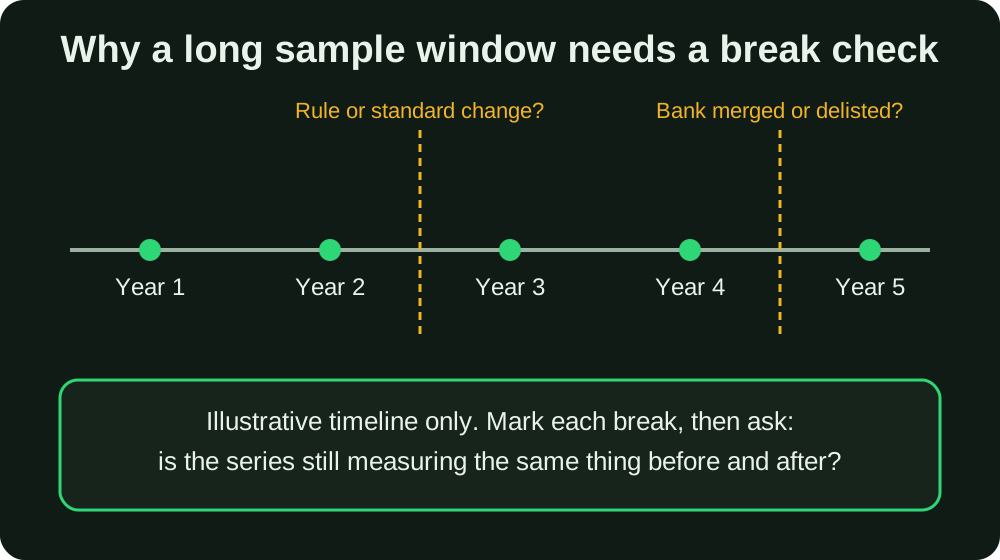
If your question names a long period, build the break check into the plan. Our research gap guide also helps you see whether earlier studies handled the same issue before you assume your window is clean.
Fictional example: a title that promises too much
This is an invented planning exercise. No dataset has been assembled, no calculation run and no finding supplied.
A student proposes: “The effect of bank credit on economic growth in Nigeria over twenty years.” They have a general idea that the CBN publishes relevant tables. They have not opened one.
The next step is a feasibility note, not a regression.
| Decision | Status in the fictional exercise | Required next step |
|---|---|---|
| Unit | Year implied, never stated | Decide year or quarter and write the rule |
| Source | “CBN data” | Name the edition, table and series, and confirm coverage |
| Coverage | Twenty years assumed | List which years each series actually has |
| Credit measure | Undefined | Pick a definition and record its source |
| Growth measure | Undefined | Pick a definition and the base the series uses |
| Breaks | Not checked | Look for revisions and definitional changes inside the window |
| Claim | “Effect” | Agree a design that can support a causal word, or reword as an association |
| Decision | Candidate only | Discuss with supervisor and revise |
“Effect” is the word to challenge first. An observed relationship between two series is not enough to claim that one caused the other, and a student project may simply not have the design for that claim. A provisional, rewritten question might ask how two defined measures move together over a period you have confirmed. It would still need a method, so the statistical test guide and your supervisor are the next stop. Do not treat the rewritten question as a ready title; it is a shape to test.
Make a variable dictionary and a coverage register
For each variable, record its meaning, source, exact field, unit, time basis, calculation rule and any unresolved doubt. Then keep a coverage register:
| Entity and period | Required source | Obtained? | Fields found? | Unresolved issue |
|---|---|---|---|---|
| Fill from your proposed scope | Exact report or table, with edition | Record the real status | Record the real status | Missing page, changed definition or another verified issue |
This is a blank structure, not data. Missing, not applicable and not disclosed must never become zero by default. If coverage fails, narrow the scope or change the question; do not manufacture the missing rows.
Distinguish your plan from the accounting version
Both subjects can use the same bank statements, so be clear about what is yours. An accounting project tends to ask about how reported items are recognised, measured or disclosed. A banking and finance project more often asks how banks, markets or policy relate to outcomes such as lending, stability, returns or access to financial services. The data sources overlap, the questions do not. If your question could belong in either department, ask your supervisor which framing the department expects. A source-reading seminar is another route entirely; the Economics seminar guide shows how a discussion-based piece differs from an investigation.
Write the question so the data can answer it
Once the route and sources look viable, write your research questions and objectives in terms the evidence can address. Avoid verbs you cannot support (“prove”, “determine the impact of”) unless the design earns them. The research questions and objectives guide shows how to keep the question, the objectives and the method aligned. Then your methodology chapter can state the sources, variables, period and limits in the order a supervisor will check them.
What will a supervisor or panel ask?
Prepare short, honest answers to these.
- Where exactly does each figure come from, and which edition?
- What does one observation represent?
- How do you know the definition did not change over your period?
- Which banks or years are missing, and what does that do to your conclusion?
- Why is this measure the right proxy for your concept?
- If you used respondents, who gave permission and how was consent handled?
- Which of your conclusions would a different design be needed to support?
Answering these from your source register and variable dictionary is much easier than reconstructing them in the room.
Take a decision note to your supervisor
Bring a one-page note: the question, the evidence route, the named sources, the unit and period, the variable dictionary, the coverage gaps and the access position. Say which claim the evidence can support and which would need a different design. Your supervisor can then redirect you before you spend weeks on data you cannot use.
Once the question and method are agreed, keep the analysis and the document connected. Bring the evidence behind every figure, and review each calculation and claim yourself when you prepare your project with UniDraft. The software prepares the documentation; it does not supply bank data, recruit respondents, run your analysis or guarantee approval.
Sources
- Central Bank of Nigeria: Annual Statistical Bulletin page, used only to show that the bulletin is published by the CBN. No figures are reproduced.
- KPMG Nigeria: The Nigeria Data Protection Act, 2023, used only for the signing date and the replacement of the earlier regulation.