Choose a Biochemistry project topic by checking whether you can run it: the instrument works, the reagents are obtainable, the safety and ethics approvals exist, you can afford enough samples and repeats, and the time fits your deadline. A title is only a plan once those five checks have answers.
UniDraft's free topic generator can build a starting shortlist from your department and a course you enjoyed. Then test every idea against the feasibility checks below before taking it to your supervisor.
Once the question and method are agreed, UniDraft helps organise your confirmed laboratory work, checked sources and supervisor instructions into an editable Word project document. Start your Biochemistry project document, bringing your own records, and verify every measurement and claim yourself.
How is a Biochemistry project different from a seminar?
A seminar is a literature review. A project needs your own data, so the bottleneck moves from "can I find papers?" to "can I get the bench time, materials and approvals?". The Biochemistry seminar guide shows the review route, using protein-structure papers as its example. For the general difference between the two assignments, see seminar paper versus final year project.
| Seminar | Project | |
|---|---|---|
| Main evidence | Published studies | Your own measurements, with controls |
| Biggest risk | Misreading a paper | A failed assay, missing reagent or too few samples |
| Approvals | Rarely any | Possibly biosafety, ethics, supervisor sign-off |
| Time shape | Reading and writing | Waiting, optimising, repeating, then writing |
| Honest limitation | Scope of the papers | Sample size, method precision, what you could not control |
Departments set their own rules. For example, the University of Nigeria, Nsukka's Biochemistry department states that a research project on a biochemical topic is a compulsory final-year course, intended to make students aware of biochemical problems in their own surroundings, and lists local-relevance themes such as nutrition and food science, local soils, microorganisms, plants and animals, and biochemical aspects of disease. Your department may phrase its expectations differently, so follow your own project brief.
What do project topics usually look like in Biochemistry?
These are planning directions, not approved titles or completed studies. Use them to see which kind of evidence each direction needs.
| Direction | What you would measure | What must be available | Limit to keep visible |
|---|---|---|---|
| Enzyme activity under defined conditions | Rate of a reaction under changed pH, temperature or substrate level | A spectrophotometer or suitable assay, purified or crude enzyme, buffers | Crude extract activity is not the same as a purified enzyme |
| Plant extract composition | Presence or amount of a defined class of compounds in an extract | Plant material identified and authenticated, solvents, standards | A screening result does not show a medicinal effect |
| Nutritional composition of a food | Standard proximate or micronutrient measures | Sample source, an established method, balances, ovens or digestion kit | Composition of your sample is not the composition of the food everywhere |
| Biochemical markers in prepared samples | A marker such as a serum enzyme in a defined sample set | Permitted access to samples, ethics approval, validated kits | Association is not cause |
| Antioxidant or inhibition assays | Capacity of an extract in a defined in-vitro assay | Reagents, standards, plate reader or spectrophotometer | In-vitro results do not prove an effect in a living body |
| Computational study | Binding scores or sequence analysis from public databases | A computer, suitable software, public data | A score is a prediction, not an experiment; the method must be justified |
Choose a direction only if your department teaches or supports it. A topic from another university's lab may be impossible in yours. Never assume reagents or instruments exist; ask.
Run the five feasibility checks
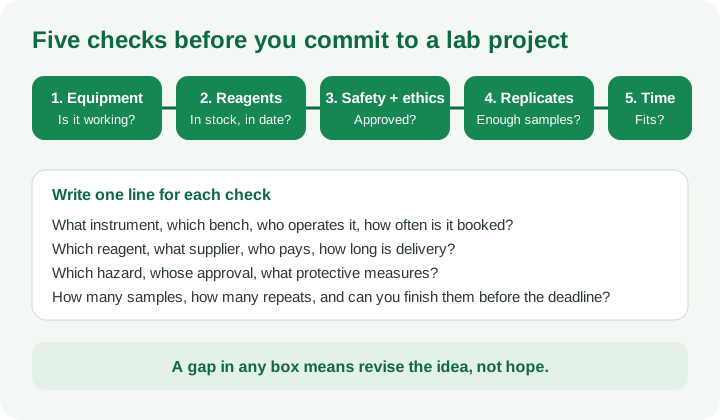
1. Equipment. Name the exact instrument, who maintains it, whether it is working today and how often it is booked. A spectrophotometer that is in repair for three months is a topic-killer. Ask whether a nearby institution can host the measurement and whether that fits your supervisor's arrangements.
2. Reagents and materials. List each reagent, grade, quantity, supplier and lead time. Substrates, kits, standards and enzymes can be costly or slow to arrive. Ask who pays, since many students are expected to cover project costs themselves unless the department says otherwise. If one critical reagent is unobtainable, the whole project fails, so find that out in week one.
3. Biosafety and ethics. Biochemistry work may involve acids, solvents, toxic reagents, microorganisms, human samples or animals. The World Health Organization's Laboratory biosafety manual, 4th edition states that a proper risk assessment should always be performed before undertaking any activities involving biological agents, and it should guide the control measures applied. Your institution will have its own rules and committees. Work with human or animal material generally needs formal approval, and the consent and privacy issues are covered in the research ethics guide. Do not begin sample collection first and ask later.
4. Sample size and replicates. Decide how many samples and how many repeats you need before you start, because you cannot add them after the deadline. A fixed rule does not exist; the number depends on your design, the variation in your method and what your department accepts. The sample size guide explains the logic for survey-style projects, and your supervisor decides what is adequate for a laboratory assay.
5. Time. Add up preparation, optimisation, the real run, repeats if something fails, and writing. Wet-lab work rarely goes right the first time, so budget for a failed run.
Technical replicates versus independent samples
This is the most common quiet mistake in a student laboratory project. Measuring one extract three times tells you how precise your pipetting and instrument are. It does not tell you how much different samples vary.
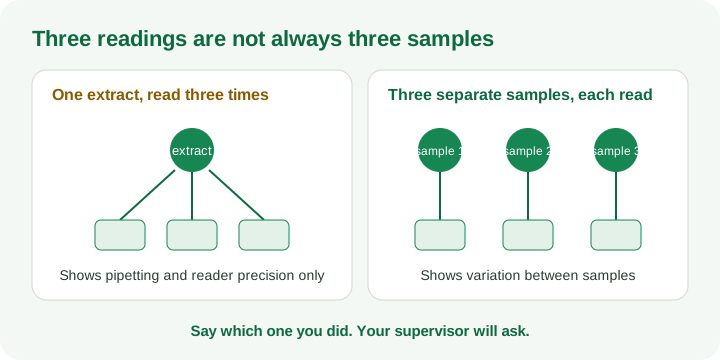
Write it plainly in your methodology: "each sample was prepared separately and each measurement was repeated" is a claim you must be able to back up with your notebook. If you used technical repeats only, say so and state the limitation. Do not call three readings of one tube "n = 3 samples".
Fictional example: a title that cannot be run
This is an invented planning exercise. No assay has been run, and no result is claimed.
A student proposes: "The anti-diabetic effect of a leaf extract in rats." They have a list of papers but nothing else.
| Check | Status in the fictional exercise | Next step |
|---|---|---|
| Question | "Anti-diabetic effect" is undefined | Decide what is measured, such as the inhibition of one enzyme in a test tube |
| Equipment | Unknown | Confirm an assay-capable spectrophotometer is available |
| Reagents | Unknown | List enzyme, substrate, standard, buffer, quantities and lead time |
| Plant material | Not yet identified | Get the plant authenticated and record where and when it was collected |
| Ethics | Animal work implied | Ask whether animal work is permitted and approved; otherwise change to an in-vitro design |
| Replicates | Not planned | Plan separate preparations and repeats, and record which are technical |
| Claim | "Effect in rats" cannot follow from a test-tube assay | Reword the objective to what the assay can support |
A narrower provisional question might ask how a defined extract affects the activity of one enzyme in a controlled in-vitro assay. That is a question shape, not a finding. Whether it is feasible still depends on your department, your supervisor and the checks above.
How do you move from a broad area to a question?
Start with a gap you can address, not a trend. The research gap guide shows how to read for what is unresolved. Then narrow in steps: a biological system, one measurable variable, a defined condition, and a comparison or control.
A useful test is to say your question as "I will measure X in Y under condition Z and compare it with W." If you cannot fill X, Y, Z and W, the topic is still an area. For the wider selection process, including how to match a topic to your brief, use the general project topic guide.
Plan the methodology around your lab record
Your methodology should be reproducible from your own notes: materials with source and grade, preparation steps, instrument settings, controls, how many samples and repeats, and how you handled outliers or failed runs. The methodology chapter guide explains the structure. Keep a dated laboratory notebook from day one, since it is the evidence behind everything in chapters three and four.
Writing chemical names, formulas and units correctly matters in this subject; the chemical formula formatting guide covers subscripts, charges and units in Word.
Common mistakes in Biochemistry project topics
- Choosing a title from a paper you cannot reproduce. A published study may rest on equipment or reagents your department does not have. Borrow the question shape, not the whole method.
- Promising a biological effect from a test-tube result. An in-vitro assay supports a statement about that assay. Words like "treats", "cures" or "protects" need evidence your design does not provide.
- Skipping the control. Without a blank, a standard or an untreated comparison, a number has nothing to be compared with. Decide your controls before the first run.
- Treating one good run as the result. A single successful run is an observation, not a pattern. Plan repeats in advance and keep the failed runs in your notebook.
- Forgetting where the material came from. Record the plant, food or sample source, the date and the place, and how identity was confirmed. A reader cannot trust a result on material they cannot trace.
- Leaving ethics until the end. Approval cannot be added after sample collection. Ask first.
- Copying another student's method section. Your methods must describe what you actually did, with your own quantities and settings.
What to ask your supervisor in the first meeting
Supervisors differ, so use these questions to find out how yours works rather than guessing:
- Is a laboratory project expected, or is a computational or field-based project acceptable?
- Which instruments and reagents does the department already hold, and which must I arrange?
- What is the expected cost to me, and is there a cap?
- Which approval forms apply to my material, and how long do they take?
- How many samples and repeats would you consider adequate for this design?
- How often do you want progress updates, and in what form?
Take a feasibility note to your supervisor
Bring one page, not a final title:
- the proposed question in the "measure X in Y under Z" form;
- the instrument, who operates it and when you could use it;
- a reagent list with sources and lead times;
- the biosafety and ethics route you think applies;
- the number of samples and repeats you propose, and which are technical;
- a rough timeline with room for a failed run;
- one thing you would cut if time runs short.
Ask which parts of this the department can support and which you must arrange yourself. Treat the supervisor's reply as the rule, because project and supervisor instructions outrank any general advice.
What happens after the bench work?
Report what you measured, not what you hoped. The results chapter guide shows how to present data without overreaching, and the statistical test guide helps match a test to your design. Run and check the calculations yourself with suitable software. If an assay failed or a result was inconclusive, say so and explain what you would change; that is more credible than an overstated claim.
Expect defence questions such as: Why this method? What were your controls? How many samples were independent? What could have gone wrong? What does your result not show? Prepare a plain answer to each from your notebook.
When your supervisor has agreed the question and you have real data, prepare your project with UniDraft. It organises your confirmed work, checked sources and instructions into an editable Word document. It does not run your experiments or analysis, supply data, or guarantee approval, so check every figure and interpretation before you submit. Placement-based laboratory work is a different assignment, covered in the laboratory science SIWES guide.
Sources
- World Health Organization: Laboratory biosafety manual, 4th edition, used for the statement on performing a risk assessment before activities.
- University of Nigeria, Nsukka Department of Biochemistry: Philosophy, Objectives and Scope, used as one example of a department's final-year project course and local-relevance themes.