
A good Business Administration project topic is one business question about a clearly defined firm or group, answerable with evidence you can actually get. "Entrepreneurship and economic growth" is a theme. A workable topic names who, where, when and what you will measure or read.
UniDraft's free topic generator can give you a starting shortlist. Treat every suggestion as a draft to test against access, your department's brief and your supervisor's view, not as an approved title.
Once your Business Administration question, design and access are agreed, UniDraft organises your confirmed work, checked sources and supervisor instructions into an editable Word project document. Start your project document with what you have verified, and review every figure and claim yourself.
This guide covers the three designs most Business Administration projects fall back on, how to check access to firms and respondents, and how to sanity-check your sample size and questionnaire before you commit. It does not list ready-made titles. Titles go stale, and a supervisor will ask why you chose yours. If you are preparing a seminar instead, the Business Administration seminar guide covers a different task: a seminar usually discusses published sources, while a project normally collects or analyses evidence of its own.
What is a Business Administration project topic, exactly?
A project topic is a question plus a plan for evidence. It has four parts:
- A business problem or practice, such as staff turnover, customer retention, record keeping, pricing or credit access.
- A defined unit, such as the staff of one firm, customers of a named market, or a set of listed companies.
- A time frame, such as "the last two years" or "the 2022 to 2024 annual reports".
- A route to evidence: a questionnaire, interviews, company records or published reports.
If one of the four is missing, your supervisor will probably send you back. The general selection rules are in the guide to choosing a final-year project topic. Here we focus on what is specific to business-type projects.
Which design fits Business Administration projects?
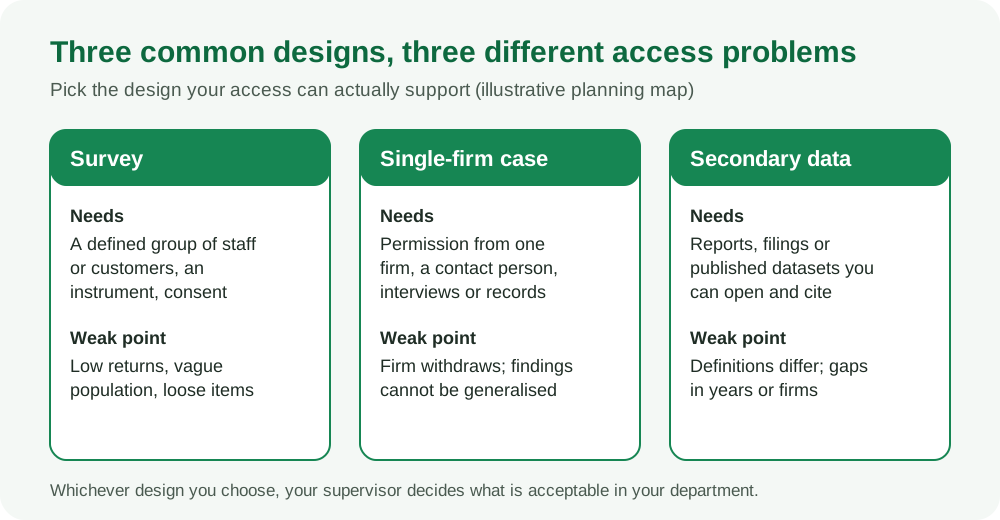
Departments differ in what they accept and in how they label designs, so treat the table as a planning aid, not a rule. Your project guidelines and supervisor decide.
| Design | Typical question shape (provisional) | Evidence | Main limit |
|---|---|---|---|
| Survey of staff or customers | How do employees of a defined group describe a practice? | Questionnaire, sometimes interviews | Results describe respondents, not every firm |
| Case study of one firm | How does one named firm handle a process? | Interviews, documents, observation | Depth over breadth; permission can be withdrawn |
| Secondary data | What do published reports show about a defined set of firms over defined years? | Annual reports, regulatory filings, published surveys | Definitions and coverage are not under your control |
Survey of staff or customers
This is the most common design and the easiest to do badly. A survey answers a question about the views, experiences or reported practices of a group. It does not show what firms actually did, and it cannot by itself show cause and effect.
Before choosing it, answer three things in writing. Who exactly is in the population? Can you reach them? Will enough of them answer? A questionnaire sent into a WhatsApp group of unknown members has no defined population, and your sampling chapter will be hard to defend. Read the guide to sampling techniques before you fix the population.
Case study of one firm
A case study trades breadth for depth. It suits questions like "how does this firm manage its distributors?" and is a poor fit for "what affects profitability in Nigerian SMEs?" because one firm cannot answer a question about SMEs generally.
The risk is access. You depend on a manager who may be busy, cautious or gone next month. Write down who gave permission, in what form, and what you may and may not record or name. The case study research guide explains how to frame the case and its boundaries.
Secondary data
Secondary data means you analyse material someone else collected: annual reports, regulatory filings, published surveys or official statistics. It avoids respondent problems, but replaces them with definition problems. Two reports may call different things "turnover" or "staff cost", and some years or firms will simply be missing.
Open the actual documents before you commit to a title. If the data for your ten-year window do not exist for the firms you named, the title fails however good it sounds. The primary and secondary data guide helps you decide which kind of evidence your question needs, and the research-design guide shows how that choice connects to your objectives.
How do I check access to firms and respondents?
Access is where most Business Administration projects quietly fail. Do these checks before you finalise the title.
- Name the gatekeeper. Who can say yes: the owner, HR, a branch manager? Get the name, not "the company".
- Ask for what you need, specifically. "May I distribute a ten-minute questionnaire to staff and interview two supervisors?" is easier to approve than "I want to study your company".
- Get the permission in a form you can show. A short letter or message from the firm, plus any letter your department issues. Requirements vary by institution; ask your supervisor what yours expects.
- Agree confidentiality. Will the firm be named or anonymised? Can you quote managers? Can you see financial records or only describe processes?
- Plan for a no. Have a second firm, a wider respondent group or a published-data design ready. A refusal in week six is survivable if you planned for it, and fatal if you did not.
- Do not use your own workplace or family firm blindly. It may be convenient, but check whether your department sees a conflict and whether the firm's owner is comfortable with what you will report.
For consent wording, participant information and what to do with personal data, see the research ethics and consent guide. Never fabricate respondents, interviews or company records to rescue a topic. If access fails, change the design with your supervisor's approval.
A fictional feasibility worksheet
This is an invented example for planning practice. The firm, numbers and outcome are made up, and no data have been collected.
A student writes: "Effect of motivation on employee performance in Nigerian companies." Using the checks above, here is how the supervisor-ready version might develop.
| Question | Draft answer in the fictional exercise | Problem to resolve |
|---|---|---|
| Which companies? | "Nigerian companies" | Far too wide; choose one defined unit |
| Which design? | Not stated | Survey, case or records? |
| Who answers? | Staff, unspecified | Define the population |
| What is "performance"? | Not defined | Self-report? Supervisor rating? Output records? |
| What does "effect" mean? | Cause claimed | A one-time survey shows association at most |
| Access? | None yet | Find a gatekeeper |
After a week of checking, the student narrows it to a provisional question: how do staff of one named distribution company describe the motivation practices they experience, and how do they rate their own work engagement? Access: the HR officer agrees in writing to circulate a questionnaire to about 120 permanent staff, with the firm anonymised. This is a better question because it names the group, matches the evidence (self-reported views) to the claim, and avoids a causal word the design cannot support. It is still only a candidate until the supervisor agrees.
How many questionnaires do I actually need?
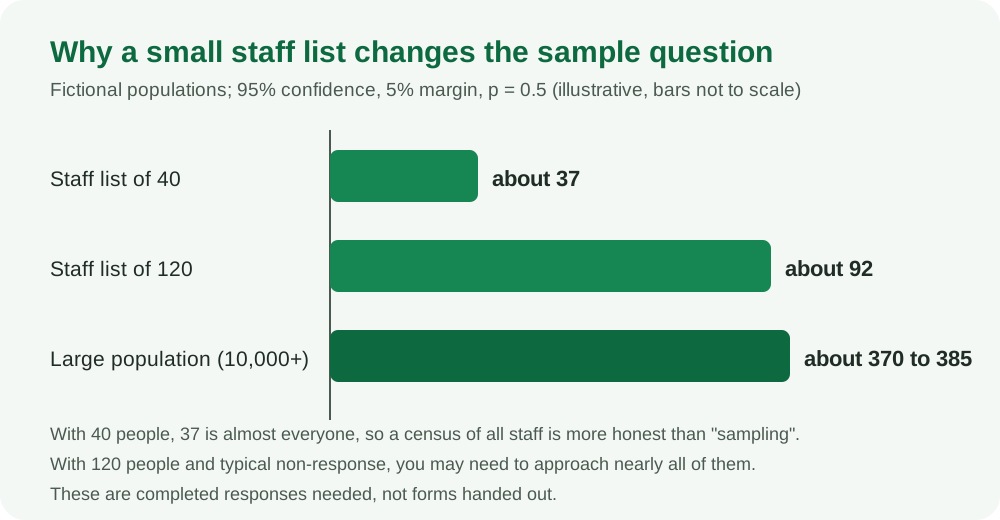
Do the arithmetic early, because it can change your topic. A commonly used approach starts from a figure of about 384 for a very large population at 95% confidence and a 5% margin of error, then adjusts it downward for a small, finite population:
adjusted sample = n0 / (1 + (n0 - 1) / N), where n0 is about 384 and N is the population size.
For the fictional distribution company with 120 staff, that is 384 / (1 + 383/120), which is about 92 completed questionnaires. For a firm with 40 staff, it is about 37, which is nearly everyone. In that case, a census of all staff is more honest than pretending to sample.
Now the part students skip: that is 92 completed forms, not 92 handed out. If you expect only some staff to return usable forms, you may have to approach almost the entire list of 120. Decide that before you promise "random sampling of 92 employees" in chapter three.
Different supervisors accept different methods (formulas, published tables, rules of thumb), and some designs, such as interviews or single-firm case studies, do not use sample-size formulas at all. The sample size guide walks through the common methods and their assumptions. Use the one your supervisor expects, show your working, and report the actual number of responses you received.
What should I check in my questionnaire before using it?
A questionnaire cannot rescue a topic, but a weak one can sink a good topic. Before circulating it, check:
- Every item maps to an objective or research question. If you cannot say which question an item serves, remove it.
- Terms are defined in the question. "Do you feel motivated?" means different things to different people. Name the practice you mean.
- One idea per item. "The firm pays well and promotes fairly" is two questions.
- Scales are consistent and labelled the same way throughout.
- Wording is neutral, with no hint of the answer you hope for.
- It is short enough that busy staff will finish it.
- Someone else has tried it. Ask classmates or a few people outside your sample to read it, and revise after what confuses them.
The questionnaire design guide covers item writing in detail. If you intend to claim your instrument is valid or reliable, read the validity and reliability guide first so you describe only checks you really performed.
What if my topic is approved but the data turn out thin?
This happens often enough to plan for. Maybe only 30 of 120 staff return the form, or a firm publishes three of the five annual reports you wanted. Do not quietly stretch the numbers. Report what you actually obtained, state the response rate or coverage honestly, and discuss in your limitations what that means for your conclusions. A smaller, honest dataset with clear limits is easier to defend than a large one nobody can trace to a real source.
Tell your supervisor as soon as you see the shortfall, not at the final draft. Options might include a second collection round, a narrower question, or a different firm. Your supervisor decides which is acceptable, and any change should be written into your methodology so the chapters still agree with each other.
Common mistakes in Business Administration topics
- Scope too wide. "Nigerian banks", "SMEs in Nigeria" and "all employees" are rarely feasible. Name a firm, a market or a defined group.
- Causal titles with survey evidence. "Effect of" and "impact of" promise more than a single questionnaire shows. Consider "relationship between" or "how respondents describe" unless your design supports more.
- Two or three topics in one title. Each extra variable multiplies your questionnaire, your data and your defence questions.
- Respondents you cannot reach. If you only know the firm by its name, you do not have access yet.
- Copying a title because it "was approved before". Departments change guidelines. Check current expectations with your supervisor.
- Treating published data as automatically comparable. Read the definitions in each report.
Questions your supervisor or panel may ask
Prepare short answers to these before your proposal defence:
- Why this firm or group and not another?
- What exactly is your population, and how did you decide who to include?
- How did you reach your sample size, and how many responses did you actually get?
- What do you mean by each key term, and where did your measures come from?
- What can your design not tell us?
- What did you do when someone declined to take part?
If you are unsure how to present these answers, the project defense guide lists the kinds of questions panels commonly raise.
From topic to document
Once your question, design and access are agreed, the work shifts to collecting and checking your evidence, then writing it up consistently. UniDraft organises your confirmed Business Administration question, your own analysis, checked sources and supervisor instructions into an editable Word project document. Start your project document with what you have verified, and review every figure and claim yourself.
UniDraft does not recruit respondents, obtain company permission, run your analysis or guarantee approval. Those remain your work and your supervisor's decision. You can also use the formatter to check layout once your draft is ready, and citations to keep references consistent.