
An educational management project examines how schools or education systems are run: supervision, funding, leadership, staffing, records or policy. To choose a topic, pick one management question, name the evidence you can legitimately get (staff views, school records or published policy), and confirm who must give permission before you write a title.
UniDraft's free topic generator can give you a starting shortlist from your department and course interests. Once your question, evidence plan and supervisor instructions are settled, start your project document: UniDraft organises your confirmed work, checked sources and supervisor instructions into an editable Word document. You still do the fieldwork and verify every claim yourself.
How is this different from a general Education project topic?
The general guide to Education project topics covers classroom evidence: teachers' accounts, learner experiences, observation and learning materials. If your assignment is literature-based, the Education seminar-topic guide fits better. This page is narrower. It deals with the administration side: head teachers and principals, school funding and records, supervision, and the policies that govern schools. That side has its own problems. You need permission from people who run the institution, your evidence is often a document, and the number of schools or officers you can reach may be small.
Educational management is also a department in many faculties of education, and its courses typically sit under headings such as school business management, educational finance, and school-community relations. Those headings are a sign of the territory, not a list of approved topics. Your department's current handbook decides what counts for you.
What does a good educational management question look like?
A management question names an activity (what is being done), a setting (which kind of school, which level, which place) and a kind of evidence. Compare these two shapes:
| Too broad | Better shaped (provisional) |
|---|---|
| "Leadership and school performance" | How do teachers in a named set of schools describe the way their head teacher involves them in decisions? |
| "Funding of education" | What do the available budget records of one school show about how funds received in a stated year were spent? |
| "Supervision in secondary schools" | What supervision activities do staff in a defined set of schools report taking place in a stated term? |
| "Education policy" | What does a specified published policy document say about a defined responsibility of school heads? |
The right-hand column is not a list of titles to copy. These are question shapes to adapt, check against literature, and take to your supervisor. Notice that none promises an effect. Words like "impact", "effect" or "influence" promise that you can show one thing causes another, and a typical undergraduate survey cannot do that. The guides on research questions and objectives and research design help you match wording to method.
Who can say yes? School-level and ministry-level access
Access is the make-or-break issue in management research, because you are asking about how an institution runs. Think of it as a ladder of people who each hold a different key.
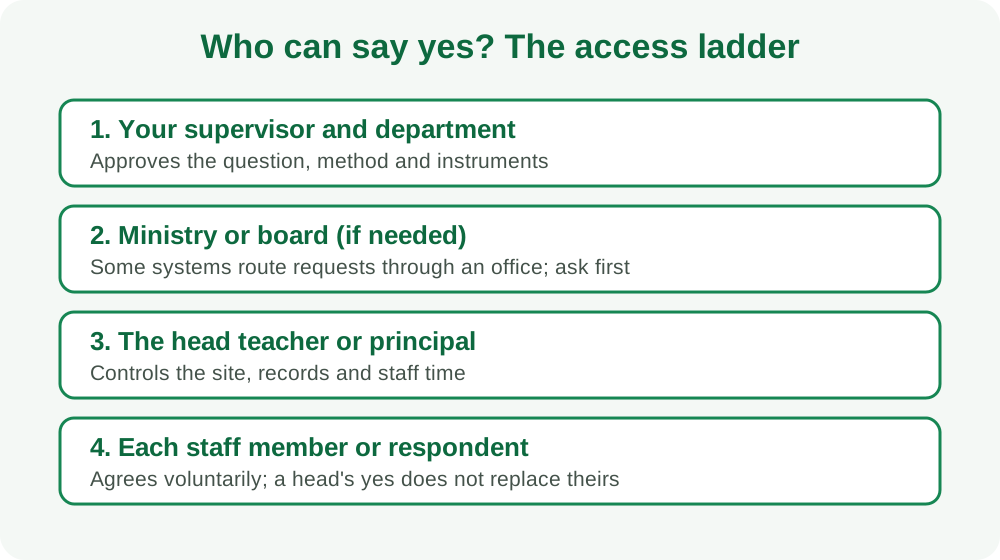
School level. The head teacher or principal normally controls the site, staff time and school records. Educational research guidance commonly says to consider approaching institutional gatekeepers before participants. The BERA ethical guidelines for educational research, which I opened, say this, and add that institutional ethical approval is usually required. BERA is a UK body, so treat it as a source of good questions to ask rather than a Nigerian rule.
Ministry or board level. Some systems require approval from an office above the school before a researcher approaches staff. Whether that applies to you depends on your state, the school type (public or private) and your department. I could not find a single national rule that covers every case, so do not assume either way. Ask your supervisor, and ask the school what its own process is.
Individual level. A head's permission does not decide for the teachers. BERA's guidance says consent should be voluntary and informed, and that people may withdraw without giving a reason. If you are a former teacher at the school, or the head knows your family, remember that power relationships can make it hard for people to say no. The research ethics and consent guide walks through this for students.
What goes into a permission letter?
A request letter is not a template to download; it must say true things about your plan. A sensible letter to a head teacher usually covers:
- who you are, your department and your supervisor, with a name the school can contact;
- the question you are studying, in plain language, and why it needs this school;
- exactly what you are asking for: staff to fill a questionnaire, a short interview, access to named records;
- how long it will take and when;
- how names and school identity will be protected, and who will see the data;
- that taking part is voluntary and the school or staff may decline;
- what you will give back, such as a summary of findings.
Your department may supply an introduction letter. Use that, and never invent an approval number, a signature or a stamp. If permission is pending, say so in your proposal.
Which evidence routes fit management topics?
| Evidence route | Typical question shape | What to settle first |
|---|---|---|
| Staff or head-teacher survey | How do respondents report a management practice? | Who counts as a respondent, instrument, anonymity |
| Interviews | How do heads explain a decision or constraint? | Consent, recording, how quotes will be handled |
| School records | What do recorded figures show for a defined period? | Permission, definitions, missing entries |
| Published policy documents | What does a document say about a responsibility? | Which version, how you will classify content |
| Several of the above | How do reported practice and recorded practice compare? | Workload; a bigger project is not a better one |
How do I run a staff or head-teacher survey?
A survey records what respondents say they do or experience. That is useful, but it is not the same as observing it. A head who reports weekly classroom visits may be right, may be generous to themselves, or may define a "visit" differently from you. Say this in your limitations.
Before you write items, decide who answers. Teachers and heads often see the same practice differently, so do not blend them without saying so. The guides on designing a questionnaire and validity and reliability cover item writing and checking. If you adopt another researcher's instrument, cite it and check it fits your respondents; do not claim it is validated for your population unless a source says so.
Can I use school records as evidence?
Records can show what was written down, which is not always what happened. A cash book shows money recorded, not every cost incurred. An attendance register shows marks made, not every absence. Before you plan around records:
- Confirm who owns them and get permission in writing for the specific records.
- Agree what you may copy or photograph, and what must stay on site.
- Define each field you will use and check whether definitions changed during the period.
- Decide how you will handle missing or incomplete entries; do not fill gaps by guessing.
- Plan how names of pupils and staff will be removed from anything you report.
Being able to see a register during teaching practice or SIWES does not give you the right to analyse it. The primary and secondary data guide helps you separate data you collect from data someone else already holds.
How do I use published policy documents?
Policy documents are attractive because they are public, but they need a method. If you study a policy, say which document, which version and date, and how you decided which parts count. A document shows what the authors intended; it does not show whether schools follow it. If you plan to code the text, the content analysis guide explains coding rules. Cite only what you have actually opened, and give the exact edition.
How do I define supervision, funding or leadership?
Management terms are slippery. If you do not define them, a supervisor or examiner will ask what you meant, and your questionnaire will be measuring something vague.
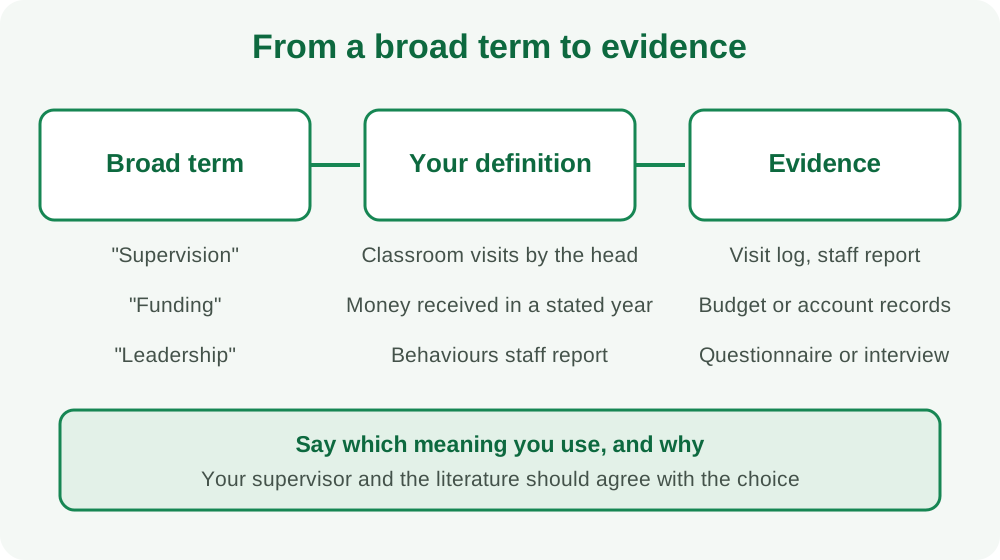
A real example of why this matters: I opened the abstract page of a 2024 article in the African Journal of Educational Management on school supervision, inspection and the quality of secondary education in Ibadan North Local Government Area, Oyo State. It reports a descriptive survey of teachers and principals using a self-structured questionnaire. From the abstract page, supervision, inspection and quality appear to be measured through the questionnaire items rather than defined separately. I did not read the full text, so I cannot say what the full article defines. The lesson for your own project is simple. When you read a study, ask how each term was actually measured, and write your own definitions in the open.
A working approach:
- Pick the meaning you will use and say why, citing sources you have read. "Supervision" can mean external inspection by officials, or internal monitoring by the head, or support for teachers' teaching. These are different things.
- Write the definition in a sentence a respondent could understand.
- Tie each term to evidence. If you cannot name what would count as evidence of "leadership style", you cannot measure it.
- Keep terms separate. A single questionnaire item that mixes funding, facilities and morale measures none of them well.
Terms like "quality" or "performance" are the hardest. If you cannot define them narrowly, say what you are doing instead, such as describing respondents' reported experience.
What if the population is small?
Management studies often involve few people: one school's staff, the heads of schools in one local area, or the officers of a single office. Small populations raise three issues.
Counting everyone may be possible. If there are only a few relevant people, you may attempt to include all of them rather than a sample. Discuss this with your supervisor; the sampling techniques guide explains the options. I am not giving a formula or a minimum number here, because the right answer depends on your design and your department's expectations.
Anonymity is harder. BERA's guidance notes that anonymity is not always achievable, for example in small communities or well-known institutions, and that researchers should consider harm if people are identified by inference. If only one person holds a post, writing "the vice principal said" identifies them. Group or generalise responses, and tell participants honestly what can and cannot be hidden.
Statistical claims weaken. With very few respondents, percentages and tests can look more precise than they are. Describe what respondents said, avoid dramatic comparisons, and treat the guide on calculating sample size as background only. Ask your supervisor what analysis your department expects.
What can I claim, and what can't I?
State the limits of your evidence at the point where you make a claim, not only in a final paragraph. A useful habit is to write each finding with its boundary:
| Evidence you have | A claim it can support | A claim it cannot support |
|---|---|---|
| Survey of staff in three named schools | These respondents reported X | Nigerian schools do X |
| One school's records for one year | The recorded figures for that school and year | Funding is inadequate in the state |
| One policy document | The document states Y | Schools implement Y |
| Heads' interviews | These heads explained Z | The practice improves results |
The guide on the limitations of the study shows how to word these honestly. A report that says what it cannot show is easier to defend, because the examiner cannot catch you overclaiming.
A fictional planning worksheet
This is an invented example: no school was contacted and no data exist. A student proposes "Supervision and Teacher Effectiveness in Secondary Schools".
| Planning issue | Problem in the first draft | Question to take to the supervisor |
|---|---|---|
| Terms | "Supervision" and "effectiveness" are undefined | Which meaning of supervision, and what evidence counts as effectiveness? |
| Claim | "Effectiveness" promises a result | Should this become a description of reported supervision practices? |
| Access | The student knows one teacher | Who formally approves access, and is an office above the school involved? |
| Respondents | "Teachers" is all it says | Heads, teachers or both, and how many are there? |
| Records | The student hopes to use staff appraisal files | Is permission realistic, and how will identities be protected? |
| Limits | Findings expected to apply "across the state" | What will the report say it covers? |
A revised candidate might ask what supervision activities teachers in two named schools report during one term. That is a different, smaller question with different limits, and it still needs approval before any data are collected.
Questions a supervisor or panel may ask
- Who gave you permission, and can you show the letter?
- How did you define supervision (or funding, or leadership), and where does the definition come from?
- Why did these schools, and could the choice have affected your findings?
- How did you protect the identities of a small group of staff?
- What does a document or record show, and what does it not show?
- What would you need to do to claim your result applies more widely?
The project defense questions guide helps you rehearse answers, and the defense preparation guide covers the process.
Common mistakes
- Choosing a topic whose evidence sits behind a door you cannot open.
- Treating a head teacher's yes as permission for every teacher.
- Using the words "impact" or "effect" in the title with only a questionnaire.
- Leaving key terms undefined, or defined differently in different chapters.
- Quoting one staff member in a way that identifies them.
- Writing a generalisation from two or three schools.
- Citing a policy you have not actually opened.
Take it to your supervisor
For each candidate topic, fill in this short sheet and bring it to your meeting.
| Field | Your note |
|---|---|
| Management question | What exactly do I want to find out? |
| Setting | Which schools or offices, which period? |
| Evidence | Survey, interview, records, policy document? |
| Access | Who approves, what is confirmed, what is pending? |
| Key terms | How will I define each, and from which source? |
| Population | How many people or records are involved? |
| Claim boundary | What can this evidence support, and what not? |
Once the topic is agreed, the final-year project step-by-step guide shows how the chapters fit together. For layout, follow your department's current instructions and the format guide. When you are ready to write, bring your confirmed question, actual evidence and checked sources into UniDraft and start your project document. You should be able to explain every method and statement in it yourself.
Sources
Pages I opened while preparing this guide:
- BERA Ethical Guidelines for Educational Research, fifth edition (2024): consent, gatekeepers, power relationships and anonymity.
- School Supervision, Inspection and Quality of Secondary Education in Ibadan North Local Government Area, Oyo State, African Journal of Educational Management (2024): abstract page only.
- Bryan and Burstow, ethical guidance in school-based research (Professional Development in Education, 2018): repository abstract only.