
An Agricultural Economics project topic works when it names an activity (a crop, animal or market), a place, a period and one economic question, and when you have confirmed the evidence exists. That evidence is usually either a farm-household survey you run or published agricultural data you can legally open and cite.
UniDraft's free topic generator can give you a starting shortlist from your department and interests. Treat each suggestion as a rough idea, then test it with the checks below before taking it to your supervisor.
Once the question, access and data are settled, you still have to turn them into a document your examiners can follow. UniDraft helps organise your confirmed question, your own results, checked sources and your supervisor's instructions into an editable Word project document. Start your Agricultural Economics project document, bringing your own data and analysis and reviewing every figure and claim.
How is this different from an Economics or Agriculture topic?
This page sits between two others, so here is the line. The general Economics project topics guide is about choosing between a time-series route and a survey route for national measures. Agricultural Economics shares that logic, but the unit is the farm household, the plot, the enterprise or the market, and the data problems are different: farmers rarely keep written records, harvests are measured in local units, and prices change by season and market day.
It is also not an Agriculture seminar. The Agriculture seminar guide is for reviewing published evidence, and the Agriculture SIWES guide is for reporting a placement you actually did. A project is an investigation you carry out. If your placement or a seminar gave you an idea, say so to your supervisor, but do not present a literature review as fieldwork.
What kinds of questions fit Agricultural Economics?
These are question shapes, labelled provisional. They are not approved titles, and nobody has confirmed that data exist for them.
| Question shape | Evidence it usually needs | First check |
|---|---|---|
| What are the costs and returns of one crop or enterprise for a defined group of farmers? | Farm-level survey or records | Can you reach enough farmers who grow it? |
| How do farmers in one area sell, and what do they pay to reach a market? | Survey of farmers or traders, price observations | Is there a market you can visit and observe? |
| What is associated with farmers adopting a practice or input? | Survey with comparable farmers | Is there real variation in who adopts? |
| How did a price or output measure move over a period? | Published series | Are definitions stable and the period covered? |
| What do farmers say limits their access to credit or inputs? | Survey or interviews | Will cooperatives or leaders give access? |
A good question is narrower than a student first expects. "Agriculture and the economy" cannot be tested; "returns to one named crop for smallholders in one local government area" can be planned. The research-gap guide shows how to find room in existing work, and the project topic choosing guide covers fitting a topic to your supervisor and timeline.
How do I run a farm-household survey that holds up?
A farm-household survey asks the people who farm, usually the household head or the person who manages the plot, about their inputs, output, sales and decisions. Most of what goes wrong happens before the data reach your spreadsheet.
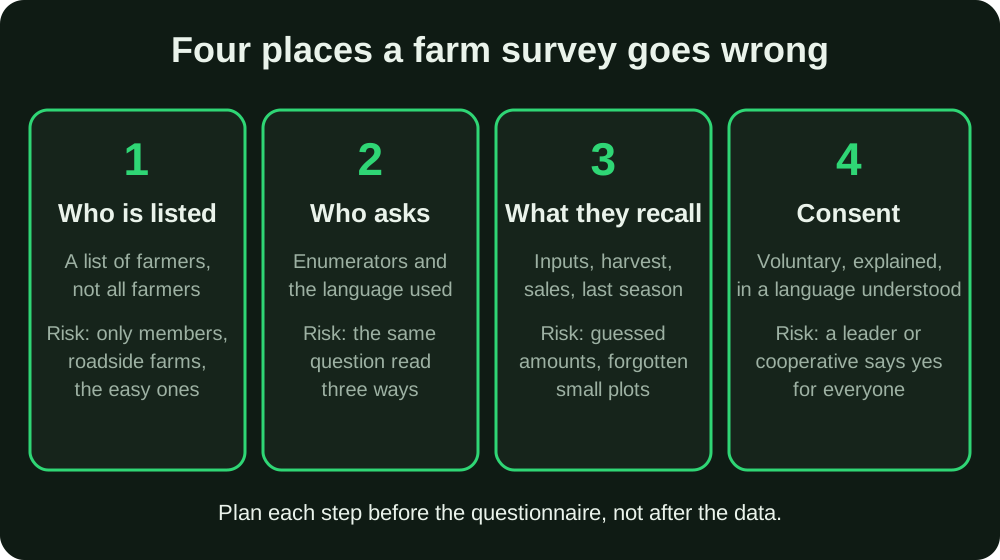
Who is in your list? You need a frame, meaning a list or map from which farmers can be chosen. A cooperative register, an extension office list or a community walk-through each covers some farmers and misses others. Registers often leave out non-members, women who farm under a husband's name and farmers who are not in the village on the day. Say plainly who your frame covers and who it misses. The sampling techniques guide explains the options in plain terms, and the sample size guide is where to start on numbers. Do not copy a sample size from a past project; confirm the approach with your supervisor.
Who asks the questions? If you work alone, you are the enumerator. If friends or course mates help, they need the same briefing: what each question means, how to ask it without leading, and what to do when a farmer does not know. Train them on a short practice round so you catch confusing wording early. A pilot study with a few farmers outside your final sample is the cheapest way to find questions that do not work.
Which language? Many farmers will answer more accurately in Hausa, Yoruba, Igbo, Pidgin or another local language than in English. Write the questionnaire in English if your department requires it, but agree on the local wording of key questions and the units in advance, and have the same person translate the same way each time. If a question can be understood three ways, you will get three kinds of answer in one column.
Which units? Farmers may report in bags, baskets, tubers, paint buckets, tins or plots rather than kilograms and hectares. Record the unit the farmer used, and note the conversion you applied and where it came from. If you converted a "bag" to kilograms, say whose bag, which crop, and that bags differ. An unrecorded conversion quietly corrupts every yield and price you calculate.
What is recall bias and how do I limit it?
Recall bias is the error that comes from asking people to remember past events. Farmers are asked to remember how much seed they bought, how many days hired workers came, how much they harvested and what they sold. The World Bank's guidance on agricultural survey design says that shorter recall reduces recall bias, and recommends, where feasible, two visits in a season rather than one, so people are asked closer to when things happened (World Bank Data Blog). A student project rarely has the budget for a large panel, but the principle carries over.
Practical ways to apply it:
- Ask about the most recent season, not several seasons back.
- Where you can, interview after harvest, close to the events you ask about, and say in the project which season you covered.
- Ask in smaller pieces ("how many bags did you sell at the first sale?") instead of a single total.
- Where a farmer keeps a notebook or receipts, ask to see them and say you did.
- For land area, the same guidance points to measured area (for example with a handheld GPS device) as an alternative to farmer estimates, where equipment and permission allow. If you rely on estimates, say so.
Then state it as a limitation. Your project will be stronger for saying "figures are farmer estimates for the last season" than for pretending they are measurements. The limitations guide shows how to write that honestly.
Which published data can I use for an Agricultural Economics project?
This is where students most often assume. Here is what could be verified for this guide, and what could not. Sources change, so open each one and record the date you retrieved it.
| Source | What was verified | What you must still check |
|---|---|---|
| FAO statistical databases | FAO's terms state that unless a dataset's metadata or page says otherwise, FAO statistical datasets are licensed under CC BY 4.0 with additional terms, so you must credit FAO. | Whether the dataset you use includes third-party data with different terms, and the exact citation FAO requires. |
| World Bank Microdata Library, Nigeria GHS-Panel (2010 to 2019 uniform panel) | Produced by the National Bureau of Statistics with World Bank collaboration, four waves from 2010/11 to 2018/19, nationally representative of about 5,000 households. Users must formally agree to conditions before access, including not trying to identify any household. | Whether you can register, the current terms, whether newer waves are released, and which questionnaire parts are included (this uniform panel covers only the household questionnaire). |
| FAO AGRISurvey page for Nigeria | Lists the National Agricultural Sample Census 2022 and the National Agricultural Sample Survey 2023, with a report and anonymised microdata for the 2023 survey, announced as released on 20 October 2025. | Access conditions at the NBS microdata catalogue, which that page does not state. |
| NBS microdata catalogue | Named by the FAO page as the place where the survey microdata links point. | This guide could not open it when checked, so confirm what is there and under what terms yourself. |
Three honest notes follow from that table.
First, "free to download" is not the same as "free to use however you like." The licence or data-use agreement decides what you can do, and a dataset that asks you to agree to conditions is telling you it is not simply open. Read the agreement before you design your project around it.
Second, published survey data are usually built for national questions. They may not include your crop, your local government area or your exact variable. Before you commit to a topic, open the questionnaire and data dictionary and find the column that holds each variable you need.
Third, how current each source is can change. The FAO page listing the 2023 survey was checked for this guide and gave the October 2025 date above; treat anything newer or older as something you verify the same way. The Federal Ministry of Agriculture and Food Security publishes reports and programme documents, but this guide did not verify an open dataset from it, so do not assume one exists. If your supervisor names a ministry source, open it, record what it is and cite exactly what you used.
The primary and secondary data guide explains what each kind of evidence can and cannot support, and the data collection methods guide helps match your method to your question.
How do I do cost-and-returns and gross margin analysis at a plain level?
Cost-and-returns analysis asks what a farmer spends on an enterprise and what it brings in. The simplest form is a gross margin: gross income minus the variable costs of producing it.
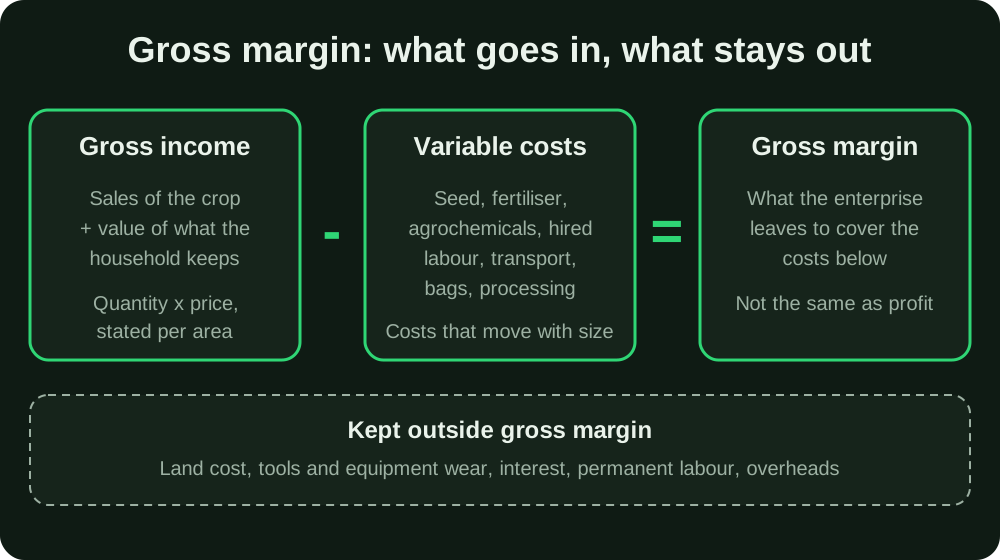
Gross income is the value of output: what was sold, plus the value of whatever the household kept. Variable costs are costs that rise and fall with the size of the enterprise, such as seed, fertiliser, agrochemicals, hired labour and transport. Fixed costs, such as the cost of land, tools and equipment wear, interest and permanent labour, are kept outside a gross margin, which is why a gross margin is not profit. This is the standard meaning used in farm-management teaching, though the exact items you include vary between departments, so confirm your supervisor's expected format.
A fictional planning example
This is an invented exercise. It contains no real data, prices, yields or findings.
A student plans to compare the gross margin of one crop for smallholders in one named community. Before collecting anything, the student fills in this plan:
| Decision | Question to settle | Status in the exercise |
|---|---|---|
| Unit of analysis | One plot, one farmer or one hectare? | Per plot, converted to a stated area unit |
| Gross income | Sold output at what price, and how is kept output valued? | Decide a valuation rule and write it down |
| Variable costs | Which inputs, and is family labour counted? | List each input; decide how family labour is treated and say so |
| Prices | Price at which point of sale, in which season? | Record place, month and unit |
| Missing answers | What if a farmer cannot recall a cost? | Record "not stated", never an estimate |
| Reading the result | What does the number show? | A figure for these farmers and this season, not all farmers |
Notice that no step involves a number. The thinking comes first. Then the student runs the arithmetic using tools the department accepts and checks it by hand on two or three farmers. If you need a test to compare groups or relate two variables, the statistical test guide helps you choose one that fits your data type.
Gross margins are also easy to misuse. A figure from one season in one community is not a general verdict on a crop, and a published budget from another country or year should be used as a rough benchmark, if at all, not copied. Whole-farm analysis, which includes fixed costs, is the way to ask whether an enterprise pays for itself over time, and that may be beyond what your project is expected to do.
How do I study a market without inventing prices?
Market analysis at a plain level starts by describing how a product moves from farmer to buyer. Decide which part of the chain your question is about: farm gate, village or town market, wholesaler, processor. Then decide how you will observe it.
- Price observation: Record the product, the grade, the unit, the market, the date and the price, ideally on more than one market day. Say who gave each price (seller, buyer or your own observation).
- Marketing costs: Ask what a trader or farmer pays to move and sell the product, such as transport, loading, market levies, storage and packaging, and record which were actually paid.
- Margins: A marketing margin is the difference between what is paid at one stage and received at the next. It is a description of a chain, not proof that anyone is being cheated, so do not write it that way.
- Seasonality: Prices often differ between harvest and the lean season. If you only observe one month, say which, and do not describe it as the year.
Be careful with published price series. Open the source, check the unit, the market, the grade and the period, and record when you retrieved it. The Economics guide mentioned earlier has a series register you can copy for any published variable, and the questionnaire design guide helps if your price questions go into a survey.
How do I get access to farmers and cooperatives?
Access is the quiet bottleneck in Agricultural Economics. A good topic fails when no farmer will talk to you.
- Start through your supervisor and department. Ask whether the department has contacts in an extension unit, a farmers' group or a research farm. A letter of introduction from the department, if your department issues one, makes approaches easier.
- Approach the cooperative or association officially. Explain who you are, what the project is about, how long it takes and what you will do with the answers. Ask what they would like back, such as a short summary of the findings.
- Do not treat leaders as stand-ins. A chairman can open a door; he cannot answer for members or consent on their behalf.
- Plan the practicalities. Farm visits depend on transport, rain, market days and farm work. Plan around when farmers are free, not around when your timetable is.
- Have a fallback. If access falls through, a narrower sample or a published-data route may still answer a smaller version of your question. Raise it with your supervisor early rather than at the deadline.
If you cannot get to farmers at all, say so before committing to a survey. A project built on data you cannot collect is the most expensive kind of mistake.
What are the ethics and consent rules for interviewing farmers?
Requirements differ between institutions, so ask your supervisor or department whether you need formal ethics review or a permission letter. Whatever the rule, certain habits apply to everyone you ask:
- Tell each person who you are, what the study is for, what you will ask and how long it takes.
- Make clear that taking part is voluntary and that they can skip a question or stop.
- Explain what happens to their answers and that you will not report them in a way that identifies a person or household.
- Give the explanation in a language they understand. If a participant cannot read, read the consent statement aloud and record that you did.
- Keep names, phone numbers and locations separate from the answers, store them safely and delete them when no longer needed.
- Do not ask for money, land documents or other sensitive details unless the study needs them, and say why if it does.
The research ethics and consent guide covers the principles, and the informed consent form sample shows what a form can look like, which you should adapt to your institution's requirements. Ask a sensitive question only if the study truly needs it, and ask in a way that does not put someone at risk of embarrassment or conflict with their neighbours.
Common mistakes in Agricultural Economics projects
- Choosing the topic from a list and only later discovering no data exist.
- Treating a cooperative register as the whole farming population.
- Mixing units and recording "bag" without saying which bag.
- Presenting farmer estimates as measured values.
- Calling a gross margin "profit."
- Using a national dataset to answer a question about one village.
- Drawing a causal claim ("fertiliser increases income") from a simple comparison of two groups.
- Copying an old project's sample size, price or method instead of justifying your own.
- Leaving ethics and consent until the report is written.
Questions your supervisor or panel may ask
- Why this crop, this place and this period?
- Who was in your sampling frame, and who was not?
- How did you handle language and units?
- How far back did you ask farmers to remember, and what does that do to your figures?
- What is included and excluded in your gross margin?
- Which published source did you use, under what terms, and when did you retrieve it?
- How did you get consent, and what did you do about participants who could not read?
- What would you do differently with more time or money?
Practise answering these from your own records, not from memory. The project defence preparation guide and common defence questions help structure your answers.
A short pre-submission checklist
- Your question names an activity, place, period and one economic idea.
- You can show where each variable came from and the date you retrieved any published data.
- Your frame, enumerators, language and units are described.
- Recall period and its limits are stated.
- Gross margin items are listed and fixed costs are kept separate.
- Consent and access are recorded.
- Every figure in your tables traces back to your data.
- The wording of your findings does not claim more than your design supports.
For your references, the citations tool can help format sources and the references guide explains the rules; follow your department's style.
Sources
Pages opened while preparing this guide. Terms and availability change, so re-check each before relying on it.