
The limitations of the study are the constraints that restrict how far your findings can be generalised, applied or interpreted, caused by your design, data, access or events during the work. They are written in the past tense, usually near the end of the discussion, and each should say what happened, why, and how it affects your claims.
UniDraft organises your confirmed methods, real results, checked sources and supervisor instructions into an editable Word project document, so the limitations you write match what you actually did. Start your project document, then add limitations only from what you really encountered. You supply and verify the facts; the software does not invent constraints for you or run your analysis.
What are the limitations of the study, in plain words?
A limitation is a fair answer to the question: "What could make a reader trust this result less, or apply it less widely, than you hoped?"
The USC Libraries limitations guide defines limitations as constraints on how far findings can be generalised, applied to practice or interpreted, arising from the research design, the methods used to establish validity, or problems that came up unexpectedly. It groups common causes into two families, which is a handy checklist:
- Methodological: a small or unrepresentative sample, missing or unreliable data, a flawed instrument, or reliance on self-reported answers, which can suffer from memory error and exaggeration.
- Researcher-related: denied or restricted access to people or documents, limited time, personal or cultural bias, or language barriers.
Notice what is not on that list: results you did not like. The same guide says negative or unexpected results are findings that need interpreting, not limitations. If your hypothesis failed, say so in your results and discussion, and see our guide to writing the discussion and conclusion for how to handle it.
Scope vs delimitations vs limitations: what is the difference?
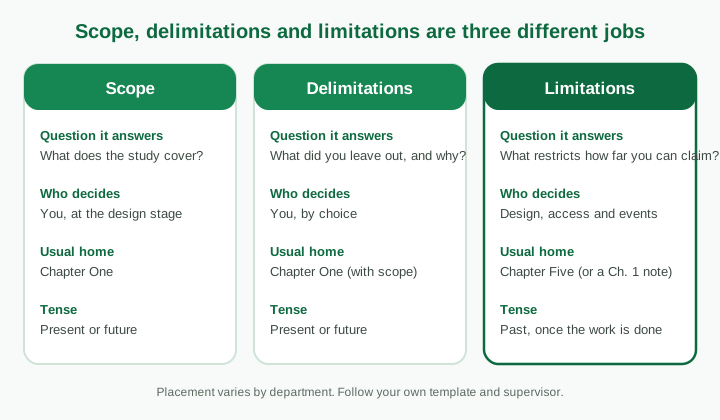
Students often write one paragraph titled "Scope and Limitations" that mixes all three ideas. Keep them apart in your head first, even if your department template merges the headings.
| Term | Plain meaning | Fictional example |
|---|---|---|
| Scope | What the study covers | "This study covers undergraduate students in one faculty during the 2025/2026 session." |
| Delimitation | A deliberate boundary and the reason for it | "Postgraduate students were excluded because their study patterns differ and the sample would have been too thin." |
| Limitation | A constraint on what the findings can tell you | "Only students who were on campus during the survey week responded, so the results may not describe students who were away." |
The USC introduction guide explains delimitations as the characteristics that limit the research and set its boundaries, arising from your choices about what to include and exclude. It adds that you should say why alternatives were set aside, for example because they were less relevant or not feasible. The same page contrasts them with limitations: delimitations are set at the design stage, limitations are weaknesses identified after the research is finished, and delimitations are not admissions of failure.
For the Chapter One side of this (background, objectives, scope and definition of terms), read the Chapter One guide. This post concentrates on the limitations half and how it connects back to the boundaries you set.
One boundary can create both
The categories overlap in real projects. Choosing one faculty is a delimitation. The consequence, that you cannot speak for other faculties, is a limitation on your claims. Write the choice and its reason in Chapter One, then in Chapter Five state the consequence for generalisation. That is two sentences doing two jobs, not repetition.
The common mistakes run both ways:
- Presenting a deliberate boundary as a flaw ("Unfortunately the study was limited to one school"). It makes a sound decision look like an unfixed problem.
- Presenting a real constraint as a boundary ("The study is delimited to 38 respondents"), when you wanted 60 and could not reach them. Be honest about which was your choice and which was forced on you.
Where do limitations go: Chapter One or Chapter Five?
Both, in different forms, though practice varies and your template decides.
- Chapter One: the scope and delimitations (what you cover and deliberately exclude). Many Nigerian templates also include a short "limitations of the study" heading here. When it appears in Chapter One you are writing before the data exist, so it can only name anticipated constraints, such as restricted access to a facility or a short data-collection window. Say they are anticipated.
- Chapter Five (or the end of the discussion): the real limitations, now written in the past tense after the work is complete. The USC discussion guide places limitations near the end of the discussion, just before the closing summary of implications, and advises being candid and self-critical without sounding apologetic.
- Defence: examiners often ask what you would do differently or how far the findings generalise. Your limitations paragraph is the prepared answer. See common defence questions and how to answer them.
If your Chapter One heading says "Limitations" and your Chapter Five says nothing, a reader will wonder whether anything was learned. If Chapter Five lists problems that Chapter One never anticipated, that is fine and normal; just do not claim you foresaw them. Where the project is staged through a proposal first, the proposal guide shows what belongs at that earlier point.
How do you write limitations honestly without undermining the work?
Honesty and strength are not opposites. A reader trusts a project more when its author knows exactly where the evidence stops.
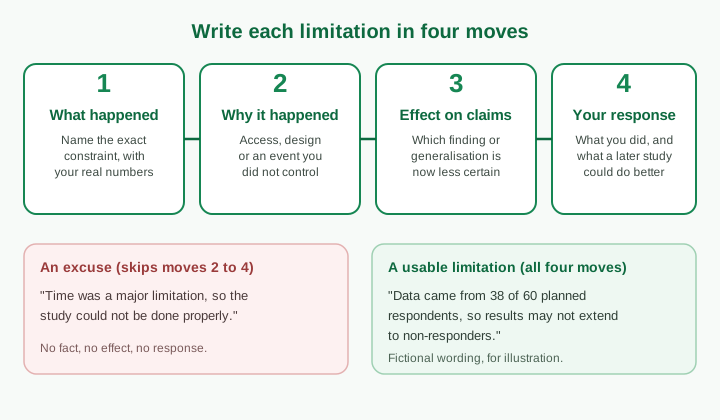
Use four moves for each limitation:
- What happened. Name the exact constraint, with your real numbers. "38 of 60 planned questionnaires were returned usable."
- Why it happened. Access, design or an event you did not control. Keep it factual, not emotional.
- What it does to your claims. Say which finding or generalisation is now less certain. This is the move students skip, and it is the one that matters, because USC's guide stresses explaining how each limitation may have affected results rather than merely listing it.
- What you did, and what a later study could do. Describe any step you actually took. Do not claim a remedy you did not use. Connecting to future research is fine, but the USC discussion guide warns against recommending fixes you could easily have made inside this study, because that suggests the data were not examined thoroughly.
Then calibrate the tone. Assess how much each limitation matters. A small mismatch in sample age does not deserve a page. A response rate so low that a main objective cannot be answered deserves honest weight, and perhaps a conversation with your supervisor before submission, because USC notes that serious limitations can mean the study design needs revisiting rather than apologising for.
Weak vs strong: fictional examples
All of these are invented for illustration. Replace them with your own facts.
Example 1: sample
- Weak: "The sample size was small, which limited the study."
- Strong: "Usable responses came from 38 of the 60 students approached, because several were away on industrial placement during the survey week. The findings therefore describe the students who responded, and may differ for students who were away. Because respondents were not randomly chosen, the results are treated as indicative for this group rather than generalised to the faculty."
Example 2: self-reported data
- Weak: "Respondents may not have been truthful."
- Strong: "Study hours were self-reported, so figures may be affected by memory error or by respondents giving answers they considered acceptable. Asking about the past seven days rather than the whole semester was meant to reduce this, but the figures remain estimates and not recorded measurements."
Example 3: access
- Weak: "The researcher faced difficulty getting information from the office."
- Strong: "The administrative office provided enrolment totals but not individual records, so the analysis could not compare results by entry year. Conclusions about differences between cohorts are therefore not made."
Example 4: a delimitation misfiled as a limitation
- Weak: "A limitation is that the study only covered the 2025/2026 session."
- Better: Move it to Chapter One as a delimitation with its reason ("one session was chosen because the records before it use a different format"). Then, in Chapter Five, add the consequence as a limitation: "Trends across several sessions cannot be inferred."
Notice that each strong version is longer than the weak one, but only by the facts a reader needs. Three of these four also quietly shape what you may conclude, which links straight to your conclusions section.
The biggest mistake: listing excuses
An excuse list sounds like this: "The researcher faced many challenges including inadequate funds, time constraints, difficulty in getting respondents, epileptic power supply and lack of cooperation from the school." It is common in project write-ups, and it fails for four reasons:
- It is generic. The same list could be pasted into any project, so it tells the examiner nothing about yours.
- It shifts blame. It reads as "this would have been better if conditions were better", which invites the question of why the design was not planned for the conditions.
- It does not affect the claims. If you cannot say what changed in your findings, it is a complaint, not a limitation.
- It pads. Longer lists dilute the one or two limitations that really do matter.
Run each candidate limitation through this filter:
| Question | If the answer is no |
|---|---|
| Is it true of this study, with a specific fact? | Delete or make it specific |
| Does it affect how your research questions can be answered? | Delete it |
| Can you state the consequence for a claim? | Rewrite until you can |
| Is it a choice you made on purpose? | Move to delimitations in Chapter One |
| Is it just an unexpected result? | Move to the discussion of findings |
Also remember USC's warning against discussing limitations unrelated to your stated problem or apologising for things you never promised to address. "Lack of previous studies" is a good example: confirm with your librarian or supervisor that the literature really is thin before you claim it. A quick check using the method in how to find research papers often shows the gap was in the search, not the field.
Which limitations are typical for different kinds of projects?
These are prompts for reflection, not a menu to copy from. Only keep those that happened.
| Project type | Constraints worth checking | What to say about the effect |
|---|---|---|
| Questionnaire survey | Response rate, non-random selection, self-report, an instrument that was not pre-tested | Which groups may be under-represented and how far results can generalise. Ideas for checking an instrument are in validity and reliability |
| Interviews or focus groups | Small purposive group, one location, researcher interpretation | Findings give depth for these participants but are not meant to represent a population |
| Case study | One organisation or site | Insight is specific to the case; see case study research for what such designs can and cannot claim |
| Software or engineering build | Tested on limited devices, data or users; no long-term trial | Which conditions the system was verified under and which it was not |
| Laboratory or field work | Equipment access, replicate numbers, short observation period, uncontrolled conditions | Which results are preliminary and how confident the readings are |
| Secondary data or records | Gaps, changes in how records were kept, data you did not collect | What the data cannot show, since you did not control how they were gathered |
For sampling-related limitations in particular, the principle is to state how the sample was drawn and what that means for generalising. Confirm any sample-size expectations with your supervisor rather than quoting a rule from the internet; our posts on sampling techniques and calculating sample size explain the reasoning.
A fictional worked example, start to finish
Imagine a study of how Year 3 students in one faculty use library databases. Facts below are invented.
Chapter One, scope and delimitations
This study covers Year 3 undergraduate students in one faculty during the second semester of the 2025/2026 session. Year 1 and Year 2 students were excluded because they have not yet been taught database search methods. Postgraduate students were excluded to keep the group comparable.
Chapter Five, limitations
Three limitations affect how these findings should be read. First, 38 of the 60 students approached returned usable questionnaires, partly because the survey week overlapped with practicals. Non-respondents may differ from respondents, so the results describe the responding group and are not generalised to the whole faculty. Second, database use was self-reported over the past month, so the figures may reflect memory error and are treated as estimates. Third, the library could provide total login counts but not individual records, so reported use could not be checked against system data. A later study could request anonymised logs in advance and use a longer data-collection window.
What makes it work: every sentence has a fact, a consequence for a claim, and a response that matches what was actually done. The scope paragraph and the limitations paragraph agree with each other. No excuses, no apologies, no inflated conclusion.
Checklist before you submit
- Scope and delimitations (Chapter One) give boundaries and reasons.
- Limitations (Chapter Five) are in the past tense and specific to your study.
- Each limitation says what happened, why, the effect on claims and your response.
- No deliberate choice is presented as a failure, and no forced constraint is dressed up as a choice.
- No limitation is an unexpected result in disguise.
- Your conclusions and recommendations do not claim more than the limitations allow. Check this against your statement of the problem and objectives, so you are not answering a question you narrowed away.
- Wording matches your department template, heading names and any supervisor comments. Format headings and page numbers with the formatting tool once the text is final.
How UniDraft fits in
UniDraft keeps your confirmed project details together: objectives, scope, methods, results, checked sources and your supervisor's instructions. When you draft Chapter Five, the limitations you write sit beside what you actually recorded, which makes it easier to spot a limitation that contradicts your own scope paragraph. The result is an editable Word document you review and correct yourself. UniDraft does not run your analysis, invent constraints, guarantee a grade or promise supervisor approval. Start your project document when your facts are ready.
Sources
- USC Libraries: Limitations of the Study: definition, types, past tense, and what to avoid.
- USC Libraries: The Introduction: delimitations as design-stage boundaries and how they differ from limitations.
- USC Libraries: The Discussion: placement and tone of limitations near the end of the discussion.
These are general academic-writing guides, not a Nigerian chapter template. Your department's project handbook and supervisor decide headings, placement and length.