
An experimental research design deliberately changes one thing (the treatment) and measures what happens to an outcome, ideally by comparing a group that receives the treatment with one that does not. In a true experiment, chance decides who is in which group. In a quasi-experiment, groups are formed some other way. Both need a clear comparison, a planned measurement and honest limits.
If experimental work is the core of your project, your methodology chapter has to show exactly what you changed, who or what received it, and how you measured the result. UniDraft organises the design decisions, results and supervisor instructions that you confirm into an editable Word document. Start your project document with UniDraft; it does not run your experiment, your calculations or your statistics for you.
What counts as an experiment, and what does not?
Three ingredients define the classic experiment, as described in the USC Libraries guide to research designs: control over the situation, randomisation (random assignment to groups) and manipulation of the independent variable. A study that only measures two things as they naturally occur is not an experiment, however many numbers it produces.
Here is a quick test. If you did not change anything, you did not run an experiment.
| What you did | Experimental? |
|---|---|
| Gave students a new revision method and measured scores afterwards | Yes, if you chose who received it and measured the outcome (quality depends on the rest of the design) |
| Surveyed students on study hours and recorded their grades | No, this is correlational: both variables were only measured |
| Fed two groups of birds different diets and weighed them | Yes, you manipulated the diet |
| Compared last year's results with this year's after a policy change you did not control | Not an experiment. Possibly a comparison of existing records |
| Built a mobile app and tested whether it meets listed requirements | Usually a development-and-evaluation design, not a true experiment |
If your project is the last kind, the research design chooser explains how to separate building from evaluating. The rest of this post assumes you really are changing something and measuring an outcome.
True experiment vs quasi-experiment: how do they differ?
The line between them is how people (or plots, samples, animals) end up in each group.
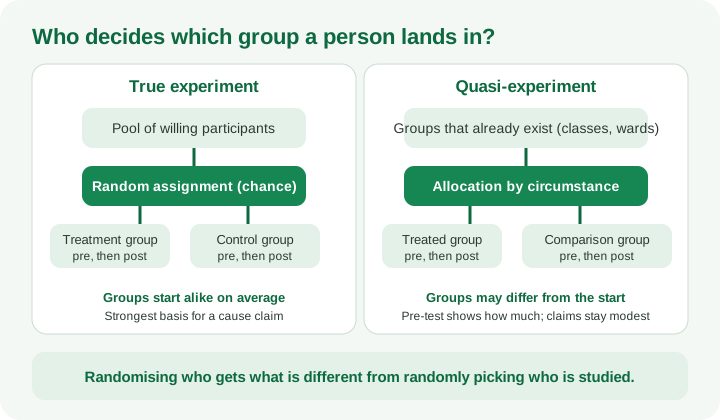
True experiment. You take your participants and let chance (a lottery, random-number list or similar) decide who gets the treatment. Because chance does the sorting, the groups should be alike on average, including in ways you never thought to measure. That is why this design gives the strongest basis for saying the treatment caused the difference.
Quasi-experiment. You still introduce a treatment and measure an outcome, but you cannot assign people by chance. Typically you use groups that already exist, such as two intact classes, two wards or two farms. The open textbook chapter on quasi-experimental research describes this as common in field settings such as education, where random assignment is hard or impossible, and notes that internal validity then sits between correlational studies and true experiments.
For most undergraduates, the quasi-experiment is the realistic one. Schools will not let you reshuffle classes, and a ward manager will not let you reassign patients. That is not a failure. It just changes what you can claim.
Two terms students confuse:
- Random sampling is how you pick participants from a wider population. It affects how far you can generalise.
- Random assignment is how you allocate the participants you have to conditions. It is what makes an experiment "true".
You can have one without the other. A convenience sample of 40 students, randomly split into two groups, still has random assignment. Be clear in your write-up about which one you did. The sampling techniques guide covers the selection side.
What is a control group, and what is a comparison group?
A control group gets no treatment, or the usual treatment, under conditions as similar as possible to the treatment group. A comparison group is the quasi-experimental version: a group that is not treated, but was not formed by chance, so it is compared rather than strictly "controlled".
Why bother? Without a group to compare, you cannot tell whether a change would have happened anyway. Plants grow with or without your fertiliser. Students improve between first and second term with or without your teaching method.
Practical points to settle with your supervisor:
- What does the control group receive? Nothing, the normal routine, or a different but harmless alternative? "Normal teaching" is a common and ethical choice in education studies.
- Is withholding the treatment acceptable? If the treatment is likely to help, consider offering it to the comparison group after the study ends.
- Can the groups contaminate each other? If treated and untreated students sit in the same hostel, ideas may spread. This is called diffusion, one of the threats listed in the internal validity overview.
How do pre-tests and post-tests work?
A pre-test measures the outcome before the treatment; a post-test measures it afterwards. Together they let you see change rather than just a final score.
The strongest simple arrangement for most undergraduates is a pre-test/post-test design with a comparison group:
- Measure both groups before anything is done (pre-test).
- Apply the treatment to one group only.
- Measure both groups again, with the same instrument or an equivalent form (post-test).
- Compare the change in the treated group with the change in the comparison group.
The pre-test does two jobs. It shows whether the groups started in a similar place, which matters hugely in a quasi-experiment. And it lets you look at change instead of raw final scores. If your groups were not alike at the start, say so openly and discuss it in your limitations.
A design with only one group and a before-and-after measurement is weaker. If scores rise, you cannot separate the effect of your treatment from everything else that happened in the same period. The Lumen chapter lists history, maturation and regression to the mean as typical rival explanations for such a design.
What can go wrong? Threats to validity in plain language
Internal validity asks whether the change you saw was really caused by your treatment. Threats to it are the rival explanations a defence panel will raise. Wikipedia's overview of internal validity lists many; these are the ones most likely to matter in a student project.
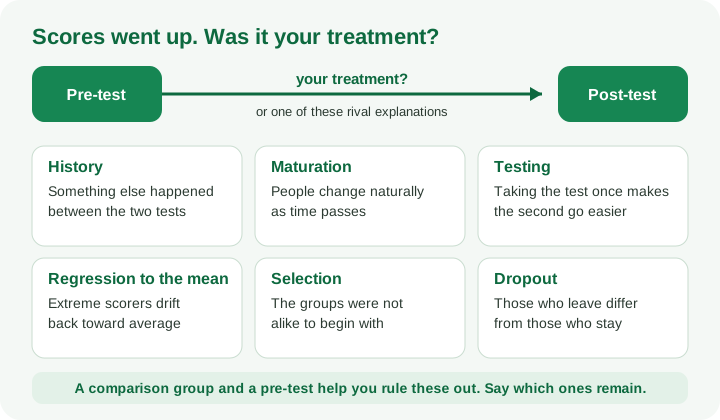
| Threat | Plain meaning | A way to reduce it |
|---|---|---|
| History | Something else happened between pre-test and post-test (a strike, an exam, a new rule) | A comparison group living through the same events |
| Maturation | People change naturally with time | A comparison group of similar age and stage |
| Testing | Doing the test once makes the second attempt easier | A comparison group, or a different but equivalent post-test form |
| Instrumentation | The measuring tool or the person scoring changes | Same instrument, same scoring rules, scorer who does not know the group |
| Regression to the mean | People picked because of extreme scores tend to score closer to average next time | Avoid picking participants only for extreme scores, or use a comparison group |
| Selection | The groups differed from the start | Random assignment if possible; otherwise a pre-test and honest reporting |
| Dropout (attrition) | Those who leave differ from those who stay | Record who left and why; compare leavers with stayers |
| Experimenter bias | You unintentionally treat groups differently | Written procedure applied identically; someone else scores if possible |
External validity is the separate question of whether the result applies beyond your setting. A neat experiment in one JSS2 class in one school does not automatically describe all schools. State the setting and avoid sweeping conclusions.
Do not claim that you "eliminated" these threats. Say which you addressed, how, and which remain. A short, honest limitations paragraph is a strength in a defence.
Which hypotheses fit an experimental design?
Experiments suit questions of the form "does X change Y?", so your objectives and hypotheses should be about a difference or an effect, not simply a relationship. If you are unsure how to phrase these, use the hypothesis-writing guide. Write the null and alternative hypotheses before collecting data, then choose the analysis. The statistical test guide is a checklist for discussing that choice with your supervisor; it will not decide for you.
Avoid causal verbs unless the design supports them. In a quasi-experiment, "was associated with a greater improvement" is usually safer than "caused".
What ethics apply when people or animals are involved?
Experiments are more ethically sensitive than surveys because you do something to participants. Treat these as questions to settle before you start, not paperwork afterwards:
- Review and approval. Ask your supervisor or department what review your project needs before recruiting anyone. Do not assume a small student project is exempt. The research ethics and consent checklist walks through permissions, consent and data handling.
- Voluntary, informed participation. People should know what will be done, what is expected of them and that they may withdraw. Pupils and other people in dependent relationships need extra care and the right permissions (for example from school authorities and guardians); confirm the requirement locally.
- Harm and benefit. Do not use a treatment that could reasonably harm participants. If the treatment is beneficial, think about whether the comparison group can receive it afterwards.
- Animals. If you are using animals, the University of Ibadan's animal ethics committee page states that approval is compulsory before any researcher there starts using animals in research, and says the committee is registered under Nigeria's national health research ethics code (ACUREC). Other institutions arrange this differently, so ask your own department who reviews animal work.
- Records. Keep raw pre- and post-test sheets, consent records and group lists safely. Do not put names or identifiers in your appendix. See the data management plan guide for ideas.
What can an undergraduate realistically run?
Be honest about scale. A realistic undergraduate experiment is small, short and tightly defined. Examples of the right size:
- Education: two intact classes, one taught a topic with a new method for a few weeks, both given the same pre-test and post-test.
- Agriculture: plots or pots receiving different treatments in a layout your supervisor approves, with a clear control plot.
- Laboratory sciences and microbiology: a controlled bench comparison, with a control, using materials the department can supply and safely dispose of.
- Psychology or behavioural work: a brief task completed under two conditions, with participants allocated by chance, if approved.
- Computing: a comparison of two versions of an interface or procedure with a small set of consenting users and a measurable outcome such as task time, run as a controlled comparison.
Things that usually are too big: long-term follow-ups, anything medical, treatments you cannot reverse, and designs needing equipment or access your department does not have. Do a feasibility check before you commit. The pilot study guide shows how to try out the procedure on a small scale first, with permission, so the main study does not fail on a practical detail.
On sample size: no honest number can be given without knowing your design, outcome and analysis. The sample size guide explains the principles; confirm what your supervisor and department expect.
A fictional worked design
This example is invented for illustration. No such study, school, data or result exists, and it should not be cited as evidence.
Question: Does a short weekly practice-quiz routine improve scores in a basic science topic compared with the usual teaching alone?
Design: Quasi-experimental, non-equivalent groups, pre-test/post-test.
| Element | Plan |
|---|---|
| Groups | Two intact JSS2 classes in one school: Class A (treatment), Class B (comparison). Allocation by which class the school can spare, not by chance |
| Treatment | Class A takes a short practice quiz at the end of each weekly lesson for four weeks. Class B gets the same lessons without quizzes |
| What is kept the same | Same teacher, same syllabus, same lesson time, same textbook |
| Pre-test | Same topic test for both classes in week 0, marked with one marking scheme |
| Post-test | Equivalent topic test in week 5, marked by the same scheme, marker unaware of class if practicable |
| Hypotheses | H0: no difference in score improvement between classes. H1: Class A improves more |
| Analysis | Compare change between pre and post across the two groups, with a test chosen with the supervisor |
| Ethics | School authority and teacher permission, guardian and pupil consent as required locally, no names in the dataset, Class B offered the quizzes afterwards |
Threats named in advance:
- Selection: the classes may differ. The pre-test shows how much, and the limitation is stated.
- History: a class test elsewhere in the school could affect scores. Both classes share the same period.
- Testing: both classes take the pre-test, so familiarity affects both.
- Teacher effect: one teacher for both classes reduces but does not remove differences in how enthusiastically each class is taught.
- Dropout: absentees are recorded and their pre-test scores compared with stayers.
What the write-up could honestly claim: if Class A improved more, the result is consistent with the quizzes helping in that school over that period. It would not prove the method works for all pupils everywhere.
Use this as a shape, not a script. Your design must come from your own question, setting and approval. The free formatting checker can later help you check the layout of tables like the one above in your final document.
Mistakes supervisors and panels commonly question
- Calling a survey or a one-time measurement an "experiment".
- Using a treatment group with no comparison and claiming the treatment worked.
- Confusing random sampling with random assignment.
- Not saying how groups were formed.
- Changing the pre-test and post-test so they are not comparable, without explaining.
- Reporting only the groups that finished, ignoring dropouts.
- Writing "caused" for a design that cannot support it.
- Starting the treatment before ethics or permission was settled.
Questions you may face at the defence
- Why did you choose an experiment (or quasi-experiment) for this question?
- How were participants assigned to groups, and why not by chance?
- What did the control or comparison group receive?
- Were the groups similar at the start? How do you know?
- What could explain your result besides the treatment?
- How did you keep the pre-test and post-test comparable?
- What ethics approval and consent did you obtain?
Prepare short, plain answers for each, and have your methodology chapter say the same thing. If the panel's questions get hard, the defence questions guide helps with the approach.
Pulling it into your project document
Once your design is approved and the data are collected, the written project must describe what you actually did, not what you planned. UniDraft helps organise your confirmed design, results and your supervisor's formatting instructions into an editable Word project document you can still revise. Start your project document when your methods and findings are ready. You still run the experiment and the analysis yourself.
Sources
- USC Libraries: Research Designs (definition of experimental design: control, randomisation, manipulation; strengths and weaknesses)
- Research Methods in Psychology: Quasi-Experimental Research (non-equivalent groups, pretest-posttest designs and their rival explanations)
- Wikipedia: Internal validity (list of threats to internal validity)
- University of Ibadan ACUREC (animal research ethics approval requirement at that institution; not a rule for every university)