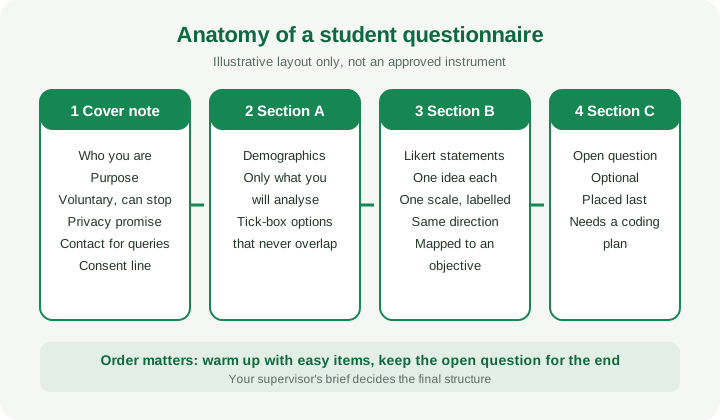
A questionnaire sample is useful as a pattern, not as content to copy. A complete student questionnaire usually has four parts: a cover note with a consent line, demographic items, grouped scale statements mapped to your objectives, and an optional open question. The fictional layout below shows each part and why it is there.
UniDraft organises your confirmed methods, instrument details and real findings into an editable Word project document once you have them. It does not write your items, collect responses or run your analysis, so the questionnaire itself has to be yours. Use the sample below to see the shape, then build the real thing from your own objectives.
Read this first: what this sample is and is not
Everything below is illustrative and fictional. The "Example University", the topic, the wording and the options were invented for teaching. It is not an approved instrument, it has not been validated or piloted, and no supervisor or ethics committee has endorsed it. Do not paste it into your project. The aim is to show how the parts fit together so you can design your own. The design logic (objectives first, scale choices, sample size, pilots) lives in how to design a questionnaire for your final year project; this page is the worked layout, with annotations.
The fictional study: a student asks how undergraduates at an imaginary campus use the campus Wi-Fi for study. The made-up objectives are:
- Describe how often students use campus Wi-Fi for study.
- Assess how adequate students find it.
- Compare responses by level of study.
If your own objectives are still loose, fix them first with how to write research questions and objectives, because every item below depends on them.
The sample layout, part by part
Part 1: Cover note and consent line
Study on campus Wi-Fi and study habits (illustrative sample)
I am a final-year student in the Department of Example Studies at Example University. This questionnaire is part of my final year project, supervised by a lecturer in my department. It asks how you use campus Wi-Fi for study and how adequate you find it.
Taking part is voluntary. You may skip any question and stop at any time without any consequence. This form does not ask for your name, matric number or phone number. Your answers will be combined with those of other respondents, used only for this project and kept secure. It takes a few minutes to complete.
If you have questions, contact me at [your university email] or my supervisor at [supervisor contact].
By continuing to answer the questions below, you confirm that you have read this note and agree to take part. (Tick to confirm: [ ] I agree)
Why it is there. University guidance on surveys points the same way. The University of Kentucky's survey-research page says participation must be voluntary and must allow the respondent to skip questions or discontinue, and MIT's COUHES guidance says the introduction should state the purpose, voluntariness, the right to skip or stop, and the confidentiality or anonymity protections. That is what the note above does, in plain language.
How to adapt it.
- Replace every placeholder with your real details. Never invent a supervisor contact or an approval.
- Say what you actually do with the data. If you cannot promise the form is anonymous (for example, an online form that records email addresses), do not claim it. Anonymous, confidential and private are different promises, so describe only what is true. The research ethics and consent checklist separates these.
- Ask your supervisor whether your department requires a formal ethics or approval step, or a specific consent template. Institutional wording beats this sample every time.
- Keep it short. A cover note that runs to a page of legal language loses respondents before question one.
What sinks it. Claiming "approved by the university" when it is not, asking for a name in a form you call anonymous, or burying the voluntary statement at the bottom.
Part 2: Section A, demographics
Section A: About you (tick one answer per question)
A1. What is your level of study? [ ] 100 level [ ] 200 level [ ] 300 level [ ] 400 level [ ] 500 level [ ] Other (please specify): ______
A2. How would you describe where you live during the semester? [ ] On campus (hostel) [ ] Off campus [ ] Other (please specify): ______
A3. How many hours of study do you do online in a typical week? [ ] Fewer than 5 hours [ ] 5 to 10 hours [ ] 11 to 20 hours [ ] More than 20 hours
Why it is there. Demographic items let you describe the sample and make comparisons such as objective 3 (compare by level). Here, A1 answers objective 3 without needing new scale items.
How to adapt it.
- Include only variables you will use in Chapter 4. Every extra personal question adds privacy exposure and gives respondents a reason to drop out.
- Make options mutually exclusive and complete. A3 uses bands that do not overlap (5 to 10, then 11 to 20). Writing 5 to 10 and 10 to 15 would leave someone with two valid answers.
- Add "Other (please specify)" when your list may be incomplete, as A1 and A2 do.
- Prefer ranges for sensitive numbers rather than exact values. The CASRAI questionnaire guidance notes each respondent should have exactly one fitting option.
What sinks it. Overlapping bands, missing options (no choice for a respondent who is part-time), and collecting data you never analyse, which an examiner will notice.
Part 3: Section B, Likert statements
Section B: Your views on campus Wi-Fi for study For each statement, tick the option that best matches your view.
Statement Strongly disagree Disagree Neutral Agree Strongly agree B1. The campus Wi-Fi connects reliably when I need it for study. 1 2 3 4 5 B2. The campus Wi-Fi is fast enough for the study tasks I do. 1 2 3 4 5 B3. I can find a place on campus with a usable Wi-Fi signal. 1 2 3 4 5 B4. I rely on campus Wi-Fi for my coursework. 1 2 3 4 5 B5. I know how to report a Wi-Fi problem to the university. 1 2 3 4 5
Why it is there. An agreement scale with ordered, labelled categories is a common way to gather attitudes and perceptions across many respondents. In this sample B1 to B3 serve objective 2 (adequacy) and B4 feeds objective 1 (how much students depend on it). B5 is a deliberately weak item: ask yourself which objective it serves. If you cannot answer, cut it, which is exactly what the objective-to-item map is for.
How to adapt it.
- One idea per statement. "The Wi-Fi is fast and reliable" would be double-barrelled; B1 and B2 split it. CASRAI's guide flags double-barrelled, leading and loaded items as the main wording traps.
- Keep the scale, labels and direction identical across the section. CASRAI's guidance recommends balanced positive and negative categories and labelling every point where you plan composite scores. Do not switch to a satisfaction scale halfway down.
- Decide on the neutral option deliberately. Sources treat the midpoint as a context-dependent trade-off, not a fixed rule: it can suit topics where many people have no strong opinion, and some researchers omit it where respondents might hide in it. Say which you chose and why in your methodology. Your department may have a convention, so ask.
- Decide the coding before distribution. Here 5 means strongest agreement. If you include any reverse-worded statements, decide how you will reverse-score them. Write this down so the coding and cleaning guide can turn it into a codebook later.
- Do not treat the numbers as proof. Whether to report category counts, scale means or a test is a design decision. See which statistical test fits your project and confirm with your supervisor.
- Frequency items need defined anchors. If you ask how often someone uses the Wi-Fi, "often" means different things to different people. CASRAI advises anchoring to a set recall period or numeric bands, for example "in the last seven days".
A frequency item in the same style (for objective 1):
B6. In the last seven days, on how many days did you use campus Wi-Fi for study? [ ] 0 days [ ] 1 to 2 days [ ] 3 to 4 days [ ] 5 to 7 days
What sinks it. Statements that hide two issues, scales that change direction, or a long block of near-identical items that tire respondents into ticking the same column.
Part 4: Section C, the open question
Section C: Anything to add? (optional) C1. Is there anything about campus Wi-Fi that affects how you study that this form did not ask? Please write briefly.
Why it is there. An open question lets respondents raise something your fixed options missed, and gives you quotable context for the discussion. It sits last and is optional so that it does not interrupt the flow or cause abandonment.
How to adapt it.
- Only include it if you will analyse it. Open text needs manual coding or thematic grouping, which takes time. A single optional item is a common compromise, but there is no universal limit; your design and supervisor decide.
- Add a line telling respondents not to include names or identifying details, since free text can reveal who wrote it.
- Plan how you will report it: themes, counts of themes, and a few short illustrative quotes. Never invent quotes to fill a table.
What sinks it. Making it compulsory, asking for a long essay, or collecting 200 comments and never reading them.
Before-and-after: fixing weak items
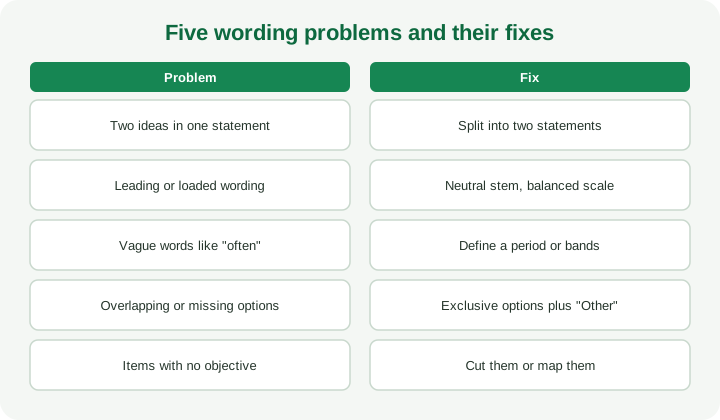
| Weak item | Problem | Better version |
|---|---|---|
| "Campus Wi-Fi is fast and always available." | Two ideas in one statement | Split into one statement about speed and one about availability |
| "Don't you agree the university has neglected Wi-Fi?" | Leading and loaded | "The university maintains the campus Wi-Fi to a standard I find adequate." |
| "How often do you study online? Rarely / Sometimes / Often" | Vague labels | "In the last seven days, on how many days...?" with bands |
| Age: 18-22, 22-27 | Overlapping bands | 18-22, 23-27 |
| "I am satisfied with Wi-Fi" on a scale mixed with agree/disagree items | Inconsistent scale | Keep one agreement scale per section |
These problems are common because they feel natural when you are writing quickly. The fix is a slow second read, with someone outside your course, asking "what would I tick if I disagreed with half of this sentence?"
Mistakes that sink questionnaires
- Copying another project's questionnaire. Its items answered a different study. They will not map to your objectives, and an examiner can tell.
- No link to objectives. If you cannot point from each item to an objective, you are collecting data for no reason.
- Skipping the pilot. Five or so people who resemble your respondents, completing it while you watch, will find problems you cannot see. The validity and reliability guide covers expert review, piloting and when a reliability statistic is expected.
- Claiming approval you do not have. Never put an approval line, supervisor name or ethics reference on the form unless it is real.
- A cover note that over-promises. Do not say "completely anonymous" if you record emails or IP addresses.
- Wrong sample for the claim. A survey of friends does not represent a whole faculty. State honestly who you reached. The sizing logic is in how to calculate sample size for a final year project, and your supervisor decides the method.
- Treating blank as neutral. A skipped item is missing, not "neutral". Plan this before analysis.
- Changing the instrument mid-collection. If you edit wording after some responses arrive, you now have two instruments. Record any change and tell your supervisor.
How to turn this sample into your own questionnaire
- Write your objectives (or hypotheses) and make an objective-to-variable-to-item table.
- Draft a cover note using your real details and your institution's required wording.
- List demographics you will actually analyse; cut the rest.
- Write one idea per statement, grouped by objective, with one consistent scale per section.
- Decide the coding, the midpoint and any reverse-scored items, and write them in a draft codebook.
- Add at most the open question you can analyse.
- Get your supervisor to review it, then pilot it with people like your respondents.
- Revise, record what changed, and only then distribute. If you build it online, follow the access, privacy and export checks in the Google Forms guide.
What goes in your project document
Your methodology should describe the instrument you actually used: its sections, scale and coding, how you checked it, and who you sent it to. The full questionnaire usually goes in the appendices. Writing your methodology chapter explains how to describe it, and the results chapter guide shows how responses become tables.
Where UniDraft fits in
UniDraft does not design or distribute your questionnaire and never invents respondents, scores or quotes. It organises the instrument details, methods, checked sources and real findings you confirm, together with your supervisor's instructions, into an editable Word document. You stay responsible for the questionnaire, the data collection and the analysis. Start your project document when your instrument and results are ready, and check your .docx against your school's rules with the free formatting checker before submission.
Sources
- Survey Research, University of Kentucky Office of Research Integrity: voluntary participation, skipping questions, discontinuing.
- Surveys, Questionnaires and Interviews, MIT COUHES: what to tell participants and confidentiality or anonymity statements.
- Questionnaire design, CASRAI: double-barrelled, leading and loaded items, balanced response options, midpoint trade-offs, pretesting.