Choose a marketing project topic by deciding who you can reach, what you can measure and which claim your evidence can support. A strong topic names a specific group, firm or platform, a construct you can define, and a method your department accepts. A broad title about "impact" is not a plan.
UniDraft's free topic generator can give you a starting shortlist. Test each suggestion against the checks below before taking it to your supervisor.
Once your supervisor agrees a topic, UniDraft organises your confirmed marketing question, your own analysis, checked sources and supervisor instructions into an editable Word project document. Start your project document with your own evidence; you still collect the data and review every claim yourself.
Everything here is a planning method, not a list of approved titles. Departments differ on what counts as acceptable, so the brief from your supervisor and department always comes first.
What are the main routes for a marketing project?
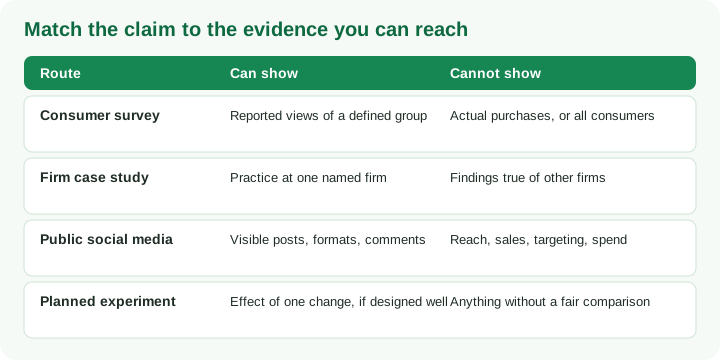
Most marketing projects follow one of four evidence routes. The route decides what you can honestly conclude, so pick it before you pick words for the title.
| Route | What you need | Limit to keep visible |
|---|---|---|
| Consumer survey | A defined group, a questionnaire, a sampling plan | Reported opinions are not recorded behaviour |
| Case study of a firm | Permission, a contact, documents or interviews | One firm cannot speak for an industry |
| Public social media study | Open accounts and a clear coding rule | You cannot see reach, sales or spend |
| Planned experiment | A fair comparison and ethical approval where needed | Without a comparison, you have no experiment |
These are original planning directions. For the wider process of narrowing a subject against your brief, see the general project-topic selection guide.
How do you plan a survey-based consumer study?
A consumer study asks a defined group what it thinks, feels or says it does. The strength is access: you can often reach respondents yourself. The weakness is that people report intentions and memories, which differ from what they actually buy.
Start with a sentence in this shape: Among [defined group] in [place], how do [measured thing] relate to [other measured thing]? Provisional question shapes might be:
- how a defined group of students describes the factors it considers when choosing a mobile data provider;
- how customers of one named kind of outlet rate service, and whether the ratings differ by a characteristic you recorded;
- how people in an area report hearing about a local product.
Treat these as shapes, not titles to submit. Each still needs a defined group, access and a supervisor's agreement. If your question compares two things or tests a relationship, write the expectation down properly; the guide to writing hypotheses shows how.
Define the population before the questionnaire
"Consumers" is not a population. "Undergraduates living in campus hostels who bought bottled water in the last month" is. You need a sentence that tells a stranger exactly who is in and who is out, because everything later depends on it: the questionnaire wording, the sampling plan and the limits of your conclusion.
Ask three practical questions. Can you list or otherwise reach the members? Will enough of them answer? Is there a reason people in your reachable group might differ from the ones you cannot reach? Write the honest answers into your methodology.
How do you check a questionnaire and a sample?
A questionnaire is your instrument, and a weak instrument cannot be rescued by good analysis. Use the checklist below before you print or share anything. The questionnaire design guide covers wording in detail.
| Check | What to ask yourself |
|---|---|
| One idea per item | Does any question contain "and" asking two things at once? |
| Matches the objectives | Can you point to the objective each section serves? |
| Answer options | Do the options cover every sensible answer without overlap? |
| Leading wording | Does the item push respondents toward the answer you want? |
| Respondent ability | Can this group actually answer, or are you asking for facts they would not know? |
| Pilot | Did a small trial group show confusion, and did you fix it? |
Sampling checks
Sampling is how you decide who answers. Two questions matter most: how were people chosen, and who did not answer. A convenience sample (whoever you could reach) is common in student work and acceptable in many departments, but you must call it what it is and avoid claiming it represents all consumers. The sampling techniques guide explains the options and when each fits.
For size, do not copy a number from a past project. Your supervisor may have a rule, and your analysis method affects what is reasonable. The sample size guide shows how to reason about it and what to record.
Before collecting, write a short sampling note: the population, how you will reach people, the target number, what you will do about non-response, and the limits this puts on your conclusions. If you use an online form, check who the link actually reaches; the Google Forms guide covers practical problems such as repeat submissions.
How do you measure satisfaction, loyalty or trust?
Marketing projects often use abstract constructs: satisfaction, loyalty, brand awareness, trust, purchase intention. You cannot see these directly, so you measure them through several items and combine the answers.
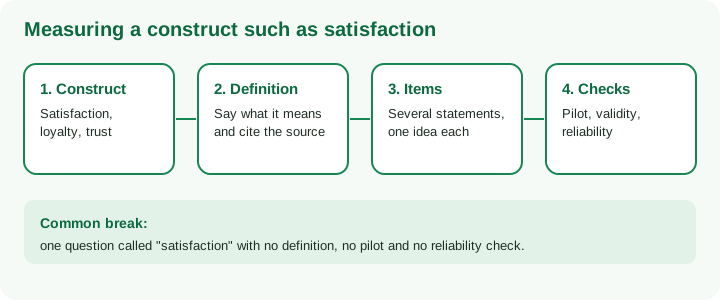
The common failure is treating a word as a measurement. A single question, "Are you satisfied?", records an impression. A measure of satisfaction needs a stated definition, items that cover its parts, and evidence that the items behave sensibly together.
A fictional measurement worksheet
This is an invented planning exercise. No data were collected and no findings are reported.
A student proposes: "The effect of customer satisfaction on loyalty to a campus food vendor." Here is how a supervisor-ready note could look:
| Decision | State in the exercise | Next step |
|---|---|---|
| Population | "Students" only | Narrow to a group you can actually reach |
| Satisfaction | One question | Define it, cite the source, write several items |
| Loyalty | Undefined | Decide: repeat visits, intention, or recommendation |
| Wording "effect" | Causal | Check whether a survey can support it, or say "relationship" |
| Sample | "Whoever answers" | State it as convenience and record the limits |
| Check | None | Pilot, then report reliability for each scale |
The word "effect" deserves attention. A survey taken at one moment can show that two measures move together, but it does not by itself show that one causes the other. Choose wording your design can defend, and use the research design guide to match question to evidence.
Validity and reliability in plain terms
Validity asks whether your items measure the construct you claim. Reliability asks whether they give consistent results. You are expected to say what you did about both, not just quote a number. The validity and reliability guide explains the usual steps and what to write.
Do not report a reliability figure you did not compute from your own data, and do not borrow one from a different study as if it were yours. If your pilot was small, say so.
What can a social media or digital marketing project actually observe?
This is where many marketing students overpromise. A title such as "The effect of Instagram advertising on sales of a small business" assumes you can see sales, ad spend and who saw the ads. Without the owner's data, you usually cannot.
What you can observe from outside:
- which platforms an organisation uses and how often it posts;
- the kinds of content it publishes, coded by a rule you write and apply consistently;
- visible engagement such as likes, comments and shares on public posts;
- the tone and content of public comments.
What you cannot observe without the owner:
- reach and impressions, which the account owner sees but the public does not;
- sales, enquiries or conversions linked to a post;
- how ads were targeted or what was spent;
- whether engagement came from real customers.
Your route is to match the question to what is visible. A content study, which describes what an account posts and how audiences respond in public, is feasible. A claim that posts caused sales is not, unless the owner agrees to share records. Another option is a survey that asks customers how they came to know the business, which measures reported awareness rather than proven effect.
If you code posts, write the coding rule first: what counts as a promotional post, how you treat reposts, which dates you cover. A second person coding a sample of the same posts is a useful check. Record these decisions, because your supervisor and examiners will ask. Public posts still involve real people, so keep personal details of commenters out of your report and follow your institution's ethics guidance.
How do you run a case study of a firm?
A case study describes practice at one named organisation in depth. Its strength is detail; its limit is that one firm does not stand for an industry. State the case boundaries: which firm, which unit, which period and which practice you are studying.
Before committing, confirm three things in writing if possible: who has agreed to speak to you, what documents or records you may see, and whether the firm wants anonymity. If a firm withdraws halfway, you need a fallback, so ask your supervisor about one early.
A feasible question might be how a named firm describes its process for handling customer complaints, answered through interviews and documents you are allowed to use. A less feasible one is "why the firm's sales fell", which needs financial records the firm may refuse to share. Use the data collection methods guide to match instruments such as interviews and document review to your question. If you are placed at a firm through SIWES, note that workplace activity and a research project are different documents; do not blur them.
Which marketing projects are risky to start?
| Risk | Why it causes trouble | Safer move |
|---|---|---|
| "Impact of X on sales" with no sales access | Sales figures are private | Ask about reported awareness or opinion |
| Population of "all Nigerians" | You cannot reach or represent them | Define a specific group and place |
| One-question constructs | Weak evidence of the concept | Build and test a scale |
| Copying a questionnaire unseen | Items may not fit your group or objectives | Adapt and pilot, cite the source |
| Causal wording from a single survey | The design cannot support it | Use "relationship" unless your design supports more |
| Case firm not confirmed | Access can vanish | Get agreement and a fallback early |
What will your supervisor or defence panel ask?
Prepare short, honest answers to these before your defence:
- Who exactly is your population, and how did you choose the people who answered?
- How did you define satisfaction, loyalty or whichever construct you measured?
- What did your pilot reveal, and what did you change?
- What does your sample let you say, and what does it not?
- Why did you choose this method over the alternatives?
- What would you do differently with more time or access?
If you do not know an answer, that is a signal to go back to your records, not to improvise.
What should you do after the data are collected?
Marketing students often treat collection as the finish line. Keep a simple data log: how many questionnaires were distributed, how many came back, how many were usable and why any were dropped. Those numbers belong in your methodology and results, and they protect you at the defence, because an examiner who asks about response rate expects an exact answer rather than an estimate. The coding and cleaning guide shows how to prepare responses before analysis without quietly altering what people said.
Keep your raw responses unchanged and work on a copy. When a respondent skipped an item, record it as missing rather than guessing an answer. If a result surprises you or contradicts what you expected, report it as it is; a project that honestly explains an unexpected pattern is stronger than one that hides it.
Finally, write limitations in specific terms. "The sample was small" is vague. "Respondents were drawn from two hostels, so the findings describe that group and may not hold for students elsewhere" tells the reader exactly how far to trust the work. That same honesty applies to a case study (one firm, one period) and to a social media study (public content only, no access to reach or sales).
Take a decision note to your supervisor
Bring a one-page note: the proposed question, the population or case, the evidence route, the construct definitions, the sampling plan, and the gaps you have not yet closed. Ask which claims the evidence can support and which would need something more. That conversation saves weeks.
Once the question and method are agreed, keep your analysis and your document connected. UniDraft helps organise your confirmed marketing question, your own analysis, checked sources and supervisor instructions into an editable Word project. Start your project document, bringing your collected evidence and reviewing every figure and claim yourself. UniDraft does not collect your data, run your analysis or guarantee approval.
If you are also writing about the same subject for a seminar, compare how the task differs in the seminar topic selection guide rather than reusing one document for both.