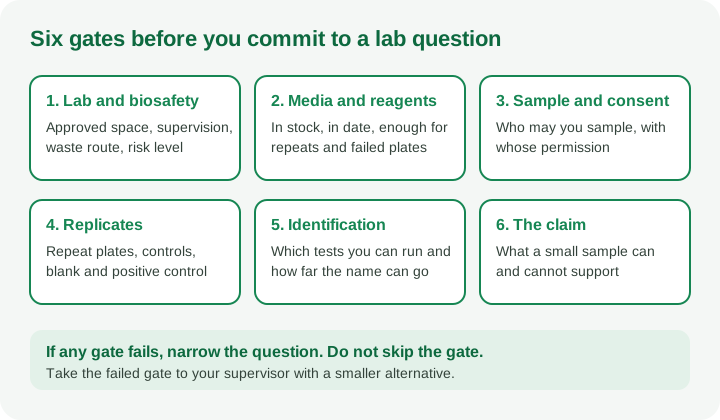
Choose a Microbiology project topic by testing the question against what you can safely and legally do in your own laboratory: approved space and supervision, media and reagents that are actually available, permission for any sample, enough replicates, and an identification method you can defend. A topic that fails one of these is a wish, not a plan.
UniDraft's free topic generator can help you build a starting shortlist from your department and interests. Take each idea through the six checks below before it goes to your supervisor.
A Microbiology project is judged by whether its claims match its evidence. UniDraft helps organise your confirmed question, your own lab records, checked sources and supervisor instructions into an editable Word project. Start your Microbiology project document, bringing the results you actually obtained and reviewing every claim yourself. The tool does not run your experiments or analyse your plates.
What this page is, and what it is not
This is a planning guide. It does not give you a list of titles that were approved, studied or recently supervised, because I cannot know your department's lab, your supervisor's interests or what was done in your school last session. Any list of "ready" titles you find online has the same problem: it tells you nothing about whether you can do the work.
Instead you get six feasibility checks, a fictional worked example that fails and is repaired, and question shapes you can adapt. Everything labelled as an example is invented for teaching. None of it is a finding.
If your assignment is a reading-based seminar rather than a lab project, you want a different page: use the Microbiology seminar topic guide. The two tasks are different and should not be mixed. A seminar reviews published evidence; a project produces your own.
What kind of Microbiology project can you actually do?
Before choosing a subject, find out which route your department allows. Different routes have very different feasibility costs.
| Route | What it usually involves | Main feasibility risk |
|---|---|---|
| Bench-based isolation and characterisation | Collecting samples, culturing, isolating, identifying organisms | Media, incubator time, contamination and identification limits |
| Antimicrobial activity testing | Testing extracts or agents against defined test organisms | Reproducibility, controls, and where the test strains come from |
| Enumeration and quality assessment | Counting organisms in water, food or surfaces against a defined standard | Sampling plan, dilution accuracy, and which standard you compare to |
| Survey or records-based study | Questionnaires or existing lab records, not culturing | Permission to use records, consent, and sampling bias |
| Review-style project | Structured literature analysis | Only allowed if your department treats it as a project |
Many departments expect bench work for a final-year project, but this varies. Ask your supervisor which routes are accepted rather than assuming. If you are unsure how to frame the broader decision, the general guide to choosing a final-year project topic covers brief, access and deadline checks that apply to every department.
Check 1: Lab access and biosafety level
Laboratories are grouped by biosafety level according to the risk of the organisms handled, and the level determines the containment, training and procedures required. Most undergraduate projects are expected to stay with lower-risk work in teaching or departmental labs, but the decision belongs to your institution, not to you and not to this page.
Ask these questions before you fall in love with a topic:
- Which laboratory will I work in, and who supervises me while I am there?
- Are there set hours? Many student labs are shared, and your incubation schedule has to fit the building, not the other way round.
- Does my intended organism or sample (for example, a clinical specimen) require a higher containment level than this lab provides?
- Where does contaminated waste go, and who autoclaves it?
- Do I need a lab induction, protective equipment or a training sign-off before I begin?
A question that mentions "pathogens from patients" can quietly turn a manageable project into one that needs clearance you do not have. If the supervisor says the question is too hazardous for your setting, that is a legitimate reason to narrow, not a reason to push harder.
Never plan to take cultures home, work in an unapproved room or improvise containment. If a topic is only possible by cutting a safety corner, it is not a feasible topic.
Check 2: Media, reagents and equipment
Write down every consumable your methods section would need. Then ask whether each one exists in the lab today.
| Need | Question to ask | If the answer is no |
|---|---|---|
| Culture media | Is it in stock, in date, and enough for repeats? | Choose a method that uses available media, or ask whether you may buy it |
| Staining and test reagents | Are reagents for Gram stain and your chosen tests available? | Drop the test or substitute one your supervisor approves |
| Incubator and temperature | Is there incubator space at the temperature you need for the full period? | Shorten the design or change the organism |
| Test organisms or reference strains | Where will controls come from? | A comparison without a control is weak; discuss alternatives |
| Sterile consumables | Plates, swabs, pipette tips, sample containers? | Reduce sample count to what you can sterilely handle |
Always plan for failure. Plates get contaminated, reagents run out and incubators break. A design that works only if nothing ever goes wrong will not survive a semester. Build in spare plates and a buffer in your timeline.
If the lab cannot supply what you need, a good project can still exist, but it is a smaller one. Say so in your proposal rather than hoping the supply appears later.
Check 3: Sample collection, ethics and consent
The sample is where many Microbiology projects stall. Different sample sources raise different issues:
- Human samples (urine, stool, swabs, blood, sputum): usually need ethical approval or an institutional permission, informed consent, confidentiality and a clear plan for what happens to the sample and any result. Do not collect these on your own.
- Clinical or hospital records and isolates: need permission from the facility, often a formal approval process, and rules on what identifying details you may keep.
- Animal samples: may need permission from the owner, farm or facility and sometimes an animal-welfare approval.
- Food, water, soil and environmental samples: usually less sensitive, but the site owner, market trader or facility often still needs to agree, and you should record exactly where and when you collected.
What applies to you differs by institution and by study design. The safest rule: do not collect anything until your supervisor has told you in writing which permissions are needed. The research ethics and consent guide explains how consent, confidentiality and approval fit a student project, and your own committee's requirements always win.
Also decide what you will do with leftover samples and cultures. Storage, disposal and who has access are part of the plan, not an afterthought.
Check 4: Replicates, controls and sample size
Microbiology results can vary a lot between plates, days and people. A single plate is an anecdote. Your design needs to show that a result can be repeated.
Think about three separate things:
- Technical replicates: repeat plating or testing of the same sample, to show the method is consistent.
- Biological replicates: different samples or independent preparations, to show the result is not one lucky sample.
- Controls: a negative control (should show no growth) and, where relevant, a positive control (should show the expected result). Without them you cannot tell contamination from a real signal.
Be realistic about count. Ten samples each plated in triplicate with controls is already a lot of plates, media and incubator space. If you cannot afford the numbers a design needs, choose a smaller question rather than a thin design stretched over a big one.
Sample size for a lab project is not the same as sample size for a survey. For a survey, the sample size guide and the sampling techniques guide are the relevant starting points; for bench work, agree with your supervisor what number of samples and replicates is defensible given your lab limits.
Check 5: How will you identify the isolates?
This is the check students most often skip, and it decides what you are allowed to write in your results.
Identification is a ladder. Each rung needs different tests and permits a different strength of claim.
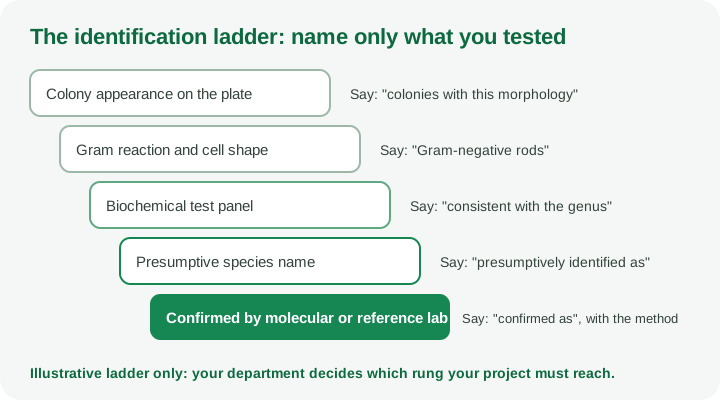
Colony morphology and Gram staining let you describe what you saw. A biochemical panel can make an identification consistent with a genus or species. Calling something confirmed generally needs molecular or reference-laboratory methods. Many student labs cannot do that, and that is fine, provided your wording honestly stops at the rung you reached.
So before choosing a topic that depends on naming organisms, ask:
- Which tests can my lab perform, and do they have the reagents?
- Will my department accept a presumptive identification, or must species be confirmed?
- If confirmation is needed, who does it, how long does it take and who pays?
If the answers are unclear, rephrase the question around what you can say, such as growth counts, morphology groups or antimicrobial susceptibility of the isolates you recovered, rather than around exact species names.
Check 6: What can a small sample claim?
A project with a handful of samples from one place and one time can describe what it found there. It cannot, on its own, tell you about a whole city, a whole hospital or a whole country.
Match your verbs to your design:
| Design | Reasonable wording | Overreach to avoid |
|---|---|---|
| Small set of samples from one site | "In the samples examined, ..." | "Water in the community is contaminated" |
| Extract tested on a few strains | "The extract showed activity against the tested strains under these conditions" | "The extract is an effective treatment" |
| Counts from one sampling date | "At the time of sampling, counts were ..." | "The market is unsafe" |
| Isolates from one clinic | "Among isolates recovered in this study, ..." | "Resistance in Nigeria is ..." |
In vitro activity does not equal a medicine, and a count above a standard in one week does not describe the long-term safety of a source. Your discussion chapter should state the limits of the sample plainly. The guide to writing discussion and conclusion shows how to keep interpretation within the evidence.
Fictional worked example: a title that fails, then is repaired
This is an invented planning exercise. No study was done and no result exists.
A student proposes: "Isolation and identification of pathogenic bacteria from patients' urine and their resistance to all common antibiotics in the state."
| Gate | Finding in the fictional exercise | Problem |
|---|---|---|
| Lab and biosafety | Teaching lab only, no clinical containment | Clinical pathogens may exceed what the lab is cleared for |
| Media and reagents | Basic nutrient media in stock, no selective media or susceptibility discs | The full susceptibility panel cannot be run |
| Sample and consent | No hospital agreement, no ethical clearance | Collecting urine is not possible yet |
| Replicates | Plan lists forty patients, no controls | Neither the numbers nor the controls are affordable |
| Identification | Gram stain and two tests available | "Pathogenic bacteria" and species names overreach |
| The claim | "In the state" | One site cannot support a state-wide claim |
Five of six gates fail, so the title cannot proceed as written. That is useful. The repair does not need a bigger lab; it needs a smaller, honest question.
A repaired, provisional direction might be: "What is the bacterial load, by plate count, on a defined set of reusable food-contact surfaces in one campus eatery, and how does it change after a stated cleaning step?" Even this is only a shape. It would still need permission from the eatery, a plan for swabbing, controls, an agreed standard for comparison and a supervisor's approval. It is not an approved title, and it makes no claim about any real eatery.
Notice what changed: the sample moved from clinical to environmental, the claim narrowed from a state to a defined set of surfaces, and the identification demand dropped from species to counts and morphology groups.
Question shapes you can adapt
These are provisional question shapes, not titles anyone has approved or studied. Each still has to pass the six gates in your own setting.
- Enumeration: How do viable counts compare between two defined sample types collected on the same day?
- Antimicrobial testing: Does a defined preparation show activity against named test strains under stated conditions, with controls?
- Hygiene practice: Does a defined hygiene step change recovery of bacteria from a defined surface?
- Susceptibility profile: How do recovered isolates from one defined source respond to a small, available antibiotic set, using a stated method?
- Fermentation: How does a measured property change over time in a defined fermentation setup that you can control and repeat?
- Records-based: What does an authorised, anonymised set of existing lab records show about a defined indicator over a defined period?
Check any shape against a literature search first. The research gap guide shows how to see what has been done before you commit.
Once the topic is agreed, write it up as a clear research question and objectives. Where you look for prior work matters too, and the guide to finding research papers covers search terms and screening.
Do a small pilot before you commit
If your supervisor agrees, a very small trial run can reveal problems cheaply: does the medium support growth, do the controls behave, is your dilution workable, can you read the plates? The pilot study guide explains the purpose, and the lesson transfers to bench work: find the failure while it is still cheap.
Only run a pilot with the lab's permission and the safety arrangements in place. A pilot that skips the permissions is not a feasibility check, it is a risk.
Keep records as you go
A lab project is only as defensible as its records. From day one keep a dated bench notebook: sample source and time, medium and batch, incubation temperature and duration, plate observations, controls, and anything that went wrong. Photograph plates where permitted and note the date and plate label.
Write down failed runs too. They explain odd results, and an honest note about contamination is better than a result you cannot explain. Keep the data in a form you can reopen later; the data management plan guide covers how to store and name files so nothing is lost before the defence.
Supervisor and defence questions to prepare for
Examiners of lab projects tend to probe the weak joints. Prepare plain answers to questions like these, using your own records:
- Why this medium, and what would have grown on it that you could not detect?
- How do you know your plates were not contaminated?
- What did your negative and positive controls show?
- How many replicates did you run, and how much did they vary?
- How exactly did you identify the isolates, and how sure are you of the name?
- Why can't your result be generalised beyond your sample?
- What would you change if you repeated the work?
If an answer is "I did not check that", say so and explain the limitation. That is better than a confident claim your records cannot support. The project defence questions guide covers how to answer when you do not know.
Common mistakes that sink Microbiology topics
- Choosing the organism first and the design second. "I want to study Staphylococcus" is a subject, not a question.
- Ignoring biosafety until the proposal is written. A late "your lab cannot handle that" costs weeks.
- Planning only the experiment that works. No spare plates, no controls and no failure buffer.
- Naming species the tests cannot support. Wording must match the rung reached.
- Collecting samples before permissions are in writing.
- Writing "effective" or "unsafe" from one small sample.
- Treating a seminar topic as a project. A reading topic does not become a lab design by adding the word "isolation".
- Copying a title found online without checking whether your lab can do it.
A checklist to take to your supervisor
Bring one page that covers:
- The proposed question in one sentence, and the route (isolation, activity testing, enumeration, records, other).
- Which laboratory, which hours and who supervises.
- A list of media, reagents and equipment, marked available or not.
- The samples: source, how many, what permission is needed and who gives it.
- The replicate and control plan.
- How isolates will be identified and the strongest wording that allows.
- The claim your design could support, and the claim it could not.
- What you will do if a gate fails.
If your placement lab is also part of your training, the laboratory science SIWES guide covers how to describe supervised lab work in an industrial-training report, which is a separate document from a project.
Once the question and methods are agreed, prepare your project with UniDraft using your confirmed work and your supervisor's instructions. You supply the real results and check every claim; UniDraft organises them into an editable Word document. It does not perform your experiments, supply samples, analyse results or guarantee approval.