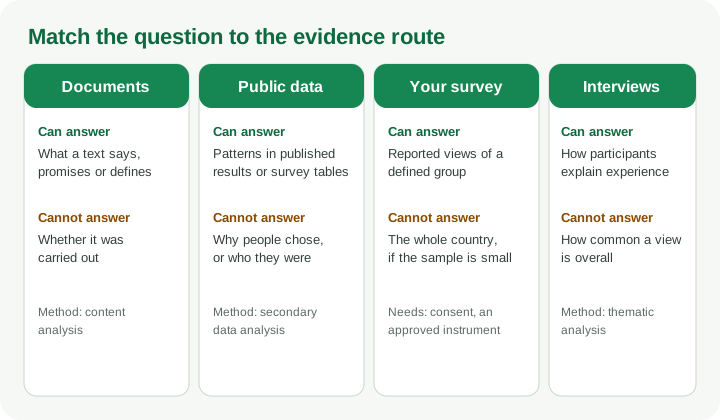
A good Political Science project topic asks one answerable question about a defined institution, process or population, and names the evidence that can answer it: documents, published election or survey data, your own survey, or interviews. If you cannot name the evidence and get it, the title is not ready yet.
UniDraft's free topic generator can give you a starting shortlist. Treat every suggestion as an idea to test against the checks below, not as an approved or already-studied title. Once your question and evidence are settled, UniDraft organises your confirmed work, checked sources and supervisor instructions into an editable Word document. Start your project document when you are ready, bringing your own evidence and checking every claim yourself.
Political Science is unusual because the evidence is public but contested, and the subject matter can be sensitive. A student can lose weeks on a title like "the collapse of democracy in Nigeria" because it has no boundary, no measure and a built-in verdict. This guide is about avoiding that: picking the evidence route first, then the wording, then the title.
This page is about the final-year project. If your task is a shorter seminar paper, the Political Science seminar guide works differently, and the two should not be mixed up. A project normally needs its own method and a results section, which a literature seminar does not.
What makes a Political Science project different from a seminar?
A seminar usually explains and evaluates what others have written. A project is expected to produce something of your own: a bounded question, a method, evidence you collected or analysed, and findings you can defend. Requirements differ by department, so read your project handbook and ask your supervisor what counts as a sufficient method.
In practice that means a project topic needs four things at once:
- A question with a clear unit (an institution, a document set, an election, a group of people).
- A scope, including the period and place.
- An evidence route you can actually use before the deadline.
- A claim limit, meaning what your evidence cannot show.
For the general version of this selection logic across departments, see the project topic selection guide. Below is how it plays out in Political Science.
Which evidence route fits a Political Science question?
Pick the route before the title, because the route decides what you are allowed to claim.
| Route | Typical question shape (provisional) | Main risk |
|---|---|---|
| Document or content analysis | How do selected public documents describe a role, policy or process? | Reading a text as proof that something happened |
| Published election data | How does a published measure differ across defined areas or elections? | Treating aggregate numbers as individual choices |
| Published survey data | What do respondents in a named survey report about a defined topic? | Ignoring sample, wording and date |
| Your own survey | What does a defined group report about one behaviour or view? | A convenience sample passed off as "Nigerians think" |
| Interviews | How do selected participants explain one experience? | Access, consent and over-generalising from a few voices |
These are planning shapes, not titles. Each one still has to be narrowed to a real institution, period and set of sources, and then cleared with your supervisor.
Can I do a document or content analysis of public sources?
Often, yes, if your brief allows it and the documents are genuinely available. This is the lowest-risk route for many students because it needs no respondents, though it asks for discipline.
Public sources a Political Science student might analyse include constitutional and legislative texts, party manifestos and constitutions, parliamentary or assembly records, policy documents, official speeches, court judgments, and institutional reports. The question you ask must be one that the text can answer. A text can show what an actor said, promised, defined or assigned. It cannot by itself show what was implemented, why someone said it, or what voters understood.
To make it a method rather than a pile of quotations, decide in advance:
- The document set and why it counts (for example, "manifestos issued for one named election by the parties I list").
- The unit of analysis: a sentence, a section, a stated commitment.
- A coding frame: the categories you will sort passages into, defined before you read.
- A source register: issuing body, title, date, version and where you retrieved it.
Use the content analysis guide for how coding frames work, and keep a second pass or a sample re-check so you can show your sorting was consistent. Where your material is interview or open-text responses instead, the thematic analysis guide is the better fit.
Common documentary pitfalls:
- Using a draft, a superseded version or a news summary instead of the primary text.
- Missing documents, then treating silence as evidence of a decision.
- Cherry-picking passages that suit one reading.
- Mixing documents from different periods as though they were comparable.
What election data is openly available, and what can it show?
Nigeria's election management body publishes material online. INEC's website links to an election results portal, the IReV result viewing portal for polling-unit results and scanned result sheets, voter-card statistics by state and ward, a polling-unit locator and a list of political parties. I opened the INEC homepage when preparing this guide and it listed these items, but portal contents and coverage change with each election cycle. Open the portals yourself, note which elections and levels are actually present, and record the retrieval date.
Some honest limits to plan around:
- Coverage is not guaranteed. Not every election or polling unit is necessarily viewable in the same form. Check before you promise a "complete" dataset.
- Scans are not spreadsheets. Result sheets viewed as images need to be transcribed by you, which takes time and introduces errors you must control.
- Counts describe counted votes. They do not describe why people voted, stayed away, or whether a process was fair. Claims about those need different evidence.
- Definitions matter. Turnout based on registered voters is not the same measure as turnout based on voting-age population, so state your numerator and denominator.
- Be careful with contested elections. Court proceedings and disputed outcomes exist for some elections. Your project should describe the published figures and the sources of any dispute without taking sides on the outcome unless your design is built to test it.
A manageable election-data question is usually comparative and descriptive: how a defined published measure varies across a small set of named areas or two named elections, with the definition stated. A question about "the effect of vote buying on the result" needs evidence that published counts alone cannot supply.
What do NBS and Afrobarometer offer?
For survey-based questions about public opinion and governance, there are two broad open routes. I verified the first directly and could not open the second from here, so treat the second as something to check yourself.
Afrobarometer describes its data as free to use and offers country datasets by survey round, merged multi-country datasets with codebooks, geocoded datasets and a browser-based online analysis tool. Its page tells users to read the data usage and access policy before using the data, so read that policy for any citation or registration conditions. For Nigeria, the Round 10 summary of results states a nationally representative sample of 1,600 adult citizens interviewed in June and July 2024, with a margin of error of plus or minus 2.5 percentage points, carried out by the Afrobarometer national partner NOIPolls. Whether a Round 10 file or a later round is available for download is something to confirm on the data pages when you start, not something to assume from this guide.
The National Bureau of Statistics (NBS) runs household, labour and living-standards surveys and maintains a microdata catalogue. Access conditions vary by dataset, and many recent datasets appear to need a free account. Most NBS surveys are social and economic rather than political, so they suit questions about context (for example, area-level conditions) better than questions about political attitudes. Check the catalogue directly and read the access terms for the specific survey.
What published survey data can and cannot do:
| It can support | It cannot support |
|---|---|
| Describing what a sample reported at a named time | Explaining why individuals answered as they did |
| Comparing groups the survey measured | Claims about groups it did not measure (such as "students" if age or status was not recorded) |
| Reporting a result with its stated margin of error | Precise statements about small subgroups or small areas |
| Tracing a question across rounds, if worded the same | Comparing rounds where wording or sampling changed |
If you analyse published survey data, you also need to say which weights, if any, you used and why. The primary and secondary data guide helps check whether an existing dataset fits the question before you build the whole project on it.
Should I run my own survey or interviews?
Only if the question truly needs people's own accounts, and only if you can reach them. Original data collection is where many Political Science projects run into trouble, because political views are personal, access to officials is uncertain and honest sampling is hard.
Survey route. A survey fits questions like "what does this defined group report about X". Define the group first (for example, registered members of one named association at one institution), then the sampling approach, then the questionnaire. A convenience sample can describe the people you reached; it cannot describe "Nigerian youth". Work through the questionnaire design guide and the sampling techniques guide, and agree the sample and any size calculation with your supervisor.
Interview route. An interview fits "how do these participants explain their experience of Y". Plan who, why them, how many, and what happens if some decline. Use the interview guide to write neutral, open questions and to plan recording and note handling.
The data collection methods overview lays out the trade-offs, and a case study approach can combine documents with a small number of interviews around one institution.
Before any contact, write down what you will do if officials do not reply, because they often will not. Have a fallback evidence route in your plan, such as relying on public documents with interviews as an optional addition.
How do I handle sensitive or politically charged topics?
Many Political Science topics touch parties, elections, security forces, ethnic or religious groups, or named public officials. That does not make them forbidden, but it does raise the standard of care. Your department sets the rules; what follows is a general planning aid.
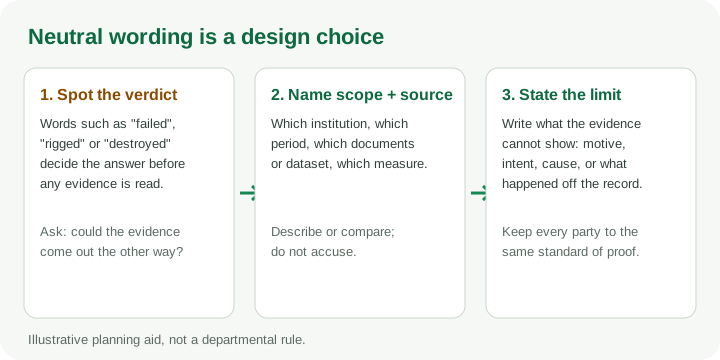
Neutrality in wording. A title that contains its own verdict ("how party X rigged the election") assumes the answer. Reframe it as a bounded question about evidence ("what do selected published sources record about the conduct of a named election in a named area"). The same wording standard should apply to every party or leader you discuss.
Claim discipline. Describe what a source says or what a figure shows. Do not attribute motive or intent without evidence that speaks to it. When sources disagree, present each with its origin rather than choosing the one you prefer.
Named individuals. Be careful with allegations about identifiable people. Quote or paraphrase sourced public statements accurately, avoid unsupported accusations, and take legal and defamation concerns seriously. If your topic centres on a named living person, discuss it with your supervisor first.
Safety. Some topics (security, communal conflict, electoral violence) can put you or participants at risk during fieldwork. A document-based design is often safer. Never go somewhere unsafe for data, and tell your supervisor if a plan raises a safety concern.
Your own position. You are allowed to have views. The project is judged on how well you handle evidence, so show that your conclusion follows from the sources, including those that cut against your expectations.
What about consent and ethics?
If real people supply information, whether through a survey, an interview or a focus group, consent and ethics apply. If you only analyse public documents or already-published datasets, the requirements are usually lighter, but your department decides, so ask.
When people take part, the usual elements are:
- A plain explanation of the purpose, who you are and who supervises you.
- Voluntary participation, with the right to decline or withdraw.
- A clear statement of what you will record and how it will be stored.
- Anonymity or confidentiality as promised, and kept. This matters more when answers concern political views, which can be risky for the participant.
- Parental or institutional permission where your participants or setting require it.
- Any ethical clearance your institution requires, obtained before collecting data.
Do not ask for more personal information than the question needs. Party membership, voting choice and ethnic or religious identity are sensitive. If you can answer the question without them, leave them out. The research ethics and consent guide covers consent forms and data handling in more detail. Do not copy a consent text from another project without checking that it matches your actual design and your institution's rules.
Fictional example: a loaded title with thin evidence
This is an invented planning exercise. No data was collected and no findings are reported.
A student proposes "How vote buying destroyed the credibility of elections in Nigeria." They have a few news reports and a downloaded election results table.
| Check | Status in the exercise | Next step |
|---|---|---|
| Question | Contains a verdict and a cause ("destroyed") | Rewrite as a bounded descriptive or comparative question |
| Unit and scope | "Nigeria", no period | Choose a named election, area or document set |
| Evidence | News reports plus a results table | News reports cannot measure vote buying; counts cannot show motive |
| Measure | "Credibility" undefined | Define it, or drop it and use a measure the data can supply |
| Claim limit | Not stated | List what the evidence cannot show |
| Supervisor check | Not done | Bring the revised question, route and gaps |
A feasible redirection might be a document analysis: how selected official reports describe a named electoral offence and its penalties, using a defined set of texts and a coding frame. It would not claim how often the offence happened. An alternative, if the department allows it, is a small survey of a defined group about their reported experience, with consent and a stated limit on generalisation. Both are provisional question shapes to take to a supervisor, not ready-made titles.
Complete a topic feasibility worksheet
| Check | What to record |
|---|---|
| Main question | One question, not "democracy" or "governance" |
| Unit and scope | Institution, document set, election or group; place and period |
| Evidence route | Documents, published data, own survey or interviews |
| Sources | Exact titles, releases, dates, versions and retrieval dates |
| Access | What you have already opened, and what you still need |
| Measure | What is counted or coded; definitions and denominators |
| Sensitivity | Named people, safety, neutrality of wording |
| Ethics | Who participates, consent, clearance, data storage |
| Claim limit | What the evidence cannot show |
| Fallback | A narrower route if access fails |
| Supervisor check | Method, scope, permissions and title wording to confirm |
This is an original planning worksheet, not a validated research instrument. Keep the completed version with your proposal so you can explain why the project is feasible.
Turn the question into measurable objectives
Once the route and scope are set, write the question and objectives so they match the evidence. The guide to research questions and objectives shows how to keep each objective tied to something you can observe. If you are unsure that your question adds anything beyond what has already been studied, the research gap guide shows how to check the literature before you commit.
Questions a supervisor or panel may ask
These are prompts to prepare your own answers to, not a script:
- Why this evidence for this question, and what could it not show?
- How did you choose your documents, areas or participants?
- How did you keep your coding or questionnaire neutral?
- What happened where data was missing or sources disagreed?
- How did you protect participants and handle consent?
- What would you do differently with more time or access?
Common mistakes in Political Science project topics
- Choosing a verdict as a title.
- Treating national totals as evidence about a small group.
- Assuming officials and politicians will agree to interviews.
- Using a convenience sample to claim a national view.
- Mixing documents or datasets from incomparable periods.
- Asking about party affiliation when it is not needed.
- Forgetting to record where and when each source was retrieved.
Next step
Pick the evidence route first, open the actual sources, then write the narrowest question they can answer, and take that plan to your supervisor. When the plan is agreed, prepare your project document with UniDraft from your confirmed work, checked sources and instructions. UniDraft does not collect data, run your analysis or guarantee approval.
Sources
- Afrobarometer: Data: description of free country and merged datasets, online analysis tool and the reference to the data usage and access policy.
- Afrobarometer: Nigeria Round 10 summary of results: sample size, fieldwork dates and margin of error cited above.
- INEC (Independent National Electoral Commission): homepage listing links to the results portal, IReV, voter-card statistics and party list. Portal contents change between elections.