If a friend has a defence tomorrow, the best message is short, warm and about them: wish them calm, remind them they know their work, and say you are rooting for them. If it has just ended, congratulate them in a sentence and ask how they feel. This page gives you ready-to-send messages for each moment: the night before, the morning of, straight after, and the thank-you notes that follow.
Every message below is an illustrative template. Swap in names and details, and change the wording until it sounds like you. Prayers are written in general, respectful language so they work across faiths, with an optional line you can add if you know your friend's tradition.
The short answer
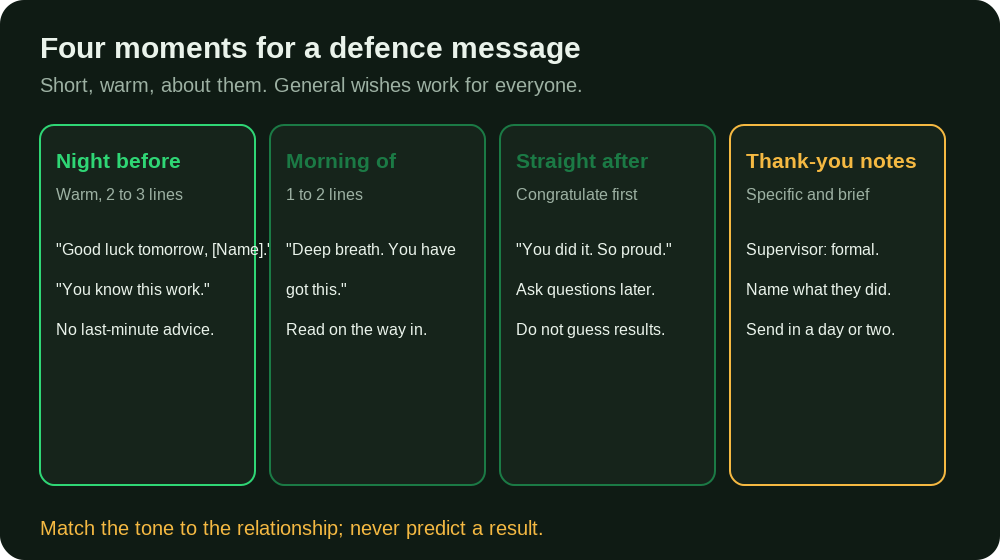
- Before: a short message the night before. Encouragement, one line of belief in them, no advice.
- Morning of: two lines at most. They will read it while getting dressed or on the way.
- After: congratulate first, ask questions later.
- Thank-yous: specific, brief, sent within a day or two.
- Social posts: thank people and keep outcomes modest until the department releases results.
- If it did not go well: support, not solutions, unless asked.
If you are the one defending, the written project in your hand should already be in order. UniDraft builds your final year project report as an editable Word document from the work you confirm, your supervisor's instructions and your school's format. Start your final year project document with UniDraft.
How to write a message that helps
Nervous people do not need a speech. They need to feel that someone is on their side. A few rules make every message better.
- Use their name. "Good luck" is fine. "Good luck, Ada" is better.
- Make it about them. Mention the work they did, the effort they put in or a quality they have. "You have been on this since January" is more comforting than "you will do great".
- Keep it short. Two or three sentences, five at most. The morning-of message should be shorter than that.
- Do not give last-minute advice. Tips on what to say or how to answer questions add pressure. The day before, the work is done.
- Do not predict a result. "You will definitely pass" can feel like a burden if things go differently. "You are ready" is safer.
- Match the relationship. A message to your supervisor is formal. A message to your roommate can be playful.
- Respect belief and background. If you are not sure what the person believes, choose wording that blesses them without assuming a tradition.
Before the defence: good-luck and encouragement messages
For a close friend or classmate
- "Good luck tomorrow, [Name]. You know this project inside out. Sleep well, eat something, and trust your preparation."
- "Tomorrow is just you explaining something you already understand. We will be cheering for you."
- "You did the hard part already. Tomorrow you just tell the story of it. Proud of you."
- "Whatever they ask, you have an answer or you can think your way to one. Breathe. You are ready."
For a group chat of course mates
- "To everyone defending this week: we have survived the nights, the corrections and the printing queues. Now go and show them the work. Good luck to all of us."
- "Defence week, here we go. Rest properly, dress comfortably, and remember the panel wants to see you do well."
- "Whoever goes in next, we are all behind you. Take a deep breath and speak slowly."
For someone anxious
- "It is normal to be nervous. It shows you care. Pick your first sentence, say it slowly, and the rest will follow."
- "You do not need to be perfect. You need to be clear. That is something you can do."
- "If you blank on a question, pause and say 'let me think about that for a moment.' Everyone does it."
For a younger sibling or a junior
- "This felt scary to many of us before you. You are more prepared than you think. Call me after, and I will want to hear everything."
For your supervisor (formal)
- "Good evening, Sir/Ma. Thank you for your guidance throughout this project. My defence is tomorrow at [time], and I am grateful for the time you gave me. I will do my best to represent the work well."
Send the supervisor message only if it fits your relationship with them. If in doubt, a short message after the defence is the safer choice.
Prayers for a project defence
These are written in respectful, general language so that anyone can use them. Where you know the person's tradition, you can add your own words. No prayer replaces preparation, and the best use of a prayer message is as encouragement, so combine it with a plain-language wish.
General wishes and prayers, suitable for any group
- "Wishing you calm, clarity and confidence at your defence tomorrow. May you remember all you know, and may the questions be fair."
- "May you walk into that room at peace, speak with clarity and leave knowing you gave your best. You are in my thoughts."
- "I am thinking of you today and hoping for steady nerves, clear words and kind panellists."
- "May your hard work be seen and your answers come easily. Good luck, [Name]."
A prayer you can say or send before you present
May I be calm, clear and honest. May I remember what I have learned, speak slowly, and answer what I am asked. May I be fair to my own work and open to correction. May the day go well for everyone defending.
A prayer for a group of classmates
For all of us defending this week: strength for those who are tired, calm for those who are nervous, clear minds in the room, and fair questions from the panel. May we finish well and help one another along.
Where you know your friend shares your faith
If you know your friend shares your faith, you may add a line in that tradition, in your own words. Keep it sincere, short and about them. Examples of the shape, without assuming any one belief:
- "I am asking God to go with you into that room."
- "I will be praying for you tonight and tomorrow morning."
- "May you be granted peace, wisdom and favour."
If you are not sure, use the general wishes above. Many classmates come from different traditions and some from none. A kind wish lands in every case.
What to avoid in prayer messages
- Pressure. "God has already given you first class" can make a student feel worse if the defence goes differently.
- Judgement. Do not suggest that a student's result reflects their faith or effort in prayer.
- Long sermons. One or two lines is enough.
- Group prayers that exclude. In a mixed group chat, a prayer for "all of us" in general language is the kinder choice.
On the day: short messages for the morning
People read these on the way in, so keep them to one or two lines.
- "Today is the day. You are ready. Go well, [Name]."
- "Deep breath. Slow voice. You have got this."
- "We are with you. See you on the other side."
- "Rooting for you in that room. Message me when you are out."
- "You know your work. Let them see it."
If you are with them, a short walk and a bottle of water mean more than a paragraph. Our guide on how to start a seminar or project defence presentation is worth forwarding to a friend who is worried about the first minute.
After the defence: congratulation messages
Congratulate first. Ask about the questions later, because many people feel flat or shaky once the adrenaline drops.
Straight after, to a friend
- "You did it! However it felt in there, you walked in and presented your own work. I am so proud of you."
- "Defence done. Go and eat something and rest. Call me when you feel like talking."
- "Congratulations on getting through your defence, [Name]. That was a big day and you showed up for it."
- "Well done. All those late nights led to today."
If the result is already known and positive
- "Congratulations, [Name]! Your hard work paid off. I am so happy for you."
- "You earned this. Congratulations on completing your defence."
- "From the first topic to the final defence, you did it. Congratulations."
- "So proud of the work you did. Enjoy tonight."
For a group of course mates
- "Congratulations to everyone who defended this week. We started this together and we are finishing it together."
- "To the set of [year]: the defences are behind us. Well done, everyone."
If you do not yet know the result
Do not guess. Defence outcomes are decided by the department, and some departments release results later or ask for corrections first. A safe message: "Congratulations on completing your defence. I hope the results are everything you hoped for." Afterwards, many students receive corrections to make before final submission, and our guide on managing final year project supervisor corrections explains how to handle them without panic.
If it did not go as hoped
This is where a message matters most. A student who is told "it is fine" by everyone can feel unheard. Try:
- "I am sorry. That sounds hard. I am here if you want to talk or if you want company."
- "One defence does not decide who you are. Take a day, and when you are ready, I will go through the corrections with you."
- "You did the work and you showed up. Whatever comes next, I am on your side."
Do not give advice unless asked. If they want to know what the next steps are, our guide on what happens if you fail a final year project sets out the usual routes without drama.
Thank-you messages after the defence
Thank-yous matter. They are also easy to forget in the relief after the defence, so write them within a day or two while the details are fresh.
To your supervisor (formal)
Dear Sir/Ma, I write to thank you for your guidance throughout my project. [One specific thing: for example, "Your comments on my methodology made the work clearer and stronger."] I am grateful for your time and patience. Thank you again.
Use your supervisor's correct title as it appears on your title page. Send it on its own, with no requests in the same message. If you need to discuss corrections, send a separate message.
To the panel or the project coordinator
If your department allows direct contact, a short note of thanks for their time is polite. Do not contact panel members individually to ask about your score or to discuss the result. Your supervisor or coordinator is the right channel.
To a classmate who helped
Thank you for [specific help: reading my chapter three, helping me test the questionnaire, lending me your charger]. It made a real difference. I owe you one.
To family
Thank you for [specific help: paying for my printing, giving me space to work, praying for me]. I could not have done this without you.
To a friend who came to support you
Thank you for coming and for waiting outside. It meant a lot to see you after.
Linking the thanks to your report
If you thanked people in your report, the acknowledgement page is where the permanent record lives. Our guide on what to write in an acknowledgement is a useful companion, and a message sent after the defence is a personal complement to it.
Social media posts after your defence
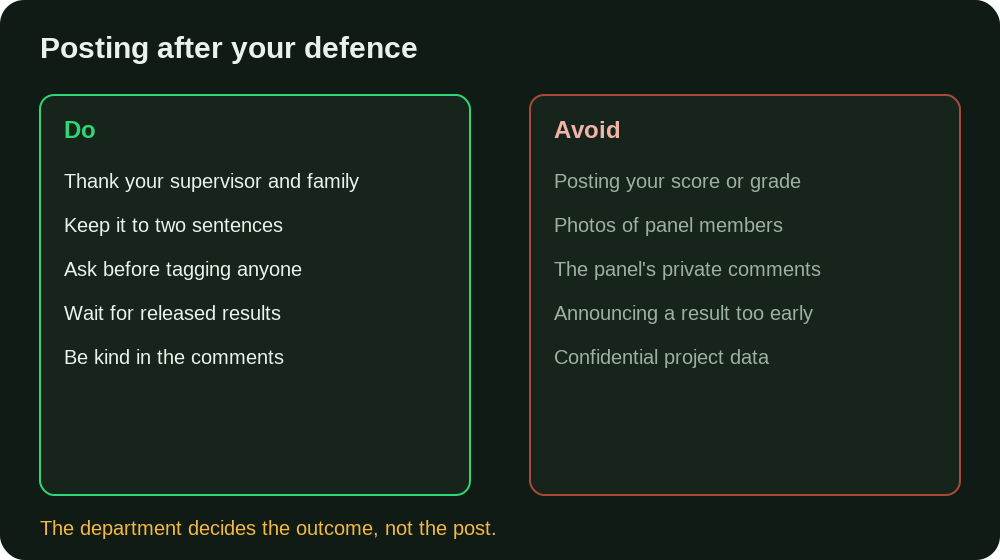
Keep it short, sincere and safe.
Simple post
Defended my final year project today. Grateful to my supervisor, my family and my friends who helped me get here. On to the next chapter.
With a photo
[Photo with classmates] We did it! Thank you to everyone who encouraged us along the way.
After results are released
Final year project completed. Thank you to [Supervisor], my course mates and my family. I am grateful.
A few ground rules
- Do not post your score or grade unless you are comfortable being compared. Results are also personal for your classmates.
- Ask before tagging or photographing people, including supervisors and panel members.
- Do not post anything about the panel's comments or private discussions.
- Do not post a result before it is released. A post that says "passed" before the department confirms can cause problems if there are corrections.
- Be kind in the comments. Not every classmate had the same experience.
- Do not post your full project or confidential data. Some projects include data that must stay private.
If you are the one defending: using these messages well
You may get many messages, and that is a good thing. A few tips:
- Silence your phone before you go in. Read the messages afterwards.
- Reply to everyone briefly later, or reply to one group chat message to say thank you.
- Keep one or two people as your "call after" contacts.
- If messages make you more anxious, mute them until after the defence.
On the preparation side, our guide to what a project defence is and how to prepare and the list of common defence questions and how to answer them are better use of the night before than reading a long message thread.
For the slides, see how to prepare a project defence presentation.
A quick message-picker
| Situation | Tone | Length | Example opener |
|---|---|---|---|
| Night before, close friend | Warm | 2 to 3 sentences | "Good luck tomorrow, [Name]." |
| Morning of | Brief | 1 to 2 sentences | "Deep breath. You have got this." |
| Straight after | Warm | 1 to 2 sentences | "You did it. I am so proud." |
| Result unknown | Neutral | 1 to 2 sentences | "Congratulations on completing your defence." |
| Result disappointing | Gentle | 2 to 3 sentences | "I am sorry. I am here." |
| To supervisor | Formal | 3 to 4 sentences | "Dear Sir/Ma, thank you for your guidance." |
| Social post | Short | 1 to 2 sentences | "Defended my project today. Grateful." |
A checklist before you hit send
- I used the person's name.
- The message is short.
- It is about them, not about me.
- I did not predict a result.
- I did not give last-minute advice.
- The tone matches our relationship.
- The wording is respectful to their beliefs, or general if I am not sure.
- I checked names and titles for spelling.
Where UniDraft fits in
The best encouragement you can give yourself is a project you know well and a document that is in order. UniDraft builds your final year project report as an editable Word (.docx) document from the work you confirm, applying your supervisor's instructions, your department's format and your university's format in that order. When your supervisor sends corrections, you supply them and get a new version, with earlier versions kept. A final year project costs ₦20,000 once, including three free supervisor-correction rounds. Before you print, run the file through the free formatting checker.