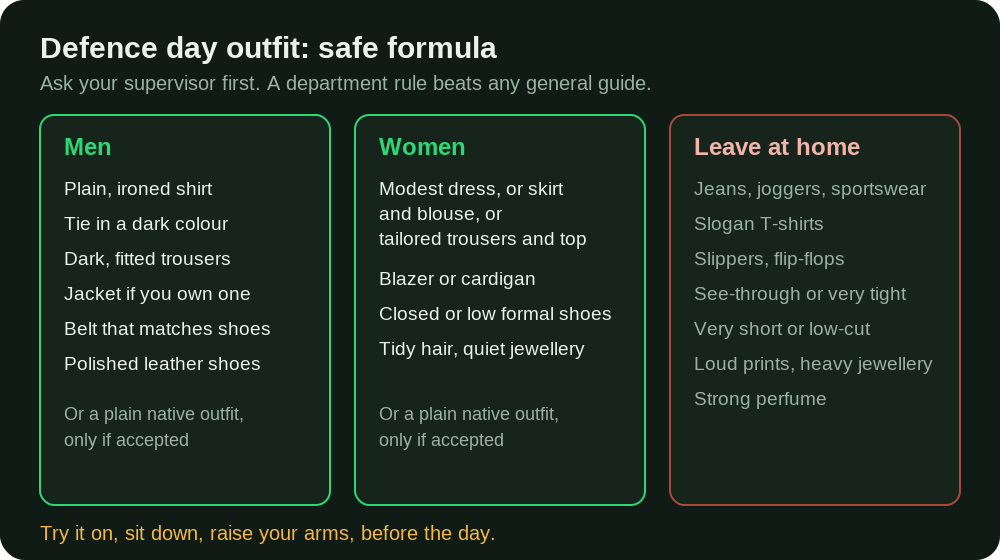
Wear formal, clean, modest clothes that fit you and let you move and breathe easily, in dark or neutral colours, with polished shoes. That is the safe answer almost everywhere. The correct answer for your own defence has one extra step: ask your supervisor or project coordinator whether your department has a stated dress code for defence day, because departments differ and their rule wins over any general guide, including this one.
This guide gives you a practical outfit list for men and women, a few ready-to-copy outfit formulas, a night-before routine, and the mistakes that cost students attention they should have spent on their work. For the defence itself, our guide to project defence covers what happens in the room.
The short answer
- Default: formal or business-formal, treated like an interview.
- Colour: dark or neutral (black, navy, grey, charcoal, brown, white, light blue) is the lowest-risk palette.
- Fit and comfort: clothes you can stand in for 45 minutes without adjusting.
- Modest: no transparent, very tight, very short or low-cut clothes.
- Neat: ironed, clean, shoes polished, hair and nails tidy.
- Ask first: if your department has a rule, or allows traditional wear, you want to know before the day.
Dressing well is a small part of your preparation, but it is the part that is easiest to get right in advance. UniDraft builds your final year project report as an editable Word document from the work you confirm, your supervisor's instructions and your school's format, so the written project you carry into the room is already in order. Start your final year project document with UniDraft.
Is there a dress code for defence day?
There is no national rule. Dress is set by individual universities, polytechnics and departments, and it is usually enforced through a student handbook or a notice. That is why you will see students at different institutions dressed very differently on defence day.
What can be verified is that many universities publish a general dress code for academic settings. The University of Lagos has a Senate-approved student dress code that asks for cleanliness, neatness, modesty, decency and appropriateness. Its list of items not allowed in academic and office areas includes very tight clothes, clothes that reveal the chest, belly or buttocks, transparent clothing, very short skirts and dresses, beachwear, night wear, bathroom slippers, T-shirts and jeans with obscene or cult-related messages, and sagging trousers. It also says that lecturers and administrators can correct students or exclude them from lectures and official business if they are not properly dressed. That policy sets the minimum in academic areas. It does not say what to wear for a project defence, which is the key point: it is a general rule that applies to you on the way to the defence room as well.
A public debate in 2026 shows how unsettled the practice is. After a UNILAG final-year student's outfit at his defence drew criticism online, news reports noted that some people argued formal dress is expected at a defence while others said many Nigerian universities do not prescribe corporate dress for defences. The university had not issued a statement on that case at the time of the report, so nobody outside the department can say what rule applied. The practical lesson is not to copy anyone's online example. Find out what your own department expects.
How to find out in five minutes
- Ask your supervisor. "Sir/Ma, is there a dress code for the defence?" is a normal question.
- Ask your project coordinator or department secretary. They have seen every outfit.
- Ask a recent graduate in your department what students wore and whether anyone was turned back.
- Check the student handbook for the dress code and any section on examinations or assessments.
- If it is a professional programme (nursing, pharmacy, medicine, engineering with regulatory links), ask whether a uniform or specific attire is required.
Write down the answer. If it is a rule, follow it exactly. If it is "formal is fine", use the guide below.
What men can wear
Men have a simple template: a clean shirt, trousers, shoes and, if possible, a jacket. Here is how to build it.
Option 1: shirt, tie and trousers
- Shirt: plain white, light blue or another light solid colour, ironed, with the collar and cuffs clean. Long sleeves look more formal, but short sleeves are acceptable if that is what you have and the weather is hot. Tuck it in.
- Tie: a plain or subtle pattern in a dark colour. Knot it neatly and make sure the tip reaches your belt.
- Trousers: dark, plain and well-fitted, not baggy and not skin tight. Ironed creases look sharp.
- Jacket or blazer: optional but helpful. Make sure it fits at the shoulders. If the room is hot, you may remove it for the presentation only if the panel and your department are comfortable with that.
- Belt: a plain belt that matches your shoes.
- Shoes and socks: leather or leather-look shoes, polished, with dark socks. Avoid sandals, canvas shoes and sports shoes.
Option 2: smart native outfit (where it is accepted)
Some departments accept a neat native outfit. If yours does, keep it plain: a well-fitted senator or kaftan style in a calm colour, matching trousers, a clean cap only if you know it is accepted indoors, and polished shoes. The same standards apply as for a suit: ironed, fitted, modest and not distracting. If in doubt, ask before committing to it.
Option 3: no jacket, no tie
If you have no tie or jacket, a clean light shirt and dark trousers with polished shoes still reads as formal. It is better to be simple and neat than to wear borrowed clothes that do not fit.
What to avoid
- Jeans, shorts, joggers and any sports or casual wear
- T-shirts, branded jerseys and clothes with slogans
- Sagging trousers
- Flip-flops, slides and canvas sneakers
- Heavy chains, many rings, caps worn indoors and sunglasses
- Strong cologne in a small room
- A jacket that is tight, creased or too big
What women can wear
Women have more options. The goal is the same: neat, modest, comfortable and easy to move in.
Option 1: dress or skirt and blouse
- Dress: a plain dress at or below the knee, with sleeves or a cover-up, in a dark or neutral colour. A dress with a defined waist or a simple sheath cut looks tidy.
- Skirt and blouse: a knee-length or longer skirt, not tight, with a plain blouse or button-down shirt. Check that the blouse is not see-through and that it stays closed when you raise your hand to point at a slide.
- Jacket or blazer: optional, and a useful layer in an air-conditioned room.
Option 2: tailored trousers and top
Straight or tailored trousers, a plain blouse or shirt and a blazer or a long cardigan. This works well if you will be moving around, writing on a board or standing for a long time.
Option 3: smart native outfit (where it is accepted)
A well-fitted skirt and blouse or a simple wrapper-and-blouse set in a calm colour can be suitable where traditional wear is accepted. As with the men's option, ask first. Keep prints calm and avoid heavy embellishment, oversized headwear and clothes you have to keep adjusting.
Shoes, hair and accessories
- Shoes: closed or low formal shoes that you can stand in for an hour. A very high heel is a risk if you are nervous and the floor is polished.
- Hair: tidy and off your face so that you are not tempted to touch it. If you cover your hair for religious reasons, a plain, neat head covering is fine and should be respected.
- Jewellery: small and quiet. Large dangling earrings and many bangles make noise when you gesture.
- Makeup and nails: natural and tidy.
- Bag: a small, neat bag or a folder, not a large shopping bag.
What to avoid
- Transparent, very tight, very short, backless, strapless or low-cut clothes
- Beachwear, night wear and casual slippers
- Ripped jeans and sportswear
- Strong perfume
- Anything you have not sat down in before the day
One more point: religious and cultural dress, such as a hijab, a head tie or a particular modest style, is not a problem and should not need explaining. If you are unsure whether your outfit meets the department's expectations, ask a lecturer you trust.
Colour, fit and comfort
Plain colours let the panel look at you and your work, and not at your clothes. Dark or neutral shades are easy to match and rarely look out of place.
| Item | Safe | Risky |
|---|---|---|
| Main colour | Black, navy, charcoal, grey, brown | Neon, very bright, very loud prints |
| Shirt or blouse | White, light blue, pale solid | Strong patterns, slogans |
| Shoes | Black or brown, polished | Sports shoes, open sandals |
| Fabric | Matte cotton or wool blends | Shiny, see-through, clingy fabric |
| Fit | Room to move | Tight at the arms, waist or neck |
Fit matters more than price. A tight jacket restricts your arms, a long trouser leg catches under your heel, and a blouse that gapes when you lean forward distracts you. Try your full outfit on, sit down, stand up, raise both arms and walk across the room before the day.
Defences can be hot, especially when there is a power cut and the air conditioning is off. Wear breathable fabrics, avoid layers you cannot remove, and bring a handkerchief or tissue. If you sweat when nervous, a light colour and a dark undershirt are better than a heavy dark shirt that shows every mark.
The night-before routine
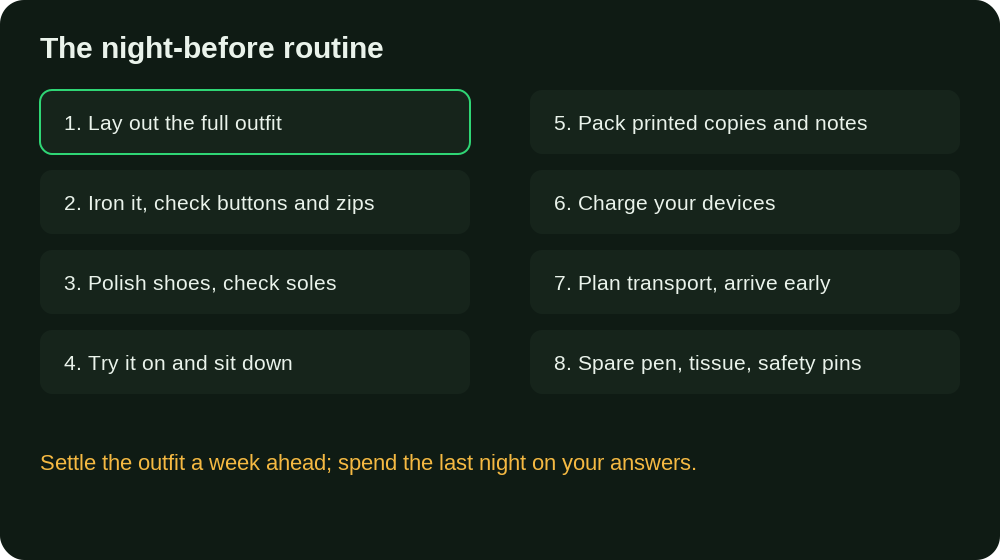
Treat the outfit like a checklist, because you will be tired and nervous in the morning.
- Lay it out. Shirt or blouse, trousers or skirt, jacket, tie or accessories, shoes, socks or tights.
- Iron it. Creases are visible from the panel's table.
- Check the small things. Buttons, zips, hems, shoe soles, shoelaces and the strap of your bag.
- Polish your shoes. It takes two minutes and it makes a difference.
- Charge your devices and pack your documents. Printed copies of your project and your notes go in a folder, not loose.
- Plan your transport. Arriving sweating and rushed undoes the work you put into dressing well. Aim to be at the venue early.
- Prepare a backup. A spare pen, tissue, safety pins and a small mirror in your bag cost nothing.
Mistakes to avoid on defence day
- Wearing something new for the first time. Shoes that rub and a shirt that is too tight are distractions you cannot fix at the venue.
- Dressing to impress your friends. The audience that matters is the panel.
- Over-accessorising. Noise and glitter attract attention to your hands and neck, not your findings.
- Ignoring the weather and the venue. A heavy jacket in a hot room, or a thin top in a cold hall, can be a problem.
- Assuming celebrity or social-media outfits are acceptable. A viral photo tells you nothing about your own department's rule.
- Skipping the question. If your supervisor could have told you in ten seconds that a particular item is not allowed, a last-minute turn-back is costly.
- Neglecting grooming. Clean teeth, tidy hair, trimmed nails and a quiet fragrance matter as much as clothes.
If you are weighing whether appearance matters when the defence is mostly about your work, think of it as removing risk, not adding marks. Our list of common defence questions and how to answer them is the better place to put your preparation time, and clothes are best settled a week ahead so they do not compete with that.
Dressing for different defence situations
A final year project defence
This is the formal case. Follow the guide above and treat it like an interview. If you are presenting to external examiners as well as your supervisor, err on the formal side.
A SIWES or IT defence
SIWES defences are often shorter and held in the department. The same rule applies: ask what is expected. Our guide to how to defend your SIWES report explains the format. If you are presenting to industry representatives, dress as you would for a workplace.
A seminar presentation
A class seminar is usually less formal, but your lecturers are still grading you. Neat, smart-casual-plus is the minimum; if in doubt, dress as you would for a defence. The opening of the presentation is just as important, and our guide on how to start a seminar or project defence presentation covers it.
An online or hybrid defence
If you are presenting through a video call, dress as you would in person from head to foot, because you may need to stand or move. Choose a plain background, check the light on your face, and avoid clothes with fine stripes that look odd on camera.
Practicals and professional programmes
If your programme involves a clinical, laboratory or workshop component, the department may require a specific uniform, coat or footwear. Follow those rules and do not substitute your own idea of formal wear.
A word on money
You do not need to spend heavily. A clean, ironed shirt or blouse, a plain skirt or trousers that fit, and shoes you have polished beat a rented outfit that does not fit. If you want a jacket and do not own one, borrow from a friend or relative. Spend your effort on the content of your defence, because that is what the panel scores.
Before the day: finish your work, not only your outfit
Your outfit is the easiest thing to fix. The harder things are the project itself and whether the panel's questions are covered. If your supervisor's corrections are still open, our guide to managing final year project supervisor corrections is a better use of tonight than an outfit rehearsal. For the document, check the formatting of your report against your institution in the university format guides and run the finished file through the free formatting checker, because a defence copy with a broken table of contents is a worse first impression than a creased shirt. If you want the overall formatting rules, see how to format a final year project in a Nigerian university.
If things go badly on the day, it helps to know what comes next. Our guide on what happens if you fail a final year project explains the usual routes for resubmission.
Outfit checklist
- I asked my supervisor or coordinator about a dress code.
- My outfit is formal, modest and comfortable.
- Colours are dark or neutral and calm.
- I tried it on, sat down and raised my arms.
- Clothes are washed and ironed.
- Shoes are polished and comfortable.
- Accessories are minimal and quiet.
- Hair, nails and grooming are tidy.
- I have a spare pen, tissue and pins.
- I know the venue, the time and how I will get there.
Where UniDraft fits in
Your clothes are one part of walking in prepared; the project you carry in is the other. UniDraft builds your final year project report as an editable Word (.docx) document from the work you confirm, applying your supervisor's instructions, your department's format and your university's format in that order. When your supervisor sends corrections, you supply them and get a new version, with earlier versions kept. A final year project costs ₦20,000 once, including three free supervisor-correction rounds.
Start your final year project document with UniDraft
Sources
- University of Lagos: Dress Code for Students (Senate approved 2017), for the general dress code for academic and office areas and the enforcement provisions. It is a general student policy and does not set a rule for project defences.
- The Nigeria Education News: debate over a UNILAG student's project defence outfit (1 August 2026), for the public debate and the point that departments' expectations for defence dress are not uniformly published. Claims in that report about other students being barred were unverified at the time and are not relied on here.