Choose a Public Administration project topic by asking which public body you can study, what evidence you can actually reach, and who will give permission before you write a title. A topic about a ministry, agency or local government is only workable when its records, documents or respondents are accessible within your deadline.
UniDraft's free topic generator can give you a starting shortlist. Treat each suggestion as a rough idea and test it against the access checks below before it goes to your supervisor.
When the question and access are settled, UniDraft organises your confirmed work, checked sources and supervisor instructions into an editable Word project document. Start your project document with your own evidence; you still collect and analyse the data and check every claim.
Why access decides a Public Administration topic
Public Administration projects usually study how a public body works: how a unit is organised, how a policy is carried out, how money is planned and spent, or how citizens experience a service. Unlike a topic that can be settled in a library, almost every one of these needs something from a real office. That is where many students lose weeks.
A broad title such as "service delivery in the public sector" sounds safe but gives you nothing to open on Monday morning. A usable topic names a unit (one agency, one department, one council), a period, and the kind of evidence you will use. If you cannot say which of those you have already seen, you do not yet have a topic.
For the general selection steps that apply to every department, read the project-topic selection guide. This post covers what is specific to government-related studies.
Which evidence routes can a public sector project use?
These are planning routes, not approved titles or finished studies. Your department decides what counts as acceptable.
| Route | What you need | A limit to keep visible |
|---|---|---|
| Published documents | Budgets, annual reports, policy documents, laws, circulars you can actually download or photocopy | They show what was stated, planned or reported, not necessarily what happened |
| Records from an office | Written permission and a named contact who can release them | Offices may delay, partly release or refuse |
| Interviews | A few named officials, a consent process, a guide | Small numbers; views of the people you could reach, not the whole institution |
| Survey of staff or citizens | A defined group, a way to reach it, an instrument, permission | The most approvals and the most that can go wrong before data exists |
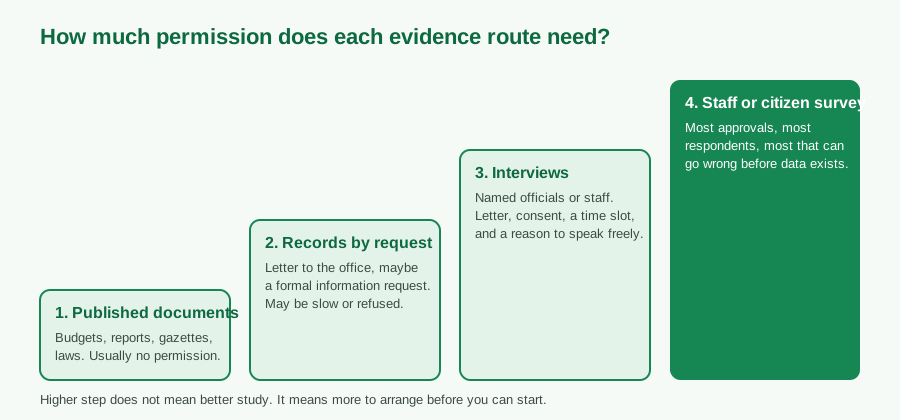
The figure below puts these routes on a ladder from least to most permission needed. Plan from the bottom up: a study that rests entirely on step four has the most risk.
A common and sensible combination is published documents as the backbone, with a small number of interviews to explain what the documents cannot. Whatever you choose, the route should follow from your question; see the research-design guide for how to match one to the other.
How do you write a case study of a ministry, agency or local government?
A case study means studying one bounded unit closely. In Public Administration the unit might be a single local government council, one state agency, or one department inside a ministry. "Bounded" matters: you must be able to say what is inside the case and what is not.
Define four things early:
- The unit. Exact official name, level of government and location. "A local government in Lagos State" is too loose; a named council is not.
- The period. A specific span, with a reason. If the documents you need only exist for some years, your period follows the documents.
- The activity. One function you will examine, such as revenue collection, a sanitation service, recruitment, or how a budget line moves from approval to release.
- The evidence. Which documents, which officials, which records, in what order.
A case study does not claim that what you find applies to every council or agency. It explains one well, and says honestly how far the lesson travels. The case-study guide walks through bounding and evidence in more detail, so use it alongside this one.
Examples of question shapes (provisional, to be checked for access and to be agreed with your supervisor):
- How does a named agency describe the steps for a particular service, and where do its own documents leave steps unclear?
- How did a named council's published budget describe spending on one service across a defined period, and what do officials say explains the pattern?
- How do staff in one department describe the process for a particular approval, and how does that match the written procedure?
None of these is a ready-made title. Each becomes a topic only after you confirm you can reach the documents or people it names.
How do you get permission to collect data in a government office?
This is the step students most often leave until too late. Rules differ by institution, level of government and even by office, so treat the points below as a typical pattern to confirm with your department, not a universal procedure.
- Ask your supervisor first. Find out what your department provides. Many departments issue an introduction letter addressed to the head of the target office; some require the supervisor's signature or the project coordinator's stamp.
- Identify the right office and person. Public bodies route correspondence through a registry or the head's office. A letter addressed to the wrong unit can sit for weeks. Ask someone who works there, or a previous student, who actually receives such requests.
- Write a short formal letter. State who you are, your department and level, the title or purpose of the study, exactly what you are asking for (documents, interviews, a survey of staff), the period it covers and a date you hope to hear by. Attach the department letter. Say how the information will be used, and that you will keep the responses confidential if that is what you are offering.
- Follow up politely and in writing. Keep a log of what you sent, when, to whom, and any reply. This log later becomes part of your methodology and helps if access is delayed.
- Have a fallback. If the office does not respond in time, a topic that relies on published documents lets you continue without starting over.
Do not promise confidentiality, anonymity or return of findings that you cannot deliver. And never present internal records or interview material as something you obtained when you did not.
Nigeria also has a Freedom of Information law (the Freedom of Information Act, 2011) that allows people to request information from public institutions. Whether and how it suits a student project, what is exempt, and how long an office has to respond are matters to confirm from the Act itself or from your supervisor. Do not assume a request will be answered quickly, or at all, before your deadline. Build your timeline so that your project does not depend on one reply.
Published government documents as evidence
Many strong Public Administration projects lean on documents that already exist. Useful categories include:
- Approved and revised budgets, and any published budget performance or implementation reports
- Annual or sectoral reports by a ministry, department or agency
- Policy documents, strategies and plans
- Laws, regulations, circulars and service charters
- Audit reports where they have been published
- Statistical publications that describe the sector you are studying
Not every office publishes everything, and what is online may be incomplete or out of date. Expect to spend real time just locating the right version.
Use the same discipline as with any source. Record the exact title, issuing body, date or fiscal year, version (approved or revised, draft or final), page or table, and the date you retrieved it. Note whether a figure is planned, released or spent; these are different, and mixing them is a classic error. Check the currency and units beside the table, and whether figures from different years are comparable.
A document tells you what an institution said at a moment in time. It does not on its own explain why something happened or whether a service improved. That is where a small number of interviews, or a second independent document, helps. Reading documents as evidence is also a method in its own right; the content-analysis guide covers how to code and report it, and the primary and secondary data guide helps you label what is which.
Fictional example: one local government idea
This is an invented worksheet. No real council, budget figures or findings are used.
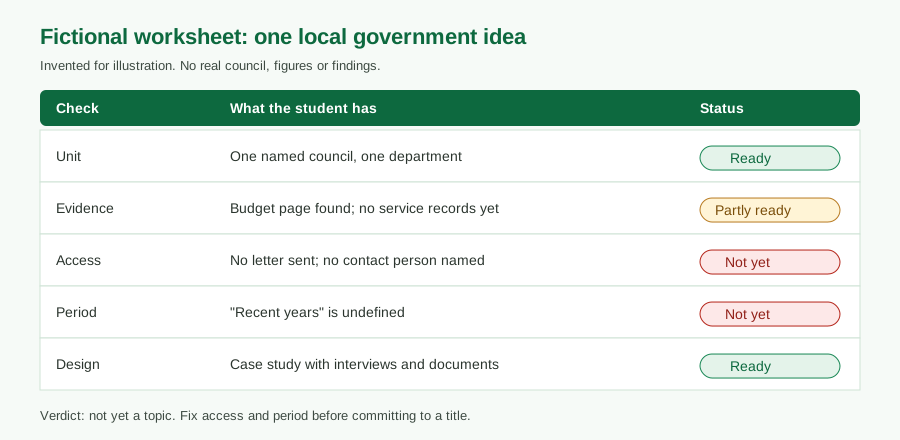
A student writes: "The impact of local government administration on rural development in Nigeria." It sounds like a topic. The worksheet below tests it against five checks after the student narrows it to one imaginary council.
What the exercise shows:
- "Local government administration" and "rural development" are both undefined. Neither names a function or a measure. The word "impact" also promises a cause-and-effect claim that documents and a few interviews cannot support.
- The "unit" and "design" are fine once a single council and a case study are chosen.
- The budget page has been found, but there are no service records, so the evidence is only partly ready.
- Access is not yet in place: no letter has been sent and no contact has been named.
- "Recent years" is not a period. The student must decide which years the documents actually cover.
The student's next step is not to start writing Chapter One. It is to pick one function, fix a period from what the documents cover, send the letter, and rewrite the question to something the evidence can answer, such as how the council's own documents describe one service across a defined span. Only then is the title worth finalising.
Survey and interview routes
If your supervisor expects primary data, think about whom you will reach and how.
Interviews. A small number of well-chosen officials (for example, a head of department, a desk officer who handles the process, and a former staff member) can explain why things work as they do. Prepare a short guide and a consent statement, and record carefully with the person's agreement. The interview guide explains how to build one, and it matters that you ask only what your research questions need. Expect junior staff to hesitate if they fear being identified; say clearly how you will protect them.
Staff or citizen surveys. A survey needs a defined population, a way to reach it and a reason people will answer. In an office, you may need the head's approval and a contact to distribute and collect forms. With citizens, you need a defined group (for example, users of one service at one location) and a sensible way to sample them. Think hard about how many responses you can realistically get; the questionnaire design guide helps with wording, and the sampling guide helps you justify who you reached and why.
Whichever route you choose, be explicit about who is missing. Officials may be more positive about their own institution than service users are; respondents you can reach are not always those who know most. These are limits to state, not reasons to avoid the study.
Ethics and sensitivity in public sector research
Public bodies handle politically sensitive matters, and your respondents may worry about being quoted. Keep identities protected where you have promised it, store files safely, and avoid naming individuals in a way that could harm them. Do not accuse an office of wrongdoing on the strength of a few documents or a single interview. The ethics and consent guide covers consent forms and confidentiality in student projects, and your department may have its own rules on top.
Common mistakes in Public Administration topics
- Choosing a national-scale title with no bounded unit or period
- Assuming records or respondents will be available without having asked
- Treating a planned budget figure as proof of what was delivered
- Claiming "impact" or "effect" from descriptive documents alone
- Sending the introduction letter in the last month
- Promising anonymity or confidentiality you cannot guarantee
- Copying a title from a project-material website without checking whether its evidence is available to you
Questions your supervisor or panel may ask
- Which exact unit and period are you studying, and why?
- What will you use as evidence, and have you already seen it?
- Who has given you permission, and in what form?
- What can your documents not tell you?
- How did you choose your interviewees or respondents, and who is missing?
- How are you protecting people who speak to you?
- What will you do if access is delayed?
Having written answers to these before your proposal defence makes the conversation much easier. If your department uses a proposal defence, the research questions and objectives guide helps you phrase the aims so they match the evidence.
Where to take it next
Bring your supervisor a one-page note: the proposed unit and period, the evidence you have already seen, the access you have requested, and the question shapes you are considering. If your seminar topic is the more immediate task, the Political Science seminar topics guide shows how to read and structure a source-based paper in a related field.
Once the question, access and method are agreed, UniDraft helps organise your confirmed work, checked sources and supervisor instructions into an editable Word project document. Start your project document, bringing your own evidence and checking every figure and claim yourself. UniDraft does not obtain permissions, find respondents, run your analysis or guarantee approval.