To deal with nervousness during a presentation, rehearse out loud in stages, memorise only your first minute, breathe slowly before you start, and pause whenever you notice yourself speeding up. To answer questions afterwards, listen, pause, restate, answer first and support second, then stop. If you do not know, say so and explain how you would find out.
The calmest defence starts with a report that is yours and that you understand. UniDraft organises your confirmed work, checked sources and supervisor instructions into an editable Word document, so when the panel opens your project you know where every claim came from. Start your project document and keep the rehearsal below for the part only you can do: standing up and speaking. UniDraft does not deliver the defence or build your slides, and it cannot guarantee a grade.
This post covers the delivery side: how you rehearse, open, breathe, pace yourself and handle the question-and-answer session. It does not repeat the content side. For the questions themselves, chapter by chapter, see 28 common project defence questions and how to answer them. For the slide plan, see how to prepare a project defense presentation. This guide is for the moment between knowing your work and being able to say it out loud in front of other people. It is written for final-year project students, but the same habits work for a seminar or a SIWES review. Panel style differs between departments and examiners, so treat everything here as a pattern, and follow your supervisor's instructions where they differ.
Why do I get so nervous before a defence?
Because it matters, and because you are being assessed in front of people who know more than you do. That is a normal reaction and not a sign that you are unprepared. The body prepares you for a challenge: a faster heartbeat, shallow breathing, a dry mouth, sometimes shaking hands.
Three facts from university skills guides are worth holding on to:
- Nerves are usually more visible to you than to the audience. A guide from the writing centre at Santa Clara University notes that audiences rarely notice behavioural signs such as shaking hands.
- Preparation is the main remedy. The same guide says that knowing your material and rehearsing it comes first, and that breathing and similar steps supplement preparation instead of replacing it.
- Rushing is the typical nervous habit. Several guides point out that nervous speakers speed up, which makes the talk harder to follow.
So the plan is not to eliminate nerves. It is to make the first minute automatic, keep your pace steady, and have a routine for questions you did not expect. If your nerves feel out of proportion, last for weeks, or interfere with daily life, speak to your university's counselling or health service. A study-skills blog cannot judge that, and nothing here is medical advice.
What is the best way to rehearse a defence?
Rehearse in rounds, with each round adding one kind of pressure. Reading your notes silently and thinking "I know this" is the most common way students under-prepare, because your mouth has not done the work.
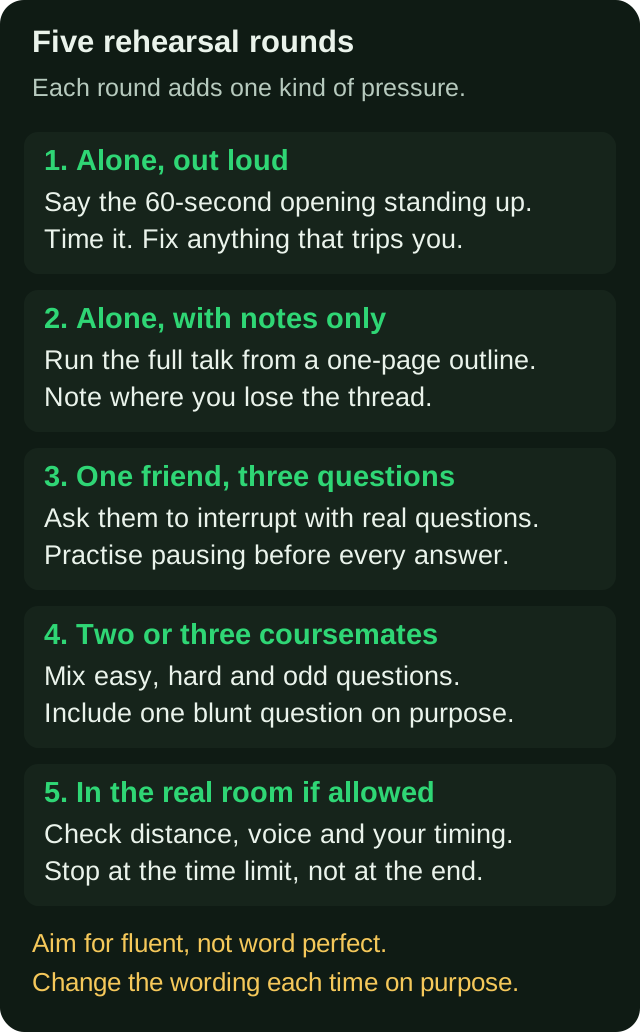
Round 1: alone, out loud, standing up. Say only your opening. Time it. The aim is a first minute that does not need thinking.
Round 2: alone, from a one-page outline. Run the whole talk using only an outline of headings and key numbers. Where you lose the thread is where your structure is weak, not where you are "bad at speaking". Fix the structure.
Round 3: one friend, three questions. Ask a friend to interrupt you with three real questions taken from your own chapters. Practise the pause before every answer. If your friend is not from your department, even better: you will find out quickly which parts of your explanation depend on jargon.
Round 4: two or three coursemates. Ask for a mix: an easy question, a hard one, and one blunt one ("Why should anyone trust this result?"). Practise answering the blunt one without becoming defensive.
Round 5: the real room, if you can. Ask whether you can stand in the defence room beforehand, or at least a similar one. Check how far your voice has to carry and where you will stand. Time the whole talk and stop at the limit.
A few rules that make the rounds work:
- Change your wording on purpose. If every run sounds identical, you are memorising sentences, not ideas. Say the same point three different ways.
- Record yourself on your phone. You will hate it for a minute, then notice that you say "you know" fifteen times or that you look at the floor during the results.
- Stop at the time limit. If your department gives you a time limit, ask your supervisor what it is and rehearse to it. Running over is a planning problem, not an emergency, but cutting slides on the day while panicking is avoidable.
- Do the last full run at least a day before. Cramming the night before raises your anxiety without improving the talk.
If you are using slides, building them is a separate job. The seminar presentation slide-structure guide covers it, and your slides are your own work, not something UniDraft produces.
How do I plan a 60-second opening?
The first minute is where nerves peak, and a smooth start tends to settle you for the rest, so put your extra effort into the introduction. Write it out, memorise it, and practise it more than anything else.
A four-part opening fits in about a minute:
- Greeting and name (5-10 seconds). "Good morning. My name is [name], and my project is on [topic]."
- The problem in one sentence (10-15 seconds). What gap or question made this project necessary?
- What you did (15-20 seconds). The objective and the method, in plain words.
- The roadmap (10 seconds). "I will cover the problem, the method, the main findings and what they mean, then take your questions."
Here is a fictional example for an invented project, so you can see the shape:
"Good morning, members of the panel. I am Ada Nwosu, and my project examines why some students at a university's hostel complex report unreliable evening internet access. Students in the hostel told me their study time was being disrupted, but there was little recorded evidence of when and where the problem occurred. I measured connection quality at three points in the complex over four weeks and compared the readings with survey responses from students. I will take you through the problem, the method, the main findings and their limits, and then I will be glad to answer your questions."
That is roughly 85 words, about 35 to 40 seconds at a calm pace. Notice what it does not contain: no apology, no "I am very nervous", no long thank-you list. If your department expects specific courtesies, follow them. For the detailed anatomy of opening lines and sample openings by discipline, see how to start a seminar or project defense presentation. This post stays with the delivery habits.
Two small habits help. First, take one slow breath at the front before you say a word. A one-second pause looks composed and gives you time to find your first line. Second, memorise a recovery line for a blank: "Let me begin that again." Say it, return to your first sentence, and carry on. Panels have seen it many times.
What do universities actually say about breathing and pace?
You do not need a ritual. The common thread in university skills guides is simple: breathe slowly before you start, and use your breath to control your speed during the talk.
- Before you start. The Santa Clara University guide describes a few minutes of slow breathing before speaking: in through the nose for a count of four, hold for four, out through the mouth for a count of four. The NHS describes a simpler version for stress: breathe in gently and steadily counting to five, then out gently counting to five, without forcing the breath and counting only as far as feels comfortable. Pick the one that feels comfortable. If holding your breath makes you feel worse, skip the hold and just slow down.
- During the talk. Santa Clara's advice is to pause and take a calming breath whenever you notice your pace speeding up or your breathing becoming shallow.
- For your eyes. The Santa Clara guide suggests dividing the room into sections and looking at each in turn instead of jumping from face to face or staring at the screen.
- For your notes. Write them in large, clear type so a glance is enough.
- Do not overdo stimulants. The same guide says too much caffeine can worsen physical symptoms of nerves. You do not need to give up tea or coffee; just avoid a heavy dose before you speak.
Practise the breathing before the day. A technique you have never tried is unlikely to help at the exact moment you reach for it.
A simple pacing routine
- Say one idea, then pause. Finish a thought, breathe, then start the next. Your breathing becomes the rhythm.
- Pause after numbers. After a key figure, stop for a second so the panel can write it down or look at the table.
- Slow down on your name, topic and conclusions. Those are the parts the panel most needs to catch.
- Use the pause as a tool. Implementing pauses gives you a moment to gather your thoughts and puts emphasis on your point.
How do I answer questions after a presentation?
Think of the question session as part of the defence, not an extra. The University of Waterloo's presentation guidelines call it the "presentation after the presentation", and a good answer leaves as much impression as the talk itself. The steps below combine advice from several university guides.
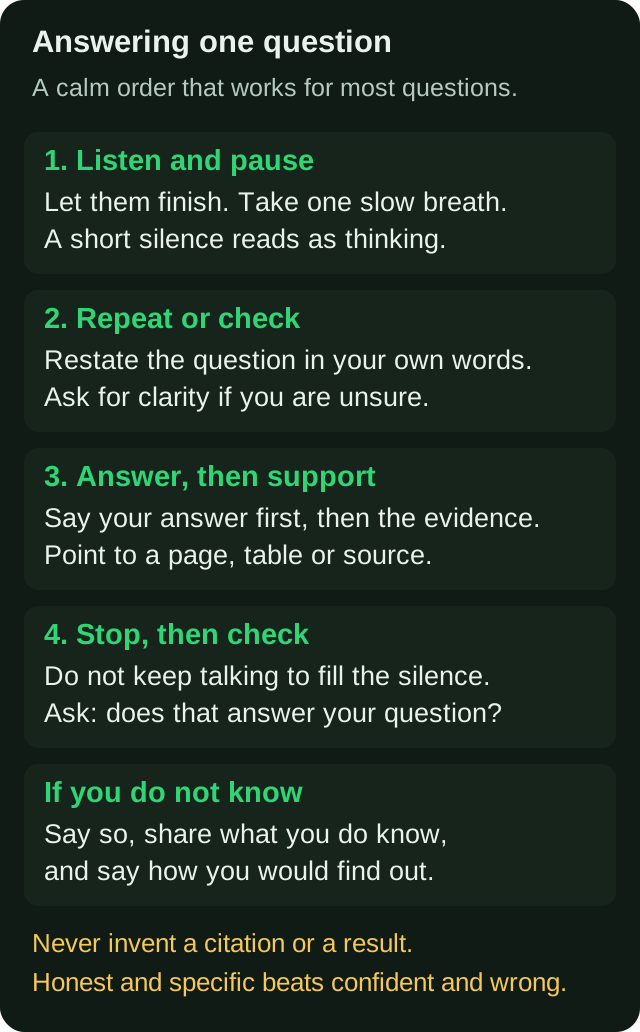
- Listen to the end. Do not start composing your answer while the panellist is still speaking. Interrupting is the quickest way to answer a question that was not asked.
- Pause. Waterloo's guidelines say only simple factual questions call for an immediate reply. A hard question deserves a breath.
- Restate or confirm. Repeat the question in your own words, or ask a short clarifying question. This confirms you heard it correctly, and it gives you time to think. In a defence with one panel, a quick "If I understand correctly, you are asking whether..." works well.
- Answer first, then support. Give the conclusion in one sentence, then the evidence: a page, a table, a source. "Yes, the result held across all three sites. Table 4.3 on page 52 shows..." is better than a long wind-up before the answer.
- Answer the question that was asked. Waterloo's guidelines warn that swapping in an easier question is obvious to the audience.
- Stop. Silence after your answer is fine. Do not fill it with extra material that opens new lines of questioning.
- Check. If the question was open-ended, ask, "Does that answer your question?"
It helps to know the pattern most people prefer for tricky questions. The University of Guelph's learning commons uses the "ABCs": Acknowledge the question, Be honest, and Contribute what you do know. Whatever the guide, the shared advice is to prepare answers to the questions you feel least sure about.
A worked example: three fictional exchanges
These conversations are invented to show the habits in action. They are not real panel questions, and your panel will word things differently.
Exchange 1: a clear question you can answer.
Panel member: Why did you choose three measurement points and not five?
Student: (pauses, breathes) So, why three points rather than five? The reason is access. These were the three places I had permission to take readings, and my supervisor agreed the choice with me. The limit is that three points cannot represent the whole complex, and I say that in my limitations section on page 61. Does that answer your question?
The student restates, answers first (access), points to a page, admits the limit honestly, and stops.
Exchange 2: a question you do not know.
Panel member: How would your results change if the readings had been taken during the examination period?
Student: I did not test that, so I cannot give you a number. In my data, readings were weakest on the evenings when the most students were online, so I would expect the pattern to be at least as strong, but I would want data to confirm it. If I extended the study, taking readings across the exam period would be the first change I would make.
The student is honest, uses the ABC pattern, gives a reasoned guess labelled as a guess, and says how they would check. They do not invent a statistic.
Exchange 3: a hostile question.
Panel member: Honestly, this looks like a small and weak study. Why should we take it seriously?
Student: (pauses) That is a fair concern about size, and it is one I should address directly. The study is small. Its purpose was to document the problem where no records existed, and it did that for the three locations I measured. I have not claimed it applies to the whole complex. A larger study using the same method would be the natural next step.
The student separates the fair point (small size) from the sharp tone, concedes what is true, restates the purpose and the limits, and does not argue.
How do I buy time without sounding evasive?
A short pause is the cleanest way. You can also use a few honest phrases that give you three to five seconds:
- "Let me make sure I have understood: you are asking about..."
- "That is worth thinking through. My first answer is..."
- "Could you tell me which table you are referring to?"
- "Let me find the exact figure so I do not misquote it." (Then do so calmly.)
What not to do: stall with a long, vague introduction that never reaches the answer, or repeat "that is a very good question" before every reply. One acknowledgement is fine. Ten is noise.
What if I do not know the answer?
This is what most students dread, and it is more manageable than it feels. Two university sources agree on the main steps. Guelph's guide says it is acceptable not to know, as long as you do not pretend. Waterloo's guidelines put the cost plainly: saying "I don't know" can cost a little credibility, but a wrong answer or a lie costs far more.
- Say it plainly. "I did not examine that directly."
- Share what you do know. The related finding, method or source that is closest.
- Offer a reasoned guess, labelled as one. "My expectation would be... but I have not tested it."
- Say how you would check. The source you would consult, the analysis you would run, or the person you would ask.
- Do not invent. No made-up citation, no remembered "statistic", no result you did not obtain.
If the panel points to a real mistake in your work, such as a wrong figure or a mislabelled table, acknowledge it, say what effect it has on your conclusions, and say how you would correct it. Errors raised at the defence usually return to you as corrections, so it helps to read about managing supervisor corrections without losing earlier work.
How do I handle a hostile or very long question?
Stay polite and slow down. Northern Illinois University's presentation guidance says not to respond in kind, and to separate fair criticism from personal attack and address the valid points. Waterloo's guidelines add that a curt reply sours the room, and that misunderstandings should be corrected gently.
A simple script:
- Pause. Breathe.
- Name the fair part. "That is a fair concern about..."
- Answer the fair part with evidence from your project.
- Correct any misunderstanding without saying "you are wrong". "As I understand it, the study measured X, not Y, so..."
- Stop. Do not add a sharp last line.
If a question is outside your scope, say so politely and explain the boundary: "That is outside what this study measured. It would be a good question for further research." NIU's guidance supports offering to discuss it afterwards.
If a question is very long or has several parts, write down the parts as you hear them. Then say, "I heard two questions: one about the sample and one about the result. Let me take the sample first." Answer each part in order and check at the end that you covered them.
If the panel members disagree with each other, do not take sides. Answer each point on its evidence, and let your supervisor or the chair guide the session. You are there to explain your work, not to win an argument.
What should I do in the last 24 hours?
- Run the opening twice. Out loud, standing up, timed.
- Do one full run from your outline. Not three. Stop at a reasonable time and sleep.
- Prepare your page markers. Flag the pages for your main tables, your method and your limitations so you can find them in seconds.
- Check the logistics. The time, the room, what to bring, what to wear, how you will reach the venue, and what your department expects you to bring (printed copies, a laptop, a flash drive). If your department told you something different from what is here, follow your department.
- Write your three recovery lines on a card: "Let me begin again", "Let me check the figure so I do not misquote it", "I did not test that directly, but...".
- Eat and drink water. Keep stimulants moderate, as the Santa Clara guide advises.
- Don't start something new. A new analysis the night before is rarely worth the risk.
On the day, arrive early, breathe, and remember that the panel's job is to understand and test your work, not to catch you out for sport. Some questions will be hard. That is part of the exercise.
Common mistakes students make
- Memorising a full script. One lost sentence and the whole thing collapses.
- Apologising up front. "Sorry, I am very nervous" gives the panel something to focus on that they might not have noticed.
- Rushing the first minute. The fastest part of the talk is usually the part that needs the most care.
- Answering before the question ends. You answer what you expected, not what was asked.
- Bluffing. The panel probably knows the area better than you do, and bluffing damages your credibility on every earlier answer.
- Arguing. Winning the point and losing the room is not a win.
- Over-explaining. Long answers open more questions. Answer, support, stop.
- Not rehearsing the questions. Many students rehearse the talk and not the Q&A, which is the part with the most uncertainty.
Where UniDraft fits in
Confidence in a defence comes largely from knowing why each part of your report says what it says. UniDraft helps you assemble your project from what you have confirmed: your own work, checked sources and your supervisor's instructions, organised into an editable Word document you can review line by line. The free citation finder can help you check sources, and the free formatter is there for questions about layout; for your own department's rules, always follow your supervisor. UniDraft does not make your slides, deliver the defence or guarantee any outcome. When you are ready, start your project document. If you are still deciding the shape of your defence, what a project defence is and how to prepare for it is a good place to begin, and the SIWES defence guide covers the placement version.
Sources
- University of Guelph Learning Commons: The ABCs of answering difficult questions in academic presentations, for acknowledge, be honest, contribute what you know.
- Santa Clara University Writing Center: Calming your nerves, for breathing, pausing when you speed up, scanning the room, and the point that audiences rarely notice nerves.
- University of Waterloo (ECE): Guidelines for answering questions, for repeating questions, pausing, not bluffing, and gentle handling of hostile questions.
- Northern Illinois University: Handling questions and answers, for staying composed with critical questioners and out-of-scope questions.
- NHS: Breathing exercises for stress, for the slow in-through-nose, out-through-mouth counting exercise.