
Harvard referencing is an author-date system: you cite the author's surname and year in the text, such as (Okoro, 2023), and list every cited source alphabetically at the end. There is no single official Harvard; each university publishes its own version, so follow the guide your department or supervisor names.
UniDraft organises your confirmed work, checked sources and supervisor instructions into an editable Word document for your final-year project. If your department wants Harvard, start your project document and tell the platform what your supervisor requires. You still read each source and check every citation yourself.
All names, years, titles and publishers below are fictional format placeholders, not real studies. Replace them with details from sources you have actually opened.
What is Harvard referencing, exactly?
Harvard is a generic term for author-date referencing. ANU's referencing page says plainly that there is no definitive Harvard style guide, and notes that several institutions base their versions on an Australian government publishing guide. The Nelson Mandela University library says its own Harvard guide may differ from other Harvard guides, and tells students to ask their lecturer or department if unsure which version to use. (Both pages are listed under Sources.)
The features nearly every version shares:
- In-text citation: author surname and year, either in brackets at the end of a statement or built into your sentence.
- Reference list: alphabetical by first author's surname, at the end of the document, listing only works you cited.
- Consistency: pick one version and apply it everywhere.
What changes between versions is the fine print: punctuation, italics, quotation marks, how many authors trigger "et al.", and whether web addresses carry an access date. That is why a Harvard example from a random website can be "right" and still wrong for your department.
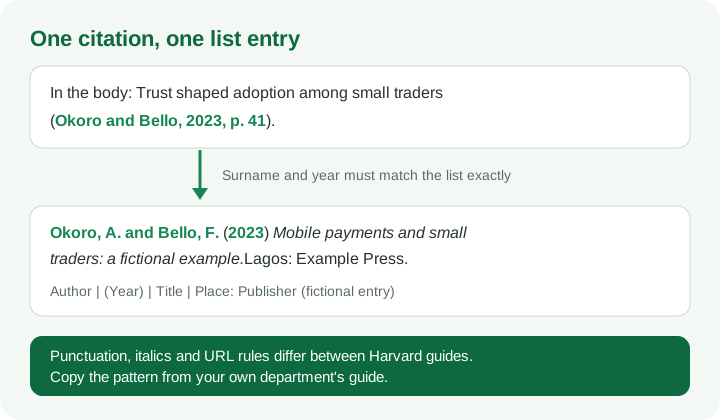
Which Harvard version should I follow?
Work down this order and stop at the first answer you find:
- Your supervisor's written instruction. It outranks everything else.
- Your department's project guideline or handbook. It may name a guide, or may only say "Harvard".
- Your university library's referencing page. Many libraries publish a Harvard guide with examples.
- A well-known published version, only if nobody has told you otherwise, and only after you ask. The Open University's quick guide to Harvard (Cite Them Right) is a widely used UK version, and the examples in this post follow its general pattern, with variations noted.
Do not mix versions. If Chapter 2 uses "and" between two authors and Chapter 4 uses an ampersand, a supervisor will mark it as inconsistent, which is an easy mark to lose. For the wider question of confirming your style before you write, the references guide compares APA, IEEE and Harvard side by side.
How do in-text citations work in Harvard?
Patterns from the Open University's Cite Them Right quick guide, shown with fictional names:
| Situation | Parenthetical | Narrative |
|---|---|---|
| One author | (Okoro, 2023) | Okoro (2023) found... |
| Two authors | (Okoro and Bello, 2023) | Okoro and Bello (2023) argue... |
| Three authors | (Okoro, Bello and Musa, 2023) | Okoro, Bello and Musa (2023)... |
| Four or more | (Okoro et al., 2023) | Okoro et al. (2023)... |
| Direct quotation | (Okoro, 2023, p. 41) | Okoro (2023, p. 41) writes... |
| Page range | (Okoro, 2023, pp. 41-42) | Okoro (2023, pp. 41-42)... |
| Web page, no page numbers | (Okoro, 2023, para. 3) | Okoro (2023, para. 3)... |
| Secondary source | (Bello, 2019, quoted in Okoro, 2023, p. 17) | Bello (2019, quoted in Okoro, 2023, p. 17)... |
| No date | (Okoro, no date) | Okoro (no date)... |
Two things to notice. First, the et al. threshold in this guide is four authors, with three authors listed in full. Other Harvard guides set a different number, and APA 7 shortens from three. Check your guide rather than carrying a rule across. Second, only the source you actually read goes in your reference list. If you met a study through another author, cite it as a secondary source and read the original if the claim matters. The same discipline applies in every style; the APA in-text guide covers it in more depth.
For several sources supporting one point, list them in one bracket separated by semicolons, in the order your guide specifies. Cite only sources that really support the claim.
How do I write Harvard reference-list entries?
Reference lists are arranged alphabetically by first author's surname, and authors stay in the order the source gives them. A list that includes background reading you did not cite is a bibliography; ask your supervisor which one the heading means.
Book
Pattern: Surname, Initial. (Year) Title of book. Edition if later than the first. Place: Publisher (some guides omit the place).
Okoro, A. and Bello, F. (2023) Mobile payments and small traders: a fictional
example. 2nd edn. Lagos: Example Press.
Journal article
Pattern: Surname, Initial. (Year) 'Title of article', Title of Journal, volume(issue), page range. Available at: DOI or URL (Accessed: date).
Musa, K. (2022) 'Trust and mobile payment use among market traders: a fictional
example', Journal of Example Studies, 14(2), pp. 55-78. Available at:
https://doi.org/10.0000/example (Accessed: 12 October 2026).
Note the single quotation marks around the article title and the italicised journal title (in your Word file, italicise the journal name; plain text cannot show it). The Open University guide's own article example has the same shape, including the DOI and access date.
Website or web page
Pattern: Author or organisation (Year last updated) Title of web page. Available at: URL (Accessed: date). If no person is named, use the organisation that runs the site as the author.
Example Regulatory Agency (2024) Guidance for agent banking operators.
Available at: https://www.example.org/guidance (Accessed: 12 October 2026).
This also answers the common search "how to cite a website": find the author or issuing organisation, the year, the exact page title, the address, and the date you opened it. If the page shows no date, many guides want "no date" in both the citation and the list.
Report
The Open University's quick guide does not cover reports and sends students to the full Cite Them Right database, so treat this as an illustrative pattern and confirm your own guide's version. A common shape treats the issuing organisation as author:
Example Regulatory Agency (2021) Annual review of retail payments. Abuja:
Example Regulatory Agency. Available at: https://www.example.org/review
(Accessed: 12 October 2026).
Keep the same elements for every report: issuing body, year, full title, place and publisher if your guide asks for them, and a web address if you read it online. Include a report number if the report carries one.
Thesis or dissertation
The Open University guide does not cover theses either, and guides disagree on layout, so again this is illustrative. A frequent shape is author, year, title, the type of degree, and the institution:
Bello, F. (2020) Cash habits of petty traders: a fictional example. MSc
dissertation. Example University.
If you read it from a repository, add the address and access date as your guide directs. Before you cite a thesis, ask whether your department accepts unpublished theses as evidence at all; some supervisors prefer journal articles and books.
How is Harvard different from APA?
They share the author-date idea, which is why students mix them up. The differences below come from comparing the Open University Harvard guide with APA 7, as described in the APA 7 in-text post. They are typical differences, not universal ones, because Harvard versions vary.
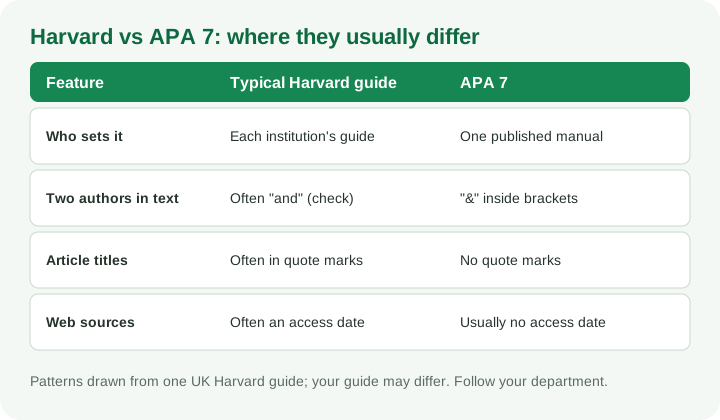
| Feature | Harvard (OU Cite Them Right) | APA 7 |
|---|---|---|
| Rule source | Institution's own version | Publication manual |
| Two authors in text | Okoro and Bello, 2023 | Okoro & Bello, 2023 inside brackets |
| Et al. | Four or more authors | Three or more authors |
| Journal article title | In single quotation marks | No quotation marks |
| Web sources | Available at: URL (Accessed: date) | Usually the URL without an access date |
| Reference list heading | Reference list or Bibliography, as told | References |
APA's own rules are laid out in the sibling post, so this guide does not repeat them. What matters here is the practical consequence: you cannot convert a list from one style to the other by changing a few commas. Rebuild each entry from the real source.
A worked example: one paragraph, then its list
Fictional literature-review paragraph in Harvard style:
Trust is repeatedly named as a barrier to mobile-payment use among small
traders (Okoro and Bello, 2023). Musa (2022) reported that fees mattered less
than trust, while the Example Regulatory Agency (2021) emphasised agent access.
The matching reference list, alphabetical by first author:
Example Regulatory Agency (2021) Annual review of retail payments. Abuja:
Example Regulatory Agency.

Musa, K. (2022) 'Trust and mobile payment use among market traders: a
fictional example', Journal of Example Studies, 14(2), pp. 55-78.

Okoro, A. and Bello, F. (2023) Mobile payments and small traders: a
fictional example. 2nd edn. Lagos: Example Press.
Check the three links between text and list: surname spelling, year, and number of authors. A year that changed from 2022 to 2023 in one place only is the most common slip after a late edit.
What should I ask my supervisor before I start?
Five short questions save a lot of rework. Ask them once, in writing if you can, and keep the reply with your notes:
- Which Harvard version, or which library guide, should I follow?
- Is the heading "References", "Reference list" or "Bibliography", and does it include uncited background reading?
- Should web sources carry an access date and a full address?
- Do you accept theses, company reports and unpublished documents as sources, and how should they be cited?
- Do I use the guide's punctuation exactly, even where it differs from what I learned in another course?
Supervisors may also ask at a defence how you chose a source, or why a cited study was not in the original paper you read. Keep your reading notes, so that you can answer from what you actually opened.
Where do I find sources I can cite with confidence?
A perfectly formatted citation of a source that does not exist, or that you never opened, is worse than a rough one. Search first, then read: the guide on finding research papers covers search routes, and reading a research paper shows how to extract what you need without skimming blindly.
The free citation finder searches OpenAlex, an open index of published academic work, and returns real papers with their authors, year and DOI where one exists. You can then copy a citation in APA, IEEE or Harvard. Treat the Harvard output as a starting point: the tool offers one Harvard rendering, your department's version may differ in punctuation, author counts or access dates, so compare it with your guide. It also does not read the paper for you, and some Nigerian journals are thinly covered in open indexes, so combine it with your library and your supervisor's reading list.
Mistakes supervisors flag in Harvard lists
- Mixed versions or mixed styles: Harvard in one chapter, APA in another, or "and" and ampersands together.
- Copied access dates: write the date you actually opened the page, not a date from someone else's example.
- Web pages with no author: the organisation is the author, not "Anonymous", unless your guide says so.
- Cited but not listed, or listed but not cited: check both directions before submission.
- Wrong et al. rule: using the three-author APA habit in a guide that lists three authors in full.
- Unread sources: an examiner can ask about any cited source at your defence. The literature review guide explains how to cite sources as part of an argument rather than a pile of summaries.
- Invented page numbers or years: use "no date" and paragraph numbers instead.
Pre-submission checklist
- My supervisor or department confirmed Harvard, and I know which guide.
- Every in-text citation has a list entry and every entry is cited.
- The et al. rule matches my guide, not another style.
- Direct quotations carry p., pp. or para.
- Web entries have the author or organisation, year, title, address and a real access date, if my guide asks for them.
- Reports and theses follow my guide's pattern, not a guess.
- I opened and read every source I cite.
- Font, spacing and margins are checked separately; see the notes on formatting a project for a Nigerian university.
The free formatting checker compares a .docx with university layout rules such as font, spacing and margins. It does not check citations, so the list above is still your job.
Where UniDraft fits in
UniDraft builds your project document around your confirmed topic, real results and the instructions you supply, with supervisor instructions taking priority over general patterns. It does not guarantee reference accuracy, approval or a grade. When your supervisor sends corrections, you supply them and a new version is produced while earlier versions are kept; see managing project corrections. For the full writing sequence, the step-by-step project guide shows where referencing fits.
Sources
- The Open University: Quick guide to Harvard referencing (Cite Them Right), for in-text patterns, book, article and web-page entries, and list ordering.
- ANU: Harvard referencing, for the statement that there is no definitive Harvard guide and the core features.
- Nelson Mandela University Library: Harvard Reference Style, for the warning that Harvard guides differ and students should ask their department.