If you're staring at a blank document with a submission date circled in red, the format is usually the easiest part to get wrong -- not because it's hard, but because the rules are scattered across a department handout, a supervisor's comments, and whatever your friend's report from two sessions ago happened to look like. This guide lays out the structure most Nigerian universities expect, in the order it actually gets checked.
The rule of precedence
Before touching fonts or margins, know that formatting rules apply in this order, highest priority first:
- Direct instructions from your supervisor -- if they told you something specific in a meeting or a marked-up draft, that wins over everything else.
- Your department's project-writing guideline -- the document (often a PDF) your department hands out or publishes for your course.
- Your university's general baseline -- the institution-wide format, used when your department hasn't specified something more specific.
Getting this order backwards -- following a generic template instead of your department's actual guideline -- is one of the most common reasons a report bounces back for corrections.
Standard preliminary pages
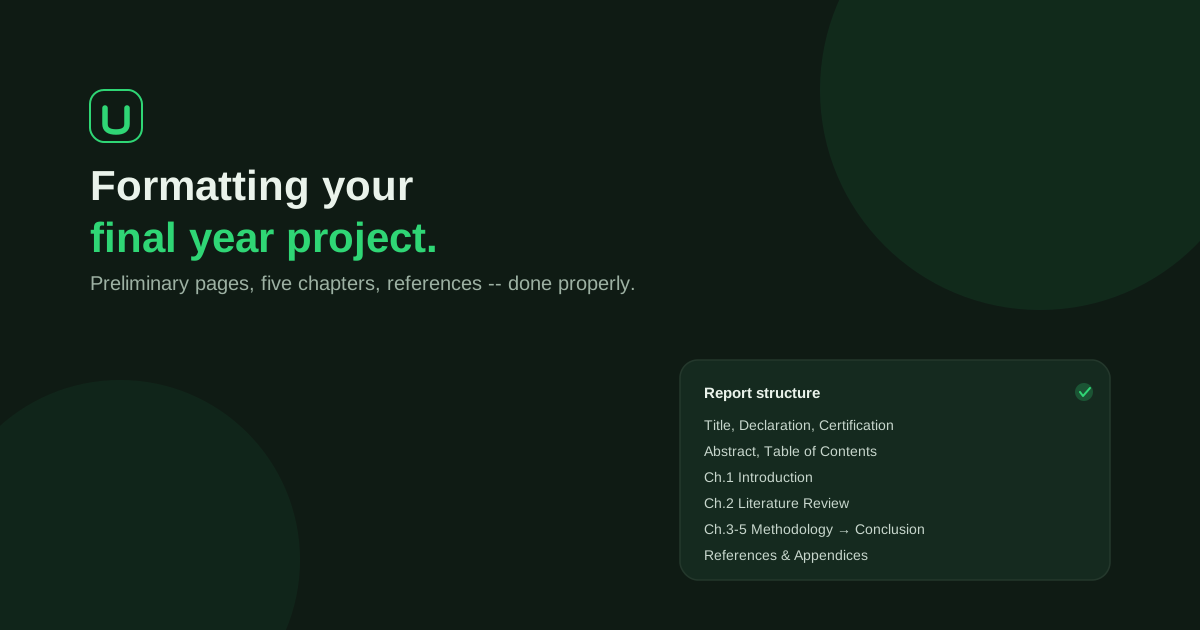
Before Chapter 1, most Nigerian university reports expect these pages, in this order:
- Title page -- project title, your full name and matric number, department, faculty, university, degree, and submission date.
- Declaration -- a statement that the work is your own.
- Certification -- signature lines for your supervisor and head of department.
- Dedication -- optional, but expected if included to be personal, not a placeholder.
- Acknowledgement.
- Abstract -- a single page summarizing the problem, method, and outcome.
- Table of Contents, List of Tables, and List of Figures.
These are typically numbered with lowercase Roman numerals (i, ii, iii…), switching to Arabic numbers from Chapter 1 onward.
The five-chapter structure
The most common structure across Nigerian universities -- especially for IT, Computer Science, and Engineering final-year projects -- is:
Chapter 1: Introduction
Background of the study, problem statement, aim and objectives, significance, scope, and limitations.
Chapter 2: Literature Review
A review of existing work, systems, or theories related to your topic, ending with the gap your project addresses.
Chapter 3: Methodology
How you approached the problem: research design, tools, system design (for technical projects), or data collection method.
Chapter 4: Implementation, Results and Discussion
What you built or found, presented with real screenshots, tables, or data -- not invented figures.
Chapter 5: Summary, Conclusion and Recommendations
A wrap-up of what was done, what it means, and suggestions for future work.
Some departments split this differently -- for example, a dedicated "System Design" chapter in Computer Science, or a "Results and Discussion" split from "Implementation" in Engineering. Confirm your department's exact chapter breakdown before you start writing -- restructuring five chapters after they're written costs far more time than checking first.
Formatting defaults (check your department first)
| Element | Common default |
|---|---|
| Font | Times New Roman, 12pt |
| Line spacing | 1.5 or double |
| Margins | 1.5" binding edge, 1" others |
| Alignment | Justified body text |
| Page numbers | Roman numerals (preliminary), Arabic (Chapter 1 onward) |
These are common defaults, not universal rules -- your department's guideline or your supervisor's instruction always takes precedence over a generic table like this one.
The mistakes that actually get reports sent back
- Formatting drift -- Chapter 1 is Times New Roman 12pt double-spaced, but Chapter 4 quietly shifts to single spacing because it was pasted in from another document.
- Citations that don't match the reference list -- an in-text citation with no corresponding entry in References, or vice versa.
- Invented or unverifiable results -- findings, figures, or approvals that can't be traced back to something you actually did or measured.
- Leftover placeholders -- a dedication that still says "[Your Name Here]," or a department name copied from a template that isn't yours.
Where UniDraft fits in
This is exactly the gap UniDraft was built to close: your supervisor's instructions, your department's guideline, and your university's baseline are applied in that precedence order automatically, so page 1 and page 90 follow the same rules -- and nothing in the document is invented. You bring your topic and your real results; UniDraft builds a submission-ready .docx around them.