
A good History project topic names one question, a defined period and place, and a source set you can really get hold of. The title is the last thing to settle, not the first. If you cannot say which documents, publications or people will give you evidence, you have an interest, not yet a project.
UniDraft's free topic generator can help you build a shortlist, which you then test against the checks below and your supervisor's brief. When your question and sources are settled, UniDraft organises your confirmed work, checked sources and supervisor instructions into an editable Word document. Start your project document once you know what you can evidence.
This guide is different from the existing History seminar guide, which is about a shorter, source-reading seminar. A final-year project asks for more sustained research, so the questions here are about scale, access, ethics and finishing. Nothing below is a list of approved or completed titles, and no historical finding is claimed.
What makes a History project topic finishable?
A History project is finishable when the question, evidence and time match. Most unfinishable titles fail on one of those three:
- The question is too big, for example a whole country across a century.
- The evidence is out of reach: closed collections, records in poor condition, or people you cannot contact.
- The time is wrong: archival travel and interviews take longer than students expect.
The general project-topic selection guide covers brief, supervisor and deadline checks that apply to every department. Here we add what is particular to History.
How do primary and secondary sources work in a History project?
A primary source comes from the period or event you study: a letter, an official file, a newspaper issue from the time, a photograph, or an account from someone who took part. A secondary source interprets that past later: a journal article, a book chapter, a thesis.
The label depends on your question, not on the item. Take a newspaper article: written by someone who lived through an event, it is primary evidence for that event; written many years afterwards, it is secondary. A later memoir, for example, can be secondary for a historian of the events but primary for a project about how that period was remembered.
This is a different use of "primary" from the research-methods meaning in other departments, where primary data means observations the student collects personally. Your supervisor may use either vocabulary, so ask. The primary and secondary data guide explains the methods meaning if your department mixes the two.
A practical rule: your argument should rest on sources, and secondary works should show you the debate, not substitute for the evidence. A project built only from textbooks is a literature summary. Check what your department expects, because some projects are expected to be archival or oral and some are historiographical.
Where can you find sources in Nigeria, and how does access work?
Be honest in your proposal about what you have actually found. Four routes are common, and each has an access question to answer before you promise anything.
| Route | What it can offer | Check before committing |
|---|---|---|
| National Archives of Nigeria | Government and administrative records, according to its official description of its mandate | Which branch holds your period and place, how to apply to consult records, condition of the material |
| University and national libraries | Books, theses, journals, some newspaper holdings | Whether the exact issues or volumes you need exist, and your borrowing or reading rights |
| Institutional or family records | Minutes, registers, letters, photographs | Permission to see and quote them, and who owns them |
| Oral testimony | Memories of participants and witnesses | Ethics approval, consent, and whether informants are alive and reachable |
What does the National Archives of Nigeria hold?
The Federal Ministry of Information describes the National Archives as responsible for locating, assembling and preserving documentary sources for research, holding federal government archives and other historical records under the National Archives Act 1992. Its page names headquarters, zonal offices at Ibadan, Kaduna and Enugu, and branch offices serving nearby states.
A 1991 description of the Ibadan branch in the journal History in Africa says it serves the former Western Region and holds official papers of governments, native and local authorities, private individuals and families, and missions. That is an old article and tells you what the collection contained then, not what you can consult today.
How do you get access, and what should you not assume?
We could not find a current public statement of reading-room rules, fees or opening hours from the sources we opened, so this guide gives none. The ministry's own page says that equipment is obsolete, that zonal buildings have deteriorated, and that digitisation would help researchers but does not say it is complete. So:
- Do not assume records you need are digitised or online.
- Contact the relevant branch directly, in writing where possible, before planning travel. Ask what you must bring, what registration involves, and whether the files for your period are available to consult.
- Ask your supervisor or a lecturer who has used the archive for a letter of introduction if one is customary.
- Record what you could and could not see. A file that was unavailable is a limitation to report, not something to guess at.
If a visit is impractical for your timetable, say so early. A project can be built from published collections of documents, newspapers held in a library, and carefully chosen secondary scholarship, provided your department accepts that design.
How do you do oral history ethically?
Oral history means recording people's memories of the past through interviews. It can give you evidence that no file contains, but because it involves people it is human-participant research, even when the subject is long ago.
The Oral History Association's principles, summarised in a Boston Public Library guide, stress that participation and consent continue throughout the process, that narrators must agree before an interview is made public, and that interviewers should be upfront about how recordings will be shared and used. The same principles ask you to respect narrators, protect them from harm when they discuss painful experiences, and think about the power gap between interviewer and narrator. That guide is a general professional source from outside Nigeria, so your own institution's rules come first.
In practice, plan these steps:
- Ask your supervisor what ethics approval or departmental process applies. Do not start interviewing before you know.
- Explain the project in plain language: who you are, what the project is for, how the recording will be used, who will see it.
- Record consent. Use a written form or ask for consent on the recording, as your department directs. A worked layout is in the informed consent form guide.
- Say clearly that a person can refuse a question or stop. Do not pressure someone to talk about painful events.
- Agree how names will be used. Decide with the narrator, in advance, whether they are named or anonymous. Do not promise control over the final text that you cannot keep.
- Keep the recording, notes and consent record safely and tell the narrator how long you will keep them.
The broader research ethics and consent guide covers permission and data protection for every kind of student project, and the interview guide helps you draft questions. An interview is evidence, not proof: people remember selectively, so compare what you hear with documents where you can.
How do you check a source in plain terms?
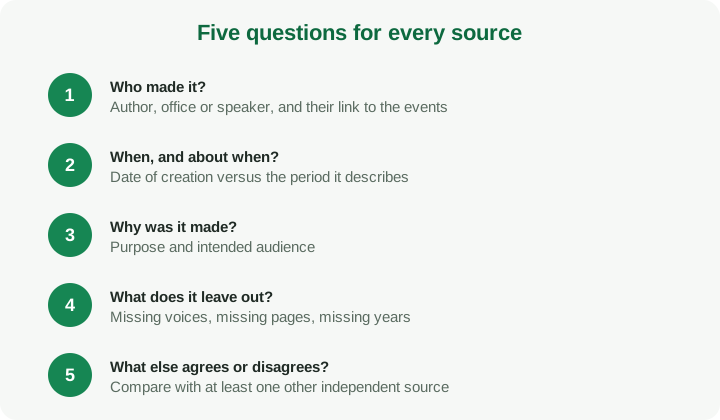
Historians call this source criticism. You do not need jargon to do it. For each source, answer five questions, and write the answers in your notes.
The U.S. National Archives teaching page "History in the Raw" makes the same underlying points: sources carry their authors' points of view, readers bring their own bias, and reliability is judged by looking for bias, contradictions and limitations. Its examples are American, so use it for method only.
Applied simply:
- Who made it and what was their link to events? An eyewitness, an official, and a later commentator will each see different things.
- When was it made, and about which period? A document written years after an event is not a record of that moment.
- Why was it made, and for whom? A tax return, a mission report, an election pamphlet and a private letter exist for different reasons.
- What is missing? Gaps in a newspaper run, torn pages and unrecorded voices limit what you can say.
- What does another source say? Where two independent sources agree you can be more confident; where they differ, explain the difference rather than choosing silently.
Source criticism is also where you stay honest. Do not claim a document shows why someone acted unless the document says so. Say what it shows, and what it leaves open.
How do periodisation and scope control work?
Periodisation means choosing the start and end of your study. Any boundary is a decision you must defend. A date like a colonial amalgamation or an independence year is a convenient anchor, but ask whether your sources support it. If your evidence begins later or stops earlier than your chosen period, change the period, not the evidence.
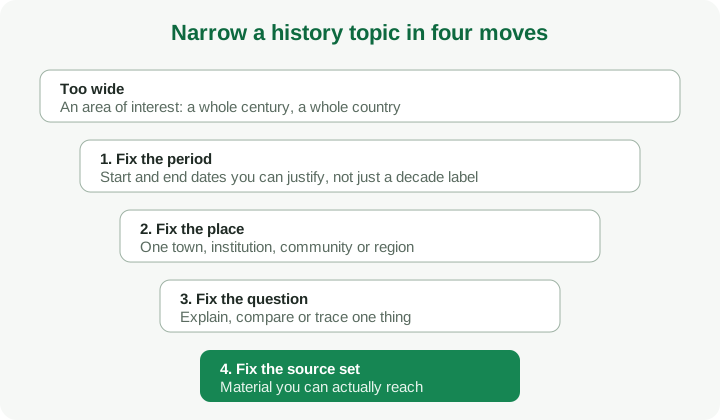
Scope control is the habit of shrinking before you begin. These moves usually help:
- Shorten the time span to what the sources cover well.
- Pick one place: a town, an institution, a community, a market, a school.
- Pick one dimension of the story, such as one policy, one institution or one practice, rather than "development".
- Pick one kind of comparison: two newspapers, two periods, or official and local accounts.
For a source-based method that takes a defined set of texts and codes them systematically, see content analysis. It suits newspapers, speeches or reports when your supervisor agrees that design, but it is a method choice, not a requirement for History.
How do you avoid an unfinishable title?
Test any title with these questions. If you answer "I don't know" to more than one, shrink or change it.
| Test | A worrying answer |
|---|---|
| Can I name the specific sources? | "Records from that time" |
| Have I seen that those sources exist and can I reach them? | "I think the archive has them" |
| Does the period match what the sources cover? | "The sources only start later" |
| Is the place small enough to cover? | "Nigeria" |
| Can one person finish in the time available? | "Interviews across several states" |
| Do I know what ethics step applies? | "I will ask later" |
| Is the question about something I can evidence? | "Why people felt" when no source records feelings |
A fictional feasibility example
This example is invented for teaching; it asserts no real events or findings. A student writes: "The history of education in Nigeria." After checking the table, they realise they have named no sources and no place.
They revise to a provisional question shape: how did one named secondary school describe its own aims in its available printed records during a defined span of years? Then they check, before finalising anything, whether the school keeps those records, whether they may consult and quote them, and whether former pupils might be interviewed. If the school has few records, they widen the source set or change the question with their supervisor. They do not write a conclusion about what the records say until they have read them.
What do supervisors and defence panels ask?
Expect questions like these, and have an answer from your notes:
- Why this period and place, and why not a wider one?
- Which sources are primary for your question, and why?
- How did you decide whether a source could be trusted?
- What could you not access, and how does that limit your argument?
- Did you get consent for every interview, and how are people named?
- How does your argument differ from the secondary literature?
The research-gap guide helps with the last question, and the guide to research questions and objectives helps you turn the chosen scope into a question your chapters can answer.
Common mistakes in History project topics
- Choosing a title first and hunting for sources afterwards.
- Treating a catalogue entry as proof you can read the item.
- Copying an old textbook account and calling it a primary source.
- Quoting a newspaper headline you have not read in full.
- Starting interviews before consent and ethics are settled.
- Presenting one person's memory as the whole community's view.
- Using a period so wide that your sources cover only a small part of it.
- Hiding gaps. Reporting what you could not see is a strength.
From a checked topic to a written project
Once your topic is settled, keep a source log from the first day: creator, title, date, where you found it and whether you consulted the full item. Use UniDraft's citation finder to help locate published scholarship, then verify every work yourself; see also how to find research papers for search habits. Archive references and interview details still come from you.
UniDraft does not conduct interviews, visit archives or create historical evidence. What it does is organise the question, checked sources and supervisor instructions that you confirm into an editable Word project document. Start your project document when your evidence is in hand, and keep every date, quotation and interpretation checkable against what you actually read.
Sources
- Federal Ministry of Information: National Archives — mandate, offices and condition of the National Archives of Nigeria as described by the ministry.
- History in Africa: The Nigerian National Archives, Ibadan (1991) — a dated description of the Ibadan branch, useful for what collections once contained, not for current access rules.
- U.S. National Archives: History in the Raw — general guidance on perspective, bias and reliability in historical sources.
- Boston Public Library: Oral History principles — a general summary of professional oral-history principles on consent and narrator protection.