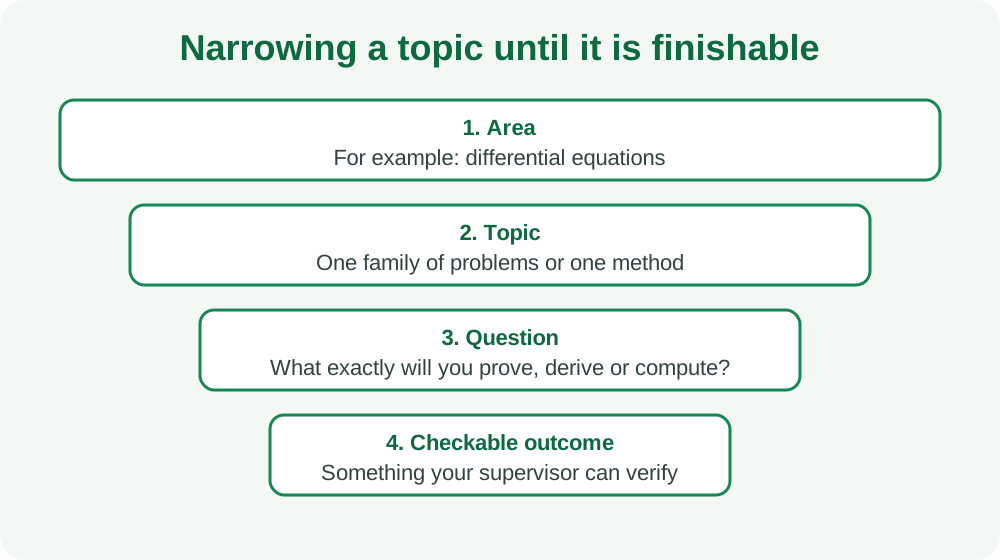
Choose a mathematics project topic by deciding what kind of project it is, what you will prove, derive or compute, and how your supervisor can check it. A broad area such as "differential equations" is not a topic. A topic names one problem or method you can finish and defend line by line.
UniDraft's free topic generator can help you build a starting shortlist. Treat every suggestion as provisional until your supervisor confirms it fits the department's brief.
When you have a topic and real working, UniDraft organises your confirmed derivations, results, checked sources and supervisor instructions into an editable Word project document. Start your project document once your mathematics is done and checked. UniDraft does not solve problems or run computations: that part is yours.
What are the three common shapes of a mathematics project?
Departments differ in what they accept, so treat these as planning categories rather than official types. They match how university project modules describe the range: the University of Dundee's mathematics project modules, for example, say a project can focus on pure mathematics, applied mathematics, modelling, computation, data or mathematical biology. Nigerian departments may use different labels, so ask which of these your own accepts.
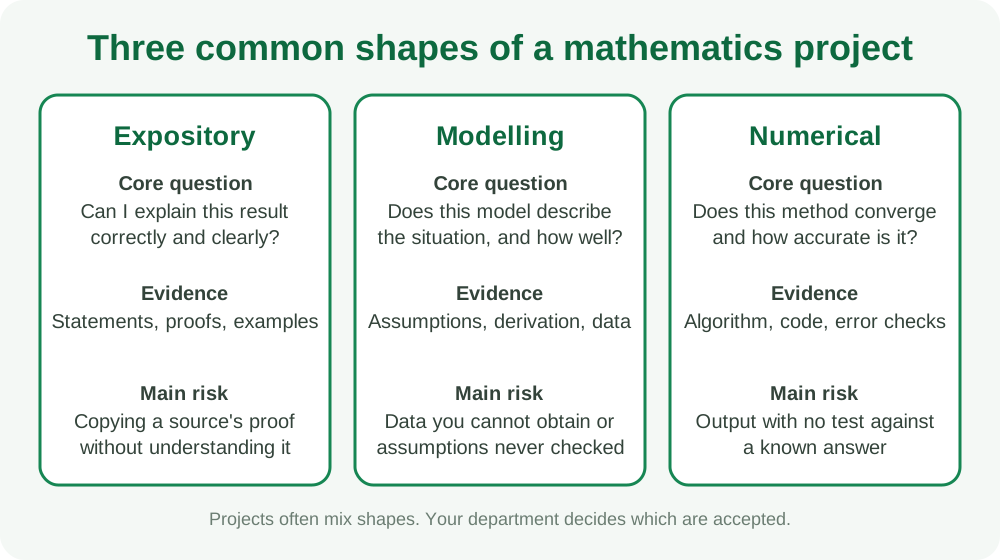
| Shape | What you deliver | What the reader checks |
|---|---|---|
| Expository or literature-based | A clear, correct account of a body of existing mathematics, with your own worked examples | Are statements precise, proofs complete, sources acknowledged? |
| Modelling | A model built from stated assumptions, solved or analysed, and compared with data or known behaviour | Are assumptions justified, the derivation sound, the comparison honest? |
| Numerical or computational | An algorithm or method, an implementation, and evidence about accuracy | Does it converge, is the error understood, was it tested against a known answer? |
Many projects mix two shapes. A numerical project often needs a short expository section on the theory behind the method; a modelling project usually ends with a computation. The mix matters less than being honest about which question you are answering.
Expository projects
An expository project takes a topic from the literature (a theorem and its proof, a method and why it works) and explains it so that a reader at your level could follow it. This is not copying. The value is in your understanding: restating definitions precisely, filling in the steps a textbook skips, adding worked examples that you have computed yourself, and explaining why each hypothesis is needed.
The usual trap is reproducing a proof you cannot explain. Your defence will test exactly that. If you cannot say what happens when a condition is dropped, you do not yet own the section. Learn to read the source properly first: how to read a research paper applies to mathematical papers too, with extra patience for the proofs.
Modelling projects
A modelling project says: here is a situation, here are the assumptions I make about it, here is the mathematics those assumptions lead to, and here is how well the result describes the situation. The weak point is almost always the data or the assumptions. If you plan to use real data, confirm you can actually obtain it, understand how it was collected and are allowed to use it. If you use simulated data, say so plainly: simulated results show how a method behaves, not what is true in the world.
A modelling project is not a statistics project in disguise, though the two overlap. If your work is mostly testing hypotheses on survey data, you may be in statistics territory, where choosing the right statistical test and designing the study carefully matter more than the derivations.
Numerical and computational projects
Here the deliverable is a method and evidence about how well it works: an iteration for solving equations, a scheme for differential equations, an optimisation or simulation procedure. The question is rarely "does it produce a number" but "is the number right, and how do I know?" Good numerical work compares output against a case with a known exact answer, shows what happens as the step size or iteration count changes, and says where the method fails.
If your project leans towards software, compare it with the Computer Science project topics guide, which treats deliverables and evaluation for software-heavy work. A mathematics department will usually want the mathematical justification as well as working code.
What do supervisors expect to see?
Requirements vary by department, supervisor and level, so read your brief and ask. The university module pages we looked at describe a common pattern of expectations: an independent investigation guided by a supervisor, a literature review, a plan managed over an extended period, understanding and explanation of advanced material, critical evaluation of arguments, methods and results, a typeset technical dissertation, and the ability to defend conclusions when questioned. Those are from one UK university, not a Nigerian rule, but they match what most supervisors look for in practice. In your own words, the checklist is:
- Precise statements. Every definition, lemma, theorem and proposition is stated fully, with its hypotheses.
- Complete arguments. Proofs have no unexplained jumps. If you cite a result, say where it comes from and that its conditions hold.
- Derivations you can reproduce. A reader should be able to follow each step from the previous one. "It can be shown" is acceptable only for something genuinely standard and cited.
- Algorithms stated clearly. Inputs, outputs, steps, stopping rule and what each parameter means.
- Verification. Some independent check that your result is right: a special case, a known value, a limit, a second method, a residual or an error estimate.
- Honest limits. What is assumed, what is not covered, where the method breaks down.
- Your own work, clearly separated from sources. Citations in the right places, and examples you computed yourself.
The last point connects to your references. A mathematical text needs consistent citation of theorems, not just a bibliography at the end; see how to write references for a final year project and the free citation tools.
What does a fictional feasibility worksheet look like?
This is an invented illustration of how to test a candidate, not a recommended title and not a study that exists. Suppose a student is drawn to "numerical methods for ordinary differential equations".
| Check | A weak answer | A workable answer |
|---|---|---|
| What exactly will I do? | Study numerical methods | Compare two named one-step methods on a small set of test problems with known exact solutions |
| What will I prove or derive? | Nothing yet | Derive each method, state its order and give the reasoning for it |
| What will I compute? | Whatever I can | Errors at several step sizes, tabulated and plotted |
| How can the supervisor verify it? | They will see the code | Tests against exact solutions and a stated error table |
| What background do I lack? | Not sure | Review the relevant course material and a named textbook chapter first |
| What happens if it goes wrong? | No plan | A reduced version: one method, fewer test problems |
The right-hand column is the point. A workable plan names its objects, its outputs and its fallback. If you cannot fill the right-hand column honestly, the topic is still too loose. Use the same test on a candidate from any shape, and take the result to your supervisor.
How do I scope a mathematics project so I can finish it?
Most unfinished projects were too broad at the start, or depended on something that never arrived. Narrow in steps.
- Start from what you already know. A project is a poor place to learn three new subjects at once. Choose a topic adjacent to courses you have passed and whose prerequisites you can finish reading in weeks, not months.
- Write the question as a sentence with a verb. "Prove...", "derive...", "compare...", "implement and test..." If the sentence has no verb, you have an area, not a question.
- Name the checkable outcome. What could your supervisor look at on a single page to see that it worked?
- Cut something deliberately. Decide in advance what you will leave out, and write it down as a scope statement. A project that does one thing correctly beats one that gestures at four.
- Plan a reduced version. Know what you will submit if the full plan runs late.
- Check availability early. Books, papers, data, software, computing access. Searching for sources is covered in how to find research papers.
- Ask for sign-off. Take your one-sentence question and your scope statement to your supervisor before building on them. The project proposal guide shows what a proposal should contain.
For choosing between areas in general, not just mathematics, the topic selection guide covers brief, access and deadline checks that apply equally here. Looking for the gap your project fills is a separate question, covered in how to identify a research gap.
Which software should I use, and what does each do?
Software cannot replace understanding, and your department may restrict what is allowed, so confirm first. Broadly, tools do one of two jobs.
Typesetting mathematics. LaTeX is a widely used system for documents with heavy notation, and online editors such as Overleaf let you write it in a browser. Word's built-in equation tools suit a modest number of equations. The University of Michigan-Dearborn library's thesis guide, for instance, suggests Word can serve if you have few equations, several simple ones or a set of similar ones, and points to LaTeX for heavier mathematics. If your department supplies a template or requires a particular format, follow that over any general advice.
Computing and checking. Python, MATLAB or its free alternative Octave, R, and spreadsheet software are common for numerical work, simulation and plotting. Computer algebra systems and graphing tools such as GeoGebra can help you check an algebraic step or visualise a function. The tool is a means: you remain responsible for the code, the inputs and the interpretation, and your supervisor may ask you to explain what any line does.
Whatever you use, record versions and keep your code and raw outputs. If code is part of the submission, ask how it should be presented; commonly it goes in an appendix, as described in appendices in academic reports. UniDraft does not do your analysis or computation: it helps assemble the finished work into a Word document once you have confirmed it.
How do I write mathematical notation in a Word project?
Even if you compute elsewhere, the final document is often Word. A few habits prevent most problems:
- Use equation objects for equations, not typed text. In Word, the Insert tab has an Equation option, and equations built there stay editable and scale properly. Pictures of equations cannot be edited and often print badly.
- Keep display equations and inline mathematics distinct. Short expressions can sit inside a sentence; important ones belong on their own line so they can be numbered and referred to.
- Number equations consistently. Pick a scheme such as (2.1), (2.2) by chapter, apply it everywhere, and refer to the number rather than "the equation above". Check the numbers again after any edit, because renumbering is where references break.
- Define every symbol at first use. Keep a list of symbols if the project uses many, and do not let one letter mean two things.
- Distinguish variables, functions and constants consistently. Decide on italics, bold for vectors or matrices, and upright text for operator names, then apply the choice throughout.
- Make figures and tables referable. Graphs of errors and tables of results need captions and numbers; see figures, tables and captions in Word.
- Check the final file, not your draft. Open the file that will be submitted, as a PDF if that is the format, and read through for missing symbols, broken fonts and equations that moved.
Chemical-formula conventions such as subscripts are covered in formatting chemical formulas. That is only relevant if your mathematics touches chemistry, but its advice about consistent notation carries over.
Common mistakes in mathematics projects
- Choosing a title first and a question later.
- Copying a proof the student cannot explain.
- Reporting a numerical result with no check against anything known.
- Using data without knowing where it came from or whether the model is appropriate for it.
- Stating a theorem without its conditions.
- Mixing symbols or changing notation between chapters.
- Leaving writing until the mathematics feels finished, then running out of time.
- Treating tool output as proof.
Questions to expect at the defence
These are typical question shapes, not a guaranteed list. Prepare to answer them with your own working open in front of you; the general approach is covered in common project defence questions.
- Why is this assumption or hypothesis needed? What happens without it?
- Can you walk through this step of the proof or derivation?
- How do you know your numerical result is correct?
- What are the limits of your model?
- What would you do next with more time?
- Which parts are from the literature, and which are your own?
Where UniDraft fits
Once your question is settled and your derivations, results and checks are done, you still need a well-organised project document. UniDraft organises your confirmed work, checked sources and supervisor instructions into an editable Word document. Start your project document, and keep reviewing every statement and calculation yourself. The free topic generator is also available if you are still comparing candidate topics.
Sources and scope
This guide used the following pages, and everything else is general planning advice that you should confirm with your supervisor:
- University of Dundee, Mathematics Project module (MA40001) and Mathematics Project (Joint Honours) (MA40005): range of project focuses and the skills and outcomes described.
- University of Michigan-Dearborn Library, Word for Theses: Equations: when Word is suitable for equations and when LaTeX is suggested.
- Nepal Journals Online, Basics and Structure of Project Writing in Mathematics: abstract only; used to confirm that undergraduate mathematics project writing is treated as having defined components.
These are non-Nigerian sources used for general description. Your department's brief and your supervisor's instructions take priority.