Choose a nursing project topic by checking four things before the title: who the participants are, which permissions you need, which design the question really calls for, and how many people you can realistically reach. A good-sounding title that needs patient records you cannot access is not a research plan. Your supervisor and department decide what is acceptable.
UniDraft's free topic generator can build a starting shortlist from your department and a course you enjoyed. Test every suggestion against the checks below before you take it to your supervisor.
Once your supervisor has agreed the question and design, UniDraft organises your confirmed nursing work, checked sources and supervisor instructions into an editable Word project document. Start your nursing project document, and keep every permission, number and clinical claim tied to your own records.
This page is about the final-year research project. If your assignment is a seminar, which is usually a review of published evidence, use the Nursing and Public Health seminar guide instead. A seminar does not normally involve patients; a project that collects data from people does, and that changes everything below.
What counts as a good nursing project topic?
A workable topic has a narrow question, a defined group of participants, a setting that will let you in, and a design that can answer what you asked. "Hypertension" is an interest. "How much do the patients attending one clinic know about their own medication?" is closer to a question, because it names a group, a setting and a thing to measure.
Do not copy any question shape from this page as your title. They are provisional prompts, not approved or completed studies. Whether a nursing school, a teaching hospital or a department will accept a question depends on its own brief. For the general selection method, see the guide to choosing a final-year project topic.
Where do nursing project ideas come from?
Instead of a list of titles, use evidence routes. Each one gives you a way to find a topic and a first feasibility question.
| Route | Where the idea comes from | First feasibility question |
|---|---|---|
| A gap in your own clinical postings | A recurring problem you saw and can describe without naming any patient | Can you study it without involving the patients you cared for? |
| A published study you can extend | The "limitations" or "future research" paragraph of a recent paper | Is the instrument available and does the setting match yours? |
| A department or hospital need | A question a unit sister or your supervisor says they would use | Will they put their permission in writing? |
| A nursing-student or staff-nurse group | Knowledge, attitudes or practice about a defined topic | Can you reach enough of that group and obtain consent? |
| A health-education question | Awareness of a prevention or care practice in a community | Is there an approved route for community fieldwork? |
If you have no gap yet, practise on reading. The research-gap guide shows how to find the sentence in a paper that says what is still unknown. Convert that into a question later, using the research-questions guide.
Here are three provisional question shapes, with no results behind them: how a defined group of final-year nursing students describes their knowledge of a named practice; how patients attending one clinic describe the information they received at discharge; whether two measured variables are associated in a small, defined sample. Each one still needs an approved scope, instrument and permissions before it becomes a title.
Why does health research need an ethics route?
Because your participants are people who may be unwell, dependent on the staff asking them to take part, or easy to identify from a small ward. Nigeria's National Code of Health Research Ethics, published by the National Health Research Ethics Committee (NHREC) of the Federal Ministry of Health, says it applies to all health research involving human participants conducted, supported or otherwise subject to regulation by any institution in Nigeria. The version I opened is dated 1 July 2007. Check with your institution whether a later edition or an institutional policy now applies.
Four points from that document matter to a student, and a fifth is what it does not settle.
- Review is by a health research ethics committee (HREC). The Code sets out how institutional committees are registered and how they review research. Which committee reviews your project is an institutional matter.
- Exemption is not self-declared. The Code lists narrow exempt categories, such as some survey and interview research. It still states that all exemptions are determined by the HREC, which decides on a proposal or written summary the applicant submits. A questionnaire does not automatically escape review. The exemption for surveys also carries conditions about whether participants can be identified and whether disclosure could harm them.
- Informed consent is described as essential. The Code says consent is valid only if the information is understandable. It sets the reading level for consent information at no higher than someone with up to nine years of education in Nigeria, and it lists what a consent form must cover, including purpose, procedure, risks, benefits, confidentiality, voluntariness and the right to withdraw.
- Applicants submit their instruments. Its list of what an applicant sends to the committee includes the proposal, the consent materials and copies of all questionnaires and instruments.
- What it does not say. It does not tell an undergraduate which office to visit, how long review takes, or whether your school treats a final-year project differently. Only your department or ethics committee can tell you that.
Read the Code itself rather than relying on a summary, including this one. For the practical checklist of participant information, anonymity wording and data handling, use the research ethics and consent checklist.
What is the difference between ethics approval, hospital permission and consent?
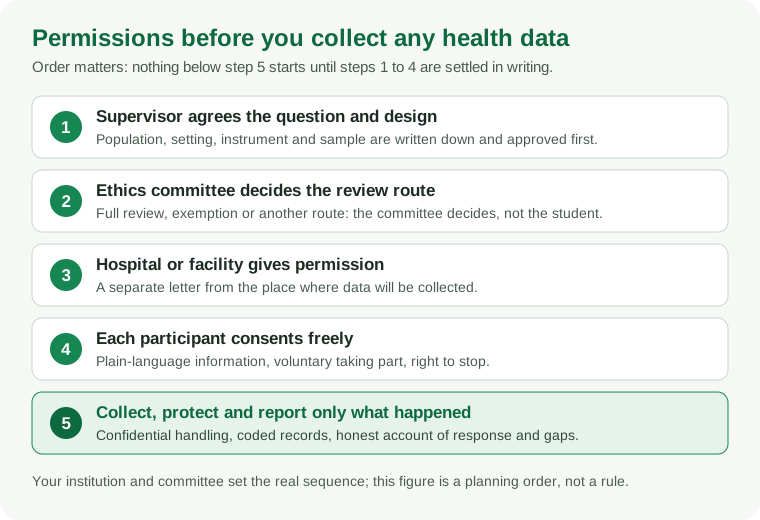
They are three separate things, and a project can fail at any one of them.
- Ethics review or clearance comes from the committee that assesses your proposal. It looks at risk, consent and confidentiality.
- Facility permission comes from the hospital, unit or school where you will collect data. An ethics decision does not open a ward door, and a ward sister's goodwill does not replace a review.
- Participant consent comes from each person, freely given. A patient who feels unable to refuse because a nurse is asking has not freely consented, which is why students are often kept away from recruiting their own patients.
Keep the letters. Your methodology should describe the permissions that actually existed, with reference numbers if you were given them. Do not describe a permission you did not receive, and do not copy another student's approval paragraph.
Confidentiality in a hospital setting
Health data is more sensitive than most student data. Four habits protect participants and you.
- Do not record names or hospital numbers unless the approved plan requires them. Use codes and keep any linking list separate and secured.
- Avoid distinctive details. "The only male midwife on night duty in a named unit" identifies a person even without a name.
- Do not quote records you were not cleared to use. Case notes belong to the facility and the patient, not to your project.
- Do not post data in group chats or leave questionnaires lying about. Store them as your approved plan says, and destroy or return them as agreed.
Wording matters here too. A questionnaire with names removed but a code list kept is confidential, not anonymous.
Which designs are realistic for an undergraduate?
Pick the design from the question, not from what sounds impressive. The figure below pairs common question shapes with the design that can support them and what that design cannot show.
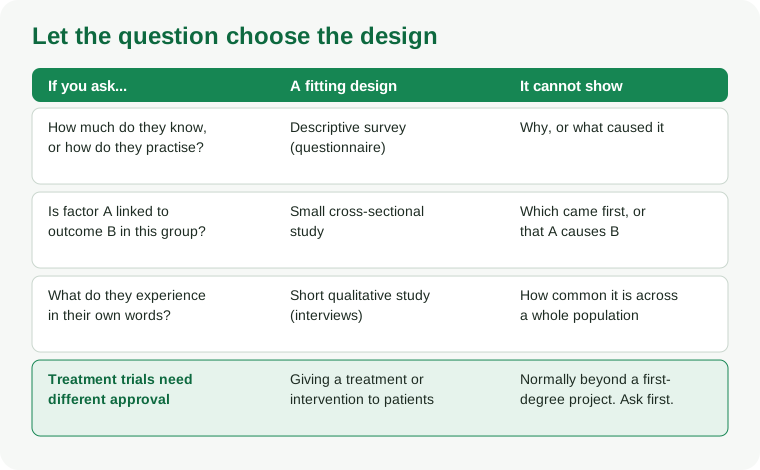
A descriptive survey describes a group at one point in time: knowledge, attitudes, practice, satisfaction, awareness. It is the usual first-degree design because it can be completed in one data-collection window. It cannot show cause.
A small cross-sectional study goes one step further and looks at whether two measured things go together in the same sample at the same time. It can show an association; it cannot show which came first or that one caused the other, so do not write "effect of" in a title unless your design supports it.
A short qualitative study with a handful of interviews suits "what is it like" questions. It does not tell you how common something is. For the choice between these, see the research design guide.
Interventions, trials and anything given to patients are a different category with heavier review. Do not plan one without your supervisor and the committee agreeing to it first. A teaching session for nursing students is not the same as a clinical intervention for patients, and which one you mean should be written plainly.
Should I use a validated instrument or design my own questionnaire?
Prefer an existing instrument when one measures your concept in a population like yours. Compare the two options honestly.
| Existing (validated) instrument | Self-made questionnaire | |
|---|---|---|
| What you must show | Source, what it measures, your permission or licence if needed, and any change you made | How every item was developed and from which literature |
| Evidence of quality | Reported by earlier users, but check it in a similar group | You must produce it yourself |
| Main risk | Wording or setting that does not fit your participants | Items that are vague, double-barrelled or leading |
| Workload | Lower for design, higher for checking fit and permission | Higher, including testing |
"Validated" is not a magic word. An instrument validated in another country, language or professional group may not behave the same way in your setting, and some scales have conditions of use. Record where it came from, who developed it, what you changed, and why. If you change items, you cannot simply say it is validated; say it was adapted and describe the checks you did.
For a self-made questionnaire, build items from the literature, ask your supervisor and a knowledgeable person to check them, and try the draft on a few people who are not in your final sample. The questionnaire design guide covers item writing, and the validity and reliability guide explains how to report checks without overclaiming.
If your department expects a pilot study, plan it before the main collection, and expect to submit the instrument to the committee, as the Code's applicant list indicates.
How do I work out a sample size?
Start with who is in the population and where you can reach them, because a number is meaningless without that. Then use a recognised method, name its inputs and cite its source.
- Define the population: all final-year nursing students in your school, patients attending one clinic over a defined period, or staff nurses on named units.
- Check the population size from a real list or record, not a guess.
- Pick the method your department expects. The sample-size guide works through Taro Yamane, Cochran and Krejcie-Morgan with examples, and tells you when each one is the wrong tool.
- Round up, then allow for non-response: people who refuse, are discharged, or return incomplete forms.
- Plan the selection, not just the number. The sampling techniques guide explains how you choose the people.
A small population changes the picture. If only forty nurses work on the units you may enter, you may be able to invite all of them, and a formula would add little. A qualitative study uses a different logic: it plans for depth and for a point where interviews stop adding anything new, and says so openly.
Two honest limits to write in your project: a calculated sample size is a target, not a promise that you will reach it, and a convenience sample (whoever is available) cannot be generalised to a whole population. Report the number you actually obtained in your results chapter.
Fictional feasibility worksheet
This is an invented planning exercise. No study was done, and the question is not a suggested title.
A student proposes: "A study of mothers' knowledge of immunisation in Nigeria." After an hour of checking, the worksheet looks like this.
| Check | Status in the fictional exercise | Next step |
|---|---|---|
| Participants | "Mothers in Nigeria" is not a defined group | Choose one clinic and one period |
| Permission | Nothing in writing | Ask the supervisor which committee applies; then request facility permission |
| Design | "Knowledge" suggests a descriptive survey | Confirm with the supervisor |
| Instrument | None yet | Search for an existing instrument on the same topic; record its source and any permission |
| Sample | No population list | Ask the unit for the registered number in the chosen period |
| Consent | Mothers may feel unable to refuse a nurse | Agree how recruitment will avoid pressure |
| Time | Review plus collection plus analysis | Back-plan from the submission date |
| Decision | Candidate only | Narrow and take to supervisor |
The student leaves with a narrower, checkable plan rather than a title, which is the point. If the committee, facility or sample numbers fall through, the topic changes; the student does not invent the missing evidence.
Mistakes supervisors commonly flag
- Starting collection after the supervisor said "good topic", before any review decision.
- Writing "anonymous" when a code list links names to answers.
- Using a validated scale but changing half the items without saying so.
- Quoting a sample-size formula without the population number or source.
- Claiming cause from a cross-sectional survey.
- Reporting 300 questionnaires distributed as if it were 300 responses.
- Copying the topic, instrument and results discussion from a previous project.
Questions to expect at the defence
- Which committee reviewed this, and what did it decide?
- How did you obtain consent, and how could a participant refuse?
- Where does your instrument come from, and what did you change?
- How did you reach this sample size, and how many people actually responded?
- What can your design not tell us?
The project defence guide helps you prepare answers from your own record rather than from memory.
Where UniDraft fits in
UniDraft does not choose your participants, obtain your permissions, run your analysis or guarantee approval. After the supervisor agrees the question and design, it helps organise your confirmed work, checked sources and supervisor instructions into an editable Word project document. Start your nursing project document, then check every permission statement, number and clinical claim against your own records and sources.
Sources
- National Code of Health Research Ethics (NHREC, Federal Ministry of Health, version dated 1 July 2007). Opened and read for scope, exemption, consent and applicant-submission points. This is a copy hosted by a third party; confirm the current edition with NHREC and your institution.