Critical analysis in academic writing means examining a source instead of only reporting it: you ask what evidence it offers, whether its method suits its question, what it leaves out, and how far it helps your own study. Description says what a source claims; analysis explains how and why; evaluation judges how much weight to give it.
If your department wants this skill shown in a seminar paper or Chapter Two, UniDraft can help you assemble it. It organises your confirmed work, checked sources and supervisor instructions into an editable Word document. Start your seminar report or project document, then read every comparison and judgement against the original papers; the judging itself is yours to do.
Supervisors often write comments such as "too descriptive", "where is your analysis?" or "so what?" on drafts. This guide explains what those comments mean and gives you a routine for fixing them. It is deliberately about the thinking and sentence-level moves. For the full structure of the chapter, use the Chapter Two guide; for reading a paper properly in the first place, see how to read a research paper.
What does "critical" actually mean in academic writing?
In everyday speech, "critical" sounds negative. In academic writing it is closer to "carefully judged". The University of Wollongong's academic skills guide describes critical analysis as taking apart what you read to judge its validity and merit, weighing evidence from several sources, questioning assumptions and noticing bias or limitations. It adds that this is not the same as finding fault; the aim is reasoned judgement based on wide reading rather than personal opinion.
Definition block. Critical analysis = describing a source only as far as needed, explaining how and why its claims hold (or do not), and evaluating its significance for your question, all supported by evidence you can point to.
Two consequences follow. First, your opinion alone is never enough: "I think this study is weak" is not analysis, while "the study surveyed only one department, so its finding may not apply to other faculties" is. Second, criticism is not the goal. A source that is well designed and relevant should be said to be so, with the reason.
Description, analysis and evaluation: three different jobs
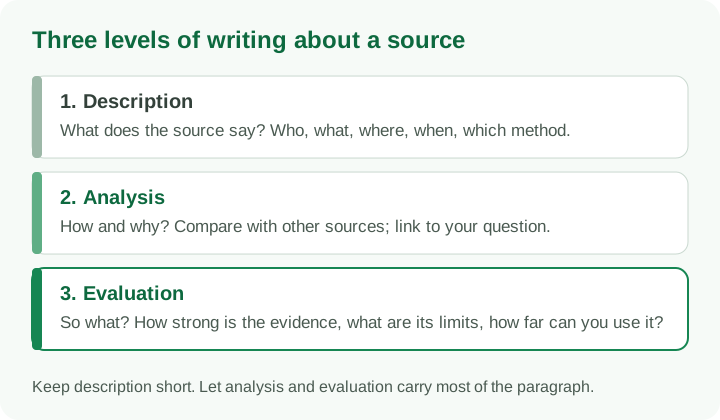
Several university guides use the same progression. Wollongong frames it as questions: description answers who, what, where and when; analysis asks how and why and interprets the information in relation to your assignment; evaluation considers significance, what could follow and what might be investigated next. Leeds University Library makes a similar point: descriptive writing reports a trend, a theory or a method, while critical writing explains what the trend suggests, why the theory fits this problem, or whether the method suited the question.
| Level | The question it answers | What it looks like in a sentence |
|---|---|---|
| Description | What does the source report? | "Author X surveyed 200 undergraduates in one faculty." |
| Analysis | How and why? How does it compare? | "Unlike the earlier interview-based work, this relied on a questionnaire, which may explain the more uniform answers." |
| Evaluation | So what? How far can I rely on it? | "Because only one faculty was sampled, the result is useful as a pointer but cannot stand for the whole university." |
The sample and findings above are placeholders for illustration, not real studies.
Description is not the enemy. Your reader must know what the source says before you judge it. The problem is a paragraph that contains only that first row. Keep description short, then do the work in the other two rows.
What is the difference between a descriptive and a critical paragraph?
Look at your draft and mark each sentence with D (description), A (analysis) or E (evaluation). A paragraph that is almost all D is a list of summaries. One test that several guides suggest is the "so what?" test: after each point you report, ask what it means or why it matters to your question. If you cannot answer, either the point does not belong or you have not finished the thinking.
Also test whether the paragraph connects back to your research questions. A study can be accurately described and still be irrelevant; analysis includes deciding that.
Which questions should I ask of a source?
Use the same four questions on every source. They apply to journal articles, textbooks and reports, and they keep you from praising or dismissing a paper out of habit.
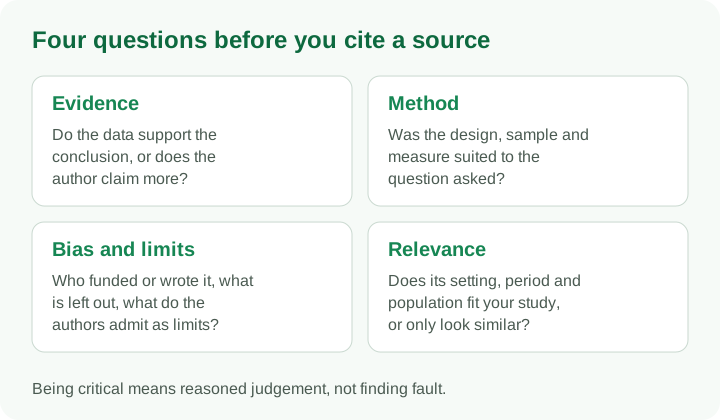
1. Evidence. What data support the main claim? Are the findings reported honestly and in full? Do the conclusions go beyond what the findings can support? A study of satisfaction cannot, on its own, show a cause.
2. Method. Was the design suitable for the question? Was the sample adequate for what is being claimed? Did the authors measure what they say they measured? You do not need to be a statistician; you need to notice when a method and a conclusion do not match. If a technical term is unfamiliar, look it up before repeating it.
3. Bias and limits. Who wrote it, when, and for what purpose? What or who is left out? Does the work consider views that conflict with its own? Do the authors state limitations, and do you agree with them? The Wollongong guide lists author background, omissions and contrary views among the useful prompts.
4. Relevance. Does the source's setting, period and population resemble yours, or does it only look similar? A study from another country or decade can still be useful, but you should say what carries over and what does not. A source can be well made and still be the wrong one for your question.
Keep the answers in your reading notes, not in your head. The six-line note in the reading guide has a "Limit" line that feeds directly into these questions, and the guide on finding research papers helps when you need stronger sources to compare.
Worked example: from description to critique
The paragraph below is fictional. The authors, numbers and findings are invented purely to show the writing moves; do not cite them.
Before (descriptive):
Okoye and Bello (2019) studied the use of mobile payment apps by market traders. They used a questionnaire and found that most traders used the apps. Ibrahim (2021) also studied mobile payment apps and found that traders used them for convenience. Adeyemi (2022) studied the same topic and found that traders liked the apps.
Each sentence is accurate and none of them tells the reader anything about how the studies relate. The paragraph is a chain of summaries.
After (analytical and evaluative):
Earlier work agrees that traders adopt mobile payment apps, but the studies are not equally strong evidence for why. Okoye and Bello (2019) report widespread use from a questionnaire, yet they sampled traders from a single market, so their finding shows what happens there and cannot be assumed for other markets. Ibrahim (2021) and Adeyemi (2022) give convenience and liking as reasons, but both relied on respondents' own statements, which tells us what traders say motivates them rather than what changes their behaviour. Taken together, the studies establish that adoption occurs but leave open how it differs between larger and smaller traders, which is the question this study asks.
What changed:
- The paragraph now opens with a point about the whole body of work, not with an author's name.
- The same facts appear, but each is weighed: sample, source of evidence, and what the claim can and cannot show.
- It ends by pointing to what remains unanswered, which links to your own research question. The research gap guide shows how to test that gap properly.
Notice what the rewrite did not do: it did not invent new findings or insult the authors. Every critical statement is something you could point to in the source. If you cannot point to it, do not write it.
Signal phrases that show your thinking
Signal phrases do not create critical thinking; they only make it visible. Use them where the evidence supports the move.
| Move | Phrases you can adapt |
|---|---|
| Agreement | "Similarly", "This is consistent with", "Both studies point to" |
| Contrast | "In contrast", "Unlike", "However, X reports the opposite" |
| Qualify | "Although the sample was limited to...", "This holds only if...", "The finding applies to..." |
| Weigh the evidence | "This suggests, but does not show", "The evidence is stronger for... than for...", "The method makes it difficult to conclude..." |
| Explain a difference | "A possible reason for the difference is...", "This may reflect the different settings" |
| Draw together | "Taken together", "Overall, the studies indicate", "What remains unclear is..." |
| Link to your study | "This is relevant here because...", "This leaves a gap that the present study addresses" |
A caution: "however" followed by nothing specific is decoration. If a supervisor reads "however, the study has limitations" and asks "which limitations?", the sentence has failed. Name the limitation.
How do I avoid over-praising sources?
Students often write "the study is very comprehensive" or "the author clearly demonstrates", because a published paper feels authoritative. Publication shows that someone reviewed the work, not that it settles your question. Replace praise with reasons: "the study measured X over two semesters, which allows the comparison the present study needs". That is still positive, but it is checkable.
Be cautious with verbs. "Proves", "confirms" and "shows" claim more than many studies can deliver. "Suggests", "reports" and "indicates" are often more accurate. Match the verb to the design: a questionnaire reports what respondents said; it does not by itself prove a cause.
How do I avoid dismissing sources unfairly?
The opposite error is writing "this study is weak" or "the sample is too small" about every paper. Three habits help.
- Judge the study against its own aim. A small exploratory study is not a failure for being small if it only set out to explore. Criticise the gap between what it did and what it claims.
- Say what the limitation affects. "The sample came from one institution, so I treat the result as a pointer for that setting" is fairer and more useful than "the sample is bad".
- Avoid dismissing without alternatives. If you set a source aside, say why (for example, it studies a different population) and what you use instead.
A review in which every source is flawed leaves the reader wondering what is known. A review in which every source is perfect leaves them wondering whether you read the papers. Aim for differences in weight, with reasons.
Applying it in a seminar report or Chapter Two
Seminar reports and Chapter Two ask for the same underlying skill, usually at different scale. In a seminar report you typically examine a topic through a handful of sources; the seminar structure guide shows where discussion fits, and your department's template decides the headings. In a final-year project, the empirical review guide covers grouping studies by theme and building a source matrix.
Practical ways to build the critical layer in:
- Add two columns to your source matrix: "How strong is the evidence for my question?" and "What does it not show?" Fill them while you read, not after you draft.
- Write the theme sentence first. Before any author's name, write the point you are making across sources.
- Compare, do not list. Put two or three studies in one paragraph and say how they relate.
- End each section with a short judgement: what the studies together establish, where they disagree, and what is still open.
- Reuse your limits notes later. The way you judge other studies' limits is the way a reader will judge yours; the limitations guide helps you state your own honestly.
Whatever you paraphrase, keep sources clearly separate from your own judgement. The paraphrasing guide explains how to restate a source without drifting into its wording.
A quick self-check before you submit
- Does every paragraph have a point of its own, stated in your words?
- Is at least half of each review paragraph analysis or evaluation rather than summary?
- Can you point to the page, table or method detail behind each critical remark?
- Have you named a reason for each source you praise or set aside?
- Have you used cautious verbs where the design only supports caution?
- Does each section end by connecting back to your research question?
Common mistakes supervisors flag
- Annotated bibliography style: one paragraph per author, no comparison.
- Vague criticism: "has some limitations" without saying which.
- Opinion without evidence: "this is not convincing" with no reason.
- Blanket praise: "excellent study" and nothing else.
- Overclaiming from a source: reporting a finding as proof of something it did not test.
- Borrowing someone else's critique: repeating a reviewer's judgement of a paper you have not read yourself.
- Description of theory with no use: explaining a theory without saying how it helps your problem.
If a supervisor has marked your draft, the seminar corrections guide shows how to turn the comments into a revision list. When your department gives its own rules for referencing and layout, follow them, and use UniDraft's formatter or citation tool only as a helper for the mechanics, not for the judgement.
Where UniDraft fits
Critical analysis cannot be outsourced; you must read the sources and decide what they show. What UniDraft can do is keep your confirmed work, checked sources and supervisor instructions in one place and organise them into an editable Word document, so your effort goes into thinking rather than assembling. Your supervisor's instructions still come first. Start your seminar report when your notes are ready.
Sources
- University of Wollongong, Academic Skills: What is "critical analysis"?
- University of Leeds Library, Academic Skills: Critical thinking and writing