Academic writing style means writing a project report that is formal, precise, evidence-based and cautious in proportion to your data. In practice: avoid slang and contractions, hedge claims only as far as the evidence needs, use passive voice deliberately, use mostly past tense for what you did, and cut words that do no work.
UniDraft helps organise your confirmed work, checked sources and supervisor instructions into an editable Word document, so the writing you do is about your own evidence. Start your project document, then use the checks below to review each chapter before your supervisor sees it.
This guide is about the sentences, not the layout. It does not give any university's formatting rules; for those, use UniDraft's format guides and formatter, and follow your own department's brief. It also stays separate from other writing topics: for rewriting sources see how to paraphrase without plagiarising, and for the Chapter 4 mechanics see the results chapter guide.
What is academic writing style, and what is it not?
Think of it as a set of habits that make a claim easy to check:
- Formal register. Complete sentences, standard grammar, no text-message spelling, no spoken fillers.
- Precision. Name the thing, the place, the period and the number, instead of "many" or "a lot".
- Calibrated certainty. Wording that is as strong as the evidence, and no stronger.
- Impersonal focus. The reader should notice the evidence before the writer.
- Economy. Every word earns its place.
It is not complicated vocabulary. Students sometimes believe that long words and long sentences sound academic. They usually sound unclear. A supervisor reading a hundred pages wants to find your claim quickly and see what supports it.
How formal should the tone be?
Formal tone is mostly about removing things you would say aloud but not write in a report. Here are fictional before-and-after pairs.
| Before (too casual) | After (formal) | What changed |
|---|---|---|
| The results were really surprising. | The proportion of late deliveries was higher than anticipated. | Opinion word replaced by a measurable statement |
| We can't say for sure why. | The data do not establish the cause. | Contraction removed, claim stated plainly |
| Lots of people use mobile money these days. | A majority of the respondents reported using mobile money weekly. | Vague quantity and time phrase replaced |
| This chapter is going to talk about the method. | This chapter describes the method. | Spoken construction trimmed |
| Everybody knows prices have gone up. | Reported consumer prices increased during the study period (cite the source). | Sweeping claim replaced by a sourced one |
Two cautions. First, "formal" does not mean "emotionless in a way that lies": if your data are weak, say so in plain, polite words. Second, do not copy phrases from other reports to sound formal. That is how stock lines with nothing behind them enter a project. If you want the reader to trust a sentence, it should be something you can point to evidence for.
What is hedging, and how much is enough?
Hedging is the practice of softening or limiting a claim so it matches the strength of your evidence. The University of Manchester's Academic Phrasebank describes the devices researchers commonly use: modal verbs such as may and could, probability expressions such as "it is likely", tentative explanations such as "a possible explanation is", and limiters such as generally, often, frequently or the majority of. It also notes that hedging is especially common in discussion sections where writers explain their findings.
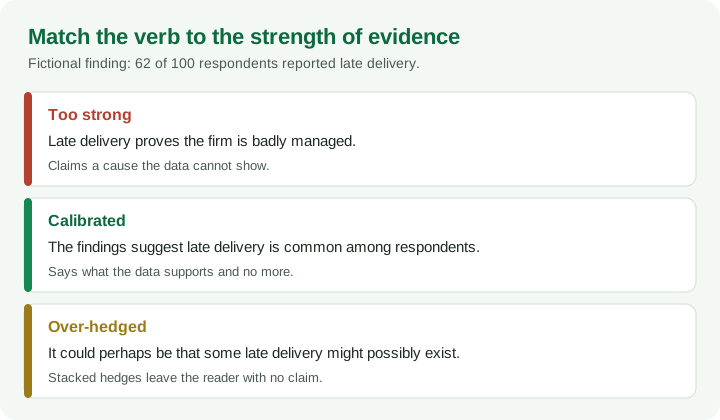
Use the figure as a quick test. If your survey shows that most of a sample reported a problem, you can say the findings suggest the problem is common in that sample. You cannot say the survey proves why it happens, because a survey of reports does not by itself show cause. At the other extreme, a sentence that stacks "could", "perhaps" and "possibly" tells the reader nothing.
A simple hedging rule
Ask two questions about every claim:
- What does the evidence directly show? State this plainly and without hedges. "Sixty-two of the 100 respondents reported late delivery" needs no "may".
- What are you inferring from it? Hedge this part. "This suggests the delays are not limited to a few suppliers."
Facts you measured are stated. Interpretations are qualified. Mixing them up is the common error, and it works in both directions: hedged facts sound unsure, and unhedged interpretations sound overconfident.
Hedging in the literature review
When you report what other authors found, the verb you choose carries your judgement. "Smith (2019) proved" implies the matter is closed. "Smith (2019) found" reports a result. "Smith (2019) argues" signals a position. Pick the verb that matches what the author actually did, and check it against the source you have read. The literature review guide covers how to organise those sources.
Active or passive voice: when is each fine?
Passive voice is not a grammar mistake. The University of North Carolina Writing Center explains that the passive can be useful to emphasise the object, when the actor is unknown, or when the actor does not matter to the reader. The same guide warns that it becomes a problem when it hides the actor, makes a claim vague, or obscures responsibility.
For a project report, here is a practical split.
| Situation | Better choice | Fictional example |
|---|---|---|
| Describing a standard procedure | Passive is fine | The samples were weighed and recorded. |
| The actor matters (a claim, a decision, a source) | Active | Adeyemi (2018) argues that the policy was poorly timed. |
| Stating what you did and your role is relevant | Active, if your department allows first person | I interviewed twelve teachers. |
| A vague agent hides who is responsible | Rewrite to name the actor | "Mistakes were made in the process" becomes "The data clerk entered some values twice." |
| Reporting that something is believed | Name who believes it | "It is argued that fees affect enrolment" becomes "Okafor (2020) argues that fees affect enrolment." |
Whether you may write "I" or "we" differs between departments and supervisors. If a recent approved project from your department is available, look at how it handles this, or ask your supervisor, then be consistent throughout. A report that switches between "I conducted" and "the researcher conducted" reads as unplanned.
The three-step passive check
Borrowing the logic of the UNC guide: find sentences with a form of "to be" plus a past participle, ask whether the reader needs to know who acted, and if so move the actor to the front. Then leave the rest alone. Do not convert every passive in the report; many are doing a perfectly good job in the methodology.
Which tense should I use in each section?
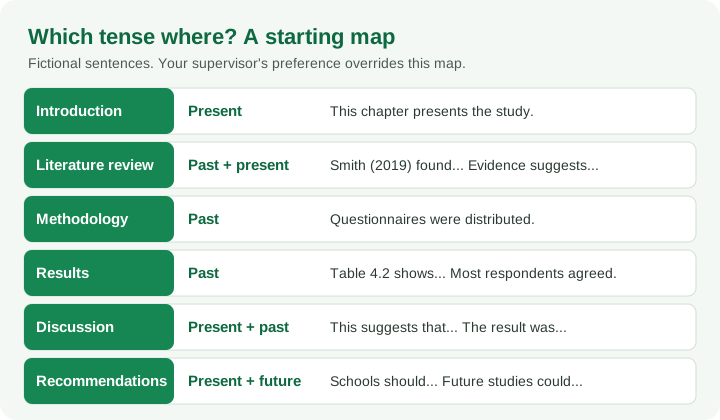
Tense tells the reader the status of a claim. Past tense marks something specific to your study, and present tense marks something still true or relevant. The University of Hull's dissertation guide sets out a pattern that most university guides broadly share, and it also says tense conventions vary across disciplines, so confirm any department preference.
In words:
- Introduction: present tense, because it describes what the document contains. "This study examines..." and "Chapter Two reviews..." Read the introduction guide for what the chapter should contain.
- Literature review: a deliberate mix. Past tense for findings tied to a specific earlier study ("Eze (2017) surveyed 200 traders"), present tense for findings now treated as established, and hedged verbs where the evidence is uncertain.
- Methodology: past tense for what you did ("Data were collected over three weeks"), with occasional present tense for a justification that still holds ("Stratified sampling is appropriate where..."). See the methodology guide for what to cover.
- Results: past tense for what you found. A present-tense pointer to the table in front of the reader is acceptable: "Table 4.2 shows that most respondents agreed."
- Discussion and conclusion: mainly present tense for what the findings mean, with past tense when you refer back to your own or earlier results. Recommendations mix present and future ("Schools should...", "Future studies could...").
The commonest tense error is drift: a paragraph begins in the past tense and slides into the present halfway through. To catch it, read only the first verb of each sentence in a paragraph, and ask whether each switch has a reason.
How do I write concisely without losing meaning?
The Purdue Online Writing Lab makes a point worth remembering: concise writing does not always have the fewest words, but it always uses the strongest ones. The aim is to remove words that do no work, not to make every sentence short.
Fictional before-and-after examples:
| Before | After | Why it is better |
|---|---|---|
| It is a fact that the study was carried out in order to determine the extent to which... | The study determined the extent to which... | Empty opener and "in order to" removed |
| Due to the fact that the respondents were many in number, the data was large. | Because the sample was large, the dataset was large. | Wordy phrases replaced, repeated idea cut |
| The questionnaire was administered and it was also distributed to the respondents. | The questionnaire was distributed to respondents. | Repeated action merged |
| There are many students who do not read the instructions. | Many students do not read the instructions. | "There are... who" removed |
Concision also applies at paragraph level. If a paragraph makes the same point three times in slightly different words, you have padded it. Padding is easy to spot in a printout and harder on screen, so print a chapter once before submission, or read it aloud.
What Nigerian-English pitfalls should I check for?
Be careful here: this is about accuracy, not about looking down on how people speak. Nigerian English is a real and widely used variety. Wikipedia's article on it notes that Standard Nigerian English is used in politics, formal education, the media and official settings. The same article notes how difficult it is to pin down one standard variety. For a project report, the safest approach is not to rely on what sounds right locally, but to check wording against a published dictionary or style guide, because your assessors will read against whichever standard your department uses.
Here are habits worth checking. The first is confirmed against a dictionary entry; for the others, look them up yourself rather than trusting memory.
- Countable and uncountable nouns. Wiktionary lists equipment as usually uncountable, so you write "the equipment was calibrated" or "a piece of equipment", not "an equipment". Check words such as information, advice, furniture, research and evidence in your dictionary in the same way and see whether they take a plural.
- Fixed prepositions. Many verbs take one particular preposition. Look up the verb and see which preposition the dictionary gives, rather than choosing the one that feels natural.
- Spoken fillers in writing. Phrases used for emphasis in speech, such as "in fact now", belong in conversation and not in a report.
- Over-long openers. "It is an incontrovertible fact universally acknowledged that..." adds nothing; start with the claim.
- Tense drift and subject-verb agreement. These show up in studies of student errors, and are mostly fixed by slow rereading rather than by new vocabulary.
- British or American spelling. Pick one spelling system and keep it. Students search both "defence" and "defense"; either is acceptable in a report if you are consistent and your department has no rule.
Two practical habits help more than any list. Keep a short personal "check list" of words you have been corrected on, and add to it each time your supervisor marks something. And when you are unsure of a word, look it up before you write it, not after the supervisor circles it.
A worked rewrite of one fictional paragraph
Here is a weak Results paragraph, followed by a revision. Everything is fictional.
Before:
The result of the study was very interesting because it showed that a lot of the staff are not satisfied with their pay and this proves that the management is not doing their work well. We can see this from Table 4.3 and it is something that everybody should worry about.
Problems: "very interesting" is opinion in a results paragraph; "a lot" is vague; the present-tense "are" mixes with past "was"; "proves" claims a cause the table cannot show; "everybody should worry" is a rhetorical flourish; and no number appears.
After:
Table 4.3 shows that 41 of the 60 staff respondents rated their pay as "dissatisfied" or "very dissatisfied". Dissatisfaction was highest among junior staff. The table does not show why respondents were dissatisfied; this is considered in Chapter Five.
What changed: a number replaced "a lot"; the claim about management was removed because the data do not support it; interpretation was deferred to the discussion; and the paragraph uses consistent past tense with a present-tense pointer to the table. The pay figures are invented for illustration and you must use your own data.
This also shows the boundary between Chapter 4 and Chapter 5 in miniature. The discussion and conclusion guide covers the interpretation side.
How does this connect to AI and plagiarism worries?
Writing style is not evidence of who wrote a text, and a clean style does not prove anything either way. What a supervisor can usually judge is whether you can explain each claim and point to its source. That is why specific, checkable sentences help you. If you are worried about how your writing might be read, see the guide on AI-writing concerns, and check your department's own policy on tools before you use any assistance.
A style check you can run in one evening
Work through one chapter at a time.
- Highlight every number-free claim. Add the evidence or soften the claim.
- Mark each verb of reporting. Does "proved", "showed" or "revealed" match what the source or table actually established?
- Circle contractions and casual phrases. Replace them.
- Read the first verb of each sentence. Fix tense drift that has no reason.
- Find passive sentences with a missing actor. Name the actor where it matters.
- Cut one word in every sentence that can spare it. Stop when meaning would suffer.
- Look up every uncountable-noun and preposition doubt. Do not trust memory.
- Check against your supervisor's earlier comments. The guide to handling supervisor corrections can help you turn them into a revision list.
Questions a supervisor may ask
- Which of these sentences states a finding and which states your interpretation?
- Why did you write "proves" here when the table shows association only?
- Can you point me to the source for this statement?
- Why does the tense change in this paragraph?
- Who is the "researcher" in this sentence, and why not say what you did?
If you can answer these about every paragraph, your style is doing its job.
Where UniDraft fits
UniDraft is not a rewriting tool. Your argument, your evidence and your sentences remain yours. What UniDraft does is organise your confirmed work, checked sources and supervisor instructions into an editable Word document, so that you can spend your review time on exactly the checks above. When your chapters are ready to assemble, start your project document. Use the free citations tool for references.
Sources
Opened while preparing this guide:
- University of Hull, dissertation guide on tenses: libguides.hull.ac.uk/dissertations/tenses
- University of North Carolina Writing Center, passive voice: writingcenter.unc.edu/tips-and-tools/passive-voice
- University of Manchester Academic Phrasebank, using cautious language: phrasebank.manchester.ac.uk/using-cautious-language
- Purdue Online Writing Lab, conciseness: owl.purdue.edu conciseness
- Wikipedia, Nigerian English: en.wikipedia.org/wiki/Nigerian_English
- Wiktionary, equipment: en.wiktionary.org/wiki/equipment