To paraphrase, read the source until you understand it, close it, restate the idea in your own words and sentence structure, compare your version for accuracy, and cite the source. Changing a few words in the original sentence is not paraphrasing, and a citation alone does not rescue it.
A paraphrase only works if the facts underneath are yours to check. UniDraft helps organise your confirmed work, checked sources and supervisor instructions into an editable Word document: start your project document once your notes are in your own words. UniDraft's free citation tool can help you format the matching reference entry.
This post teaches the skill itself. For what a similarity report does and does not prove, read what a plagiarism report is in a final year project. For writing style questions about detectors, see avoiding AI detection in academic writing. Here we focus on the sentence-level craft, and the examples below are fictional.
What is the difference between a quote, a paraphrase and a summary?
All three are ways of using someone else's work, and all three need attribution. They differ in how closely your writing stays to the source and how much of it you cover.
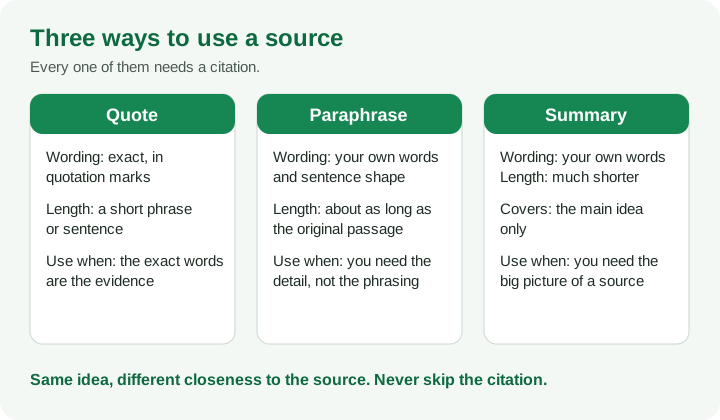
| Method | Wording | Length compared with the source | Typical use in a project |
|---|---|---|---|
| Quote | Exact words, in quotation marks | A short phrase or sentence | A definition or statement you will analyse |
| Paraphrase | Your own words and sentence shape | About as long as the passage, often somewhat shorter | A specific finding, figure or argument you need in detail |
| Summary | Your own words | Much shorter; the main idea only | The big picture of a whole article or chapter |
A useful test is to ask what you need from the source. If you need the detail but not the phrasing, paraphrase. If you need only the overall point, summarise. If the author's exact words are the evidence, quote them.
A fictional source passage to practise on
Everything below uses an invented passage, so you can follow the method without worrying about a real author. Imagine this appears in a fictional journal article by "Adekunle and Bassey (2021)":
"Rural clinics that kept written stock records and counted their medicines every month reported fewer stock-outs than clinics that relied on memory, mainly because shortages were noticed before the shelves were empty."
You are writing a literature review and want to use this idea. Here are the three approaches.
Quote: Adekunle and Bassey (2021) observed that "shortages were noticed before the shelves were empty" in clinics that kept written records.
Summary: Adekunle and Bassey (2021) link regular written stock records to fewer shortages in rural clinics.
Paraphrase: According to Adekunle and Bassey (2021), clinics that wrote down their stock and checked it each month spotted a low supply early, which helped them avoid running out compared with clinics that depended on staff remembering what was left.
Notice that the paraphrase keeps the meaning, adds no claim the source did not make, and does not copy the sentence order. The citation is built into the sentence.
How do I paraphrase step by step?
Academic skills guides from different universities agree on a similar method. Here it is in five steps.
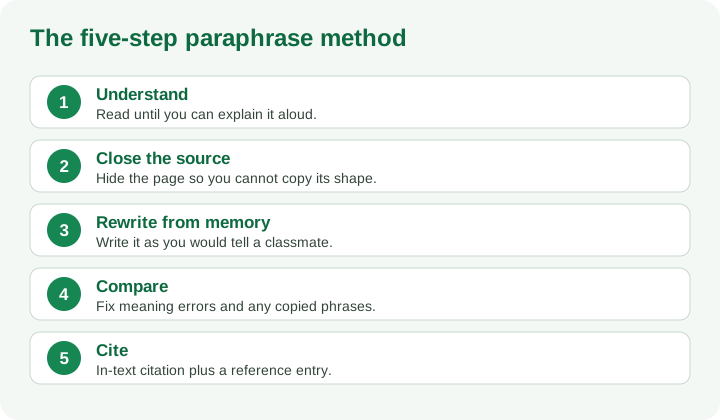
Step 1: Understand the passage first
You cannot paraphrase what you do not understand. Read the passage more than once. Mark the words that carry the meaning, such as technical terms that you must keep or look up. If you cannot explain the idea aloud to a classmate, you are not ready to write it. Reading the whole paper, not just the one sentence, also stops you from lifting a claim out of context; the guide on how to read a research paper shows a quick way to do that.
Step 2: Close the source
Hide the page or turn the screen away. This is the step most students skip, and it is the one that stops you from copying the shape of the original sentence. If you have to look at the source to write each clause, you are copying.
Step 3: Rewrite from memory, in your own voice
Write the idea as you would explain it to a friend, then tidy it into academic English. Change the structure, not only the vocabulary. Start from a different point in the idea, split a long sentence or combine two short ones. Keep the technical terms that cannot change; a term like "stock-out" has no better substitute.
Step 4: Compare with the original
Now open the source. Check three things. First, is the meaning accurate, with no added or dropped claims? Second, is the wording and sentence shape clearly different? Third, did a phrase of four or five words slip through unchanged? Rewrite it or put it in quotation marks. Do not change meaning to suit your argument; if the source says "reported fewer stock-outs", do not turn it into "eliminated stock-outs".
Step 5: Cite it, every time
Add the in-text citation in your required style as you write, not afterwards. Then make sure a matching entry appears in your reference list. Your department will tell you which style to use, and the posts on writing references for a final year project and APA 7 in-text citations cover the mechanics.
What does a weak paraphrase look like next to a strong one?
Using the same fictional passage, compare three attempts.
| Attempt | Text | Verdict |
|---|---|---|
| Original | "Rural clinics that kept written stock records and counted their medicines every month reported fewer stock-outs than clinics that relied on memory, mainly because shortages were noticed before the shelves were empty." | Source |
| Weak (word swaps) | Rural health centres that maintained written stock records and counted their drugs monthly reported fewer stock-outs than centres that relied on memory, primarily because shortages were noticed before the shelves were empty (Adekunle & Bassey, 2021). | Patchwriting. Same order, same structure, same ending |
| Weak (meaning changed) | Adekunle and Bassey (2021) prove that record keeping removes drug shortages in every clinic. | Overclaims. The source did not say "prove", "removes" or "every clinic" |
| Strong | Clinics in the study that logged their stock and counted it monthly ran out of medicines less often than those that relied on memory, because staff saw a falling supply early enough to act (Adekunle & Bassey, 2021). | Own structure, accurate meaning, cited |
The first weak version looks tidy but follows the original clause for clause. The second is the opposite problem: it is in new words but says something the source never said. A good paraphrase passes both tests.
What is patchwriting, and why does a citation not fix it?
Patchwriting is copying a passage and then deleting or swapping some words, or rearranging a few phrases. Academic skills guides describe it as a failed paraphrase: you have done the surface edits without doing the thinking. One library guide states plainly that patchwriting is still plagiarism even with a citation, because the wording and structure still depend too heavily on the original.
Typical signs of patchwriting:
- Your sentence has the same order of ideas as the source, clause by clause.
- You replaced words with thesaurus synonyms, sometimes awkward ones.
- A run of four or more words matches the source exactly.
- You could not restate the idea without the source open.
If you notice patchwriting in your draft, you have two honest options: rewrite it properly using the five steps, or put the exact words in quotation marks and cite them. Pasting text into a "rewriter" tool is not a third option; it produces the same word-swap problem, often with distorted meaning. Several university guides advise students to avoid paraphrasing tools for this reason.
When should I quote instead?
Paraphrase is the default in most project writing, but quote when:
- the exact wording is the point, such as a definition you will then analyse;
- the text is a policy, legal or regulatory statement where changing words could change meaning;
- the phrase is a named term or coined expression that you cannot restate;
- you plan to disagree with the author's exact claim and need to show it fairly.
Quote sparingly. A chapter made mostly of quotations shows the reader very little of your own understanding, and it is also the pattern that makes a similarity report light up. Keep quotes short and always attribute them. Whether long quotations need to be indented and how page numbers are given depends on your referencing style and department, so check your handbook or ask your supervisor.
How do I use paraphrasing in a literature review?
A literature review is where most students paraphrase heavily, and where the worst mistakes appear: a paragraph that is really a list of "Author A said... Author B said..." with each sentence lightly reworded. Instead:
- Group sources by idea, not by author.
- Make your point first, then support it with one or two paraphrased sources.
- Show how sources relate: agree, disagree, build on one another.
- Cite each paraphrase where it appears, not once at the end of a paragraph.
The post on writing a literature review walks through this, and finding research papers helps you pick sources worth paraphrasing in the first place.
How should I keep notes so I never copy by accident?
Most accidental plagiarism starts in the notes. A few habits help:
- Paraphrase while you read. Write notes in your own words, not pasted text.
- Mark any exact wording in your notes with quotation marks and a page number, so you cannot mistake it for your own phrasing later.
- Record the full source details immediately, including author, year, title and where you found it.
- Keep your own comments separate from what the source says, for example in a different column.
A reference manager can store these details so they are ready when you cite; see Zotero and Mendeley for students.
Common paraphrasing mistakes
| Mistake | Why it is a problem | Fix |
|---|---|---|
| Swapping words with synonyms | Same structure; reads as patchwriting | Rewrite from memory with a new structure |
| Paraphrasing without understanding | Distorted or nonsensical meaning | Read more, ask your supervisor, or choose a simpler source |
| Changing the claim's strength | "Suggests" becomes "proves" | Keep the source's hedging and limits |
| Citing once for a whole paragraph | Reader cannot tell which ideas are whose | Cite where each paraphrased idea appears |
| Forgetting the reference entry | In-text citation points to nothing | Run a two-way check of citations and reference list |
| Paraphrasing a secondary source as if it were the original | Misattributes who found what | Cite what you actually read, or find the original |
Questions a supervisor may ask
- "Can you explain this paragraph without reading it?"
- "Where exactly did this idea come from, and which page?"
- "Why did you quote here instead of paraphrasing?"
- "Is this your claim or the author's?"
If you paraphrased from understanding, these questions are easy. If you copied the shape of a sentence, they are not. That alone is a good reason to follow the method.
A pre-submission paraphrase check
- Every paraphrase has an in-text citation in the required style.
- Every citation has a matching reference entry, and vice versa.
- No run of four or more unchanged words from a source, unless quoted.
- No claim is stronger than the source made it.
- Quotations are short, intentional and attributed.
- You can explain each paraphrased paragraph without the source open.
- Your department's rules on similarity, quoting and AI assistance have been confirmed in writing with your supervisor.
Where UniDraft fits
UniDraft does not write your understanding for you. It organises the work you have confirmed, the sources you have checked and the instructions from your supervisor into an editable Word document, so your paraphrased notes end up in the right chapter. When you are ready to assemble the draft, start your project document from your own notes, and use the citation tool for reference formatting. Read your final text yourself, because accuracy and honest attribution are your responsibility.
Sources
These pages were opened while preparing this guide. They are general academic skills guides, not Nigerian institutional rules; follow your own department's policy.