
A declaration page for a project is the student's own signed statement, usually after the title page, that the work is original, was carried out under supervision and has not been submitted for another award. A certification or approval page is different: it is normally signed by other people. Names and wording vary by institution, so follow your own department's template.
UniDraft organises your confirmed work, checked sources and supervisor instructions into an editable Word document, preliminary pages included, so the order you were given is the order you work to. Start your project document, then prepare the wording below from your own instructions. Only you can make your declaration, and only the named officials can sign theirs.
What exactly are the declaration, certification and approval pages?
These three pages sit in the preliminary pages and are often confused. In plain terms:
- Declaration: the student speaking. "This work is mine, here is how it was done, I have not submitted it elsewhere."
- Certification: a statement that the work meets a condition, such as having been done under supervision. Depending on the institution it is signed by the supervisor and officials, or by the student.
- Approval: a record that the finished work has been accepted, with the names, signatures and dates of the people who accepted it.
The trap is that institutions do not assign these meanings the same way. The next section shows this from three real guides, and you will see why copying a senior's page can leave you with the wrong statement on the wrong page.
How do Nigerian institutions actually differ?
I opened three institutional guides to check. Each is one document for one institution or faculty at one date, not a national rule.
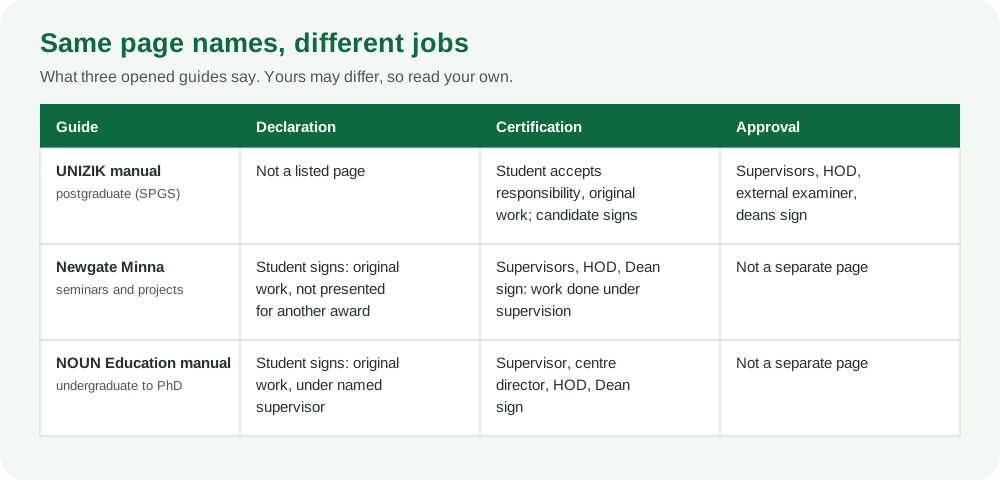
Nnamdi Azikiwe University (UNIZIK) Manual of Style. This manual covers projects, theses and dissertations submitted to the School of Postgraduate Studies, so it is postgraduate guidance and not an undergraduate rule. It lists the preliminary pages as title page, certification, approval page, dedication (if any), acknowledgements, abstract and table of contents. There is no declaration page. Its certification is a formal statement in which the candidate accepts responsibility for the work and says it is original and not submitted elsewhere, signed by the candidate. Its approval page carries the names, signatures and dates of the supervisor(s), head of department, external examiner, Dean of Faculty and Dean of the School of Postgraduate Studies.
Newgate University Minna, Guidelines for the Preparation of Seminars and Project Reports. Here the preliminary pages run cover page, title page, declaration, certification, dedication, acknowledgements, abstract, contents and lists. The declaration is a signed, dated statement by the candidate that the report is original work not presented for another award. The certification is signed by the supervisors, examiners, Head of Department and Dean, confirming the work was carried out under their supervision. The sample certification names a supervisory committee chairman and members, the Head of Department and a named Dean, so the signer list there is set by that faculty's sample.
National Open University of Nigeria (NOUN), Faculty of Education research project manual. The preliminary pages include a declaration and a certification. The sample declaration has the student state that the project is a record of original work done under a named supervisor. The sample certification is signed by the supervisor, the study centre director, the Head of Department and the Dean. The manual also says students submit after the supervisor has signed the certification page and the centre director has signed their part. Even inside this manual the contents sample lists certification before declaration while the page list puts declaration first, which is a reminder to confirm the order rather than copy any sample.
Notice the pattern. UNIZIK's "certification" is the student's statement, while Newgate's and NOUN's "certification" is signed by supervisors and officials. Two of the three have a student-signed declaration, and none of them lists all three pages. If you borrow wording from one place and use it in another, you can end up with the student "certifying" something that should be endorsed by an official, or an official line you were never meant to prepare.
The certification page guide covers the certification fields and handoff in more detail, so this guide does not repeat them.
What order do these pages usually come in?
There is no single national order. The guides above show three:
| Guide | Order of the pages listed |
|---|---|
| UNIZIK manual (postgraduate) | Title, certification, approval, dedication, acknowledgements, abstract, contents |
| Newgate Minna guidelines | Cover, title, declaration, certification, dedication, acknowledgements, abstract, contents, lists |
| NOUN Education manual | Title, declaration, certification, dedication, acknowledgements, contents, lists, abstract |
Common patterns you will see: title page first, then the statement pages (declaration, certification, approval, in whichever combination your department uses), then dedication and acknowledgement, then the abstract and contents. The details move around, as the NOUN list above shows with its abstract coming after the contents while the other two put it before. Use the order in your own handbook.
For university-specific layouts, the free format guides list what each institution's rules say. If you are numbering these pages, the preliminary pages normally take Roman numerals and the main text starts again at 1. The Roman and Arabic numbering guide shows how the section break works in Word.
What does a declaration actually say?
A declaration is a short set of claims about the work, followed by a signature line and a date. The claims you are likely to meet are:
- The work is the student's own original work.
- It was carried out under named supervision, in a named department.
- Information from other sources has been acknowledged and referenced.
- The work has not been submitted for another degree, diploma or award.
Not every department uses all four, and the NOUN sample, for instance, only has the student say the work is a record of original work done under a supervisor. Use the claims your template includes, no more, no fewer.
Here is fictional wording to adapt. It does not describe a real student, supervisor or department, and it is not an official form. Replace every square bracket with your details and replace the claims with those in your own template.
DECLARATION
I, [full name], with matriculation number [matric number], declare that this project, titled "[project title]", is my own original work, carried out in the Department of [department], [faculty], [university], under the supervision of [supervisor's name]. Information drawn from the work of others has been acknowledged in the text and in the list of references. This project has not been submitted for any other degree, diploma or award.
____________________ ____________ Student's signature Date
Before you sign that, ask yourself whether each sentence is true for your project. If you used a dataset someone else collected, or a section was adapted heavily from a source, the statement "original work" may need your supervisor's guidance on how to describe it. The similarity report guide explains how checks work, and the referencing guide covers acknowledging sources properly. A declaration is a personal statement of fact, so it should never be written or signed "for the format".
What does an approval page look like?
Where a department has an approval page, it generally records a decision: the work has been examined or accepted, followed by lines for each person who decides. In the UNIZIK postgraduate example the lines are for the supervisors, head of department, external examiner, Dean of Faculty and Dean of the School of Postgraduate Studies. Your department's version might have fewer or different lines.
A fictional layout to adapt, with the lines left blank because they belong to other people:
APPROVAL
This project, "[project title]", written by [student's name], has been examined and approved by the persons named below for the award of [degree] in [programme], [university].
____________________ ____________ [Role as named in your handbook] Date
____________________ ____________ [Role as named in your handbook] Date
Do not fill the roles by guessing. Use the roles written in your own department's instructions, and ask your coordinator if the list is unclear. This sample is only a shape, so it does not establish that any real person approved anything.
Who signs, and what must you never do?
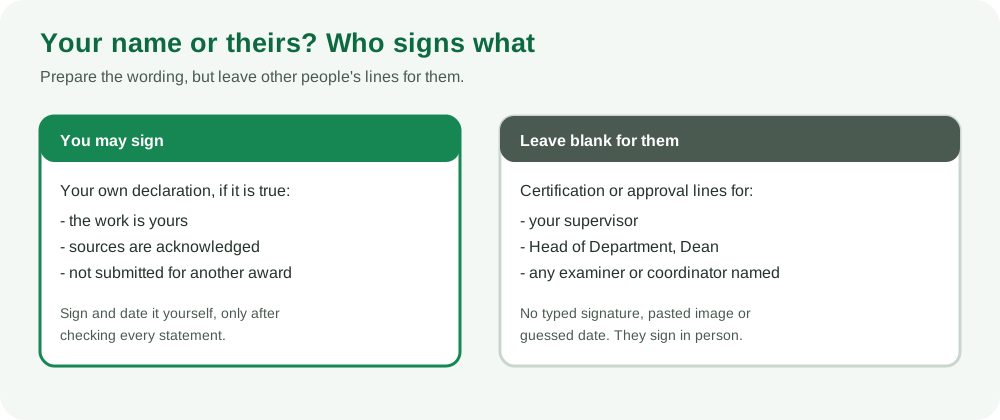
The rule of thumb is simple. You sign your own statement. Everybody else signs theirs.
- Never sign for a supervisor, Head of Department, examiner or Dean. That includes a scribbled imitation, a signature image copied from another document, or an electronic signature added without that person's permission. It would put a false endorsement on a document you are submitting for an award, and institutions treat false statements in submitted work seriously.
- Never type a date for someone else's signature. The date is part of what they confirm.
- Do not sign your own declaration early. Wait until the final version is ready, because the statement describes the report you are actually submitting.
- Do not present a drafted page as proof of approval. A page containing approval wording is not approved until the right people have signed it through the process your department sets.
What you can usually do is prepare the typed page with your project title, name and matric number, then present the correct version to your supervisor for signature. If your supervisor asks you to prepare the wording, use your department's template and leave their lines for them. The corrections guide explains how to keep the version history straight if the report changes after a review.
What are the common mistakes?
- Copying a senior's page without checking the heading. A page headed "Certification" in last year's project may have been the student's statement in their department and an official's in yours.
- Leaving another student's details behind. Wrong supervisor name, an earlier project title or a different programme. Search the whole file for the old names before printing.
- Different titles on different pages. The title page, declaration and approval page should carry the same agreed title. Change one and you must check the rest.
- Making claims you cannot support. Saying the work was done under supervision when no supervisor was assigned, or originality when large parts are adapted without acknowledgement.
- Mixing up the pages. Putting a declaration's claims on an approval page, or an acknowledgement's thanks on the declaration.
- Wrong order or missing page. Some departments want a declaration, some want an approval page. Check rather than adding all three to be safe.
How do I find out what my department wants?
Follow this order, because each step overrides the one below it:
- Your supervisor's instruction. If they tell you which pages to include and in what order, that is final.
- Your department's project handbook or template. Look for a sample preliminary pages section.
- The faculty or university style manual. Some, like the ones above, give sample wording. These apply to the group of students they were written for, which may or may not include you.
- Recent approved projects in your department. Useful for layout, but not proof of what is currently required. See what to look for in the sample project guide.
If the answers still conflict, send one question to your supervisor or project coordinator: "Which of declaration, certification and approval pages does my project need, in what order, and who signs each?" Keep the reply, since it settles any later dispute.
How do the neighbouring pages differ?
A quick way to keep the surrounding pages from blurring into the declaration:
| Page | What it is | Who writes or signs it |
|---|---|---|
| Declaration | A statement of fact about the work | The student |
| Certification / approval | A statement or decision endorsed by others (or, in some guides, the student's responsibility statement) | As your handbook says |
| Dedication | A personal tribute, usually optional | The student; see how to write a project dedication |
| Acknowledgement | Thanks for real help | The student; see what to write in an acknowledgement |
| Abstract | A summary of the study | The student; see how to write the abstract |
For the whole project layout, including how these pages fit in front of Chapter One, the Nigerian university project format guide covers the broader Word setup, and the step-by-step project guide shows where the preliminary pages fall in the writing process.
Questions a supervisor may ask
- Which wording does our department use for this page?
- Is every statement in your declaration true of this version of the project?
- Does the title on this page match the title on the title page?
- Who needs to sign before you submit, and in what order?
- Have you left other people's signature lines blank?
A last check before you print
- The pages match your handbook in name, wording and order.
- Your name, matric number, programme, department and project title are correct and identical across pages.
- Your declaration is true and you are comfortable signing it.
- Every other signature line is blank until that person signs.
- The file you present for signature is the final version.
UniDraft helps you organise the confirmed details, sources and instructions into an editable project document, so changes to a name or title can be made in one place. It does not sign or approve anything. Start your project document and keep the declaration, certification and approval pages for the people who must make them.
Sources
- Nnamdi Azikiwe University, Manual of Style (School of Postgraduate Studies), preliminary pages and Appendices A2 and A3.
- Newgate University Minna, Guidelines for the Preparation of Seminars and Project Reports, chapter 2 and Appendices III and IV.
- National Open University of Nigeria, Faculty of Education Research Project Manual and Format, preliminary pages and sample declaration and certification pages.