
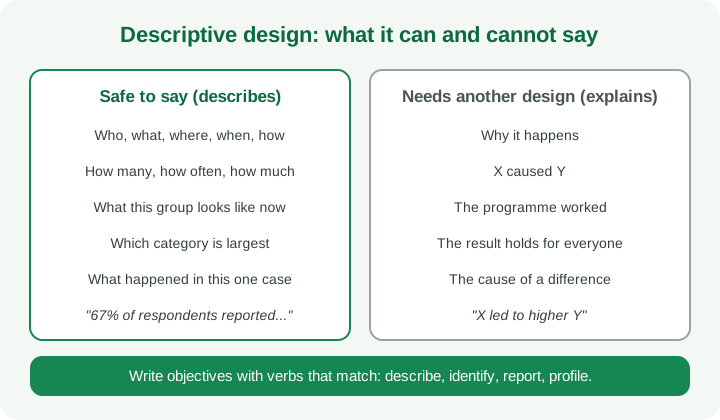
A descriptive research design is a plan for describing what exists: how many, how often, what kind, in which place or at what time. It collects data without manipulating anything, and it answers who, what, where, when and how. It cannot, on its own, show why something happens or what caused it.
UniDraft can help you write the design up once you have decided it. It organises your confirmed design decisions, real results, checked sources and supervisor instructions into an editable Word document. Start your project document with your own data and your supervisor's instructions to hand. You design, collect and analyse; UniDraft does not run the study.
This post is about one design. For the full menu of designs and how to pick one, see the research design chooser. For survey planning in detail, there is a separate survey design guide.
What is descriptive research design, in plain words?
The idea is simple. You pick a group, an event or a situation, and you describe it carefully and accurately. You do not change it, test a treatment on it or compare a treated group with an untreated one.
Three university library guides we opened word this in similar ways:
- The USC Libraries guide says descriptive designs help answer who, what, when, where and how, and that a descriptive study cannot conclusively ascertain answers to why.
- The Illinois Institute of Technology library guide says descriptive research documents the current state of a phenomenon or population, asking what is happening rather than why. It lists surveys, case studies and observation as common methods.
- The University of Missouri nursing guide calls surveys, case reports and cross-sectional studies snapshots that can show prevalence and trends but not cause and effect.
So a descriptive design is a strong choice when the honest answer to your research question is a description. It is a weak choice when your question starts with "why", "does X improve Y" or "what effect".
Descriptive design versus the words around it
| Term | What it means | Relationship to descriptive design |
|---|---|---|
| Descriptive | The purpose: describe what exists | The design itself |
| Survey | A method: ask many people the same questions | Often the way descriptive data is collected |
| Case study | A strategy: study one bounded case in depth | Can be descriptive |
| Observation | A method: watch and record | Can be descriptive |
| Cross-sectional | Timing: one snapshot | Often descriptive, but cannot show cause |
| Correlational / analytical | Purpose: examine relationships or causes | Where description ends (see below) |
This is why "descriptive survey design", the phrase you will see in many Nigerian project reports, is not wrong. It names the purpose (descriptive) and the method (survey) together.
What are the types of descriptive research?
The sources agree on a short list and disagree on the edges. The map below shows the three common routes.
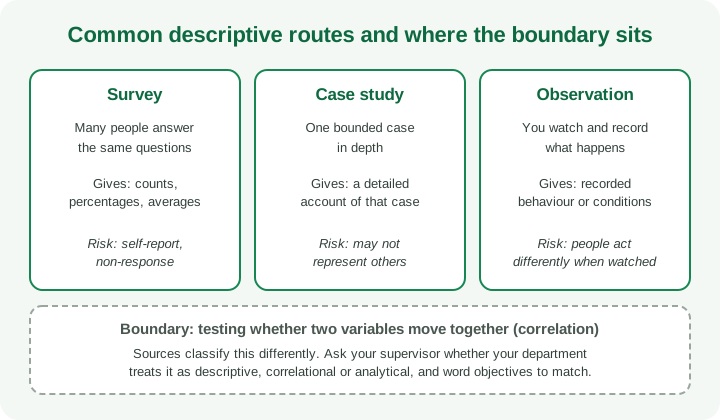
Survey. You ask a defined group the same questions and summarise the answers as counts, percentages and averages. Survey is the route most final-year students use. Sampling and instrument quality decide whether the description is believable; see sampling techniques and how to design a questionnaire.
Case study. You describe one bounded case in depth, such as one office, one process or one programme. The IIT guide lists case studies among descriptive methods, though the USC guide treats case study as a separate design, which is a good example of sources disagreeing. If your supervisor wants a case study, read the case study guide rather than relabelling it.
Observation. You watch and record behaviour or conditions, often with a checklist. The USC guide notes that observation happens in a natural setting, but the observer and the instrument matter a great deal. A starter checklist is in the observation checklist guide.
Cross-sectional and longitudinal. These describe when you collect data. Cross-sectional means one snapshot. Longitudinal means repeated measurement. A descriptive longitudinal study can describe change over time, though it still does not explain the cause of the change.
Where does correlational work fit?
Here sources really do differ. Some textbooks treat correlational research as a separate design. Some library guides group relationship-finding under analytical or cross-sectional designs. The IIT guide says description cannot examine relationships between factors, while the USC guide says a cross-sectional study can find relationships at one point in time but cannot establish cause.
You do not need to settle that debate. You need to be consistent. If your objective is "to examine the relationship between A and B", say so and ask your supervisor whether the department calls that descriptive-correlational, correlational or analytical. Then use the same label in Chapter One, Chapter Three and the conclusion. The deeper treatment of choosing among these is in quantitative research methods.
When does a descriptive design fit a final-year project?
It fits when:
- Your question is a what, how many or how often question. "What study habits do 300-level students report?" is descriptive. "Do study habits improve grades?" is not.
- Little is documented about your setting. Description gives a baseline. The IIT guide says projects often start with description and later move to analytical work.
- You cannot manipulate or compare. Many projects have no access to an experiment or control group, but can reach a population by questionnaire or observation.
- Your timetable is short. A single round of data is the usual practical plan.
- Your department or supervisor accepts it. Confirm this first.
It fits badly when you want to claim impact, effectiveness or cause. A student who wants to show that a training programme "improved" staff performance needs a design that compares before and after, or treated and untreated groups, not a one-round description. The experimental design guide covers what that takes.
A fictional worked example
Everything below is invented to illustrate the thinking. Names, numbers and findings are not from a real study.
Ada is a final-year Business Administration student. Her first draft title promised "the effect of social media marketing on sales of small businesses". She has no sales records, no comparison group and one semester. Her supervisor asks what she can honestly deliver.
Ada rewrites her aim as a description:
Aim: To describe how small shop owners in one market area currently use social media for their businesses.
Objectives: (1) identify which platforms owners use; (2) describe how often they post; (3) report the reasons owners give for using or not using social media; (4) report the difficulties they mention.
Design: Descriptive survey, cross-sectional, one round of data collection.
Notice what changed. "Effect on sales" is gone because her design cannot support it. Every objective now uses a verb that a survey can deliver. What she gains is a finding she can defend: a clear picture of current practice in one area.
Her results chapter could then say "of the 62 owners who completed the questionnaire, 41 reported using WhatsApp for customer contact" (invented numbers). It could not say "social media increased sales". A panel member who asks about sales gets a straightforward answer: the study did not measure sales, by design, and the limitation section says so.
How do you write a descriptive design in Chapter Three?
Departments set their own Chapter Three structure, so follow your template. Within it, a descriptive design section usually needs to answer the following, in your own words and for your own study:
- State the design and the reason. Name it ("descriptive survey design", "descriptive case study") and say why description fits your questions.
- Define the population and the unit. Who or what is described? Students in one department, one office, one set of records?
- Explain selection. How were respondents or sites chosen, and what does that mean for who the result speaks for?
- Describe the instrument. Questionnaire, interview guide, observation checklist or record sheet, and how you checked it works.
- Explain collection. When, how, by whom, with what consent.
- State the analysis. For a descriptive study this is usually frequencies, percentages, averages or themes. The descriptive statistics guide covers the reading of those.
- Name the limits. What the design cannot show, in line with the limitations guide.
For the wider chapter, the methodology writing guide shows how these pieces sit together. If your department has a formatting brief for chapters, follow it; UniDraft's formatter and format pages are the place for university-specific layout questions, not this post.
A sample paragraph pattern (fill with your own facts)
This study adopted a descriptive survey design. The design was considered appropriate because the study sought to describe [what], among [who], at [where and when], rather than to test the effect of any intervention. Data were collected once, using [instrument]. [Number] of [number invited] respondents completed it. Responses are summarised using [frequencies and percentages].
Replace every bracket with a fact you can verify. Never copy a sample paragraph from another report and leave its numbers or institution behind.
What claims can a descriptive study support?
Use this as a rule of thumb for Chapters Four and Five.
| You may write | You should not write |
|---|---|
| "Most respondents reported..." | "This proves that..." |
| "Respondents who used X also tended to report Y" (if you measured both) | "X caused Y" |
| "In this case, the process involved..." | "All organisations do..." |
| "Within this sample, the largest group was..." | "Nigerian students generally..." |
| "The findings suggest a need to examine..." | "The programme is effective" |
Generalising depends on how people were selected and how many responded, not on the word "descriptive". If you used a convenience sample, describe your respondents and stay modest about who the result speaks for.
Common mistakes with descriptive designs
- Writing causal objectives. "To determine the effect of..." needs a design that can test an effect. Reword or change design.
- Using "descriptive" as a label with no description. If the results chapter lists tables but never says what they show, the design is decoration.
- Confusing the instrument with the design. A questionnaire is a tool. The design explains who, when, how and what can be claimed.
- Mixing labels. Calling the study descriptive in Chapter One, correlational in Chapter Three and experimental in the conclusion.
- Hiding non-response. Report how many were invited and how many answered.
- Over-generalising from one case or one school. Say where and when the data came from.
- Skipping the limits. The USC guide itself lists limitations of descriptive work; so should you.
Questions a supervisor or panel may ask
- Why is description enough for your research questions?
- Which of your objectives could a descriptive design not answer?
- How did you choose your respondents, and who is missing?
- What does your result tell us about people you did not survey?
- Why did you not test a relationship or an effect?
- What would be the next study after this one?
What if my supervisor says my project is "too descriptive"?
This comment usually means the write-up lists findings without interpreting them, not that description is forbidden. Interpretation is still allowed inside a descriptive study: say what the pattern means for your setting, compare it with what your literature review reported, and point out what is surprising. What you cannot do is slide from "what we found" to "why it happens" without evidence that supports the why.
If the supervisor actually wants an explanation, you may need to change the objectives and the design together. Ask which of the two they mean before rewriting anything, and record their answer in your notes.
A design checklist before you collect data
- Every objective starts with a describing verb (identify, describe, report, profile).
- The design label matches your supervisor's wording.
- Population, sample and selection are written down.
- The instrument matches each objective.
- Consent and ethics steps are confirmed with your department.
- You know which claims you will not make.
For wording of questions and objectives, see how to write research questions and objectives. For data-collection choices, see data collection methods.
Where UniDraft fits
Once your design is fixed and your data is real, UniDraft can organise your confirmed work, checked sources and supervisor instructions into an editable Word project document. Our free topic generator can help you shape a describable question first, and the citations tool can help with referencing. Start your project document when you are ready. Follow your department's brief for anything it specifies.
Sources
Pages opened while preparing this guide: