A workable English Language project topic joins one language feature, one body of data you can really get, and one framework that explains how you will analyse it. "Language in Nigerian music" is only an interest; it becomes a topic when you can name the texts, the feature and the method, and say what the evidence cannot show.
UniDraft's free topic generator can give you question shapes to test against your department's brief. Treat every suggestion as provisional until your supervisor confirms it. When your data and method are settled, UniDraft helps organise your confirmed work, checked sources and supervisor instructions into an editable Word project document. Start your project document once you have something real to organise.
This guide is about planning the evidence behind a language study. It does not list "approved" titles, because no one outside your department can approve one for you. For shorter seminar-scale ideas see the English Language seminar topic guide, and for interpretation of novels, poems and plays see the Literature seminar guide.
What counts as an English Language project?
Department rules differ, so read yours first. In general, a language project asks a question about how language works or is used, and answers it with systematic evidence: written texts, spoken data, learner output, participants' reported views, or an existing dataset. It is not an essay of opinions about language, and it is not a summary of textbooks.
That is the main difference from a literature project, where the evidence is the interpretation of a literary work. It is also different from a content-analysis project, which is one method you may borrow for coding texts. Here the framework is linguistic: you are asking about grammar, vocabulary, sound, meaning, discourse or attitudes to language.
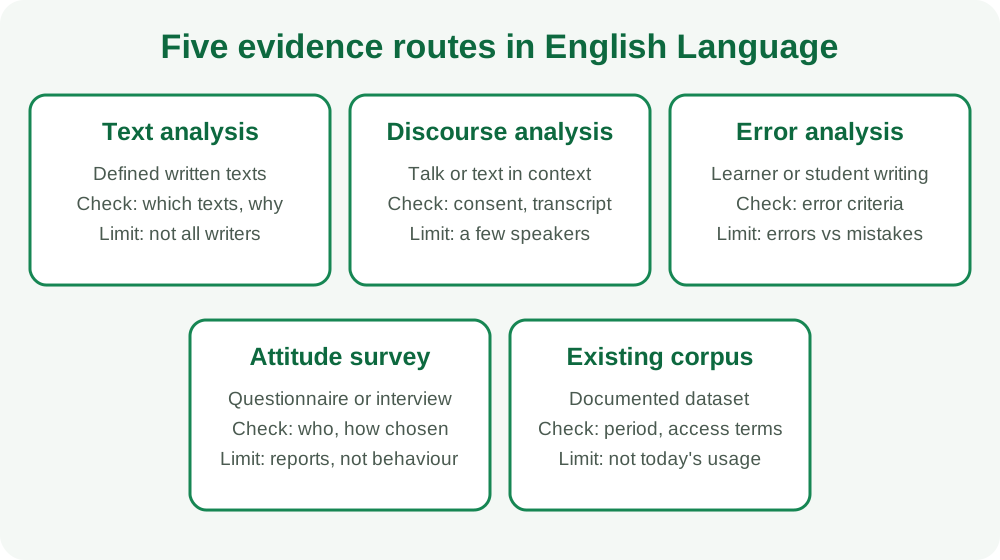
The five routes to evidence
The figure above groups the usual routes. Each has a different bottleneck, so choose by asking which data you can access before the deadline, not which title sounds impressive.
| Route | Typical question shape (provisional) | Main bottleneck |
|---|---|---|
| Text analysis | How is a feature used in a defined set of written texts? | Justifying why those texts |
| Discourse analysis | How do speakers or writers do something (persuade, hedge, open a meeting) in context? | Getting data and transcribing it |
| Error analysis | What kinds of errors appear in a defined set of student writing, and how do you classify them? | Permission, and defensible criteria |
| Attitude survey | What do a defined group of people say about a language choice? | Sampling and instrument quality |
| Existing corpus | How is a word or structure used in a documented dataset? | Access terms, period, feasibility |
Pick one primary route. A second route is fine as support, but a project that tries to do a corpus study, a survey and a discourse analysis in one semester usually does none of them well.
Text analysis: choose the texts for a reason
Text analysis starts with a selection rule. If you analyse "newspaper headlines", say which newspapers, which dates, how many, and why. "Whatever I could find online" is not a rule, and a supervisor or external examiner will ask.
Then define the feature before you count anything. If you are studying, say, hedging, write down what counts as a hedge and what does not, with examples. Decide the unit: a word, a clause, a sentence or a whole text. Keep a log of ambiguous cases and how you ruled on them. If you change a category after seeing results, record that you did and why.
One caution: the same word can do different jobs in different places. Counting a word is not the same as counting the function you care about, so read the cases in context before you report totals.
Discourse analysis: from talk or text to a claim
Discourse analysis looks at language in use: how people accomplish things with talk or writing in a setting. Common data in student projects include recorded conversations, classroom interaction, sermons, radio or television talk, political speeches, advertisements and social media posts.
The framework matters more here than in a simple count. Different traditions ask different questions, such as how a speaker builds a position, how turns are organised, or how power is signalled. You must name your approach, define its key terms in your own words from sources you have read, and apply them consistently. Two approaches can give different readings of the same extract; that is normal, but you must say which one you are using.
For public material (broadcasts, published speeches, public posts), still ask your supervisor how to cite it and whether the department treats it as needing ethical clearance. For recorded private talk, go to the next section. If your analysis is built on themes you develop from the data, the thematic analysis guide shows how to document the steps.
Collecting spoken and written data: consent, recording and transcription
Anything involving identifiable people needs a plan before you press record. The principles are widely shared, even though forms and approval steps vary by institution: people should know what you are collecting and why, agree freely, be able to withdraw as far as your design allows, and have their identity and recordings protected. Read your institution's own requirements, and use the research ethics and consent guide and the consent form sample as planning aids, not as a substitute for your department's form.
A practical checklist for spoken data:
- Permission first. Get your supervisor's go-ahead and any required clearance before recording. Do not record people secretly and decide later whether to use it.
- Say what the recording is for, who will hear it, how long it is kept and whether quotations will appear in the project.
- Decide on names. Use codes or pseudonyms (Speaker A, Participant 3) in the transcript and the write-up, and keep the key linking codes to real names separate and protected.
- Mind the setting. People speak differently when they know they are recorded. Note the setting, the relationship between speakers and the equipment, and mention the effect as a limitation rather than ignoring it.
- Store it carefully. Keep audio files and signed forms somewhere only you and your supervisor can reach, and delete or hand over as your department requires.
- Children and vulnerable people need special care. Ask your supervisor before approaching them, and do not assume ordinary consent is enough.
Transcription is part of your analysis
A transcript is a decision, not a neutral copy. You choose what to write down: pauses, overlaps, laughter, code-switching between English, Pidgin or a Nigerian language, false starts. State your transcription conventions in a short key and apply them the same way throughout. Whatever level of detail you choose, it must match the question. A study of turn-taking needs pauses and overlaps; a study of vocabulary choice may not.
Put the key in an appendix, and keep transcribed extracts short and numbered so you can refer back to them in the analysis. The appendices guide covers where full transcripts and forms usually belong, subject to your department's rules.
Written data raises its own questions: who owns the text, whether the source allows you to quote it, and how you record the date and version you accessed. Save a dated copy of anything that might change or disappear online.
Corpus work and small-sample caveats
A corpus is a collection of language material put together for analysis. You can build a small one yourself from your selected texts, or query an existing one. The University of Münster's ICE Nigeria page describes a corpus of spoken and written educated Nigerian English of about one million words, collected between 2009 and 2012, available through a DOI link. Before using any such resource, read its documentation and access terms yourself, check that your question can really be answered from it, and remember its collection period when you describe "current" usage.
The central caveat is representativeness. Lancaster University's teaching page on sampling explains that a corpus can only support generalisations as far as it represents the variety being studied, and that skew in the sample limits what you can say. For a student, that has plain consequences:
- A corpus you build is a sample of what you chose. Say how you chose it and what it leaves out.
- A small sample can show that something occurs and how it is used. It is much weaker evidence that something is typical or common across a community.
- More text is not automatically better. Twenty texts from one source tell you about that source. A broader range of sources and genres makes wider statements more defensible.
- Do not invent a minimum size. Whether a sample is adequate depends on your question and design. Ask your supervisor what your department expects, and see the sampling techniques guide for the vocabulary.
Compare counts fairly
If you compare two text sets of different lengths, raw counts mislead. The University of Mainz corpus teaching page shows why frequencies are normalised to a common base, such as per million words, before comparing. In a student project the base may be per 1,000 words or per 100 sentences, whichever fits your data. Check the contexts as well as the numbers, and do not call a difference significant unless you have used a suitable test and your supervisor agrees the design supports one. The guide to choosing a statistical test covers that decision.
Error analysis: classify carefully and fairly
Error analysis studies the language that learners or students produce when it departs from a target norm. A well-known starting point is the distinction, usually credited to Corder, between systematic errors, which reflect what the learner has not yet mastered, and unsystematic mistakes, which are slips. Read his work or a reliable textbook account yourself and cite the version you read; do not borrow a definition second-hand.
For a student project the hard parts are not the idea but the procedure:
- Whose writing, and with what permission? Student scripts are personal data. Get permission through your supervisor, remove names and keep the originals secure.
- What is your target norm? Standard British English? A Nigerian educated variety? Your institution's marking expectations? Say which, and justify it. Calling every difference from one norm an "error" is a judgement you must defend.
- How do you classify? Build a category list (for example tense, concord, spelling, word choice) from the literature, test it on a few texts, revise it, then apply it consistently. Record borderline cases.
- How do you count? Errors per script, per 100 words or per category all answer different questions. Pick the one that fits.
- Can you explain causes? Usually not from scripts alone. Suggesting mother-tongue influence, teaching or carelessness as a cause needs separate evidence, so present it as a possibility.
Attitude and perception studies: questionnaires and interviews
If your question is about what people think or say they do, such as attitudes to Nigerian Pidgin, to a local accent, or to English as a language of instruction, a questionnaire or interview fits. The data are self-reports, which is a real and honourable kind of evidence, but it is not a record of behaviour.
Follow the usual discipline: define who your population is, how you will choose respondents, and what each question is supposed to measure. The questionnaire design guide walks through wording and structure. If you interview, the interview guide worksheet separates your research questions from the questions you will actually ask.
If you use agreement scales, the Likert scale analysis guide covers handling them. Sensitive points specific to language attitudes: people sometimes give the answer they think a student of English "should" give, and wording like "correct English" or "broken English" can carry judgements that bias responses. Pilot your questions on a few people and ask your supervisor to read them before you distribute anything.
Choose a framework, then define it
Most weak language projects fail at this step. A framework is the set of ideas that tells you what to look at and how to interpret it. Examples of the kinds of things a framework supplies: categories for grammar or discourse, a theory of politeness, a model of variation, a scheme for classifying errors.
To use one properly:
- Name it and cite where it comes from. Read the original or a reliable account, not just a summary on a notes website.
- Define the key terms in plain words and show how each one will be recognised in your data.
- Say why it fits your question, and why you did not use an alternative.
- Apply it consistently, and report cases that do not fit instead of hiding them.
- Keep it distinct from your own opinion. The framework is borrowed; your analysis is the part that is yours.
If you are unsure how a framework differs from the wider set of ideas around a study, read the conceptual versus theoretical framework guide. Then tie it to the research questions you write; the research questions and objectives guide helps keep the two aligned.
What can a language study claim?
The second figure sets out how far each kind of statement can reach. Stay on the lower steps unless your design justifies the upper ones.
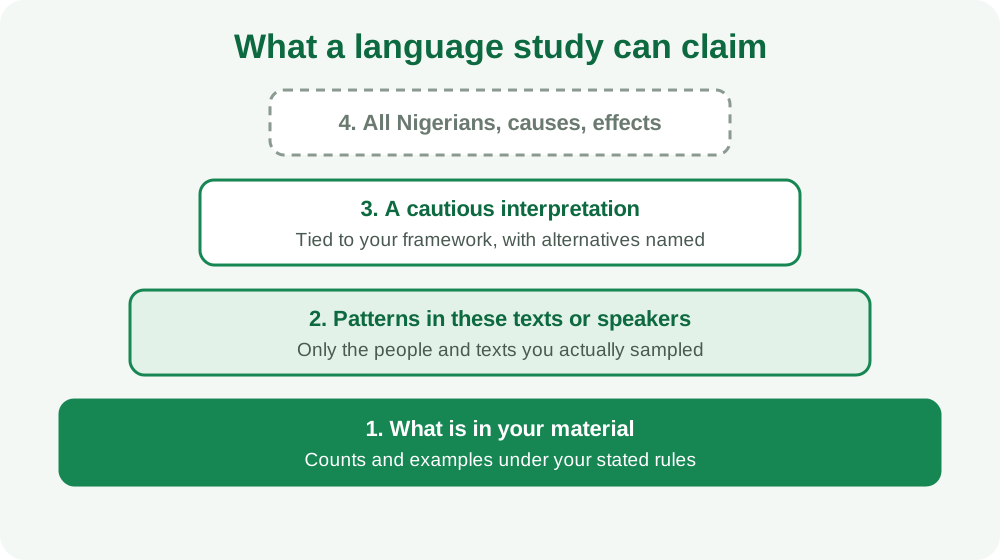
- "In these 30 texts, the feature appears in these contexts." Supported by your data, if the counts and coding are honest.
- "Among these speakers, this pattern is common." Supported only for the speakers you recorded and the setting you recorded them in.
- "This suggests..." An interpretation tied to your framework, with alternative readings named.
- "Nigerians use English this way", "social media causes errors", "teachers are to blame." These are rarely justified by a student project. Present them as questions for further research.
Put the boundaries in your limitations section in specific terms (who, what, when, how selected), instead of a generic sentence about small samples.
A fictional feasibility worksheet
This is an invented example for planning practice. It is not a real study or a recommended title.
Interest: how students open requests in emails to lecturers.
Question shape (provisional): How do a defined set of student emails open a request, and what do they name first?
Data: Needs real emails, which are personal data. Option A: ask volunteers to donate emails with names removed, with supervisor approval. Option B: use a published teaching corpus. Option C: change to a survey of how students say they open emails.
Framework: Needs a defined scheme for request strategies from the literature, not one invented the night before.
Main risk: access and consent. If Option A fails, the topic collapses.
What the project could not claim: how all Nigerian students write, or whether the openings worked.
Notice that the worksheet starts by exposing the risky step. Fill in one like it for each idea on your shortlist and drop whichever one fails on access.
Common mistakes in language projects
- Choosing a framework you cannot define in your own words.
- Using "data" you cannot trace to a source, date and permission.
- Counting words and then talking about meaning without reading the contexts.
- Treating a few recordings as proof about a whole region or generation.
- Mixing standards: labelling Nigerian English features "errors" without saying which norm you chose and why.
- Writing the conclusion before the analysis and bending the data to fit.
- Presenting a questionnaire's answers as if they showed actual speech behaviour.
- Adding a second and third method to look thorough, then finishing none.
Questions you may get at the defence
Practise answering these aloud; the common defence questions guide shows how to structure answers.
- Why did you choose these texts or speakers?
- How did you define the feature you counted, and what did you do with unclear cases?
- Why this framework and not another?
- How did you protect your participants, and what consent did you get?
- How did you transcribe, and what did you leave out?
- What can you not say from your data?
Before you commit to a topic
- You can name the data, where it comes from and when you will have it.
- Permission and consent are agreed, in writing where your department asks for it.
- The framework is named, read in the original or a reliable source, and defined.
- You can state the question in one sentence without the word "and" more than once.
- Your supervisor has seen the shortlist and approved the direction.
When you are ready to turn confirmed material into chapters, the choosing a research design guide helps match design to question. UniDraft organises your confirmed work, checked sources and supervisor instructions into an editable Word project document; the analysis, interpretation and choices remain yours. Start your project document.
Sources
- University of Münster: ICE Nigeria — describes the corpus period, content and access link.
- Lancaster University: Sampling and Representativeness — teaching discussion of sampling and the limits of claims from a corpus.
- Johannes Gutenberg University Mainz: Normalizing frequencies — explains normalising counts to a common base.