
The independent variable is the factor you expect to influence something else, or the one you deliberately change; the dependent variable is the outcome you measure. In "the effect of X on Y", X is independent and Y is dependent. Control, moderating and mediating variables describe other roles around that pair.
Getting this right early makes the rest of the project easier. UniDraft helps organise your confirmed research question, variables, checked sources and supervisor instructions into an editable Word document. Start your project document, and keep the definitions and analysis your own. If you are still choosing what to study, the free topic generator can give you a starting shortlist to test with your supervisor.
What is a variable, and what is not one?
A variable is any characteristic that takes different values across people, organisations, places or time. "Monthly income" is a variable because it differs from one household to the next. "Nigeria" is not a variable on its own; it is a setting. "Banking" is a topic, not a variable. This is the single most common confusion, and it explains why so many draft titles look complete but cannot be tested.
A quick test: can you imagine two different values or categories? If the answer is no, you are probably looking at a topic, a place or a population, not a variable.
| What you wrote | Topic or variable? | Why |
|---|---|---|
| Social media | Topic | No values or categories are specified |
| Hours spent on social media per day | Variable | It can be 1, 4, 7 hours and so on |
| Secondary schools in Kano | Population or setting | Describes who or where, not what varies |
| Teaching method (lecture vs demonstration) | Variable | Two categories |
| Student performance | Concept to be measured | Needs an operational definition, such as exam score |
For how variables sit inside your wider design, see the section on measurement in quantitative research methods, which also covers the levels of measurement (nominal to ratio).
What are the types of variables in research?
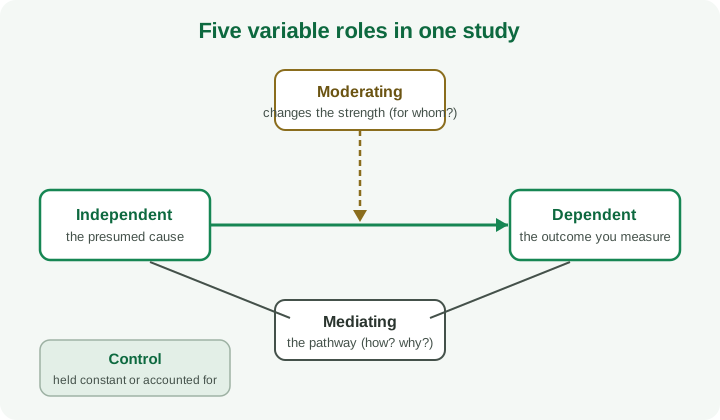
Independent variable (IV)
The factor you think produces a change, or the one you manipulate in an experiment. It is also called the predictor, explanatory or exposure variable depending on the field and design. In a survey you do not manipulate it; you measure it as it already exists.
Dependent variable (DV)
The outcome. It is what you measure to see whether it changes with the independent variable. Also called the outcome or response variable. Your results chapter is largely about the dependent variable.
Control variables
Factors that could also change the outcome, which you keep constant, measure, or account for statistically so they do not confuse your result. The purpose is to remove alternative explanations. In an experiment you may hold something constant by design (same room, same test paper, same duration). In a survey you usually cannot hold things constant, so you collect the information (for example, level of study) and adjust for it in the analysis.
Do not confuse a control variable with a control group. A control group is a set of participants who do not receive the treatment; control variables are factors kept constant or adjusted for across everyone. Choose controls with a reason, based on what earlier studies in your field treated as relevant, not simply because the questionnaire already contains the item. Be careful not to "control away" a mediator, because that removes part of the effect you are trying to measure.
Mediating variable
A variable on the pathway: the independent variable affects it, and it in turn affects the dependent variable (X to M to Y). It answers how or why the effect happens. A mediator is both an outcome of X and a driver of Y.
Moderating variable
A third variable that changes the strength, direction or significance of the X to Y relationship. It answers for whom or under what conditions the effect differs. It does not sit on the causal path. In analysis it is usually examined through an interaction between X and the moderator.
The distinction in one line: mediator = the mechanism, moderator = the condition. The same variable can in principle play either role, so your research question and the theory behind it decide, not the name of the variable.
Four fictional examples across disciplines
These are illustrative, not suggested or approved topics. Check with your supervisor before adapting any of them.
1. Education. Question: does teaching method affect practical-exam scores in a Biology class? The independent variable is teaching method (simulation or demonstration). The dependent variable is practical-exam score. Controls might include prior performance and class size. A possible moderator is gender, if the question is whether the method works differently for different groups. Whether a variable like gender belongs as a moderator or only as a control depends on what you actually want to ask.
2. Business. Question: does the quality of customer service affect repeat purchase in small retail shops? Independent: customer service quality (measured by a validated scale). Dependent: repeat purchase intention. A possible mediator: customer satisfaction, if you reason that service shapes satisfaction and satisfaction shapes repeat purchase. A possible control: shop size.
3. Health. Question: does hand-washing training influence infection-related absences among hostel residents? Independent: attendance at training (yes or no). Dependent: number of infection-related absence days in a set period. Controls: hostel type, number of residents per room. Be explicit about how you will obtain absence data and whether you have the consent and access to do so; see research ethics and consent.
4. Computer science. Question: does a caching setting change a web application's page-load time? Independent: caching setting (on or off). Dependent: page-load time in milliseconds under a stated test setup. Controls: the device, network condition and page content, all kept the same for each run. Here, "network condition" is held constant by design rather than adjusted statistically.
Notice the pattern: each example names one presumed cause, one outcome, and a short, reasoned list of controls. Projects with six independent variables and no clear question are harder to defend.
How do I identify variables from my title?
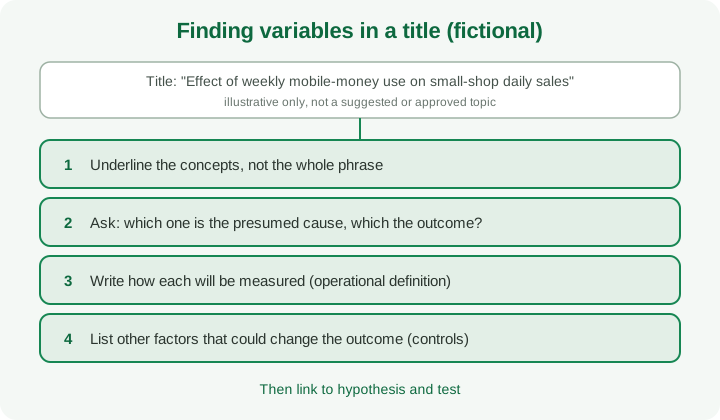
Take a fictional title: "Effect of weekly mobile-money use on small-shop daily sales."
- Underline the concepts, not the whole phrase. "Mobile-money use" and "daily sales".
- Ask which is the presumed cause and which the outcome. The word "effect of A on B" usually marks A as independent and B as dependent. Other signals: "influence of", "impact of", "relationship between", "difference in ... by ...", "predictors of".
- Check whether the title hides a sample. "Small-shop" here describes who you study. It is a population, not a variable, unless you compare shop sizes.
- List plausible alternative explanations. Location, shop age, product type. These become controls.
A title that is only a topic ("Mobile money in small business") has no variables yet. That is not a failure; it simply means the question has not been sharpened. Rework it with the guidance in how to write research questions and objectives.
How do I write an operational definition?
A concept such as "performance" or "satisfaction" cannot be measured until you say what you will actually observe. An operational definition states how a variable will be measured or produced in your study, which lets another person understand exactly what you did and repeat it.
Guides on this usually list three parts: the variable and its attributes, the measure you will use, and how the data will be interpreted. A simple way to lay it out is a table.
| Variable | Conceptual meaning | Operational definition | Scale |
|---|---|---|---|
| Teaching method | The approach used to deliver a topic | Class taught by simulation or by demonstration, as recorded in the lesson plan | Nominal (two categories) |
| Practical-exam score | Practical competence | Score out of the marks set on the department's practical test | Ratio |
| Customer service quality | How well staff meet customer needs | Mean of a set of rating items on a scale, using a validated instrument you cite | Ordinal or interval-like, per your supervisor |
| Page-load time | Speed of delivery | Milliseconds from request to full load, measured by a named tool under fixed conditions | Ratio |
Two cautions. First, the same concept can be measured in more than one valid way, so say why you chose yours. Second, an operational definition makes a variable measurable, not automatically meaningful. A weak measure gives weak evidence, which is why validity and reliability of a questionnaire matter. If your measure is a Likert-type item set, read the guidance on Likert scale analysis before you decide how to treat it.
How do variables map to hypotheses and tests?
Your variables should appear unchanged in your objectives, hypotheses, instrument and analysis. If "service quality" becomes "customer care" in Chapter 3 and "staff attitude" in Chapter 4, the thread breaks and a panel will notice.
| Variable pairing | Example question shape | Family of tests to consider |
|---|---|---|
| Categorical IV, numerical DV (two groups) | Do the two groups differ on the outcome? | Independent-samples comparison, or rank-based alternative |
| Categorical IV (three or more groups), numerical DV | Do several groups differ? | ANOVA family or rank-based alternative |
| Two categorical variables | Are the two associated? | Chi-square family |
| Numerical IV, numerical DV | Is there a relationship? | Correlation or regression |
| Several predictors, one outcome | What predicts the outcome, adjusting for controls? | Multiple regression or similar |
This table names families only. The right test also depends on your scale of measurement, assumptions, sample design and your department's expectations, so confirm with your supervisor. The decision path is in which statistical test to use.
Once you have an output, how to interpret a correlation table and the t-test and ANOVA guide show how to read it.
On the hypothesis side, each hypothesis should name the independent and dependent variable: "There is no significant effect of teaching method on practical-exam score" has both. Mediators and moderators usually need their own statement of what you expect, and they need a design and sample that can support the extra analysis; ask your supervisor whether that is realistic for a final-year project. The null and alternative forms are explained in how to write hypotheses. If your project uses a framework to explain how variables connect, see conceptual vs theoretical framework.
Common mistakes supervisors flag
- Treating the topic as a variable. "Banking" or "education" gives you nothing to measure.
- Treating the population as a variable. "Secondary school students" is who you study; "level of study" may be the variable.
- Reversing cause and outcome. Ask which one could plausibly influence the other, and justify that with theory or earlier studies.
- Too many variables. Every extra variable needs a definition, a measure and an analysis. Keep the set justified.
- Calling every extra variable a moderator. A moderator needs a reason (theory or earlier work) to change the relationship; otherwise it may only be a control or a descriptive background item.
- Claiming cause from a survey. A survey can show an association; a causal claim needs design features to support it. Word your conclusions to match your design.
- Changing variable names between chapters.
- Skipping operational definitions. If you cannot say how it is measured, the instrument cannot be built.
A quick identification worksheet
Fill this in for your own project, then take it to your supervisor.
- My research question, in one sentence:
- Concept that is the presumed cause (independent):
- Concept that is the outcome (dependent):
- How I will measure each (operational definition, instrument, scale):
- Factors I will hold constant or adjust for (controls), and why:
- Any mechanism I want to test (mediator)? Why:
- Any condition under which the effect may differ (moderator)? Why:
- Who or what I am studying (population, not a variable):
- The hypothesis or objective that uses these exact names:
- The test or analysis my supervisor agreed fits this pairing:
If you cannot complete item 2 or 3, the question needs another pass before you write any chapter.
Questions a panel may ask
- "Which is your independent variable and which is your dependent variable, and why that direction?"
- "How exactly did you measure this variable?"
- "What did you do about other factors that could explain the result?"
- "Why is this variable a moderator and not a control?"
- "Does your design allow you to say it causes the outcome?"
Prepare short, specific answers and tie them to your methodology. More on handling a panel is in common project defense questions.
Where UniDraft fits in
You choose and define the variables, collect the data and run the analysis yourself. UniDraft helps organise your confirmed work, checked sources and supervisor instructions into an editable Word project document, so the variable names you settled on carry consistently through your chapters. Start your project document when your question and variables are agreed. For formatting questions, follow your own department's brief and use the formatter or format pages as a reference.
Sources
Opened while researching this guide:
- University of Southampton Library: mediation vs moderation
- Simply Psychology: mediating vs moderating variables
- Editor World: control variables in research design
- National University Library: variables and operational definitions
Definitions here are general research-methods usage. Your department or supervisor may prefer different terms or a specific textbook; follow their guidance.