
Education students mostly use six methods: survey, case study, action research, quasi-experiment with intact classes, content analysis of curricula or policy documents, and interviews with teachers. Pick the one whose strongest honest claim matches your question, then check that a school will actually let you use it.
UniDraft helps organise your confirmed methods, instruments, checked sources and supervisor instructions into an editable Word document. Start your project document once your design is agreed, and use the free topic generator if you are still choosing the question. Run the study and the analysis yourself.
This page is about choosing the method. If you need a topic first, see education project topics.
For leadership and administration studies, read educational management project topics, and for studies touching pupils' personal issues, guidance and counselling project topics.
How do I match a method to my education question?
Begin with the verb in your question. "How many" and "what goes with what" point towards a survey. "How does it work here" points to a case study. "Can I improve my own teaching" points to action research. "Did one group do differently after a method" points to a quasi-experiment. "What do these documents contain" is content analysis. "How do teachers explain what they do" calls for interviews.
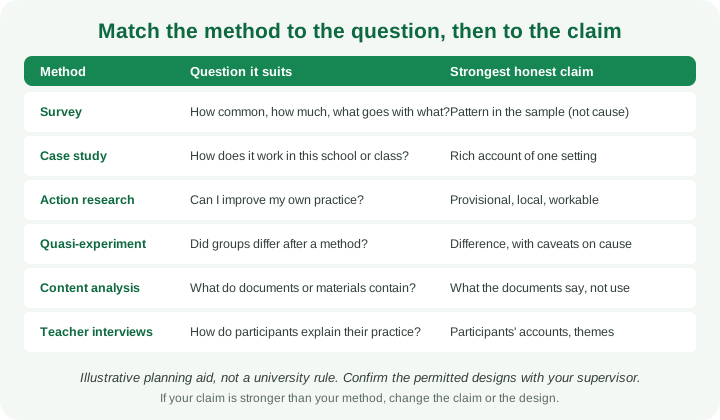
The right-hand column matters more than students expect. A supervisor or panel will not usually object to a small sample; they object when the conclusion is bigger than the method. Choosing a research design covers the general logic. Here we keep to what education students tend to meet in schools and colleges.
What can each method actually claim?
Survey. A questionnaire to teachers, pupils or students can describe how common a view or practice is in your sample and whether two things go together. It cannot show why. The survey research design guide walks through timing, mode, sampling frame and non-response.
Case study. One school, one department or one class, studied in depth through observation, documents and conversation. It gives a rich account of that setting. It does not tell you about schools in general; say so plainly. See the case study guide.
Action research. In the education literature, action research is inquiry carried out to understand, evaluate and then change practice, usually by the teacher in their own classroom. One open textbook chapter describes a basic cycle of planning a change, acting on it, observing what happens, reflecting, and repeating. Findings are treated as provisional and local, and the chapter notes that outside factors can explain gains, so causal claims are weak. That is not a flaw to hide; it is the honest scope of the method.
Quasi-experiment. Groups are compared after one received a method or resource. A university course resource explains that the difference from a true experiment lies in random selection and assignment, and that groups in a quasi-experiment are often intact classes that need not be randomised; it attributes the lack of randomisation partly to ethical issues in schools. The experimental design guide covers pre-tests, post-tests and threats to validity.
Content analysis. You code a defined set of documents, such as a syllabus, textbook units, policy statements or exam questions, against a stated scheme. You can say what the documents contain. You cannot say how teachers use them. See content analysis.
Interviews with teachers. Participants' own accounts of their practice, analysed for themes. The claim is about how those participants describe things, not how many teachers do them. Use the interview guide to design the questions and thematic analysis to work out what you found.
How do I get into a school?
Access is where many education projects stall, so plan it before the method is fixed.
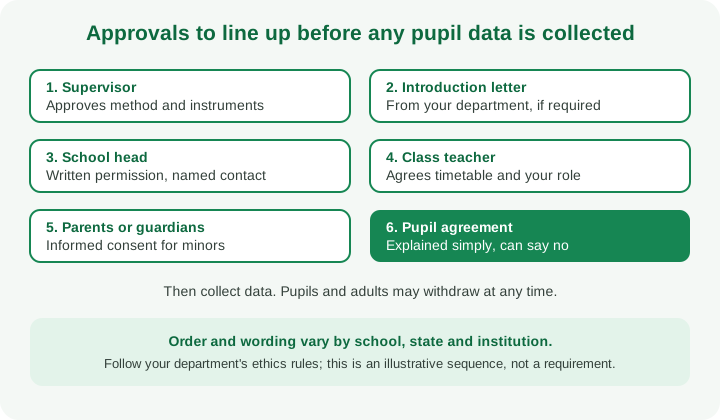
A typical chain, which varies by institution, runs like this:
- Your supervisor approves the method and the instruments.
- Your department issues an introduction letter if it requires one.
- The head teacher or principal gives written permission, with a named contact.
- The class teacher agrees the timetable and what your role is in the room.
- Parents or guardians give consent where pupils are minors.
- Pupils are told, in language they follow, what you are doing and that they can say no.
Ask for permission in writing, say exactly what you will do and for how long, and be ready to be told no or "not this term". Have a second school or a second method in mind. A permission letter that promises "access to all SS2 classes" is a risk if the principal never agreed to it; keep the wording to what was actually granted.
What about consent when pupils are minors?
Guidance written for educational research in the UK, summarised in an Open University learning unit, says participants should understand why they are involved, how their contribution will be used and who will see the results; consent is sought before the research begins; any child or adult may withdraw at any time without giving a reason; and the best interests of the child are the primary consideration. It also says privacy and confidentiality should be protected and data stored securely. Those are international principles, not Nigerian rules. Your department may have an ethics form or consent template, so follow it. Our research ethics and consent guide and the sample consent form walkthrough show what to cover.
Practical points that apply to most school studies:
- Do not collect names if you do not need them. Use codes.
- Make it clear that taking part, or declining, does not affect grades.
- Do not photograph or record pupils unless the permission specifically covers it.
- Ask the school what you should do if a pupil mentions something worrying; do not decide this on the spot.
- Never ask a class teacher to pressure pupils into taking part.
Which instruments do education students use?
Instruments follow the method. Three are most common.
Tests. Used in quasi-experiments to measure achievement before and after. Your own test must cover what the lessons actually taught, and the supervisor or a subject teacher should review it. Do not borrow a test and call it valid without saying who checked it.
Questionnaires. Used in surveys. Keep them short enough for a school period, in language the respondents can read. The questionnaire design guide and the notes on validity and reliability help you justify what you used.
Observation schedules. Used in case studies and action research to record what happens in a lesson against pre-set categories. Decide the categories before entering the class, trial them once if you can, and say what the observer is and is not allowed to record. See the observation checklist guide.
How do I sample classes and schools?
You often cannot sample pupils one by one, because the school day arrives as classes. That makes the class or the school the unit you can realistically choose, which has two consequences. First, say which unit you selected and why: "two intact JSS2 classes in one school, as timetabled by the principal". Second, do not claim random sampling unless a random process was really used. If your sample is the classes you were allowed into, call it a convenience or purposive sample. The sampling techniques guide explains the terms. Do not borrow sample-size numbers from a template; agree them with your supervisor.
A fictional worked example
This example is invented for illustration. It is not a real study or a recommended title.
Amaka is a final-year Education (Biology) student. She wants to know whether group concept-mapping helps pupils remember cell structures.
- Question as first written: "Does concept mapping improve performance in Biology?" This is a causal claim about all pupils.
- Access reality: One school will give her two Year 10 classes for four weeks. She cannot move pupils between classes.
- Design chosen: A quasi-experiment with two intact classes. One class does concept-mapping activities, the other follows the usual lesson. Both sit the same short test before and after.
- Instruments: A test written from the lesson notes and reviewed by the class teacher and supervisor; a short pupil feedback form.
- Permission: Supervisor sign-off, department letter, principal's written permission, parental consent forms, a short explanation to the class.
- What she can claim: "Pupils in the mapping class scored higher on average than the other class on the second test, and the classes differed at the start in this way." Not "concept mapping works."
- What she cannot claim: That the method caused the difference, since classes had different teachers' habits, ability levels and moods on test day.
Her supervisor might then ask her to add a short teacher interview about how the activities went, turning a thin result into something with context. Combining methods like this is covered in the mixed methods guide.
A second fictional example: documents instead of pupils
Also invented, for illustration only.
Tunde cannot get a school to host him this term, so his supervisor suggests a content analysis. He chooses a small, clearly defined set of materials: the stated learning objectives in one subject's published curriculum document and the end-of-unit questions in one textbook for one class level. He writes a coding scheme before reading (for example, whether an objective asks learners to recall, apply or evaluate), tests it on a few items, and has a second person code a sample so he can report how far the two agreed.
His strongest claim is about the documents: "In these materials, most objectives ask for recall." He cannot say teachers teach that way or that pupils learn that way. Because no pupils are involved, consent for minors does not arise, though he still needs permission to use any document that is not public, and he must cite every source. That trade, safer access for a narrower claim, is exactly the kind of decision to show your supervisor.
Which method fits when two seem possible?
Students often hesitate between two neighbouring methods. These rules of thumb are planning aids, not institutional rules.
| If you hesitate between | Ask yourself | Usually leans toward |
|---|---|---|
| Survey and interviews | Do I need numbers across many people, or explanations from a few? | Survey for spread, interviews for depth |
| Case study and action research | Am I teaching this class, or watching it? | Action research only if you are the practitioner |
| Quasi-experiment and survey | Will a method actually be applied to one group? | Quasi-experiment only if you control the lessons |
| Content analysis and case study | Can I get into the school at all this term? | Content analysis if access is uncertain |
Whichever you choose, write down the reason in Chapter 3 in one or two sentences. Panels like to see the reasoning, not just the label.
What happens to the data afterwards?
Each method points to a different kind of analysis, and it helps to know this before you collect anything. Survey and test scores lead to counts, averages and comparisons that you run in your own tool, with your supervisor's guidance on which are appropriate; see descriptive statistics for the basics. Interview and observation notes lead to coding and themes. Documents lead to a coding scheme and a table of what you found. Plan the storage too: keep a master list of codes separate from the data, back files up, and decide when you will delete anything identifiable.
Questions a supervisor or panel may ask
- Why this method and not a survey or an interview?
- Who gave you permission, and is it in writing?
- How did you choose these classes or schools?
- Who reviewed your test or questionnaire?
- What happened to pupils who did not consent or were absent?
- What would you say your result does not show?
Prepare short, honest answers. "I did not randomise because the school keeps classes intact, and I note the groups differed at the start" is a good answer. "My result proves the method works" is not.
Common mistakes
- Choosing a method because it sounds impressive, then discovering the school will not allow it.
- Writing the conclusion before the method is secured.
- Using "action research" for a project where you merely visited a class once.
- Calling a convenience sample "random".
- Treating a class test score difference as proof of cause.
- Collecting identifiable pupil data you never needed.
- Copying a methodology chapter from a past project and changing the school's name.
Where UniDraft fits
After your design, access letters and instruments are agreed, UniDraft can help you turn the confirmed work, checked sources and your supervisor's instructions into an editable Word project document. Start your project document and review every claim yourself. To keep your references in order as you go, try the free citation tool.
Sources
Opened and used for this guide:
- Clark, Porath, Thiele and Jobe, What is Action Research for Classroom Teachers (LibreTexts open textbook)
- Foundations of Educational Research, Module 8, Florida Gulf Coast University course resource
- The Open University, OpenLearn: ethics in educational research (based on BERA guidance)
These are international teaching resources, not Nigerian rules. Confirm institutional, ethics and school requirements with your supervisor and department.