A seminar paper and a final year project can share a topic, but they do different jobs. A seminar paper usually shows that you can find, understand and judge existing research on a focused question, and then present it. A final year project usually shows that you can carry out your own study, design or implementation and report what you actually found. Your course outline and departmental guideline decide the exact rules, and they differ between institutions.
Choose the right document workflow before expanding your material. UniDraft helps organise confirmed sources and instructions for a seminar report, or verified methods and findings for a final-year project, into editable Word documents. Start the document your assignment requires, then check it against the brief. It does not turn seminar reading into invented project findings.
The short answer
- Purpose: a seminar demonstrates understanding and synthesis. A project demonstrates that you can do original, supervised work.
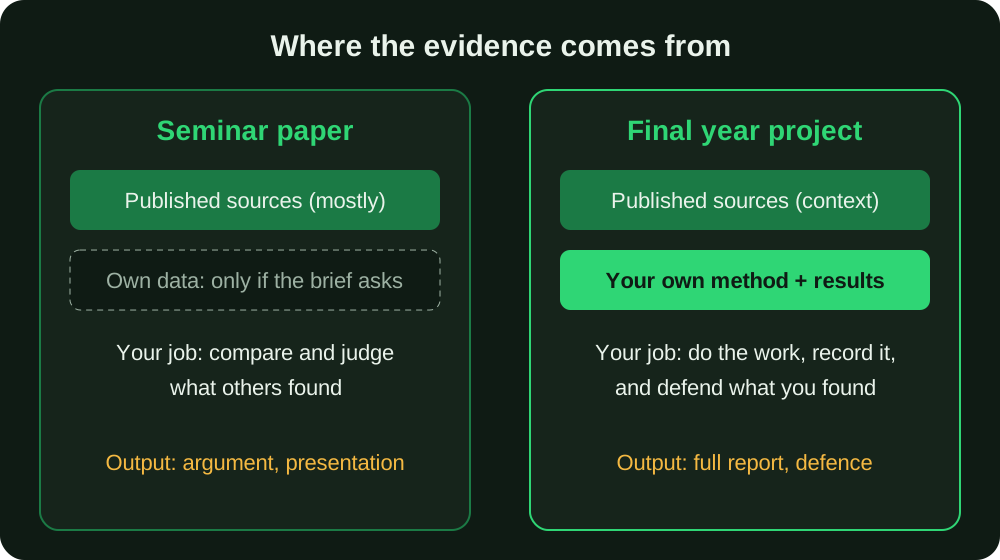
- Evidence: a seminar leans on published sources. A project needs your own method and your own real results, plus sources for context.
- Size: a seminar is normally shorter and finished within a semester. A project is longer and usually runs across one or two semesters.
- Assessment: a seminar is often a written report plus a presentation. A project is often a proposal, supervisor review, full report and a defence.
- Do not assume: some seminar courses ask for a small data component, and some project reports in design-heavy fields look different from a research survey. Confirm with your department.
Comparison table: purpose, length, evidence, supervision, marking, timeline, defence
| Question | Seminar paper or report | Final year project |
|---|---|---|
| Main purpose | Show understanding and synthesis of a focused topic | Answer a defined research problem, or document a design, system or investigation you completed |
| Typical length | Length specified by the actual seminar brief | Length specified by the actual project brief |
| Evidence | Mostly published sources; original data only if the brief requires it | Sources plus your own real method, work and findings |
| Supervision | Often a course coordinator or a lecturer assigned to guide your topic | Usually a named project supervisor, with meetings and corrections across the period |
| Structure | Thematic sections or a short chapter outline | Formal chapters and preliminary pages (declaration, certification, abstract, tables of contents) |
| Marking | Written report and presentation, sometimes marked by several lecturers | Supervisor mark, plus a panel or defence mark, combined according to department policy |
| Timeline | Weeks to one semester | Proposal, fieldwork or build, writing and corrections, usually one to two semesters |
| Defence | Often a presentation and question session | Usually a more formal oral defence, sometimes with an external examiner |
| Typical credit weight | Often a smaller course unit load | Often a larger weighting, and sometimes required to graduate |
These are common patterns, not national rules. Course labels can vary. Confirm the actual assignment rather than inferring its rules from a course name or another institution’s example. The safest habit is to ask your coordinator for the exact departmental outline before you write anything.
Purpose: what each document is trying to prove
A seminar asks, "Do you understand this area well enough to explain it and take a position?" You choose a focused question, gather credible sources, compare what they found, and end with an argument or a recommendation. The meaning and goals of a seminar are about communication and critical reading, not discovery.
A final year project asks, "Can you carry out a piece of supervised work from problem to result?" You state a problem, set objectives, choose a method, collect or build something, analyse it, and report honestly what happened. The complete picture is in our explainer on what a final year project is.
Use the brief to establish the document type. A record-based or literature-based final-year project can still involve an original selection and analysis method; not every project requires new participant data or a prototype.
Length and structure
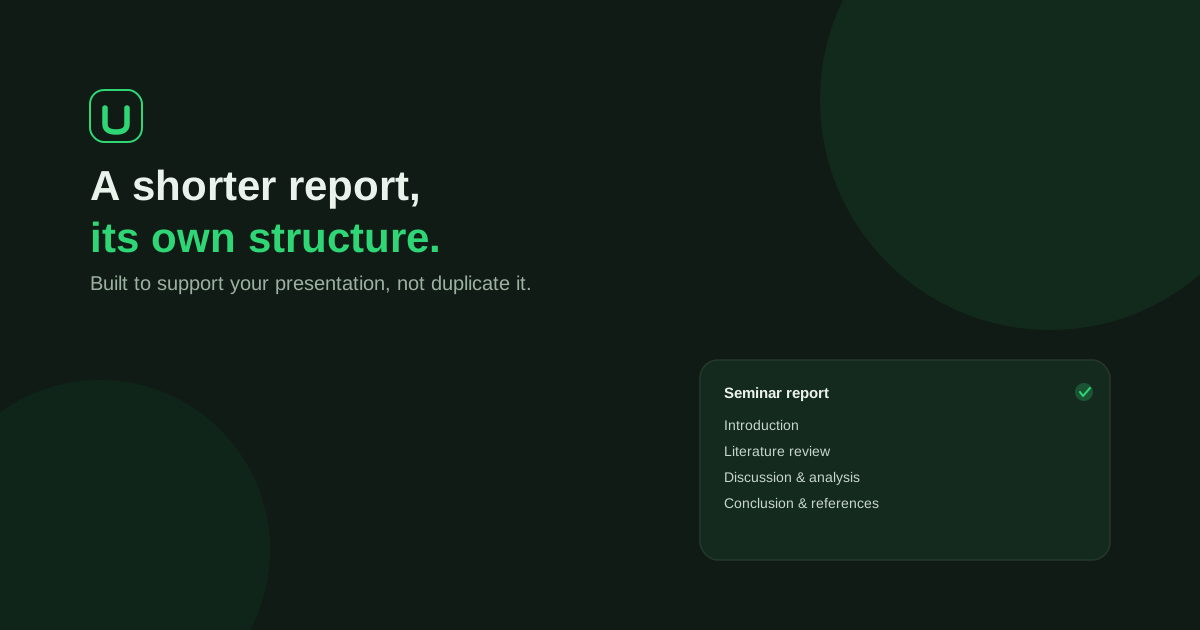
Seminar reports are shorter, and departments vary a lot. Some ask for thematic sections such as introduction, background, main discussion, critical evaluation and conclusion. Others use a compressed chapter format. Our guide to structuring a seminar report in Nigeria shows one adaptable outline.
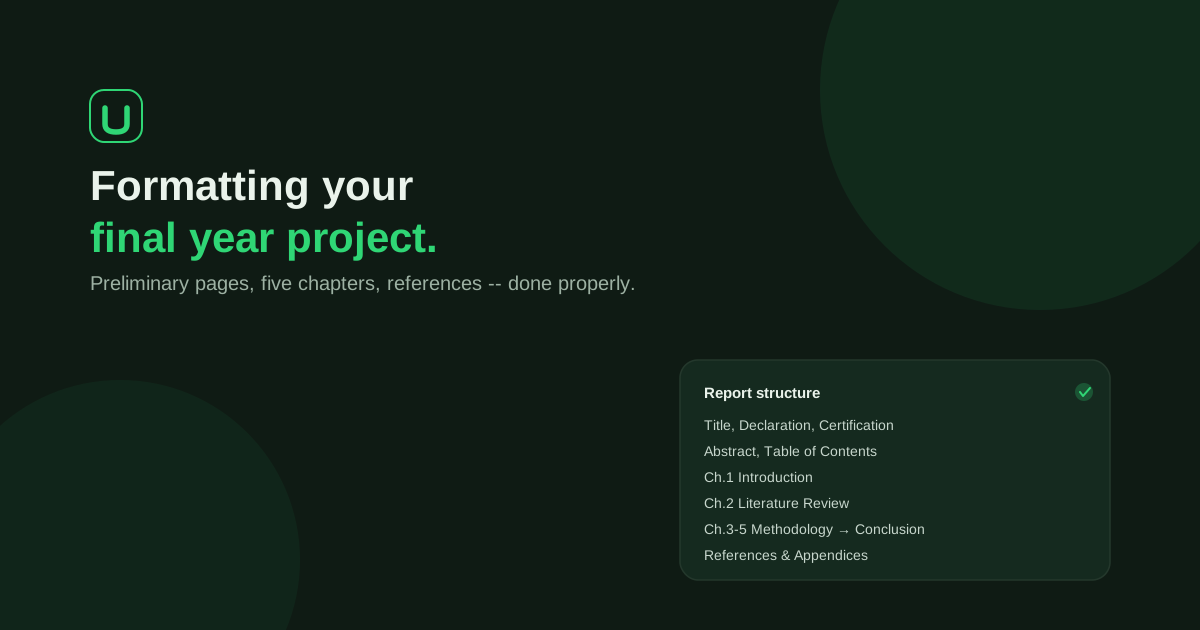
Project reports usually follow the familiar five-chapter pattern: introduction, literature review, methodology, results and discussion, summary and recommendations, with preliminary pages before Chapter 1 and references and appendices after Chapter 5. Engineering and computing departments often change chapters 3 and 4 to design, implementation and testing. That is why a project from Computer Science can look very different from one in Education or Sociology, and both can be correct for their departments.
The difference is not just page count. A seminar's body can hold together with an argument that develops across themes. A project needs internal consistency across chapters: the problem in Chapter 1 has to connect to the objectives, the method has to be able to answer them, and the results have to address them.
Evidence: the difference examiners care about most
In a seminar, evidence means sources. That means peer-reviewed articles, books, official reports and standards that you have actually read and cited correctly. The skill is selection and comparison. A common mistake is to turn the literature section into a list of summarised abstracts. Your marker wants to see sources set against each other: where they agree, where they disagree, and which is stronger and why. The literature review guide shows how to do that, and it applies to a seminar just as much as to a project. To find real sources without inventing any, use the free citation finder.
In a final year project, sources give context but your own work is the centre. You need to describe what you did in enough detail that someone else could follow it, then present the results you actually obtained, including awkward ones. Marks are often lost when the methodology says one thing and the results show another. See how to write the methodology chapter if you are unsure how much detail is expected.
Neither document allows invented data, invented references or fabricated approvals. If your seminar course requires a small case study or observation, treat it as evidence in its own right: state how you gathered it, from whom, and with what permission.
Supervision and approval
Seminar supervision is often lighter. A coordinator may approve a topic, provide a template or a schedule, and mark the report with other lecturers. Some departments assign each student an individual guide.
Project supervision is usually closer and more formal. You typically have a named supervisor who approves your topic, reviews your proposal, comments on drafts and signs off before submission. Many departments also involve the head of department (HOD) or a project committee in topic approval. Feedback tends to arrive in rounds, so keep your versions organised. Our guide to handling supervisor corrections covers how to track changes without losing earlier work.
If a supervisor's written instruction conflicts with a general template, the supervisor's instruction usually wins, because it is specific to your work. Keep those instructions in writing.
Marking, timeline and defence
Marking. Seminar marks often combine the written report and the presentation, and may come from more than one lecturer. Project marks often combine supervisor assessment, the written report and the defence, weighted according to departmental policy. Ask for the marking scheme. Even a one-page rubric tells you where to spend your effort.
Timeline. A seminar can be completed in a few weeks to a semester: pick a topic, read, outline, write, present. A project takes longer because fieldwork, data collection or building cannot be rushed. A realistic project plan works backwards from the defence date, leaving time for the corrections that nearly always follow.
Defence. A seminar is typically a presentation with questions. Prepare a clear argument and know your sources. Our guide to structuring a seminar presentation shows how to compress the paper into slides. A project defence usually goes further: the panel probes your method, your choices and your results, so you must be able to explain why you did what you did. For that, read what a project defence is and how to prepare. Some departments run seminars and defences in near-identical ways, so ask how yours works.
Timeline comparison at a glance
| Stage | Seminar paper | Final year project |
|---|---|---|
| Topic approval | Often quick; lecturer or coordinator | Proposal, supervisor and often HOD or committee approval |
| Reading | Central activity | Context and justification |
| Data or building | Usually none | Central activity |
| Writing | One drafting cycle plus feedback | Several chapters with rounds of corrections |
| Presentation or defence | Presentation and questions | Formal defence, sometimes with an external examiner |
| Total effort | Weeks to one semester | Often one to two semesters |
Which skills each builds
| Skill | Seminar paper builds it | Final year project builds it |
|---|---|---|
| Finding and judging sources | Strongly | Moderately |
| Synthesis and argument | Strongly | Moderately |
| Speaking to an audience | Strongly | Strongly |
| Research design and method | Lightly | Strongly |
| Data collection or system building | Rarely | Strongly |
| Analysis and interpretation | Lightly | Strongly |
| Long-form writing and consistency | Moderately | Strongly |
| Handling supervisor feedback | Moderately | Strongly |
| Defending choices under questioning | Moderately | Strongly |
If you plan a research career, a seminar builds the reading and argument skills that a good literature review needs, while a project builds the practical skills employers and postgraduate supervisors look for.
Decision guide: which document is this, and what should you do first?
Work through these questions in order.
- Does your brief require you to collect, measure or build something? If yes, you are probably writing a project or a project-style seminar. If no, treat it as a literature-based seminar.
- Do you have a named supervisor and a proposal stage? Usually a project. A course coordinator and a set schedule usually point to a seminar.
- Is it its own course code with credit units? Read the outline. The title alone can mislead, because "project seminar" or "seminar" can appear in either.
- Who assesses it and how? A rubric that includes methodology, results and discussion signals project-like expectations even inside a seminar course.
If it is a seminar, start by choosing a manageable topic, then narrow it until you can cover it in the length allowed. Generate ideas with the free topic generator if you are stuck.
If it is a project, begin with choosing a topic that fits your department, then write a proposal. The proposal guide covers what supervisors expect at that stage.
If you are doing both in the same year, treat them as separate assessments. Use the seminar to explore the field, but do not lift its text into your project without your supervisor's agreement.
When a seminar topic becomes a project topic
A seminar on "barriers to mobile banking among students" might review published studies. A project on a related question needs a specific population, research questions and objectives your supervisor approves, a feasible method, real observations or results, and analysis that answers those questions.
The seminar can help you find a gap or sharpen a proposal. It does not establish that you gathered data or completed later work. Discuss reuse with your supervisor and follow your institution's academic integrity rules. Check your institution’s reuse and academic-integrity rules before submitting material for a second assessment.
Common mistakes and how they get flagged
- Writing a project when a seminar was asked for. The examiner sees unnecessary methodology and no real synthesis. Check the brief.
- Writing a seminar when a project was asked for. The report has references but no method or results. Supervisors will ask "where is your own work?"
- Copying a template from another university. Layout and headings may not match your department. Look for your department's own guide, or start from the format guides and the free formatting checker.
- Listing abstracts instead of comparing sources. Markers write "descriptive, not analytical".
- Presenting borrowed statistics as your results. This is fabrication and can lead to serious penalties.
- Ignoring the presentation. A well written seminar can still lose marks if you cannot answer questions on it.
Pre-submission checklist
- I have the course code, approved title and page or word limit in writing.
- I know whether a supervisor or coordinator signs off, and I have their instructions.
- Every source in the text appears in the reference list, in the style my department requires.
- If data is required, its origin and permitted use are documented; new data, secondary data and published background figures are distinguished.
- My headings, fonts, spacing and margins match the departmental or university guide.
- I know the date, format and duration of my presentation or defence.
- I have kept a copy of each version I submitted for feedback.
Where UniDraft fits in
UniDraft builds the written document as an editable Word (.docx) file for both document types: seminar and final-year project reports. Check the current price and included correction rounds before checkout. It works from your confirmed topic and real results, your supervisor's instructions, your department's format and your university's format, applied in that order of priority. It keeps a seminar's rules and a project's rules separate, keeps earlier versions when corrections arrive, and never invents results, sources or approvals.
It does not turn a literature-only seminar into fictional project results, does not run statistics for you, and does not make presentation slides. You still supply the real work.
Sources
The general distinctions in this post are planning comparisons, not measured prevalence across Nigerian tertiary institutions and are not taken from a single national rule. For your own requirements, use your course outline, departmental project or seminar handbook, and the written instructions of your supervisor or coordinator. For regulator and standards background, see the National Universities Commission (universities) and the National Board for Technical Education (polytechnics and technical colleges).