A final year project is the capstone that most Nigerian degree programmes end with: an independent piece of work that shows you can apply what you have learned to a real problem, not just recall it in an exam. You pick a problem, work on it with a supervisor, write it up as a formal report, and defend it in front of lecturers.
If you are just starting, this guide explains what the project involves, why your department insists on it, how long it should be, how it is assessed, and how it changes between engineering, computing, the sciences and the arts and social sciences.
Your own investigation is the centre of the project; the report should make it clear. UniDraft helps organise your confirmed topic, work, findings and instructions into an editable final-year project document. Start your project report with UniDraft, then review the evidence and citations before submission. It does not carry out the research or guarantee approval.
The short answer
- What it is: a supervised, original investigation or build on a specific problem, documented in a formal report (commonly five chapters) and usually defended orally.
- Who has to do it: students whose programme requires the relevant project course; check your own course list and regulations.
- How big it is: often a two-semester course carrying several credit units; the NUC's Computing standards, for instance, split it into two 3-unit courses.
- Who decides the rules: your project supervisor, then your department, then your university. Regulators like the NUC set curriculum standards, but they do not set one page count or one template for everyone.
- What it is not: an essay, a copy of a senior's project with the names changed, or a document a machine can write from nothing. It is your work.
What it actually involves
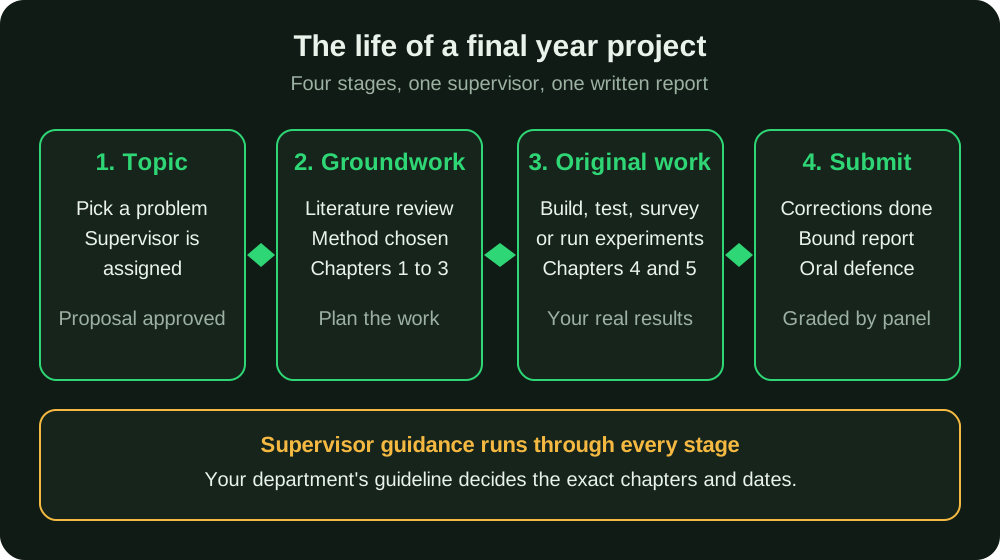
Three things, broadly: choosing a topic and a specific problem within it, doing original work under a supervisor's guidance, and documenting all of it in a formal, structured report.
1. Choosing a topic and a specific problem. A topic is an area ("mobile payments"). A problem is a gap inside it ("small traders in your town cannot verify a transfer quickly, and they lose sales"). Supervisors approve problems, not areas. If you are stuck, read our framework for choosing a final year project topic or try the free topic generator for a shortlist based on your department.
2. Doing original work. "Original" does not mean nobody has ever touched the subject. It means you contribute something of your own: you conduct a justified investigation, critically analyse permitted existing material, implement or evaluate a system, test a design, or apply an appropriate method to a defined question. Do not claim uniqueness without evidence. Your supervisor reviews your progress, and in many departments must approve specific chapters before you can submit. In the NUC's Computing standards, for example, the second project course requires the supervisor to approve the implementation and evaluation chapters before the final report goes to the department for grading.
3. Writing it up. The written report is the record of everything above. The usual shape is the five-chapter structure: introduction, literature review, methodology, results and analysis, then discussion, conclusion and recommendations. Our formatting guide covers preliminary pages, numbering and layout in detail. Some technical departments use six chapters, and some split the project into two courses, with a proposal in the first and the full report in the second.
A typical timeline
Most projects run across the final year, often two semesters, but institutions differ. A realistic outline for a student in a two-semester project:
| Period | What should be happening |
|---|---|
| Start of first semester | Topic idea, supervisor assigned, problem narrowed down |
| Weeks 3 to 8 | Proposal, problem statement, objectives, literature search |
| End of first semester | Chapters 1 to 3 reviewed by supervisor; proposal defence in some departments |
| Second semester, first half | Building, experiments or data collection |
| Second semester, second half | Analysis, Chapters 4 and 5, supervisor corrections |
| Final weeks | Abstract, binding, submission and defence |
Treat this as a planning aid, not a rule. Your department will publish real deadlines, and the ones that matter are the ones your project coordinator announces.
Why it exists
It is the point in a degree programme where you are expected to work independently on a substantial problem, rather than completing assignments with clearly bounded scope. That demonstrates both the technical knowledge from your programme and your ability to plan and carry out a large piece of work yourself.
There is also a regulatory reason. Programmes in Nigerian universities are accredited by the National Universities Commission against its minimum academic standards, and polytechnic programmes by the National Board for Technical Education (NBTE). Those curricula list the project as a course. For example, the NBTE curriculum for HND Taxation states that final year students should carry out individual project work, produced and bound by the student. The NUC's CCMAS for Computing lists Final Year Project I and II as compulsory courses. So your department does not require the project out of habit; the programme is built around it.
Employers and postgraduate admissions panels also treat it as evidence. When you say you can manage a project, the report and defence can provide evidence of that work. That is another reason to build the work properly rather than borrowing from a senior's project: a panel will ask you why you made a choice, and you have to answer from experience.
How length and structure vary
Use the page or word limit and scope in your actual project instructions. Always defer to your specific department's guideline over a generic number. Technical and implementation-heavy projects (engineering, computer science) often include more diagrams, code listings or technical appendices; research-heavy projects (social sciences, humanities) tend to have a deeper literature review and discussion.
Structure also varies in small ways that cost marks if you ignore them:
- Number of chapters: five is the common pattern, but some departments use six (for example, splitting design and implementation).
- Title length: the National Open University of Nigeria's Faculty of Education manual, for example, sets a maximum of 23 words for the title. Other institutions have their own limits.
- Front matter: declaration, certification, dedication, acknowledgements, tables of contents, lists of tables and figures, and an abstract. Some want them in a specific order and numbered in Roman numerals (how to do that in Word).
- Binding and copies: NOUN's manual requires hard-cover binding and a set number of hard and soft copies; other institutions specify colours, spine text and copy numbers of their own.
- Referencing style: APA, Harvard or IEEE depending on the department. See our guide to the references list and APA 7 in-text citations.
Your quickest way to settle all of this is to ask your supervisor or HOD for the department's project handbook, then check a few past projects that received good grades. For a per-university breakdown, browse the university format guides.
How it differs by discipline
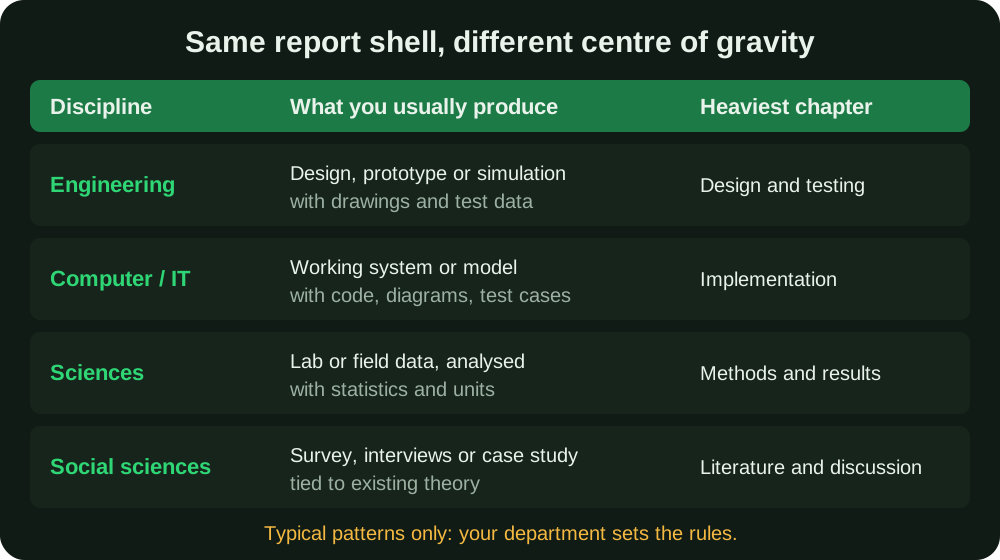
The report shell is similar everywhere; what you put inside it and where the weight sits is not.
- Engineering: typically centres on designing, building or simulating a system, often with a physical or software prototype and technical schematics alongside the written report.
- Computer Science / IT: usually involves building and testing a software system or model, with implementation and testing chapters carrying significant weight. The NUC's Computing standards describe the project as an independent or group investigation of a software, hardware, communication or networks problem, carried out under a lecturer's supervision, with a written proposal submitted to the supervisor before registration.
- Sciences: often centres on original experimental or field data, with a stronger emphasis on methodology and statistical analysis of results. Units and formulas must be written correctly (chemical formulas and units).
- Social sciences, education, arts and humanities: usually a survey, interview study, case study or textual analysis linked to existing theory. The questionnaire, the sample size and the choice of statistical test become the parts your supervisor watches most closely.
Polytechnics and colleges of education
In polytechnics, ND and HND programmes also carry a project. The NBTE curricula describe it as individual project work, and the NBTE's HND text stresses that it should be as practical as possible in many programmes. Do not infer the required scale or difficulty from the qualification name alone; follow the actual curriculum and brief. Colleges of education use a research project format similar to the Faculty of Education manual mentioned above. Because names differ, always ask what your own institution calls it.
Is it a project, a thesis or a seminar?
Words get used loosely. "Final year project" and "undergraduate project" usually mean the same capstone. "Thesis" and "dissertation" are more often postgraduate. A seminar is a shorter, literature-based report plus presentation, and it is a different requirement; our comparison of seminar paper vs final year project explains the difference. SIWES is different again: it is a work-experience report, and what SIWES is is covered separately.
How it is graded
Grading schemes are set by departments, so there is no national formula. Common components include:
- Continuous assessment by your supervisor across the year (attendance at meetings, progress, drafts submitted on time).
- Assessment of the written report by the supervisor and often a second examiner.
- An oral defence in front of a panel, covered in what a project defence is and common defence questions.
The exact split of marks between these varies. Ask for the departmental mark scheme early. Knowing that, say, the report carries more than the defence, or the reverse, changes where you spend your time.
Common mistakes and how supervisors flag them
| Mistake | How it shows up | Fix |
|---|---|---|
| Topic too broad | Objectives you cannot measure; a literature review that never ends | Narrow to one place, one group, one system, one time period |
| Copying a senior's project | Same objectives, same tables, mismatched dates and names | Use past projects for structure only; build your own data and argument |
| Objectives and results do not match | Chapter 4 answers questions Chapter 1 never asked | Write objectives first and check each one has a result |
| Missing evidence | Claims with no data, screenshots, test results or calculations | Keep records as you work; what a good sample contains |
| Citations that do not exist | Reference list entries that cannot be found | Use the free citation finder and open every source yourself |
| Ignoring the format guide | Wrong margins, spacing, numbering, referencing style | Run your file through the formatting checker before submission |
| Going quiet on your supervisor | Long gaps; a huge draft dumped at the end | Book short, regular meetings and send drafts chapter by chapter |
| Losing track of corrections | Old comments reappear; the wrong version is submitted | See managing supervisor corrections without losing earlier work |
A rule you can rely on: never invent results, and never invent references. If your experiment failed or your survey response was low, you write that honestly and discuss why. A supervisor can respect an honest limitation; a fabricated table usually gets found out at the defence.
What to do if you feel behind
Almost everyone feels behind at some point. The practical response is to shrink the problem, not to abandon the plan:
- Tell your supervisor early. They have seen this before and can narrow the scope faster than you can.
- Cut the objectives you cannot realistically finish. Three solid objectives beat six half-done ones.
- Write in parallel. Draft literature review sections while data collection continues.
- Protect the deadline that carries a penalty, usually the submission date announced by the department.
If the worst happens, our post on what happens if you fail your final year project explains the usual consequences and how to avoid them.
Pre-submission checklist
- Topic and supervisor formally approved in writing, if your department requires it.
- Required chapter reviews and endorsements completed by the responsible people.
- Objectives, methods, results and conclusion line up one to one.
- Every table and figure numbered, captioned and referred to in the text.
- Every in-text citation appears in the reference list and vice versa.
- Abstract written last and consistent with your actual findings.
- Front matter complete: declaration, certification, dedication, acknowledgements, contents pages.
- Margins, fonts, spacing and page numbers checked against your department's format.
- Required number of copies and binding style confirmed with the department.
- Defence date, room and panel confirmed, and your presentation rehearsed (how to prepare a defence presentation).
If you want a step-by-step writing plan next, read how to write a final year project, step by step and how to write a final year project proposal.
Where UniDraft fits in
Whatever your discipline, UniDraft builds your final year project report around your actual topic and results, applying your supervisor's, department's and university's formatting rules in the correct order. Use project/supervisor instructions first, then student-confirmed guidelines, department patterns, university baseline and platform defaults. Review the output against the actual work and applicable requirements.
It works from what you confirm: your topic, your results (you can upload a .docx with your tables and labelled images) and your supervisor's instructions. It does not invent data, activities or sources, and it cannot guarantee a grade or approval. When your supervisor sends corrections, you supply them, confirm the changes UniDraft extracts, and a new version is produced while earlier versions are kept. Check the current project price and included correction rounds before checkout. The topic generator, citation finder and formatting checker are free with no signup.
Sources
- NUC Core Curriculum and Minimum Academic Standards (CCMAS) for Computing, 2023 for the CSC 497 and CSC 498 final year project courses (3 units each), the proposal requirement and supervisor approval.
- NUC accreditation page for how programmes are accredited against the minimum academic standards.
- NOUN Faculty of Education Research Project Manual and Format (2019) for the 23-word title limit, five-chapter layout and binding requirements at that institution.
- NBTE HND Taxation curriculum for an example of the individual final year project requirement in polytechnic programmes.