If your department has told you to "do a seminar", check whether the brief requires a written report, an oral presentation, discussion or a combination. This guide explains what a seminar is in a Nigerian university or polytechnic, what it is meant to demonstrate, what a good topic looks like, how long it runs, and how to get through it from topic approval to the question session.
For the written part of your assignment, UniDraft helps organise your confirmed topic, checked sources and guidelines into an editable seminar report. Start your seminar document once the brief and topic are ready. You review the argument and references, then build and rehearse any required presentation separately.
The short answer
- In the report-and-presentation assignment discussed here, a seminar combines a focused written account with an oral presentation; other seminars use different formats.
- In many Nigerian programmes it is a requirement before graduation, and it is separate from your final-year project.
- It tests whether you can research a narrow topic properly, pull existing literature into a clear argument, and explain it to an academic audience in writing and out loud.
- Confirm the talk duration, question period and report length in your actual course brief; this guide does not prescribe universal figures.
- Rules on format, marking and timing come from your department and supervisor, not from a single national standard.
What a seminar actually is
In this guide’s report-and-presentation context, the assignment combines a focused written account with an oral presentation. In many Nigerian university programmes it is a requirement before graduation, distinct from your final-year project, which is a larger, separate requirement.
The word has an older, broader meaning too. Universities elsewhere use "seminar" for a small discussion class where a tutor and a handful of students explore a topic together; the University of Greenwich's study-skills guide, for example, describes it as a group discussion and exchange of ideas. Some assessed departmental seminars combine a written paper and spoken discussion. Confirm the format rather than treating that combination as the definition of every seminar.
Words that get confused with "seminar"
Students use several nearby words. Here is how they usually differ.
| Term | What it usually means | How it differs from your seminar |
|---|---|---|
| Seminar (departmental) | Written report plus oral presentation on one focused topic | The exercise this guide is about |
| Presentation | Any talk with or without slides | Only the spoken half of a seminar |
| Colloquium / departmental talk | A talk, often by a lecturer or visitor, to the department | You are the speaker, but it is not normally assessed as a course |
| Project defence | Oral examination of your final-year project | Tests original work; see what a project defence is |
| Workshop / conference | Skills session or research meeting | Not a graded course requirement |
Two departments may also use different names for the same thing: "seminar", "seminar presentation", "technical report" or "seminar paper". If your course code says one of these, read the course outline rather than guessing.
Seminar versus final-year project
The commonest confusion is between a seminar and a project. A literature-based seminar reviews existing scholarship; another seminar may present original work. A final-year project may involve research, design, implementation or a source-based study. The brief, scope and evidence determine the actual distinction. Some departments set the seminar in one year and the project in the next; others run both in final year. The comparison in seminar paper vs final-year project in Nigeria goes through the differences in more detail.
If your course calls the oral assessment a defence, use the seminar-defence meaning and preparation guide to connect the talk with the questions about your paper. The course brief decides whether and how this is assessed.
What it's meant to demonstrate
Unlike a final-year project, which usually involves original research or implementation, a seminar typically demonstrates your ability to do three things:
- Research a focused topic thoroughly. You find credible sources, not just the first few search results.
- Synthesise existing literature into a coherent argument. Synthesis means comparing sources, noting where they agree and disagree, and reaching a supported position. A list of summaries, one paragraph per source, is not synthesis.
- Present it clearly to an academic audience, both in writing and verbally.
That third point matters more than students expect. Many people write a decent report and then read a slide aloud in a monotone. Lecturers marking the exercise are usually judging whether you understand the topic well enough to explain it and to answer questions you did not prepare for.
What examiners tend to look for
Departments publish their own marking schemes, so treat this as a common pattern, not a rule. Panels usually look at:
- Topic fit: narrow, relevant to your programme, approved in advance.
- Depth and accuracy of content: correct, current, drawn from real sources.
- Structure: a logical order, from introduction to conclusion.
- Referencing: in-text citations that match a reference list in the style your department requires.
- Format: margins, fonts, spacing and numbering as your department specifies.
- Delivery: timing, clarity, eye contact and how you handle questions.
Ask your seminar coordinator for the marking scheme. It tells you exactly where the marks are, and it is usually more specific than anything you will read online.
What a good seminar topic looks like
Narrow and specific beats broad. Compare:
Too broad: "Financial Technology in Nigeria."
Focused: "The Role of Mobile Money in Financial Inclusion Among Rural Traders in Southwest Nigeria."
The focused version gives you enough specificity to build a real argument and literature review around, rather than skimming a topic too large for the assigned report.
A quick test for any topic
A good seminar topic passes five checks:
- Can you state it as a question? "How far has mobile money reached rural traders in Southwest Nigeria?" is answerable. "Fintech" is not.
- Is there enough published work? Check whether accessible sources address the question at the depth your brief requires; no fixed source count establishes viability.
- Is it small enough for the time? You must be able to explain the core in the time slot you are given.
- Is it relevant to your programme? An interdisciplinary question still needs a clear fit to the programme and brief.
- Is it approved? Never start writing before your supervisor or coordinator has signed off.
Broad to narrow, by department (illustrative)
These are examples of how to narrow a subject; they are not a list to copy. Check local rules about title reuse; each student must do and represent their own work honestly.
| Department | Too broad | Narrower and workable |
|---|---|---|
| Computer Science | Cybersecurity | Phishing detection approaches used by Nigerian mobile banking apps |
| Nursing | Maternal health | Community health worker roles in reducing maternal deaths in rural Nigeria |
| Civil Engineering | Concrete | Effect of locally sourced aggregates on concrete compressive strength |
| Education | Technology in schools | Use of low-bandwidth digital tools in Nigerian secondary schools |
| Accounting | Taxation | Digital tax collection and small-business compliance in Nigeria |
Two of the blog's topic guides show this narrowing in action: seminar topics for education students and seminar topics for nursing and public health students.
If you need to shrink a topic to fit a short slot, read short seminar topics for a presentation.
Haven't settled on a topic yet? See our framework for choosing a seminar topic, or try the free topic generator for a shortlist based on your department and favourite course. Be careful with downloaded lists too; why a "seminar topics PDF" is riskier than it looks explains the problem of everyone in the department picking the same recycled title.
How long it runs
Use your department's current brief to plan the oral presentation and written report. When it's time for your slides, see the seminar PowerPoint structure guide.
Confirm three things in writing or from the current guideline: the time slot, the page or word limit and what it includes, and whether questions are inside or separate from the presentation time. Do not borrow another department's limits.
Planning backwards from the date
A seminar goes wrong when the topic is chosen late. Work backwards from your presentation date.
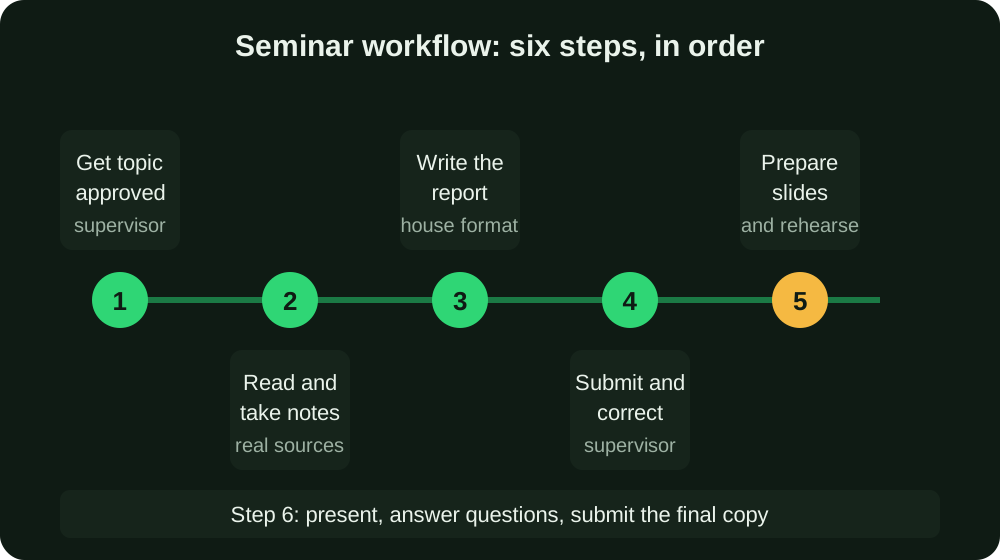
A workable rough allocation for a semester:
| Stage | Share of your time | Notes |
|---|---|---|
| Topic approval | First 1-2 weeks | Ask the coordinator for the approval deadline on day one |
| Reading and notes | About a quarter | Log full source details as you read, so referencing is quick later |
| Writing the report | About a third | Draft in the department's structure, not a blank page |
| Supervisor corrections | 2-3 weeks | Allow the review time agreed with your supervisor |
| Slides and rehearsal | Last 2 weeks | Rehearse aloud with a timer |
Treat these as a planning aid, not a departmental rule.
What goes into the written report
Most Nigerian seminar reports follow a familiar shape, though your department's template overrides any general outline:
- Preliminary pages: title page, certification (where your department requires it), dedication or acknowledgements, abstract, table of contents, lists of tables and figures.
- Introduction: background, why the topic matters, the aim and the scope of the review.
- Main body: the review itself, organised by theme, not by author.
- Discussion or analysis: what the evidence collectively says, where it conflicts, and the gaps.
- Conclusion (and recommendations if required).
- References.
The full breakdown lives in how to structure a seminar report in Nigeria. If you want to see what a well-built one looks like before you start, read seminar report sample: what a strong one looks like.
Sources and referencing
For a literature-based seminar, source quality and synthesis matter; their assessment weight comes from the actual rubric. Use journal articles, books, reports from government agencies and university publications. Cite each in the style your department names (APA, Harvard and IEEE are all common) and match ordinary citations to reference entries, allowing legitimate style exceptions such as unretrievable personal communications. The free citation finder searches for real, published sources and formats them in APA, IEEE or Harvard. For APA specifics, the APA 7 in-text citations guide covers the patterns you will use most.
Never cite a source you have not seen. An invented or wrongly attributed citation is the quickest way to lose the panel's trust, and a lecturer can check in seconds.
The oral presentation
The talk is where many students lose marks they earned on paper.
- Open with the problem, not your name and matric number. Say why the topic matters in the first minute. See how to start a seminar or defence presentation for opening lines that work.
- One idea per slide, with short phrases. Slides support the talk; they are not a script.
- Time yourself. Rehearse aloud at least three times. Check the actual timing and assessment rules.
- Prepare for questions. Expect "why did you choose this topic?", "what is the gap in the literature?" and "what would you recommend?". Real panels also ask about a fact in your own report, so re-read it before the day.
- Know your report. If a lecturer opens to page 12 and asks about a figure, you must be able to explain it.
For slide layout, the slide-by-slide seminar PowerPoint structure is the guide to use, and how to prepare a project defence presentation is helpful for the delivery side even though it is written for a defence.
Corrections after the first submission
Allow for the review and correction process your assignment actually uses, including possible comments on structure, evidence, layout or references. Keep every version, and record what each round changed. If you overwrite an earlier file and the supervisor later says "the previous version was better", you cannot go back. Managing seminar report corrections without losing earlier work describes a workable routine.
Common mistakes and how supervisors flag them
| Mistake | How it shows up | Fix |
|---|---|---|
| Topic too broad | "Superficial", "no depth" | Narrow it with a place, group or time frame |
| Summary, not synthesis | "Just a list of sources" | Reorganise by theme and compare sources |
| Out-of-date or weak sources | "Where is the recent literature?" | Find recent journal or agency material |
| Missing or mismatched references | "Cited but not listed" | Check every citation against the list |
| Wrong format | "Follow the departmental guide" | Check margins, spacing and fonts against the rules |
| Reading slides aloud | "Unprepared" | Talk from the topic, use slides as prompts |
| Overrunning time | Cut off by the chair | Rehearse with a timer |
| Copying from a seminar found online | Similarity flag, or the same title as a coursemate | Write your own; reference what you use |
On copying: a downloaded seminar shared across a department is easy for lecturers to recognise, and many institutions run similarity checks. Writing your own also means you can answer questions on it, which is where a copied seminar collapses.
Pre-submission checklist
Before you submit the written report:
- Topic approved by the supervisor or coordinator
- Structure follows the department's template
- Ordinary citations and references match, with any legitimate style exceptions checked
- Sources are real, checked and recent enough for your field
- Margins, font, spacing and page numbering match the department's rules (a free .docx formatting checker tests these against a university's requirements)
- Figures and tables are numbered and captioned
- Abstract written last and matches the final content
- Spelling is consistent and follows your confirmed style instructions
- File saved with the version number and date
Before the presentation:
- Time slot confirmed and rehearsed aloud
- Slides checked on the actual venue laptop or projector
- Printed or offline copy of your report on hand
- Answers ready for the five most likely questions
Where UniDraft fits in
Once you've settled on a topic, UniDraft builds your seminar report as an editable Word document that follows your department's seminar-report structure and formatting. It builds around your confirmed topic, project/supervisor instructions, student-confirmed guidelines, department patterns, university baselines and platform defaults, in that priority order, and it does not invent sources or approvals. See our full seminar report structure guide for the chapter breakdown.
- Seminar report: check current pricing and included correction rounds before checkout. You supply the supervisor's corrections, confirm the extracted changes, and a new version is produced. Earlier versions are kept.
- Free tools with no signup: the citation finder, the topic generator, the formatting checker (the .docx is not stored) and university format guides.
To be clear about the boundary: UniDraft does not produce slides or any presentation content. It handles the written report only, so you still build your own deck and rehearse your own talk. It also cannot promise a grade or an approval.
Sources
- National Universities Commission (NUC): the regulator of Nigerian universities, responsible for minimum academic standards and accreditation. Its site does not prescribe a seminar format, which is why your department's guideline is the rule you follow.
- University of Greenwich Academic Skills: Discussions and Seminars: describes the general academic meaning of a seminar as a group discussion and how to prepare for one.