You have a seminar topic and a slot of 5, 10 or 15 minutes, and the report behind that topic is far too big to fit. The fix is not to speak faster or to squeeze every section into a slide. The fix is to choose one narrow slice of the topic and present that slice well.
Need ideas to start from? Try UniDraft’s free topic generator, using your department and a course you enjoyed. Bring the shortlist back to the checks below before taking a proposed topic to your supervisor.
A short talk is easier to plan from a report with a clear question and evidence trail. UniDraft helps organise your confirmed topic, sources and instructions into an editable seminar document. Start your seminar report with UniDraft, then choose the slice your actual evidence supports. You build and rehearse the slides; the software does not create them.
The short answer
- A short slot does not need a different topic. It needs a smaller slice of the one you already have.
- Cut to a single claim you can state in one sentence, support with appropriate evidence, and defend under questions.
- Optional planning budget: start with one point in 5 minutes, one with an example in 10, or two related points in 15. Test the actual material aloud rather than treating these counts as rules.
- Skip the source-by-source literature review. One sentence on the gap is enough.
- Rehearse against a clock. Use a timed rehearsal to find material that exceeds the actual slot.
Why a short slot punishes a wide topic
In a full seminar you can show the background, the main argument, some evidence and a discussion. In a short one, the audience only remembers what you spent real time on. If you spread five minutes across six subtopics, each gets under a minute, nobody follows any of them, and the panel is left with the impression that you skimmed.
There is also a practical limit set by speech. The University of Kent's guide to giving an oral presentation suggests roughly 100 to 130 words per minute for a scripted talk, and 130 to 160 words per minute if you speak without a script. That means a 5-minute slot holds only about 500 to 650 scripted words. Compare that illustrative word budget with your actual speaking pace and visual material. This is the arithmetic behind the whole idea: the slot cannot hold your report, so you must pick what goes in.
If you are still deciding what the topic is, settle that first with our guide on how to choose a seminar topic, then come back here to scope it for the time you have. If you are unsure what a seminar is meant to achieve in your department, what a seminar is and what it is for clears up the basics.
What "one slice" means in practice
A slice is a single, self-contained claim inside your topic. Good slices have a shape you can recognise:
| Slice type | What it looks like | Example phrasing |
|---|---|---|
| One finding | A checked result with its context and limits | "Payback time is driven mainly by battery cost" |
| One mechanism | How something works, in steps | "How a mobile-money transfer is authorised" |
| One comparison | Two options on one criterion | "Borehole versus piped water on running cost" |
| One case | A single documented example | "One clinic's queue redesign and what changed" |
| One problem and one fix | A specific fault and its remedy | "Why network drop-outs happen in hostels and one fix" |
Bad slices are usually labels, not claims: "Solar energy", "Cybersecurity", "Malnutrition". A label tells the panel nothing about what you will prove. A slice ends in a verb or a comparison.
The one-sentence test
Write your slice as one sentence. Then check three things:
- Could you say it aloud in under 20 seconds without running out of breath?
- Does it contain more than one "and"? If so, you probably have two slices.
- Could a panellist ask "how do you know that?" and you point to one specific piece of evidence in your report?
If the answer to any of these is no, cut again.
Worked narrowing examples
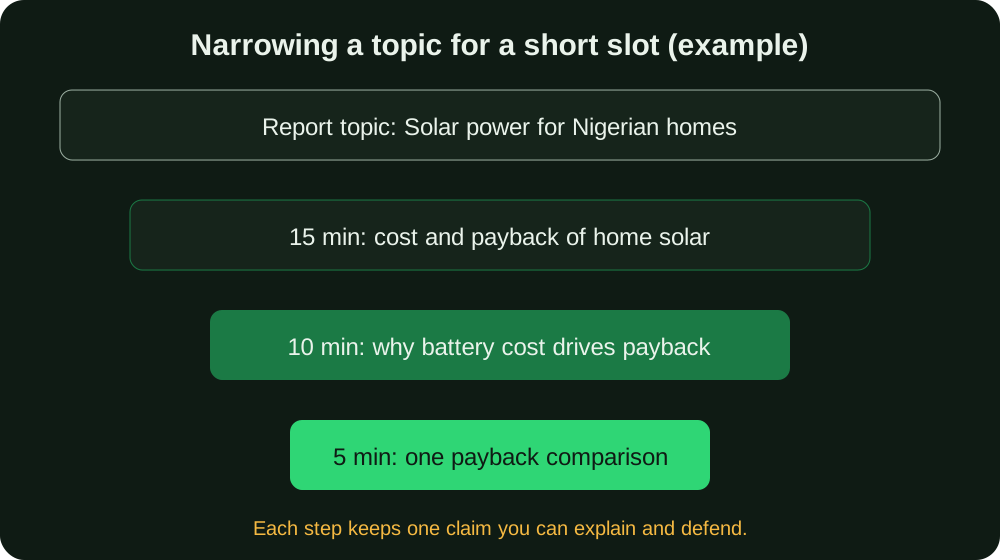
The next examples are illustrative ideas, not real projects. They show the cutting process: start with the report topic, then narrow for each slot. Figure 1 shows the same idea visually.
Example 1: Computer science
- Report topic (illustrative): Phishing attacks on Nigerian bank customers.
- 15 minutes: Two phishing tactics described by checked sources, with an example and limitations for each.
- 10 minutes: How fake SMS alerts trick customers into giving away a one-time code, with one example flow.
- 5 minutes: Why a request to disclose a one-time code needs careful verification, using a checked security source. This is a proposed topic, not a claim to prevent every form of fraud.
Example 2: Nursing and public health
- Report topic (illustrative): Antenatal care attendance in a primary health centre.
- 15 minutes: Two barriers to early booking, cost and distance, with what a reviewed source says about each.
- 10 minutes: Distance as a barrier and one service change that could reduce it.
- 5 minutes: One barrier, one piece of evidence, one practical recommendation.
If your seminar is in this area, our list of seminar topics for nursing and public health students shows how wide topics are usually framed before you narrow them.
Example 3: Education
- Report topic (illustrative): Use of formative assessment in secondary schools.
- 15 minutes: Two formative techniques and when each fits a large class.
- 10 minutes: Exit tickets as a formative technique in a large class, with a worked classroom example.
- 5 minutes: One quick technique a teacher can use in the last five minutes of a lesson, and what it tells them.
More framing help for this area is in seminar topics for education students.
Example 4: Engineering
- Report topic (illustrative): Power quality problems in a university campus network.
- 15 minutes: Voltage sag and harmonic distortion compared on cause and effect.
- 10 minutes: How voltage sag happens and one mitigation approach.
- 5 minutes: One cause of voltage sag and what a stabiliser or UPS does about it.
Example 5: Business and social sciences
- Report topic (illustrative): Cashless payment adoption among market traders.
- 15 minutes: Two adoption barriers, trust and transaction fees, with how each shows up in a small trader's decision.
- 10 minutes: Trust as an adoption barrier and one way sellers reduce it.
- 5 minutes: One barrier, one example, one implication for a bank or fintech.
Notice what stayed the same across the five examples: each narrowed version still has a claim, a reason and a practical result. What shrank was the number of things being claimed.
Illustrative short-slot topic ideas by discipline
These are proposed questions to investigate, not factual findings or approved topics. Source-check any suggested mechanism or intervention before presenting it. Confirm anything you choose with your seminar coordinator or supervisor, because some departments assign or approve topics. Each is already sliced to fit a short slot.
| Discipline | Illustrative slice ideas |
|---|---|
| Computer science / IT | How a password manager reduces credential reuse; how caching speeds up a web page; one common SQL injection pattern and its fix |
| Engineering | One cause of transformer overheating; how a soil test informs a foundation choice; what a circuit breaker does in one fault type |
| Health sciences | One risk factor for hypertension in adults; how handwashing steps reduce infection; one screening tool and what it detects |
| Education | One way to give feedback in a large class; how a lesson objective guides an assessment; one classroom management routine |
| Agriculture | How a soil pH reading changes fertiliser choice; one storage method that reduces grain loss; drip versus flood irrigation on water use |
| Business / accounting | How a single ratio, such as the current ratio, signals liquidity; one inventory control method; what a break-even point tells a small business |
| Social sciences | One factor linked to school dropout; how a survey sample can bias a result; one policy and one measured outcome |
| Sciences | One step of a laboratory technique and why it matters; one property of a compound and its everyday use; how one instrument measures a quantity |
If you want more raw material before slicing, the free topic generator can give you candidate topics by department. Treat what it returns as a starting list and run every candidate through the one-sentence test above.
What to cut when the slot is short
- Drop the full literature review walkthrough. Say what gap your slice addresses in a sentence or two. Your report holds the detail; the panel can ask about it. For what a proper review covers, see how to write a literature review.
- Pick one finding or argument, not all of them. A rushed summary of everything leaves nothing clear.
- Cut background not needed for your one point. Context earns its place only if the audience needs it to follow you.
- Cut the agenda slide. In five minutes, an outline slide eats time you need. Say your one claim in the opening sentence instead.
- Cut reference-heavy slides. Name a source aloud where it matters and keep the full list in the report.
- Cut secondary results. Show one table or figure that supports your slice, not the whole set.
What to keep, however short the slot
- A one-sentence statement of what the topic is and why it matters to this audience.
- The one specific point, with enough evidence for it to be believable.
- A brief, honest note on what your evidence does not show. A short talk still needs to admit limits rather than overstate certainty.
- A closing sentence that repeats your claim, so it is the last thing the room hears.
A timing plan for 5, 10 and 15 minutes
Figure 2 shows one way to divide the minutes. It is a starting point, not a rule; your department or coordinator may set a different structure or time limit, so ask before you plan.
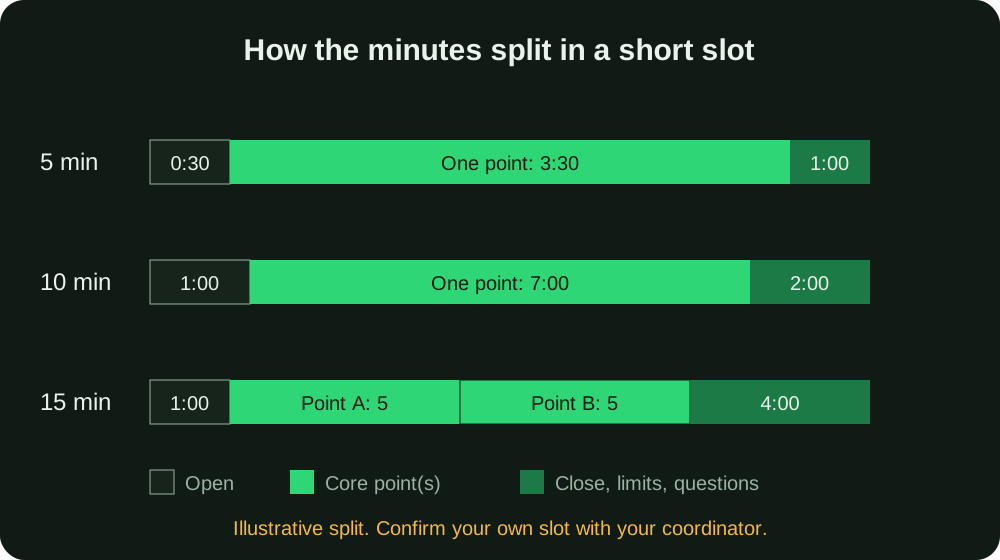
The University of Kent's guide gives a comparable proportion for a 10-minute talk: about one minute of introduction, eight of main body and one of conclusion. Our illustrative plan leaves more room at the end. Confirm whether your own question time is inside or outside the presentation slot.
The 5-minute plan
- Opening (about 30 seconds). Your topic in one sentence and why the audience should care.
- One point (about 3 to 3.5 minutes). State the claim, show one piece of evidence, explain what it means.
- Close (about 1 minute). Repeat the claim, name one limitation, invite questions.
At scripted pace, this is roughly 400 to 500 spoken words. Write the script, then count.
The 10-minute plan
- Opening (about 1 minute). Topic, why it matters, and your slice in one sentence.
- One point with a worked example (about 6 to 7 minutes). Claim, evidence, then a concrete example the audience can picture.
- Close (about 2 minutes). Limitation, what it means in practice, questions.
The 15-minute plan
- Opening (about 1 minute). Topic and the shape of the talk.
- Point A (about 5 minutes). Claim, evidence, example.
- Point B (about 5 minutes). A second claim that connects to the first, not a separate topic.
- Close (about 4 minutes). Link the two points, note limits, take questions.
The connecting word matters. If Point B could be given as a separate talk without Point A, you have two topics and the audience will feel the jump.
How to rehearse a short talk
Time your own talk aloud instead of assuming the written script will fit. A few habits fix most of it:
- Time a full run, not a mental one. Reading silently is faster than speaking. Use a phone timer and say every word.
- Rehearse in front of someone. The Kent guide recommends practising in front of a friend or colleague and asking for feedback. Grand Valley State University's oral presentation tips also stress repeated practice and recording yourself so you can listen critically.
- Build in a cut point. Decide in advance which example you will drop if you are running behind. A planned cut is calm; an improvised one shows.
- Practise the pauses. A short pause between points costs seconds and lets the audience absorb the claim.
- Rehearse the first thirty seconds until it is automatic. Prepare the opening so you can return to it if you lose your place. Our guide on how to open a seminar or defence presentation walks through that opening.
Common mistakes with short slots
- Choosing a label instead of a claim. "Renewable energy" is a label. "Battery cost drives payback for home solar" is a claim.
- Covering everything thinly. The panel remembers nothing specific and may ask why you left out an area.
- Adding a second point because you have time left. A calm, complete single point is better than two rushed ones.
- Presenting a claim the report does not support. After a short talk, panellists often ask for the source. If your slice is not backed in your written report, you cannot point to it.
- Reading the report aloud. Written and spoken text behave differently. Spoken text needs shorter sentences and repetition of the key claim.
- Skipping the limitation. Overstating certainty is easy in a short talk. One honest sentence about what you did not show makes you more credible.
What panels tend to ask after a short talk
Short talks invite short, sharp questions. Prepare answers to these five:
- Why did you choose this slice of the topic?
- What is your strongest piece of evidence?
- What does your slice leave out?
- Could your claim be wrong in some setting? When?
- What would you do with more time?
If you expect a longer panel session, see common defence questions and how to answer them for the wider pattern of questions.
A pre-presentation checklist
- My slice fits in one sentence I can say in under 20 seconds.
- I have confirmed the time limit and whether questions are inside or outside it.
- My script or talking points were timed aloud, not silently.
- I know which example I will drop if I run behind.
- Every claim I make can be traced to my report.
- I have one honest sentence about limitations.
- My opening thirty seconds is rehearsed.
- I have prepared answers to the five questions above.
Choosing a slice from your report
If you already have a finished or draft seminar report, choosing a slice is an editing job. Read your headings and find the section where your evidence is strongest, meaning the part with a clear result, table or worked example. That section is usually the best slice. If your report follows the usual structure, our guide to how to structure a seminar report in Nigeria will help you see where the strongest section sits. And if your supervisor's corrections are changing the report, check that your slice still matches the latest version; managing seminar report corrections covers how to keep versions straight.
Whatever slides you prepare are your own work, and the advice in this seminar PowerPoint structure guide still applies. A downloaded list of ready-made topics is not the answer here, and why a downloaded seminar topic list is riskier than it looks explains why.
Choose one comparison from your discipline
The Microbiology seminar guide offers questions you can narrow to one measurement or evidence limitation, rather than attempting a whole public-health field in a short slot. The Computer Science seminar guide offers similarly bounded comparisons, such as citation presence versus citation support. Pick one question your reviewed sources can answer; a short slot does not justify removing the limitations that make the answer accurate.
Where UniDraft fits in
UniDraft builds the written seminar report as an editable Word document, around your confirmed topic and your real results, in your department's format. It does not make slides or presentation content, and it does not invent evidence, so the slice you choose must come from work you actually did. Once the report exists, picking one slice from it is much easier than starting from a blank page.
- Seminar report workflow at /seminar-report; check the current price and correction allowance before checkout.
- Free topic generator at /topics for candidate topics before you narrow.
- Free formatting checker at /formatter to test a .docx against your university's rules before submission.
Sources
- Giving an oral presentation, University of Kent: sample time splits for a 10-minute talk and suggested speaking rates for scripted and unscripted delivery.
- Oral presentation tips, Grand Valley State University Office of Undergraduate Research and Scholarship: guidance on timing yourself early and rehearsing repeatedly.