Choose an Environmental Science project topic by testing the question against what you can actually sample, get analysed and defend: a defined place and period, permission to enter the site, a laboratory or instrument you can use, safe working conditions, enough replicates and a comparison that fits your claim. A topic that fails one of these is a wish, not a plan.
UniDraft's free topic generator can help you build a starting shortlist from your department and interests. Take each idea through the checks below before it goes to your supervisor.
An environmental project is judged by whether its claims match its evidence. UniDraft helps organise your confirmed question, your own field and laboratory records, checked sources and supervisor instructions into an editable Word document. Start your project document, bringing the results you actually obtained and reviewing every claim yourself. It does not collect your samples or run your analysis.
What this page is, and what it is not
This is a planning guide. It gives no list of titles presented as approved, current or already studied, because it cannot know your department's laboratory, your supervisor's interests or what was done in your school last session. A list of "ready" titles tells you nothing about whether you can do the work.
You get feasibility checks, a fictional worked example that fails and is repaired, and provisional question shapes. Everything labelled as an example is invented for teaching and is not a finding.
If your task is a reading-based seminar, use the Environmental Science seminar topic guide instead, which focuses on waste evidence in the literature.
For laboratory-heavy neighbours, see the Microbiology project topic guide (isolates, biosafety, media). This page covers the part they do not: field sampling design.
What kind of environmental project can you do?
Find out which route your department accepts. Each has a different feasibility cost.
| Route | What it usually involves | Main feasibility risk |
|---|---|---|
| Water quality sampling | Collecting from wells, boreholes, streams or taps and measuring chosen parameters | Lab access, container and preservation rules, time to analysis |
| Soil sampling | Collecting from defined depths and sites, then analysing physical or chemical properties | Site permission, sample preparation facilities, representative sampling |
| Air or noise monitoring | Using an instrument or method at fixed places and times | Instrument access, calibration, and short records |
| Survey or records-based study | Questionnaires or existing agency records about an environmental issue | Access to records, consent, sampling bias |
| Review-style project | Structured analysis of published evidence | Only allowed if your department treats it as a project |
Many departments expect some original data, but this varies, so ask rather than assume. The guide to choosing a final-year project topic covers brief, access and deadline checks that apply in every department.
How do you design water, soil and air sampling?
Start from the question, not the instrument. Decide what you want to say at the end, then work backwards to the sites, times and measurements that could support it.
Water. Decide the source type (for example, boreholes versus open wells), the number of sources, and the dates. Use containers and a collection method suited to the parameter, because a bottle that suits chemistry may not suit microbiology. The Microbiology guide covers why sterile handling matters for bacteria. Record the exact point of collection and how long samples wait before analysis. For many parameters the waiting time and temperature change the result, so follow the method your laboratory uses and ask the analyst what it needs.
Soil. Define the land use, the depth you will sample, and how many points make up each site. A single scoop from one corner is not "the soil of the farm". Describe how you chose points (a stated pattern, not wherever was convenient) and how you will mix, label and store the sample. The sampling techniques guide explains how choosing units in a study connects to what you can generalise.
Air and noise. Instruments need calibration and a recorded location, height and time. Short readings are sensitive to wind, traffic and the time of day, so note them. If you cannot get a calibrated instrument, a chosen method may need to change or the question may shrink.
Whatever the medium, write the same five lines before you start: the question, the sites, the dates, the measurements and who analyses what.
Can you get the analysis done? Lab and instrument access
Sampling is the easy half. Many projects stall because nobody confirmed who would analyse the samples.
| Check | What to ask | If the answer is no |
|---|---|---|
| Analyst | Who runs the instrument or test, and are they available in my window? | Change the parameter or the schedule |
| Parameters | Can this laboratory measure each parameter I listed? | Remove the parameter, do not promise it |
| Containers and reagents | Who supplies bottles, preservatives, standards? | Reduce sample number to what you can supply |
| Turnaround | How soon after collection can samples be received? | Plan collection around lab hours |
| Cost | Is there a fee per sample, and who pays? | Reduce the design before spending |
| Records | Will I receive the raw results and method used? | Ask now; you will need them for the methodology |
A common mistake is listing ten parameters because a published paper did. Choose the fewest that answer your question and that the laboratory can actually measure. The data management plan guide helps you decide how raw readings and lab sheets are stored.
Field permissions and safety
An environmental project takes you to places that belong to someone else. Before you go:
- Permission to enter and sample. Boreholes, farms, markets, schools, estates, factories and dumpsites all have owners or managers. Get written agreement, and ask your supervisor whether a departmental letter is needed. Public does not always mean open to sampling.
- Ethics where people are involved. Interviews, household questionnaires and photographs of people raise consent questions. The research ethics and consent guide explains how consent and confidentiality fit a student project.
- Safety. Waterlogged ground, flooded channels, steep banks, vehicles on roads, hot weather and unknown waste are real hazards. Do not sample alone, tell someone where you are going, and use suitable footwear and gloves. If a site looks hazardous, tell your supervisor instead of entering it.
- Hazardous waste and facilities. Do not enter or handle material at a waste or industrial site without the operator's agreement, safety briefing and your supervisor's approval.
Your institution's rules decide what is allowed. This page cannot replace its safety or permission procedure.
Which published standards can you use, and how?
Standards turn numbers into something a reader can interpret, but only if you cite the right one for the right question. Two examples show the principle; verify the current text yourself.
- WHO drinking-water guidelines. WHO's Guidelines for drinking-water quality: fourth edition incorporating the first and second addenda was published on 21 March 2022 and is widely used as a basis for national drinking-water standards. It is built around health-based targets and water safety planning, so it frames drinking water as a managed system and not just a table of limits.
- WHO air quality guidelines. WHO's global air quality guidelines (22 September 2021) cover particulate matter (PM2.5 and PM10), ozone, nitrogen dioxide, sulfur dioxide and carbon monoxide. If your project measures one of these, check the exact averaging time the guideline uses and compare like with like.
- Nigerian regulations. The National Environmental (Surface and Groundwater Quality Control) Regulations, 2011 (S.I. 22 of 2011) were made under the NESREA Establishment Act, 2007, and cover surface and groundwater quality, discharge permits, and the abstraction and construction of wells. NESREA also publishes air quality regulations that have been amended over time, so confirm you are reading the current version.
Three rules prevent embarrassing mistakes:
- Match the sample to the standard. A guideline written for drinking water does not automatically apply to a stream, and a groundwater regulation does not automatically apply to wastewater. Read what the document says it covers.
- Cite edition, year and the exact table. "WHO standards" is not a citation. Use the citation tools and your department's referencing style.
- Do not copy limit values from a blog, a project PDF or a seller's page. Get them from the primary document, because values are revised and a secondary page may be outdated or wrong.
Comparing your result with a limit tells the reader whether a value is above or below that limit. It does not, on its own, tell them whether people were harmed.
Baseline versus comparison sites
If your question contains the word "effect", "impact", "influence" or "difference", you need something to compare against.
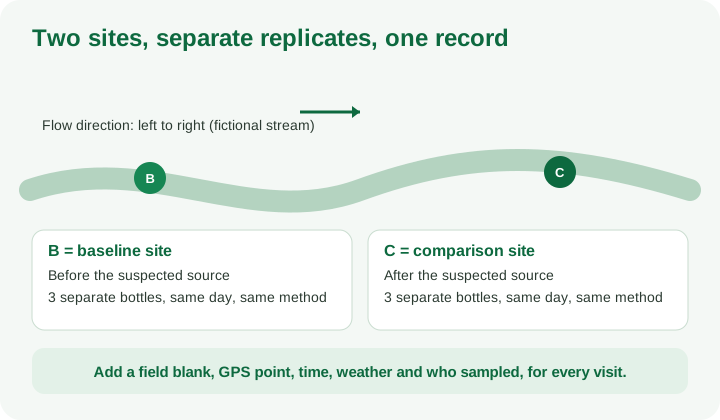
- A baseline site represents conditions before or without the activity you are studying, such as upstream of a discharge or on land away from a dump.
- A comparison site is the place you suspect is affected, such as downstream or beside the activity.
- A control site is a matched place with no exposure, chosen to resemble the exposed site in every other way you can manage.
The comparison is only fair if the sites are alike in other respects: similar soil, similar depth, similar water source, similar time of sampling. If the upstream site is a clean spring and the downstream site is a slow, shaded pond, any difference could be the setting, not the activity. State openly why you believe the sites are comparable, and where they are not.
Before-and-after designs need data from before. If you did not measure before, do not claim a change over time. Be wary of calling a site a baseline because it is "probably cleaner". That is a guess, not a baseline.
Replicates: separate samples or repeated readings?
Replicates tell the reader whether a value can be repeated. There are two different kinds, and mixing them up is a common error.
- Independent replicates are separate samples from the same site, collected and bottled separately. They show how variable the site is.
- Repeat measurements are the same bottle analysed more than once. They show how precise the measurement is, not how variable the site is.
Three readings from one bottle are not three samples from the site. The Biochemistry guide explains the same distinction for laboratory assays.
How many replicates are enough depends on your design, the variability and the analysis. Do not copy a number from another project. Use the sample-size guide to understand the reasoning, then agree the number with your supervisor and statistician or lab lead. Also consider a field blank: a container of clean water handled like a real sample, which helps show whether bottles or handling added contamination. Ask your laboratory whether it expects blanks, and what it wants for your parameters.
Fictional worked example: a title that fails, then is repaired
This is an invented teaching example. No sampling was done and no results exist.
A student proposes: "The effect of a market's waste on the groundwater quality of the whole town."
| Problem | Why it fails |
|---|---|
| "Effect" | The plan has one sampling visit and no baseline, so no effect can be shown |
| "The whole town" | Four wells near one market cannot represent a town |
| "Groundwater quality" | Ten parameters listed, but the lab can measure only four |
| Wells | The owners have not agreed, and one well is unsafe to approach |
| Replicates | One bottle per well, three readings from each bottle |
The supervisor asks three questions: what can the lab measure, which wells can you legally use, and what can one visit tell you?
Repaired version (provisional question, to agree with a supervisor): "How do measured values of selected parameters in a small number of named wells near one market compare with values in wells further from it, on the sampling dates?"
| Change | What it fixes |
|---|---|
| Question asks for a comparison, not an effect | The claim now matches the design |
| Two groups of wells, near and farther, with owner permission | There is something to compare against |
| Four parameters the lab confirmed it can measure | The plan is analysable |
| Separate bottles per well, plus a field blank | Variability and handling are visible |
| Limits section says dates, wells and method only | No claim about the town or about cause |
The repaired project is smaller, and it is one the student can finish and defend.
What small-scale monitoring can and cannot claim
A short sampling campaign is real data, and it has real limits. Be exact about both.
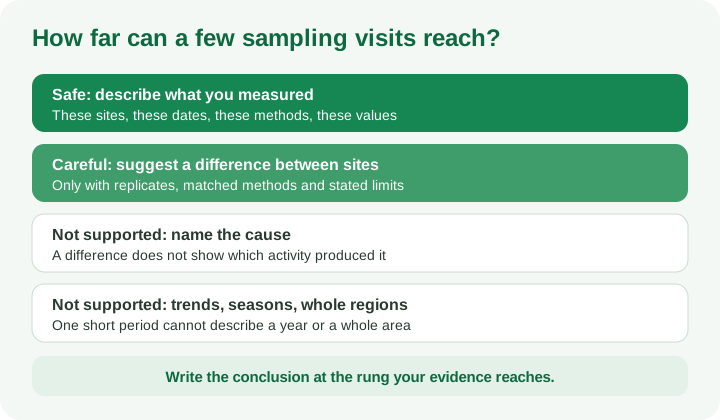
It can describe the values you measured at the sites and times you sampled, using the method you state. With sensible replicates and comparable sites, it may suggest that two places differ.
It cannot show what caused a difference, because nearby activities, geology, rainfall, the age of a well or the way a sample was handled could all contribute. It cannot show a trend or a seasonal pattern from a short window, and it cannot describe a whole area from a handful of points. It cannot show harm to health just because a value is above a limit.
Useful wording: "At the sampled wells on the sampling dates, values of X were higher near the market than farther away." Weak wording: "The market pollutes the groundwater." The limitations guide shows how to state these limits without undermining the work.
Provisional question shapes you can adapt
These are shapes, not approved titles. Replace the brackets with your place, period and parameters only after you have checked every feasibility item above.
- How do measured values of [chosen parameters] compare between [source type A] and [source type B] in [named area] on [sampling dates]?
- How do [soil property] values differ between [land use A] and [land use B] at [stated depth] in [named site]?
- Do measured [air or noise] readings at [named locations] differ between [time windows], using [stated instrument and method]?
- How do published standards define [the quantity] for [sample type], and how do my measured values compare with the relevant limit?
Each shape names a place, a period, a unit and a comparison. If a shape cannot be filled in with things you can actually do, it is not your topic yet.
Do a small pilot first
Visit the site once. Collect one trial sample with the planned bottle and method, deliver it to the laboratory, and ask what went wrong. A pilot shows whether your route works, whether the site is accessible, whether the laboratory accepts the container, and how long the process takes. It is far better to learn this with one bottle than with the whole dataset. Keep the pilot out of your final results unless your supervisor says otherwise.
Supervisor and defence questions to prepare for
- Why did you choose these sites, and how do you know they are comparable?
- What did you do to avoid contaminating or changing the samples?
- What is the difference between your replicates and your repeat readings?
- Which standard did you compare against, and does it apply to this sample type?
- What happened to results that did not look right?
- Can you say the activity caused the difference? Why or why not?
- What would you do with more time and a larger budget?
The methodology guide helps you record the design so these questions have written answers, and the results chapter guide shows how to present them without overclaiming.
Common mistakes in Environmental Science topics
- Promising a whole town, state or river from a few points.
- Using the word "effect" with no baseline or comparison.
- Listing parameters the laboratory cannot measure.
- Treating repeated readings from one bottle as independent samples.
- Comparing results with a standard written for a different sample type.
- Copying limit values from a secondary page instead of the original document.
- Sampling on private or hazardous land without permission.
- Skipping field records, so nobody can say when or where a sample was taken.
- Presenting a difference between sites as proof of cause.
A checklist to take to your supervisor
| Item | Your answer |
|---|---|
| Question (place, period, one sentence) | |
| Route (water, soil, air, survey, review) | |
| Sites and who gave permission | |
| Baseline or comparison logic | |
| Parameters and who measures each | |
| Replicates (independent versus repeat) and field blank | |
| Standard to be used, with edition and document | |
| Safety plan and who knows where I am | |
| Pilot done or planned | |
| What the data will not be able to claim |
Bring it to the first meeting. A short written plan is easier to correct than an idea in your head.
After the fieldwork
Keep raw sheets, lab reports, site notes and photographs together, because your chapters depend on them. When the evidence is in, UniDraft can help organise it with your checked sources and supervisor instructions into an editable Word document. Start your project document. For laboratory-style placements, the laboratory science SIWES guide covers a different task. Your own measurements, calculations and interpretation remain yours to produce and verify.
Sources
Pages opened while preparing this guide:
- WHO: Guidelines for drinking-water quality, fourth edition incorporating the first and second addenda (published 21 March 2022).
- WHO global air quality guidelines (22 September 2021).
- ECOLEX: National Environmental (Surface and Groundwater Quality Control) Regulations, 2011 (S.I. 22 of 2011) (summary of scope and enabling Act).
This guide does not reproduce limit values. Read the full primary documents and ask your supervisor which standard your department accepts.