Choose a Guidance and Counselling project topic by pairing one question about learners' needs, experiences or outcomes with participants you can legitimately reach, a suitable scale or interview approach, and a claim your evidence can honestly support. With minors, permission and confidentiality decide feasibility before the title does.
Use UniDraft's free topic generator to draft a starting shortlist, then test each idea against the checks below. Once your question, methods and findings are confirmed, start your project document: UniDraft organises your confirmed work, checked sources and supervisor instructions into an editable Word document. You remain responsible for the study, its permissions and its conclusions.
Why is a counselling project different from other Education topics?
In most Education projects the risk is a weak design. In Guidance and Counselling, the participants may be adolescents, the subject may be distress, bullying, family problems or exam anxiety, and a careless questionnaire item can bring that distress to the surface. So the questions a supervisor asks first are about people, not about chapters.
This post focuses on those decisions: school access, minors, confidentiality, instruments, small intervention studies and claims. For the wider choice of educational evidence routes (teachers' accounts, records, materials), read the Education project-topic guide. For the psychological side of topic choice, see the Psychology seminar-topic guide. Your department may assess a counselling project differently from an Education Management project, so follow your own supervisor and handbook.
How do I get school and parental permission?
Treat permission as a chain of separate yeses, not one signature.
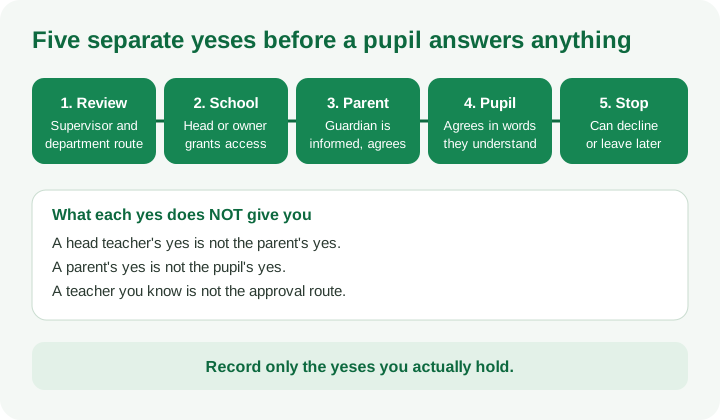
BERA's Ethical Guidelines for Educational Research (fifth edition) is an international professional resource, not a Nigerian university rule, but its structure helps you ask the right questions. It describes seeking agreement from those with legal responsibility for children, such as parents or guardians, while also seeking the child's own assent in a form suited to their age and reading ability. It also notes that institutions act as gatekeepers, that researchers should usually follow the institution's own approval and safeguarding procedures, and that group leaders agreeing does not remove an individual's right to decline.
Practical consequences for a student researcher:
- Approach in a sensible order. Settle your department's route with your supervisor first; then approach the school through the proper channel, not through a friendly teacher alone.
- Do not rely on placement access. Being allowed into a school for teaching practice or as a visitor is not the same as being authorised to recruit pupils for research.
- Write information in plain language. A form drafted for adults may be unreadable to a 13-year-old. Ask how your department expects age-appropriate wording.
- Do not pressure. BERA flags that dual roles, for example a teacher researching their own pupils, can make it hard for participants to say no. If you are known to the pupils as a teacher or counsellor-in-training, raise this with your supervisor.
- Ask whether opt-in or opt-out is acceptable. BERA treats opt-in as the general preference, with opt-out acceptable only in some circumstances where local rules allow. Your reviewer decides, not you.
For the general logic of separating approval, access and participation, use the research ethics and consent checklist. For wording to adapt, see the annotated informed consent sample. Neither replaces what your institution requires.
If you are researching university students (adults) instead of minors, the school and parent steps fall away, but voluntariness, privacy and distress risks remain, and your department's review still applies.
Where does confidentiality stop?
This is the section examiners and supervisors care about most, because a counselling project that promises "everything you say is confidential" may be promising something no responsible counsellor can.
The American Counseling Association's VISTAS article on school counsellors (Dansby-Giles, 2014, noted there as archived) reports that confidentiality may be breached when a student is in danger of harming themselves or others, and that school counsellors in the study most often broke confidentiality for matters such as bullying, suicide, safety threats and pregnancy. It also notes that the counsellors had to reconcile several overlapping documents themselves. A New South Wales Department of Education legal bulletin (reviewed 2016) similarly describes situations where disclosure is required or permitted, advises counsellors to tell students at the start that there may be circumstances in which they need to tell someone, and says parental permission is needed for significant therapeutic interventions. Those are American and Australian sources and are used here only to show the shape of the issue. Nigerian legal duties and school policies are for your institution and supervisor to confirm.
What this means for your study:
- Say the limits out loud in your information sheet. BERA advises that information sheets and consent forms state where confidentiality may have to be broken.
- Plan before you collect. If a pupil writes that they are being harmed or that they want to hurt themselves, who do you tell, in what time, and who decides? Agree this with your supervisor and the school contact in advance, not on the day.
- Do not become the counsellor. A student researcher collecting data is not delivering counselling. If your design needs a qualified counsellor to be present or on call, say so in your proposal and confirm it is arranged.
- Keep a dated note of any concern you raised and to whom, as BERA recommends for disclosure decisions.
- Protect the data. Pupil names, class lists and linking codes belong in the secure arrangements you agreed, not in a chat group.
Fictional illustration (no school, no pupils): a student plans an open-ended item, "Describe a problem that worries you at home". A reviewer asks what happens if a pupil describes abuse. The student realises the form never mentioned limits, no referral contact exists, and the item invites exactly the disclosure they cannot handle. They remove the item, replace it with a closed scale on study habits, and add a line about who to speak to. The topic got safer and smaller, which is the right direction.
Should I use scales and questionnaires, or interviews?
Both are legitimate; they answer different questions.
| Question you are asking | Likely route | What to establish first |
|---|---|---|
| How widely do learners report something, and do groups differ? | A scale or questionnaire | Whether an existing instrument fits your population, and its permission to use it |
| How do participants describe an experience in their own words? | Interviews or focus groups | Whether talking about it is safe, and who is present |
| Do reported levels differ between two groups? | Scale scores compared | That the groups are comparable and the comparison is honest |
| How do counsellors say they handle a situation? | Interviews with practitioners | Access, and what is confidential about their cases |
Scales. Many counselling studies use an adapted or published scale for something like exam anxiety, study habits or career decision-making. Do not assume a scale made elsewhere suits your pupils: language, age range and meaning can differ. Ask whether you may use it, whether it was developed for a similar group, and whether items need review. The questionnaire design guide covers wording, and the validity and reliability guide explains what checking an instrument involves.
Interviews. Interviews can capture nuance, but they put you in a private conversation about sensitive things. Decide the setting, whether a third person is nearby, whether you will record and how you will stop if a participant becomes upset. The interview guide helps with question structure; the safeguarding questions above still apply.
Sensitive items. For young participants, ask your supervisor whether items about self-harm, family conflict or abuse are acceptable at all in a student project. Often the safer decision is to study a related, less sensitive construct.
Can I run a small counselling intervention for my project?
Some departments allow a short intervention, for example a few group sessions on study skills, with a pre- and post-measure. Many do not for undergraduates, and none should assume it. If your supervisor allows it, work through these limits.
- Who delivers it? A final-year student is not automatically qualified to deliver therapeutic interventions. Confirm what you are permitted to do and who supervises. The NSW bulletin above notes parental permission is needed for significant therapeutic interventions in that system, which illustrates why this question matters.
- What is the dose and fidelity? A single session and a six-week programme are different things. Record exactly what was delivered, to whom, when and by whom.
- What about the comparison group? BERA notes that where a design advantages some participants, researchers should consider mitigating it, for example by offering an effective intervention to the control group later. Ask how fairness is handled.
- What are the alternative explanations? Pupils may improve because of time, exams ending, other teachers or simply being measured twice. A small group with no comparison cannot rule these out. See the experimental design guide for how designs differ, and the pilot study guide if you need to test your procedure first.
- What if the intervention makes someone worse? Have a stopping rule and a referral route before you begin, and agree both with the supervisor.
Many good projects avoid an intervention altogether and instead study how an existing service is perceived, used or experienced. That is a perfectly respectable undergraduate scope.
What can a counselling project claim, and what can it not?
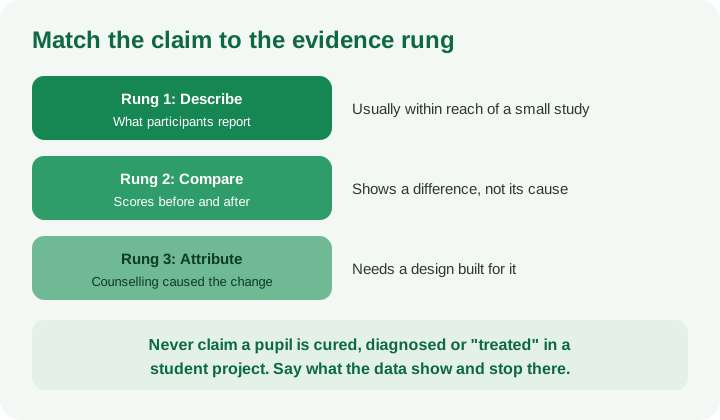
Keep the language of your title, objectives and conclusion at the rung your evidence reaches.
| If your evidence is | You can say | You should not say |
|---|---|---|
| A cross-sectional scale from one school | These respondents reported X at this time | Counselling services improve or fail to improve X generally |
| Scores before and after a short programme | Scores differed (or not) between the two points | The programme caused the change |
| Interviews with a few counsellors or pupils | These participants described X | This is how all counsellors or pupils experience it |
| Records of attendance at a counselling unit | The recorded pattern within the access you had | Why people attended or did not |
Words to avoid in a student project: cured, treated, diagnosed, proved, eliminated. You are not diagnosing anyone, and a score on a scale is not a diagnosis. Discuss results as patterns in the data, and use your limitations section to be specific about school selection, self-report, small samples and who chose to take part. For participants, avoid describing children in ways that could identify them, even in a fictional-sounding story.
How do I turn this into a topic direction?
Below are original planning directions, not approved titles, not studies that exist and not claims about what schools or counsellors currently do. Adapt only after checking your brief, literature and access.
- How do learners in a defined stage describe seeking help from the school counsellor? Evidence route: interviews or a short open-and-closed questionnaire. Watch for: who is present, how you avoid pressuring participants, and what you do with a disclosure.
- What do teachers say their role is in referring pupils to the counsellor? Evidence route: interviews with staff. Lower risk than interviewing minors, and your questions concern practice, not individual pupils.
- How is a specified study-skills or career-guidance activity described by participating students? Evidence route: questionnaire after a normal school activity you do not control. Watch for: claims of impact beyond what students report.
- What do counsellors in a defined setting say limits their work? Evidence route: interviews with practitioners. Watch for: confidentiality about their cases and institutional approval for access.
- How do adult university students describe using a campus counselling or guidance unit? Evidence route: questionnaire or interviews. Watch for: sensitive disclosure, institutional access and whether the unit's records are off limits.
- How are guidance services presented in selected school documents or handbooks? Evidence route: document analysis. A feasible route if participant access is hard, though you still need permission to use the documents and a clear selection rule.
The general topic-selection guide explains the approval and supervision checks that apply to any department.
Take this feasibility worksheet to your supervisor
Complete it for each serious candidate. "Unknown" is a useful answer when it names work still to do.
| Field | Your note |
|---|---|
| Question | What precisely do I want to understand about whom? |
| Participants | Minors or adults, which stage, how reached, who is the gatekeeper? |
| Permissions | Department route, school, parent or guardian, participant: what is confirmed, what is pending? |
| Instrument | Scale or interview guide: source, permission to use, language and age fit |
| Sensitivity | Which items or questions could cause distress, and what is the response plan? |
| Confidentiality limits | What will participants be told, and who do I tell if there is a safety concern? |
| Qualified support | Who with counselling expertise supervises or is on call? |
| Claim boundary | What would the evidence support, and what must I not say? |
| Data handling | Where records are stored, who sees identifiable data, when they are deleted |
| Fallback | What smaller or lower-risk version will I do if access fails? |
Once the candidate is agreed, write research questions and objectives that match the evidence you can actually collect, and a methodology that describes the permissions and process that really happened.
Common mistakes in counselling projects
- Titles that promise impact ("The Effect of Counselling on Academic Performance") when the evidence is a questionnaire about perceptions.
- Writing "all information will be kept strictly confidential" with no mention of limits.
- Treating a headteacher's signature as parent and pupil consent.
- Copying a foreign scale without checking it fits Nigerian pupils' language and age.
- Including questions about abuse or self-harm with no response plan.
- Describing a mixed-ability sample in one school as "Nigerian secondary school pupils".
- Inventing an ethics approval number, signed forms or a counsellor's endorsement to complete a chapter.
Questions a supervisor or defence panel may ask
- Who gave permission, and in what order?
- What did you tell pupils about the limits of confidentiality?
- What would you have done if a pupil disclosed harm?
- Why this scale, and has it been used with a similar group?
- Why do your results not show that counselling caused the change?
- Who qualified supports participants during or after data collection?
- How did you protect the identity of the school and the pupils in your write-up?
Prepare spoken answers using the defence questions guide for general structure; your own answers must reflect what you really did.
Where UniDraft fits
You secure the permissions, run the study and verify the findings; UniDraft helps organise your confirmed work, checked sources and supervisor instructions into an editable Word document. When your question, methods and results are settled, start your project document. To check citations, there is a free citation tool, and your institution's layout rules are in the format guides.
Sources
Opened and used for this guide:
- BERA, Ethical Guidelines for Educational Research, fifth edition (2024)
- Dansby-Giles, G., Informed Consent, Confidentiality, and Duty to Warn With School Counselors, VISTAS Online, American Counseling Association (2014, archived)
- NSW Department of Education, School counsellors and confidentiality (legal issues bulletin, reviewed 2016)
These are international professional and policy resources, not Nigerian rules. Confirm institutional, legal and professional requirements with your supervisor and department.