Choose a mechanical engineering project topic by checking whether you can make or obtain the parts, reach the workshop and instruments, work safely, state a measurable target and test it more than once. Fabrication, test-rig, simulation and energy projects each fail in different ways, so pick the route before the title.
UniDraft's free topic generator can help you build a starting shortlist, which you then test against the checks below and take to your supervisor. Once the topic is agreed and you have real drawings, readings and notes, UniDraft organises your confirmed work, checked sources and supervisor instructions into an editable Word project document: start your project document. You still design, build, measure and verify everything yourself.
If you are still working out how to choose a topic in general, read the general guide to choosing a project topic first. Electrical students have their own version of this problem, covered in electrical and electronic engineering project topics. This post is about what is specific to mechanical work: machines, materials, heat, flow, workshops and measurement.
What counts as a mechanical engineering project?
Most mechanical final-year projects fall into one of four routes. Your department may allow all of them or only some, so ask.
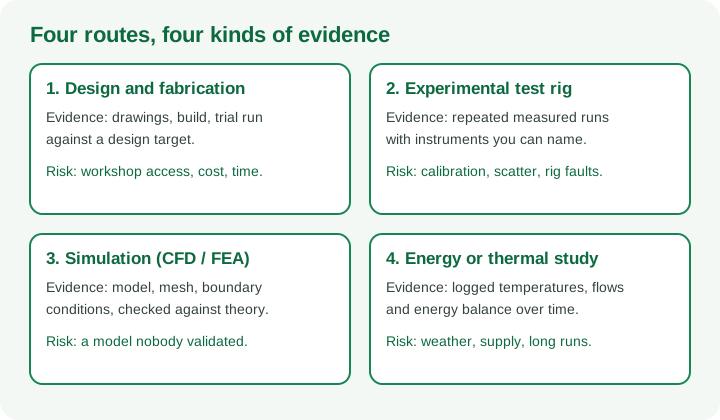
| Route | What you deliver | What the panel can check | Typical way it goes wrong |
|---|---|---|---|
| Design and fabrication | Drawings, a built device, a trial against a design target | Do the drawings match the object, and did it meet the target? | The workshop cannot make a part, or the build overruns the time |
| Experimental test rig | A rig, a test method and repeated measurements | Are the readings credible, repeatable and honestly reported? | Uncalibrated instruments, one-off runs, rig faults |
| Simulation (CFD or FEA) | A model, its assumptions and results | Are the geometry, loads and mesh sensible, and was anything checked against theory or a measurement? | A pretty plot from a model nobody validated |
| Energy or thermal study | Logged temperatures, flows or energy over time | Is the energy balance reasonable and the data complete? | Weather, power cuts and long runs that never finish |
Books written for capstone design courses in mechanical engineering, such as the Springer text Senior Design Projects in Mechanical Engineering, describe the work as phases: scoping and specification, conceptual design, then detail design, with project management and grading rubrics treated as part of the job. That matches how a good Nigerian project is judged too: the decisions and their evidence matter as much as the finished object. Your own handbook is the rule that binds you, not a textbook.
Why not copy a title?
I searched for Nigerian mechanical project topics. Results were mostly undated lists, topic banks and reposted material, with little about workshop access, instrument error, cost or defence questions. Copying a title from them carries risks:
- The department may have supervised the same title many times, so the panel expects a clearly new angle.
- The original may have used a workshop, material or software you cannot reach.
- You will not know why the design choices were made, and the defence asks exactly that.
- Similarity to submitted work can raise questions.
Use topic areas as raw material, then make the question yours through your constraints and measurable goals. The sections below give you the tests for doing that.
What do panels and supervisors actually look at?
Department rules differ, so treat this as a pattern, not a rule. In most mechanical defences the panel is looking for evidence of engineering judgement:
- Why this design or method rather than another?
- Where did your numbers come from: a drawing, a datasheet, a standard, a measurement or an assumption?
- How did you check the result, and how much do you trust it?
- What would you change?
A beautiful machine with no stated target and no test is weaker than a modest device with a clear target, honest runs and a good explanation of the gap.
Where do ideas come from?
Look for problem areas and sharpen them. These are directions to investigate, not approved topics or studies that exist:
| Area | A question shape to explore (provisional) | What to check early |
|---|---|---|
| Agro-processing equipment | Can a small machine perform a defined processing step to a stated throughput? | Material access, workshop capability, a way to measure throughput |
| Solar thermal or drying | How does a simple collector or dryer behave under defined loading and conditions? | Instruments, safe long runs, weather you must wait for |
| Heat transfer | How does a defined change to a surface or flow change a measured temperature? | Thermocouples, a stable heat source, repeat runs |
| Materials and strength | How does a defined material or treatment behave under a defined test? | Whether a testing machine is available, specimen preparation |
| Engines and fuel use | What can be measured about a defined engine setup under controlled conditions? | Safety, fuel handling, a way to load and measure |
| Machine design | Can a mechanism be designed to meet a stated load and size? | Calculations you can defend, a way to prove them |
| Maintenance and reliability | What does a defined record of failures suggest about a defined machine? | Real records you are allowed to use |
Your surroundings are a good source of problems: unreliable power, heat, local crops, workshops that repair rather than manufacture. Ask your supervisor and the workshop technologists what the department can actually support. A supervisor who already works in the area gives sharper feedback.
Check 1: Can the workshop make it?
For a fabrication project, design what your workshop can build, not what a catalogue shows. Ask the technologists, early, direct questions:
- Which machines work today: lathe, milling machine, drilling machine, welding, sheet-metal tools?
- Who operates them, and are students allowed to?
- What is the queue, and how many days do you realistically get?
- Can the workshop hold the tolerances your drawing asks for?
- What does outside fabrication cost, and how long does it take?
Every drawn dimension should be one that somebody can actually produce and check. If a part needs a process the workshop lacks, change the design or the plan now. Ask what you may do yourself and what a technologist must do. A part you could not describe how it was made will be a hard defence question.
Check 2: Can you measure it, and trust the instrument?
An experimental project is only as good as its measuring. List every quantity you need and the instrument for it, then check whether you can reach it:
| Quantity | Typical instrument | Question to answer |
|---|---|---|
| Temperature | Thermocouple, thermometer, data logger | How was it calibrated, and where is it placed? |
| Pressure | Pressure gauge or transducer | Does its range suit your values, and what is its resolution? |
| Flow | Flow meter, or timed collection of a volume | How accurate is it at your flow rate? |
| Speed and force | Tachometer, load cell, scale | Who calibrated it, and when? |
| Dimensions | Vernier calipers, micrometer | What is the smallest division you can read? |
| Electrical input | Multimeter, power meter | Does it cover your range safely? |
Calibration means checking an instrument against something better, so you know how far off its readings are. Ask the laboratory what has been calibrated and when, and note it. Record each instrument's resolution and stated accuracy from its manual or label. If no calibration information exists, say so honestly in the report rather than implying a certainty you do not have. Even published undergraduate teaching material admits this limit: a Cambridge University Press chapter of case studies from typical undergraduate experiments notes that calibration information is often not available and leaves its contribution out of the calculations. Say what you could and could not account for.
Check 3: Repeat runs and uncertainty, in plain words
One reading is not a result. Any measured quantity wobbles from run to run because of the instrument, the setup, the operator and the conditions. Your job is to show how much, and say what you think causes it.
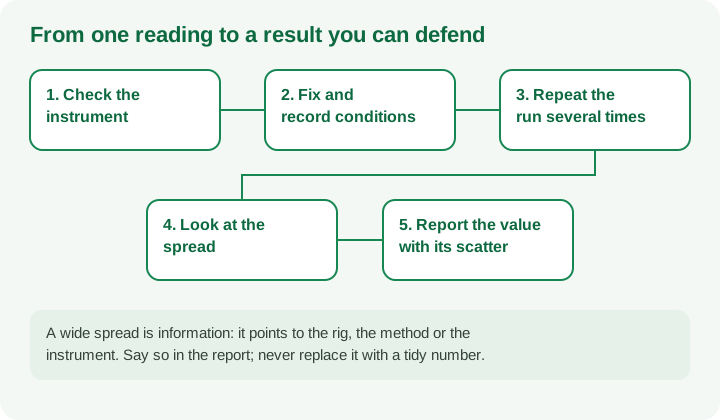
A plain-level routine that most supervisors would recognise:
- Check or calibrate the instrument, and write down its resolution.
- Fix the conditions you can control and record the ones you cannot, such as ambient temperature or supply voltage.
- Repeat the run, and keep every run, including the odd one.
- Look at the spread. A tight spread suggests the setup is repeatable; a wide spread points to the rig, the method or the instrument.
- Report the typical value with its scatter, and say what the instrument itself could not resolve.
Two ideas are worth keeping apart. Accuracy is how close a reading is to the true value; precision or repeatability is how closely repeated readings agree with each other. A rig can repeat beautifully and still be wrong. Formal uncertainty analysis follows an international approach, set out in the Guide to the Expression of Uncertainty in Measurement and summarised in the US National Institute of Standards and Technology note on the subject, which separates uncertainty obtained from repeated readings from uncertainty obtained in other ways. You do not need to master it for every project. Ask your supervisor what level of uncertainty treatment your department expects, and do not use thresholds or formulas you cannot source. The experimental research design guide covers controls and variables, and the results chapter guide shows how to present what you measured.
Check 4: Simulation, hardware, or both?
Briefs differ, so ask the direct question: "Does the project need a physical prototype, or is simulation acceptable?" If you use computational fluid dynamics (CFD) or finite element analysis (FEA):
- Name the software and version, and keep the model files.
- State the geometry, material properties, loads, boundary conditions and the mesh you used.
- Say what you checked the model against: a hand calculation, a published case or your own measurement.
- Label every figure as simulated or measured.
- Explain any disagreement with a measurement rather than hiding it.
A coloured contour plot is not a result until someone knows the model is sensible. A simulation that you have checked against even a simple hand calculation is far easier to defend than a complicated one you cannot explain. Many students use the software as a black box; your panel may ask what the software is actually solving, so read enough to answer. Say plainly what you did and did not do, and what the software did for you.
Check 5: Is it safe, and who supervises you?
Safety is a feasibility test, not a footnote. Rotating machinery, pressure, hot surfaces, hot oil or fuel, welding, grinding and heavy lifting can injure you or others. Settle these before you start:
- What are the hazards in your design: moving parts, heat, pressure, fuel, noise, electrical supply?
- Who in the workshop or laboratory supervises that work?
- What guards, protective equipment and emergency stops are planned?
- Can you test at a lower, safer level first?
- Do you know the workshop's rules and where emergency equipment is kept?
This post is a planning aid, not safety training. Follow your department's rules and qualified staff. If a supervisor tells you to scale a rig down for safety, treat it as part of the engineering decision. If your SIWES placement involved similar machines, the mechanical engineering SIWES report guide shows how to describe real workshop observations without bluffing.
Check 6: Cost, time and a target you can test
Write a bill of materials and services before committing: material and stock sizes, bought-in parts such as bearings, belts, motors and fittings, workshop charges, instruments to hire, and a margin for rework. I am not quoting a naira figure because prices vary by city and change often. Price your own list from real suppliers and cut scope if the total is beyond you or your department.
Then write each target in a form you can test:
- Quantity: what is measured (throughput, temperature rise, deflection, efficiency).
- Target: the number and unit you commit to.
- Condition: load, speed, input or environment.
- Method: how and with what you measure it.
- Pass rule: what result counts as meeting the target.
Justify each target from a standard, a datasheet, a user need or a stated assumption, not a number chosen to look good. Writing targets after the build, fitted to what the machine did, is one of the most common weaknesses. See how to write a project proposal for presenting scope and resources to your supervisor.
A fictional feasibility worksheet
This is an invented planning exercise, not a recommended title or a completed project.
A student proposes: "A machine to improve food processing for all Nigerian farmers." Applying the checks:
| Check | Status in the exercise | Next step |
|---|---|---|
| Scope | Far too broad ("all farmers") | Narrow to one defined processing step and one material |
| Route | Not chosen | Decide fabrication, test rig, simulation or a mix |
| Workshop | Not asked | Ask which machines and technologists are available |
| Instruments | None listed | List quantities and instruments, check calibration |
| Safety | Moving parts likely | Plan guards and supervision |
| Cost and time | No list | Price materials and workshop charges, add margin |
| Target | None stated | Write quantity, target, condition, method and pass rule |
| Decision | Candidate only | Revise and discuss before committing |
The result is not "approved" or "rejected". It is a set of questions that turn a vague wish into something defensible. Whichever version you end up with, the methodology guide shows how to describe a design and test procedure clearly.
What will the defence panel ask?
Prepare answers in your own words, from your own work, to questions like these:
- Why did you choose this design or method over the alternatives?
- Where did each dimension, material and rating come from?
- What was your target, and why that number?
- How did you measure it, and how reliable was the instrument?
- How many runs did you do, and how much did they vary?
- Which results are simulated and which measured, and why do they differ?
- What are the limits of the work, and what would you change?
- What hazards did you manage?
- What did it cost, and could it be cheaper?
- What did you do yourself, and what did workshop staff or others do?
The last question matters: describe your role truthfully. For general defence preparation, including how defence is also spelled defense, see common project defence questions, and write your limitations section before the panel does it for you.
Common mistakes
- Choosing a title because it sounds advanced, then finding the workshop cannot make it.
- Buying materials before agreeing scope, workshop time and instruments.
- Setting targets after the build.
- Reporting one run as a result.
- Presenting simulation as measurement, or the reverse.
- Using software or a kit without knowing what it does.
- Leaving safety to the end.
- Hiding a failed test instead of explaining it.
- Skipping the record: dated drawing revisions, photographs you are permitted to take, raw readings, calibration notes.
Take a decision note to your supervisor
Bring a one-page note: the problem, the route you propose, a rough drawing or model idea, the bill of materials, the workshop and instruments you need, the safety plan, three or four draft targets and a short test plan. Ask directly whether the scope fits the brief and whether a prototype, simulation or both is expected. Their answer, not a checklist, settles the topic.
When your confirmed work and readings are ready, start your project document with UniDraft. It organises your confirmed work, checked sources and supervisor instructions into an editable Word document. It does not design your machine, run your tests, supply measurements or guarantee approval; you review every figure and claim yourself.
Sources
- Springer: Senior Design Projects in Mechanical Engineering (book page, via Bookshare): describes the scoping, conceptual and detail design phases and the role of project management and rubrics in capstone design.
- Cambridge University Press: Case studies in measurement uncertainty: case studies from typical undergraduate experiments, and the note that calibration information is often unavailable.
- NIST: Technical Note 1297, measurement uncertainty introduction: the CIPM approach and the ISO Guide on which formal uncertainty treatment is based.
- University of Duhok, College of Engineering: Guidelines for Final Year Mechanical Engineering Project Report: states that reporting is an essential skill for a mechanical engineer (an Iraqi institution, used for context only; your own department's rules apply).