Choose a civil engineering project topic by checking whether you can reach the lab or site, follow a named standard, work safely, afford the materials and state measurable specifications with replicate tests. A title that fails any of these becomes an expensive problem in your final semester. Your supervisor and department brief make the final call.
UniDraft's free topic generator can help you build a starting shortlist; run every suggestion through the checks below before you take it to your supervisor. Once you have an agreed topic with real test records, calculations and sources, UniDraft organises your confirmed work, checked sources and supervisor instructions into an editable Word project document. Start your project document; you still design, test and verify everything yourself.
Civil engineering projects are not like literature-based topics in other departments. You are normally expected to test, design, model or measure something and defend the numbers. That makes feasibility the real topic-selection skill. If you are still working out the general rules, read the general guide to choosing a project topic first, then come back here. The electrical equivalent of this post is the electrical and electronic engineering topics guide, which uses a similar logic with different equipment.
What makes a civil engineering topic good?
A good topic is a question, a method that can answer it, and evidence you can collect. In practice:
- A clear need: a local material, a failure pattern, a design problem or a site constraint someone cares about.
- A scope small enough to finish with the lab time, materials and money you actually have.
- A named standard or code for each test or design step.
- Properties stated with units and a pass rule before you start.
- Enough depth that your supervisor sees engineering judgement, not only a recipe.
Requirements vary by university and department. Some publish project guidelines, some assign topics through supervisors, and some let students propose their own. This post gives you a way to test ideas, not a list of what your department will approve.
Which of the four routes fits you?
Most civil engineering projects fall into four routes, and each has a different bottleneck.
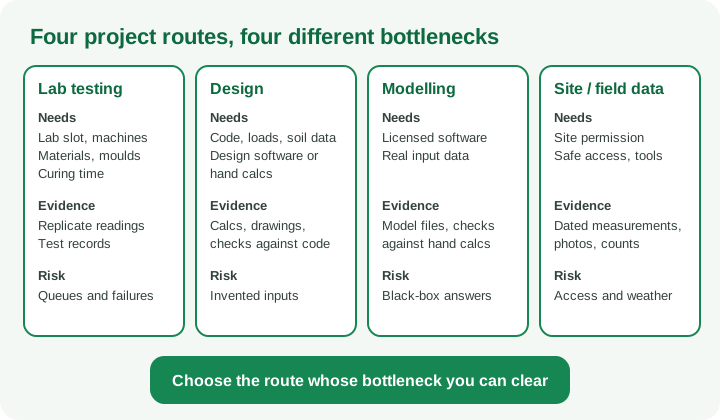
| Route | Typical question shape (provisional) | Main bottleneck |
|---|---|---|
| Lab testing of materials | How does changing one ingredient or treatment affect a measured property? | Lab slots, curing time, enough material from one source |
| Design and analysis | Can a defined element be designed to meet a code for stated loads? | Reliable input data and knowing the code well |
| Software modelling | How does a modelled system respond when one parameter changes? | Licensed software and real input data |
| Site or field data | What do measurements at a defined location show over a defined period? | Permission, safe access and weather |
These are directions, not approved topics or completed studies. The civil engineering SIWES guide and the built environment SIWES guide are about reporting placement work you saw; a final-year project is different because you plan the test or design and answer for the results.
Check 1: Can you reach the lab, and does it have the machine?
Laboratory work is where many civil engineering topics stall. Before committing, ask the lab technologist, not only your supervisor:
- Which machines work today (compression machine, sieves, compaction moulds, CBR equipment, ovens, curing tank)?
- When is the lab free, given other classes and other final-year students?
- Do you supply moulds, materials or consumables?
- Who operates the machine, and who signs off your readings?
- Is the machine calibrated, and is a record available?
Curing is also a hidden schedule item. A test at a stated age cannot be rushed: if your plan needs specimens tested after several weeks of curing, work backwards from your submission date, then add slack for a failed batch. A commercial testing laboratory, for example, describes keeping cubes in monitored water tanks until the age the client requires, which shows why a curing period belongs in the schedule from the start. If the machine you need does not exist in your department, say so now; some students arrange outside testing, which adds cost and delay and needs your supervisor's agreement.
Check 2: Which standard or code will you follow?
Every test and design step should trace to a named document. Examples of the kinds of documents involved (confirm with your supervisor which your department uses and which edition applies):
- Concrete strength testing: the BS EN 12390 series covers testing hardened concrete; Part 3 covers compressive strength of test specimens. BSI's catalogue page for the 2002 edition of Part 3 shows it as withdrawn, so editions have changed. Your lab may follow a later edition or a different standard, so write the exact one it uses.
- Soil testing: BS 1377 (1990), Parts 1 to 9, is the soils-for-civil-engineering test series cited by Nigerian studies on laterite and road subgrade, which report particle size, Atterberg limits, compaction and CBR tests under it.
- Structural design: older projects cite BS 8110; the UK replaced it with Eurocode 2 (BS EN 1992-1-1). Which one your department teaches or accepts varies, so ask rather than guess.
- Road materials: Nigerian road studies compare soils against Federal Ministry of Works and Housing road specifications. Several unofficial PDF copies circulate online, so get the official edition from your department instead of an unverified download.
Two honest habits help. Cite the standard number, part and year exactly as your lab or department gives it. And never copy a limit value, such as a minimum strength or maximum plasticity, from another report without finding it in the document itself. The methodology guide shows where standards belong in the write-up.
What is the safety picture?
Safety is a feasibility check, not a footnote. Casting concrete involves alkaline cement on skin, heavy lifting and moulds; crushing specimens releases fragments and dust; soil sampling means excavation; site data means traffic, edges and weather; steel and welding mean heat and sparks.
- Ask what personal protective equipment the lab requires and who supplies it.
- Never run a crushing or loading machine unsupervised.
- Do not enter trenches or excavations without proper support and a competent person.
- For site work, get written permission, tell your supervisor where you will be, and do not work alone.
- If a design or test needs a hazard your department cannot supervise, change the scope.
This post is a planning aid, not safety training. Follow your department's rules and the people responsible for the lab.
What will it cost?
Write a cost sheet before you commit: materials (cement, aggregates, admixtures, steel, soil samples), moulds or consumables, transport of material to campus, outside tests if any, printing, and a margin for a failed batch. Price from real suppliers near you; prices change by city and month, so this post gives no naira figures.
Common surprises:
- Buying a small batch and then running short, so the replacement batch behaves differently.
- Transport of bulk soil or aggregate.
- Outside laboratory fees if your department cannot do a test.
- Software licences, if your route is modelling and the department does not provide them.
Reduce the scope if the total is beyond reach. A smaller study done properly beats a large one abandoned half-way. For presenting scope and resources, see how to write a project proposal.
How do you write specifications you can measure?
A specification states what you will measure, how, and what counts as success. "Better" or "more durable" is a wish.
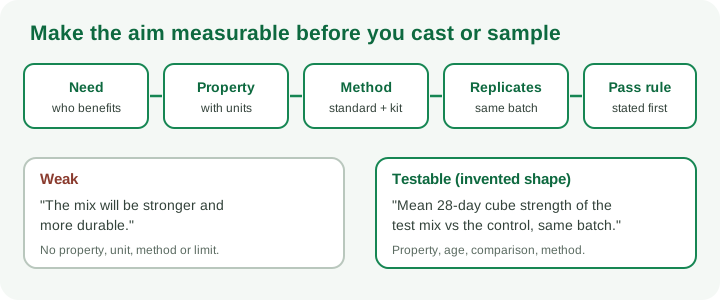
For every objective, write five things: the property (with units), the method (standard and equipment), the conditions (age, moisture, temperature, loading rate as the standard states), the replicates and the pass rule. Decide the pass rule and the comparison before testing, not after seeing the numbers.
Replicates are repeat specimens made and tested the same way. They are what let you say whether a difference is real or just scatter. I am not giving a magic number: the count should come from your standard, your lab's practice and your supervisor, and it should be chosen before you cast. If you want the general idea of how much data is enough, the sample size guide explains the principle, though lab specimens are not survey respondents. Also keep a control: a reference mix, soil or design against which the change is compared, made under the same conditions.
A fictional feasibility worksheet
This is an invented planning exercise, not a recommended title or a completed project; no specimens exist and no results are implied.
A student proposes: "Improving the strength of concrete in Nigeria using local waste materials."
| Check | Status in the exercise | Next step |
|---|---|---|
| Scope | Far too broad ("concrete in Nigeria", "waste materials") | Pick one named material from one source and one property |
| Lab access | Not checked | Confirm compression machine, curing tank and free slots |
| Standard | None stated | Ask the technologist which standard and edition the lab follows |
| Material | Source and consistency unknown | Fix one source; record where and when it was collected |
| Control | Missing | Add a reference mix cast under the same conditions |
| Replicates | Not planned | Agree the count with the supervisor before casting |
| Schedule | Ignores curing time | Work backwards from submission date; add slack |
| Safety | Not discussed | List PPE, supervision and disposal of broken specimens |
| Decision | Candidate only | Narrow, then discuss before buying material |
The outcome is not approved or rejected. It is a list of questions that turns a vague wish into something you can defend. The experimental research design guide explains how control, variable and measurement fit together.
What about design-only, modelling and site-data projects?
Design projects (a beam, a foundation, a small drainage system) can work well if the inputs are honest. Do not invent loads, soil bearing values or rainfall. Take them from a code you can name, a site investigation you can cite, or a stated assumption you flag as an assumption. Show calculations step by step so a panel can follow and check them, and keep drawings consistent with the calculation. The system design diagrams guide can help with clear sketches, though structural drawings follow their own conventions.
Modelling projects need a check: compare the model with a hand calculation or published case so you can say why it deserves trust. State the software, version, element types, boundary conditions and assumptions, and keep the model files. "The software gave this answer" is not an explanation a panel will accept.
Site or field-data projects (traffic counts, flood marks, settlement readings, material surveys) depend on access. Get permission in writing, record date, time and conditions for every observation, and keep raw records. Where several people measure, say how you made readings consistent. See the primary and secondary data guide for the difference between data you collect and data you borrow, and cite borrowed data properly.
What will the defence panel ask?
Panels vary, but civil engineering panels often probe the reasoning behind your numbers. Prepare answers, in your own words and from your own work, to questions like these:
- Why did you choose this material, design or site?
- Which standard did you follow, and which edition?
- How many specimens did you test and why that many?
- What was your control, and how was it prepared?
- Were results consistent between replicates? What explains the spread?
- How did you handle a result that looked wrong?
- What are the limits of your study and how far can the findings be generalised?
- Where did each input in your design come from?
- What safety risks did you manage?
- What did you do yourself, and what did the technologist or others do?
The last question matters: describe your role truthfully. For general defence preparation (also spelled defense), see common project defence questions. Write limitations plainly; the limitations guide shows how.
Common mistakes in civil engineering project topics
- Choosing a topic first and checking the lab afterwards.
- Casting or sampling before the test plan, standard and replicates are agreed.
- Writing the pass rule after seeing the numbers.
- Forgetting curing time in the schedule.
- Copying a standard number, limit value or design input from another report.
- Mixing materials from different sources or batches without recording it.
- Presenting modelled or calculated values as measured results.
- Hiding a failed batch instead of explaining it.
- Leaving raw data sheets, lab records and photographs unorganised until the last week.
Keep a dated notebook from the first day: batch records, specimen labels, readings, machine used, who supervised. When you write the results chapter, the results chapter guide shows how to report what you measured before interpreting it.
Take a decision note to your supervisor
Bring one page: the problem, your route (lab, design, modelling or site), the standard you propose, a cost sheet, the lab access you have confirmed, the safety plan, three or four draft specifications with replicates and a pass rule, and a schedule that includes curing or site constraints. Ask directly whether the scope fits the brief and what evidence the department expects. Their answer settles the topic.
When your confirmed work, readings and supervisor instructions are ready, start your project document with UniDraft. UniDraft organises your confirmed work, checked sources and supervisor instructions into an editable Word document; you design, test and verify everything and review every figure and claim yourself.
Sources
- BSI: BS EN 12390-3:2002, Testing hardened concrete: compressive strength of test specimens: scope of the standard method; this edition is listed as withdrawn, so confirm the edition your lab uses.
- Journal of the Nigerian Society of Physical Sciences: A Preliminary Geotechnical Assessment of Residual Tropical Soils around Osogbo Metropolis as Materials for Road Subgrade: example of Nigerian soil tests (particle size, Atterberg limits, compaction, CBR, direct shear) reported under BS 1377 (1990).
- Kiwa: Concrete cube testing: describes monitored water-tank curing and testing at client-specified ages.