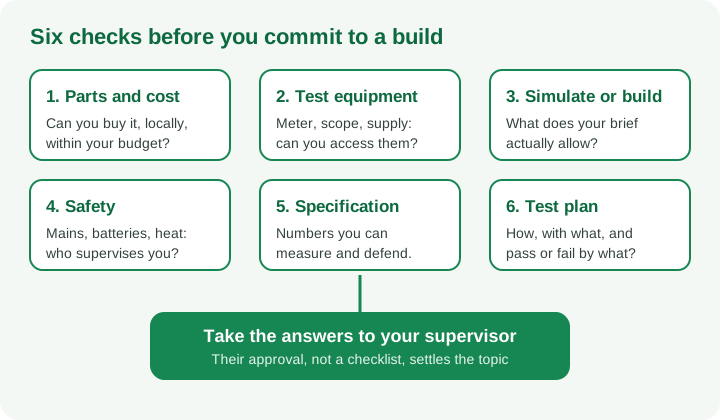
Choose an electrical or electronic engineering project topic by checking whether you can source the parts, access the test equipment, work safely, state measurable specifications and plan a test that proves them. A title that sounds impressive but fails any of these checks becomes an expensive problem in your final semester.
UniDraft's free topic generator can help you build a starting shortlist. Run each suggestion through the feasibility checks below before you take it to your supervisor.
Once you have a topic and real design notes, circuit diagrams and measurements, UniDraft organises your confirmed work, checked sources and supervisor instructions into an editable Word project document. Start your project document; you still design, build, test and verify everything yourself.
Engineering projects are different from the literature-based topics in other departments. You are usually expected to design, build or simulate something, test it against stated specifications, and defend your choices. That makes feasibility the real topic-selection skill. If you are still working out the general rules for choosing, start with the general project-topic selection guide, then come back here for the engineering-specific checks.
What makes an engineering project topic good?
A good topic is a problem, a design that responds to it, and a test that shows whether the design works. In practice that means:
- A clear need (who or what is this for, and why does existing practice fall short?).
- A scope small enough to finish with the parts, tools, time and money you actually have.
- Specifications you can measure, stated with units before you build.
- A test plan that compares what you built with those specifications.
- Enough depth that your supervisor can see engineering judgement, not just wiring a kit.
Requirements vary by university and department. Some departments publish project guidelines, some assign supervisors who set the scope, and some allow student-proposed topics. This post gives you a way to test ideas; it does not tell you what your department will approve. Your supervisor and departmental brief decide.
Why you should not copy a title
Searching for project topics returns many generic lists and project-material sellers. I looked at what comes up for Nigerian electrical and electronic engineering topics: most results are undated lists, some are reposted from other sites, and few say anything about what it costs or what a panel will ask. A title copied from such a list carries hidden risks:
- The department may already have supervised it many times, so your panel expects a clearly new angle.
- The original may have used parts or software you cannot get now.
- You will not know why the design choices were made, which is exactly what the defence asks.
- Similarity to submitted work can raise questions. See the plagiarism and similarity guide for how checks are viewed.
Use topic areas as raw material, then make the question your own through your location, constraints and measurable goals.
Where do electrical and electronic project ideas come from?
Instead of ready-made titles, look for problem areas and sharpen them. These are directions, not approved topics or completed studies:
| Area | A question shape to explore (provisional) | What to check early |
|---|---|---|
| Power and energy | How could a small solar or backup arrangement be sized for a defined load? | Load data you can measure, battery and panel availability, safety of high-current wiring |
| Control and automation | Can a defined process be controlled to hold a stated variable within a stated band? | Sensor and actuator access, response time you can test |
| Embedded and IoT | Can a microcontroller system log and report a defined quantity reliably? | Board availability, connectivity you can rely on, power budget |
| Communications | How does a defined link behave under stated conditions? | Whether you can measure signal quality, not just claim it |
| Instrumentation | Can a sensor chain measure a quantity to a stated accuracy? | A reference instrument to compare against |
| Power electronics | Can a converter or inverter meet a stated output under a stated load? | Safe test setup, suitable load, protection |
Your own environment is a good source of problems: unreliable supply, heat, costly imported equipment, local workshop needs. Ask your supervisor and technologists which problems the department can support. A supervisor who already works in the area is more likely to give useful feedback.
Check 1: Can you get the parts, and what will they cost?
Write a bill of materials before you commit. For each part, record the exact part number or rating, the supplier you will use, the current price you were quoted, and a fallback if it is out of stock.
Things students often underestimate:
- Imported modules and specialised chips can be scarce or priced by the exchange rate.
- Delivery time can consume weeks you do not have.
- Counterfeit or out-of-spec parts cause confusing faults. Buy from a source you trust.
- You need spares: parts get damaged while you learn.
- Enclosures, connectors, wire, a power supply and tools are part of the cost too.
I am not giving a naira figure because prices change and differ by city, supplier and design. Price your own list and add a margin for spares. If the total exceeds what you or your department can fund, reduce the scope now rather than discovering it in the final month. See how to write a project proposal for how to present scope and resources to your supervisor.
Check 2: Can you test it? Equipment and access
Building something you cannot measure gives you nothing to put in your results chapter. List the instruments your test plan needs, then confirm you can reach them.
| Need | Typical instrument | Question to answer |
|---|---|---|
| Voltage, current, resistance | Digital multimeter | Is it calibrated, and does its range cover your values? |
| Waveforms and timing | Oscilloscope | Does the lab have one free in your testing window? |
| Variable supply | Bench power supply | Can it supply your current safely? |
| Power quality | Power meter or analyser | Is one available, and who may operate it? |
| Reference measurement | A trusted instrument | What will you compare your device against? |
Ask the laboratory staff what is working, what is booked and what the rules are for borrowing. Lab access limits and queue times are real constraints. If your plan depends on equipment the department does not have, say so to your supervisor early. Also record each instrument's accuracy where the manual states it, because you will need it to explain measurement error.
Check 3: Simulation, hardware, or both?
Briefs differ. Some expect a built, working prototype; some accept simulation; many want simulation first, then hardware to confirm. Do not assume. Ask your supervisor the direct question: "Does the project need a physical prototype, or is simulation acceptable?"
Honest reporting matters whichever you use:
- Name the simulation tool and version, and keep the model files.
- State assumptions and model limits (ideal components, simplified loads).
- Label every figure as simulated or measured.
- If you build hardware, compare it with the simulation and explain differences.
Simulation is not a shortcut around testing. It is a tool for checking a design before spending money, and it cannot replace measurement when your brief requires a prototype. Hardware that disagrees with simulation is a finding to explain, not a defect to hide. The system design diagrams guide helps you draw block diagrams and flowcharts that show how the parts connect.
Check 4: Is it safe, and who supervises you?
Safety is a feasibility check, not a footnote. Mains voltage, large batteries, capacitors, motors, heat and soldering can injure you or others. A topic that needs mains-level power or high-current batteries must be done under competent supervision and with proper protection.
Questions to settle before you start:
- What is the highest voltage and current in your design, and where?
- Who in the department or workshop supervises that testing?
- What protection is planned: fusing, isolation, enclosures, an emergency switch?
- Can you test at reduced, safer levels first?
- Do you know the lab's safety rules and where its emergency equipment is?
This post is a planning aid, not safety training. Follow your department's rules and the guidance of qualified staff. If a supervisor tells you to scale down a design for safety, treat that as part of the engineering decision. If your SIWES placement involved similar equipment, the electrical/electronic SIWES report guide shows how to describe real safety observations honestly, without inventing procedures.
Check 5: Write specifications you can measure
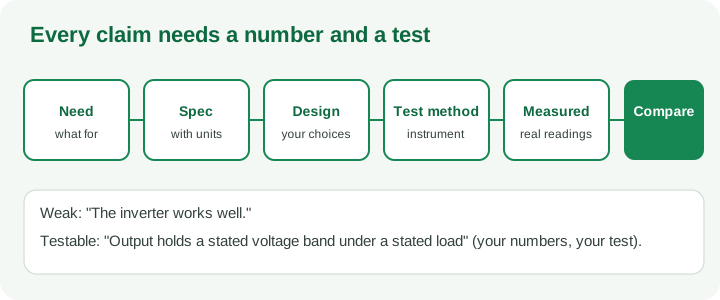
A specification states what the design must achieve, with a number, a unit and a condition. "Efficient" or "reliable" is a wish; a testable specification is a promise you can check.
Draft each specification with these parts:
- Quantity: what is measured (output voltage, response time, error).
- Target: the number and unit you commit to.
- Condition: the load, input range or environment it must hold under.
- Method: how and with what you will measure it.
- Pass rule: what result counts as meeting the specification.
Choose targets you can justify from a standard, a datasheet, a user need or a stated assumption, not a number invented to look good. If you cannot justify a figure, discuss it with your supervisor. The software requirements guide covers the same requirement-writing discipline for software-heavy projects, which applies to firmware and embedded systems too.
Check 6: Plan the test before you build
A test plan is the bridge between your specifications and your results chapter. It lists each test, the setup, the instrument, the number of readings and the pass rule. Writing it first stops you building something you cannot verify.
A fictional worksheet shows the shape. This is an invented planning example: no device exists, no readings were taken and no results are implied.
| Specification (invented) | Test | Instrument | Readings | Pass rule |
|---|---|---|---|---|
| Output stays inside a stated band at a stated load | Load the output at three defined steps | Multimeter, known load | Repeat each step several times | All readings inside the band |
| Responds within a stated time to a stated change | Apply a step change, capture the response | Oscilloscope | Several captures | Time under the stated limit |
| Safe temperature at full load | Run at full load for a stated period | Thermometer or probe | Record at intervals | Below the stated limit |
Repeat measurements, record the instrument and conditions, and keep raw readings in a dated log. The software test cases guide shows how to structure test cases with expected and actual results, a pattern that works for hardware tests too. When you present measured data, follow the advice in how to write the results chapter: report what you measured, then interpret it.
A fictional feasibility worksheet
This is an invented planning exercise, not a recommended title or a completed project.
A student proposes: "A smart power system for every home in Nigeria." Applying the checks:
| Check | Status in the exercise | Next step |
|---|---|---|
| Scope | Far too broad ("every home") | Narrow to one defined load and one use case |
| Parts and cost | No parts list yet | Build a priced bill of materials with spares |
| Test equipment | Not checked | Confirm lab access and instrument availability |
| Simulate or build | Undecided | Ask the supervisor which the brief requires |
| Safety | Mains-level power likely | Agree supervision and protection, or test at safe levels |
| Specifications | None stated | Write quantities, targets, conditions and methods |
| Test plan | None | Draft before buying parts |
| Decision | Candidate only | Revise and discuss before committing |
The result is not "approved" or "rejected." It is a list of questions that turn a vague wish into a project you can defend. Use the research-design guide to see how a question connects to the evidence needed to answer it.
What will the defence panel ask?
Panels vary, but engineering defences commonly probe the reasoning behind your design. Prepare answers, in your own words and from your own work, to questions like these:
- Why did you choose this design over alternatives?
- How did you choose each component value or rating?
- What are your specifications, and where did the targets come from?
- How did you test them, and how accurate were your instruments?
- Which results are simulated and which measured? Why do they differ?
- What are the limits of your design and what would you change?
- What safety risks did you manage?
- What does it cost, and could it be made cheaper?
- What did you do yourself, and what did others help with?
The last question matters: describe your role truthfully. Do not claim work you did not do. For more on handling questions, see common project defence questions, which covers the general defence (also spelled defense) format.
Common mistakes in engineering project topics
- Choosing a topic because the title sounds advanced, then discovering the parts are unavailable.
- Writing specifications after the build, fitted to whatever the device did.
- Buying components before agreeing scope and test equipment access.
- Leaving safety to the end.
- Presenting simulation as measured hardware, or the reverse.
- Hiding failed tests instead of explaining them.
- Using a kit or module without understanding what it does inside.
- Skipping the documentation: circuit diagrams, code, calibration notes, a dated measurement log.
Take a decision note to your supervisor
Bring a one-page note: the problem, your proposed design idea, the bill of materials with prices, the test equipment you need, the safety plan, three or four draft specifications and a short test plan. Ask directly whether the scope fits the brief and whether simulation, hardware or both is expected. Their answer, not a checklist, settles the topic.
Once the topic is agreed, keep your design notes, circuit diagrams, code, measurement logs and sources organised as you go. Methodology writing will be much easier if you recorded your choices; the methodology guide shows how to describe a design and test procedure clearly.
When your confirmed work, readings and supervisor instructions are ready, start your project document with UniDraft. UniDraft organises your confirmed work, checked sources and instructions into an editable Word document. It does not design circuits, run your tests, supply measurements or guarantee approval; you design, build and verify everything, and you review every figure and claim yourself.