
Choose a Psychology project topic by checking the concept you will measure, the scale you are allowed to use, the people you may ethically ask and the claim your design can support. A title is only a research plan once those four are settled with your supervisor.
UniDraft's free topic generator can build a starting shortlist for project topics for Psychology students. Test every suggestion against the checks below before you take it to your supervisor.
When your supervisor has agreed the question and design, UniDraft organises your confirmed Psychology work, checked sources and supervisor instructions into an editable Word project document. Start your Psychology project document, and keep every approval, score and interpretation tied to your own records. The project document workflow shows what to bring.
This page is about the final-year project, which usually collects or analyses data. If your assignment is a seminar built on published studies, read the Psychology seminar topics guide instead. Using people changes the whole list of checks below.
What makes a Psychology project topic workable?
A workable topic has one defined construct, one question, a named group of participants, a measure you may legitimately use and a design that fits the claim. "Stress among students" is an area. "How a defined group of final-year students describe their stress using one published scale" is closer, because it names a group, a measure and a limited verb.
Every question shape on this page is provisional. None is an approved title, a completed study or a finding. Whether your department will accept it depends on its own brief and your supervisor, so read the guide to choosing a final-year project topic for the wider method.
Psychology topics also have an extra trap. Concepts such as "anxiety", "self-esteem" or "resilience" sound obvious, so students skip defining them. Your reader cannot check your project unless you say what the word means and how it was measured.
Which evidence route fits your question?
Instead of a list of titles, start from a route. Each route gives you a way to generate a topic and a first feasibility question.
| Route | Where the idea comes from | First feasibility question |
|---|---|---|
| Replicate a published survey locally | A paper using a named scale in another population | Is the scale available for your use, and does the paper explain scoring? |
| Compare two defined groups | A difference you can describe, such as year of study | Can you reach both groups and keep them separate in the analysis? |
| Association between two measures | Two constructs a paper suggests are linked | Do you have a scale for each and a way to avoid sensitive items? |
| Small controlled experiment | A simple, low-risk manipulation from a textbook or paper | Will ethics review accept it, and can you assign participants at random? |
| Existing records or published data | Data that is already public and anonymous | Does it measure what your question needs? |
Here are three provisional shapes, with no results behind them: how two defined groups of students differ on one published measure; whether two measured variables are associated in a small, defined sample; how a short, low-risk task changes a simple performance score between two randomly assigned groups. Each still needs an approved scope, a permitted instrument and permissions before it becomes a title.
If you do not yet see a gap, practise reading for one. The research-gap guide shows how to find the sentence that says what is still unknown.
Which topics need extra care?
Some Psychology topics put participants at risk, and a student researcher is not trained or insured to handle that. Depression, trauma, abuse, suicide, substance use, sexual behaviour and self-harm are examples. Others involve groups who may not be free to refuse, such as children or people in care.
This is a boundary, not a ban. Many departments allow related topics in safer forms, for example a review of published evidence, or a general measure of wellbeing instead of a clinical screen. The Nigerian National Code of Health Research Ethics, in the version I opened, names psychologically disabled persons among the vulnerable participants for whose review the committee should co-opt knowledgeable people. Read that as a signal that these studies get more scrutiny, not as a rule for your project.
Before you commit, ask your supervisor:
- Does my institution allow this topic at undergraduate level at all?
- If a participant becomes distressed or discloses harm, what exactly am I allowed and expected to do?
- Who is the named person I can refer participants to?
- Can I answer the question with less sensitive items or published data instead?
Do not diagnose anyone. A score on a scale you administered is a research result, not a clinical judgement, and you are not qualified to give one.
What can your survey or small experiment actually claim?
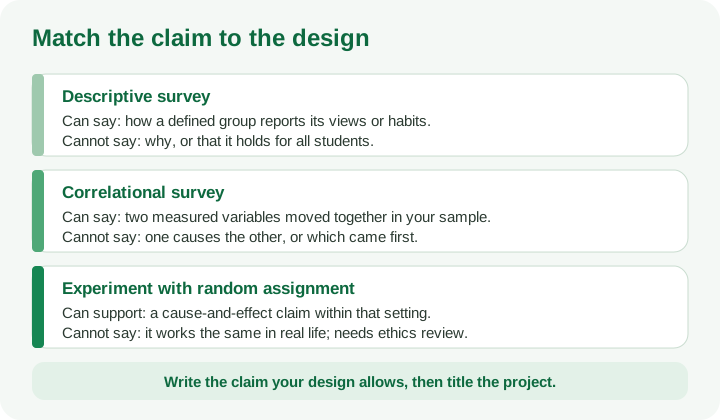
Your design caps your claim. OpenStax's Psychology 2e chapter on research approaches explains that survey, observation and archival methods are correlational, so they can show relationships between variables but cannot support cause-and-effect claims. It also notes that surveys depend on what people say, and people do not always respond accurately.
The same chapter says generalising from a survey needs a sufficiently large and diverse sample, and that experiments give control over variables but often take place in artificial settings. Those points drive most of what a fair Psychology project can claim.
- Descriptive survey. You can describe how your defined group answered. You cannot say why, or that the result holds for all Nigerian students.
- Correlational survey. You can report that two measures moved together in your sample. You cannot say one caused the other, or which came first.
- Experiment with random assignment. You may be able to support a cause-and-effect claim, within that setting. You cannot assume it works the same outside the lab or classroom.
Changing "effect of" to "relationship between" in a title does not repair a weak design. If your question is causal and your design is a one-time questionnaire, change the question or the design. The research design guide and the survey design guide help you match the two.
If you plan an experiment, read the experimental research design guide first.
Published scale or self-made questionnaire?
This is the decision that most often goes wrong in Psychology projects. A published scale has been used and described by others, so you can cite how it was built and how to score it. A questionnaire you invent has none of that history, and your examiner may ask you to prove it measures what you say.
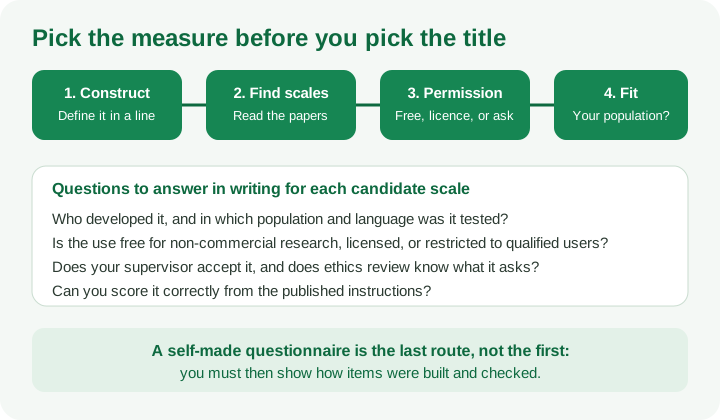
Use the route in the figure: define your construct in a line, find published scales in papers on that construct, check each one's permission status and then check whether it suits your population and language. Treat a self-made measure as the last route.
Can I use a scale freely because it is published?
Not automatically. A scale printed in a paper is usually still protected by copyright. The University of Saskatchewan's guide to using tests explains that APA PsycTests records carry a permissions field. One status says the test may be used for research or teaching without a permission request provided the use is non-commercial. Others tell you to contact the corresponding author, the publisher or both. For commercial tests, the publisher supplies licensing, often for a fee.
The same guide warns that some tests can only be purchased, administered or interpreted by a licensed or certified professional, and that even qualified users should first discuss the instrument with a professor, obtain ethics approval and get author or publisher permission. Plymouth University's psychometric test library notice says most of its tests are copyright protected and cannot be reproduced without written permission, and that permission can take several weeks.
For a Nigerian student that means:
- Find the scale's original source and who holds the rights.
- Check whether its use is free for non-commercial research, licensed or restricted.
- Where permission is needed, email the author or publisher early, say exactly how you will use the scale and keep the reply.
- If you get no answer or a refusal, choose a different scale. Do not use it anyway.
- Do not paste the full scale into an appendix unless the permission allows it. Ask your supervisor what to include.
I could not verify a single Nigerian rule on test licensing, so treat these as principles from the guides above and confirm the local position with your supervisor and library.
If I must build my own questionnaire, what do I owe the reader?
You owe an account of how the items were developed, checked by someone qualified and tried on a small group, plus an honest statement of what that does and does not show. The questionnaire design guide and the validity and reliability guide explain what to report. Do not write that your questionnaire "is valid and reliable" without evidence you can show.
How big and how varied does the sample need to be?
Do not copy a number from a friend's project. The right size depends on your question, the design, the population and what your department requires. Choose a recognised method, state its inputs and source, and plan for people who do not respond. The sample size guide and the sampling techniques guide explain the principles, and your supervisor can confirm any minimum your department sets.
Two checks matter more than the number:
- Who is missing? If you recruit only from one hostel, one faculty or one WhatsApp group, say so and limit your wording to that group.
- Who is the sample for? A convenience sample of one department cannot support a claim about Nigerian students. Name the group you actually studied.
For a small experiment, ask how participants will be placed into groups. Random assignment is what lets you argue the groups were comparable at the start, so describe how you did it, not just that you did.
Do I need ethics approval and consent?
Do not decide that yourself. The Nigerian National Code of Health Research Ethics, in the version I opened (dated 1 July 2007, on a third-party copy), says it covers health research involving human participants in Nigeria. It lists limited exempt categories, including some educational tests, surveys and interviews, but not where participants can be identified and disclosure could place them at risk or damage their reputation. It also states that all exemptions are determined by the health research ethics committee, not by the researcher.
Whether a Psychology project counts as "health research" under that Code is a question for your institution. Your university may have its own ethics route, a departmental committee or a supervisor sign-off. Ask which applies, what it needs and how long it takes, before you recruit anyone.
Then plan consent properly:
- Explain what participation involves, how long it takes, who can see the data and that people can stop at any time.
- Do not link consent to marks, favours or friendship.
- Collect only the identifying detail you need, and store it separately from responses.
- Keep the record of consent in the way your institution approves, and do not publish names or signatures in an appendix.
The research ethics and consent checklist walks through this, and the consent form sample shows the elements a form can contain. Neither replaces your institution's own form.
Fictional example: narrowing a title that is too big
This is an invented planning exercise. No data has been collected and no findings exist.
A student proposes "The effect of social media on depression among all Nigerian students." They have read a few papers and found a published scale, but have not checked its permission. They plan to email a questionnaire to course mates.
| Problem | Why it matters | Next step |
|---|---|---|
| "Effect" in the title | A one-time questionnaire cannot show a cause | Reword the question or change the design |
| "Depression" | A high-risk topic; a score is not a diagnosis | Ask whether a general wellbeing measure is acceptable |
| "All Nigerian students" | A convenience sample cannot represent them | Name the actual group and department |
| Scale not checked | Use may need permission or be restricted | Record the permission status and contact the owner |
| Course mates as sample | Pressure to agree; identification risk | Plan voluntary, anonymous participation and review |
| No ethics route | Collection could start too early | Ask which committee or sign-off applies |
A more defensible provisional question is: how a defined group of students in one department describe their daily social-media use, and whether it is associated with one wellbeing score from a scale they are permitted to use. It is still a candidate, not a title. Scope, measures and permissions need your supervisor's agreement.
What will a supervisor ask at the proposal or defence?
Expect questions like these, and write your answers down before you meet:
- Which construct are you measuring, and how do you define it?
- Why this scale, and who gave you permission to use it?
- How do you know it suits your participants and language?
- How did you choose your sample, and who is missing from it?
- What claim does your design support, and what does it not?
- Which committee or person approved your data collection?
- What did you do about participants who became distressed or withdrew?
- How did you protect identities and store the data?
The project defence preparation guide and the common defence questions guide show how to rehearse. Bring the permission email, the ethics decision and your measure's source, not just your results.
Common mistakes in Psychology projects
- Choosing a dramatic topic before checking that you may study it.
- Using a scale you cannot show you have permission to use.
- Writing "effect" or "impact" over correlational data.
- Calling a questionnaire score a diagnosis.
- Generalising a convenience sample to all students.
- Putting identifying details in the report or appendix.
- Collecting data before the review decision is in writing.
- Changing a hypothesis after seeing the results without saying so.
Take a decision note to your supervisor
Bring a one-page note: your construct and its definition, your question and design, the claim the design supports, your scale and its permission status, your sample and how you will reach it, the sensitive-topic risks and your ethics route. Then agree a timeline with the extra weeks that permission and review may need.
Once the plan is settled, keep the analysis and the document connected. Prepare your Psychology project document with UniDraft from your confirmed work and instructions, and check every source, score and interpretation yourself. UniDraft's citation finder can help you locate sources to verify.
Sources
- OpenStax, Psychology 2e: Approaches to Research. Opened and read for the limits of surveys, correlational evidence and experiments.
- University of Saskatchewan Library: Using tests and measures. Opened and read for permission statuses, licensing and restricted tests.
- University of Plymouth Psychology: Copyright notice for psychometric tests. Opened and read for copyright and written permission. It describes one university's library, not a Nigerian rule.
- National Code of Health Research Ethics (NHREC, Federal Ministry of Health, version dated 1 July 2007). Opened and read for scope, exemption and vulnerable participants. This is a third-party copy; confirm the current edition with NHREC and your institution.