
Recommendations for further studies are the part of Chapter Five where you tell future researchers what your project left unanswered and how it could be tested. Recommendations proper are different: they tell a named audience what to do because of your findings. Both must trace back to specific results, not to general opinion.
UniDraft organises your confirmed findings, checked sources and supervisor instructions into an editable Word project document, so your closing chapter can be built on what you actually found. Start your project document, then write each recommendation only from results you can point to. You supply and verify the facts; UniDraft does not run your analysis.
What are the parts of the closing chapter?
A final year project's last chapter usually carries several short jobs. Names and order vary, so treat this as a map rather than a rule. Some Nigerian guides list summary, conclusion, recommendations, limitations and suggestions for further studies as separate headings; others fold them into one "Discussion, Conclusion and Recommendations" chapter. Your department's manual overrides all of these.
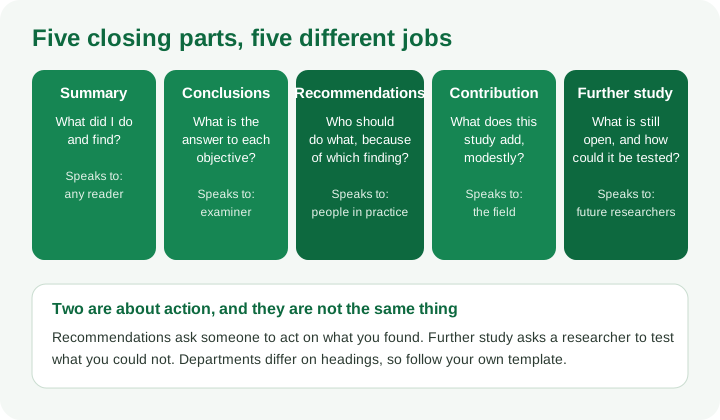
| Part | The question it answers | Typical length |
|---|---|---|
| Summary of findings | What did the study do, and what did it find? | A short recap, not a rewrite of Chapter Four |
| Conclusions | What is the answer to each objective or research question? | Often a sentence or paragraph per objective |
| Recommendations | Who should do what, because of which finding? | A short, numbered list |
| Contribution to knowledge | What does this study add, modestly stated? | One or two sentences |
| Suggestions for further research | What remains open, and how could it be tested? | A short list |
Length is a convention, not a rule. Ask your supervisor what they expect. This post does not repeat how to write the discussion or the limitations; those have their own guides. Read how to write the discussion and conclusion for interpreting results against the literature, and limitations of the study for stating constraints honestly. Here we deal with what follows them.
What is the difference between a summary and a conclusion?
Students often write the same paragraph twice under two headings. They are different:
- Summary: a brief recap of the whole study. The problem, the method, the sample or system, and the main findings in a few sentences. A reader who skipped the middle chapters should know what happened.
- Conclusion: the answers. For each research question or objective in Chapter One, one plain statement of what the evidence showed.
A university library writing guide on conclusions says a conclusion should restate the study's objectives and main arguments without simply repeating results, and should not bring in new information or speculate beyond the evidence. That fits the split above: the summary describes, the conclusion answers.
A fictional illustration, using an invented study of how second-year students at an imaginary polytechnic use library e-resources:
Summary (weak): "This chapter summarises the study. The study was very important and many things were found."
Summary (strong): "This study surveyed 120 second-year students in one department about their use of the library's e-resources. Questionnaires were analysed with percentages and means. Most respondents were aware the resources existed, but fewer than a fifth had used them in the last term."
Conclusion (strong): "Objective 2 was to determine how often students used the e-resources. The study concluded that use was infrequent among the respondents, despite high awareness."
The numbers are invented to show shape. Yours must come from your own Chapter Four, which is why how to write the results chapter matters: a conclusion cannot be clearer than the results beneath it.
How do you make recommendations follow from your findings?
A recommendation is an argument with three parts: what you found, who is in a position to act on it, and what they should do. The USC writing guide on the discussion section describes recommendations as general lessons drawn from the results, and says each implication, recommendation or research suggestion should be grounded in the findings and not go beyond the evidence. Speculation, it adds, should be clearly labelled.
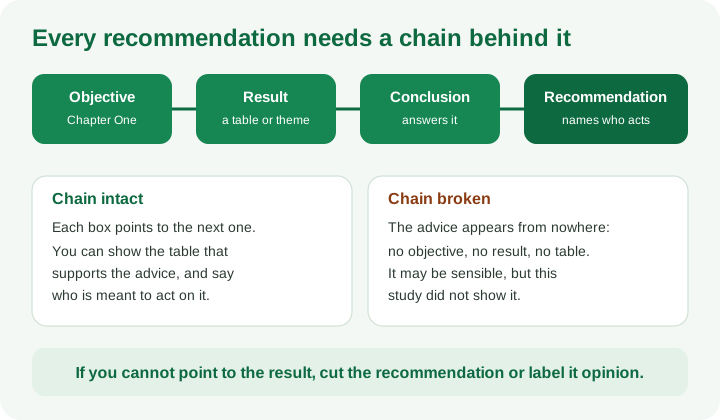
A practical way to do this is a chain, as in the figure below. Start from each objective, find the result, state the conclusion, and only then write the recommendation.
Use this worksheet for every recommendation before it goes into the chapter:
- Which objective is this about? Write its number.
- Which result supports it? Name the table, figure or theme. If you cannot, stop.
- Who should act? Name a real audience: the department, the organisation you studied, a regulator, the library.
- What exactly should they do? One concrete action, not a mood.
- Is it realistic and proportionate to the evidence? A study of 80 respondents in one department does not justify a national policy.
The same chain helps at your defence. When a panel asks "what is your basis for this recommendation?", you answer with the result and the table. See common defence questions and how to answer them for the wider set of questions to rehearse.
What do weak and strong recommendations look like?
Here is the same finding written badly and well. Again, the study and the figures are fictional and exist only to show the shape.
The finding: In an invented survey of 100 students in one faculty, most respondents who reported not using the library's online resources said they did not know how to log in.
| Weak recommendation | Why it fails | Strong recommendation |
|---|---|---|
| "The school should improve its library." | No audience action, no link to a result | "Since most non-users in this sample reported not knowing how to log in, the library should consider a short login orientation for new students." |
| "Students should read more." | Not tested by the study, applies to anything | "Departments could ask the library to include the login steps in the first-semester orientation, as non-use in this sample was linked to not knowing how to access the service." |
| "The government should provide funds." | Wrong audience, no evidence, no finding about funding | Leave it out, unless the study actually measured funding. |
| "More research should be done." | Placeholder, says nothing | Move it to suggestions for further research and make it specific (see below). |
Notice what the strong versions do. They begin from the result, they use hedged but clear language ("should consider", "as non-use in this sample was linked to"), and they name the audience. They also stay inside the sample: the evidence came from one faculty, so the advice is scoped to similar settings.
Watch for two quiet upgrades students make by accident. The first is turning a correlation into a cause ("because students lacked training, they did not use the service") when the study only showed that the two went together. The second is stretching "this sample" into "Nigerian students". Both are the kind of overreach that draws a correction.
The mistake of recommendations unsupported by results
This is the most common reason Chapter Five is sent back. It looks like this:
- A list of five or six recommendations where only one or two connect to anything in Chapter Four.
- Recommendations copied from a similar project's final page, so they address findings your study never produced.
- Recommendations on topics the study never measured (funding, government policy, staff attitudes) because they sound sensible.
- Advice the study itself could have tested but did not. The USC guide warns that proposing something your own data could have tested can suggest the data were not examined thoroughly.
Run a simple audit. Put every recommendation on a line, and next to it write the table or theme it came from. Any line left blank has three possible fates:
- Cut it. Usually the best choice.
- Move it to further research, if it is really a question the study could not answer.
- Keep it, labelled as the researcher's view, if your department allows opinion. Say it is not drawn from the findings. Many supervisors prefer it removed.
If a supervisor wrote "recommendations not supported by findings" or "too generic" on your draft, the audit above is the fix. Managing final year project supervisor corrections covers how to work through comments like this without losing track of versions.
How do you write suggestions for further research?
Further research is a different job from recommendations. You are not telling an organisation what to do; you are telling a future researcher what is still open. The USC discussion guidance says suggestions for future research can sit in the discussion or the conclusion but not both, should follow from limitations or from unresolved questions and unexpected patterns in the data, and can frame new questions as hypotheses for later testing.
Good sources for suggestions, all drawn from your own project:
- A limitation. If you studied one faculty, a repeat in other faculties is a natural next step.
- An unexpected result. If the pattern surprised you and you could not explain it, say what a study to explain it would need.
- A variable you did not measure. If your discussion mentioned a plausible factor you had no data on, name it.
- A method you could not use. If you used a survey and think interviews would explain the "why", say so.
- A gap in the literature that your study narrowed but did not close. See how to identify a research gap for how to describe one.
Weak versus strong, with a fictional case:
Weak: "Further studies should be carried out on this topic to cover more areas."
Strong: "This study covered one faculty in one session. A repeat across several faculties would show whether the low use of e-resources found here holds elsewhere. An interview-based study could also explore why students who knew about the service still did not use it, which a questionnaire could not answer."
The strong version names the gap, links it to a limit of the study (one faculty, one method), and says what kind of study would address it. It does not promise that such a study will find anything.
What about contribution to knowledge?
Some departments ask for a "contribution to knowledge" heading; others do not. If yours does, keep it to a sentence or two and make it modest. For an undergraduate project this is usually one of:
- evidence from a setting or group that earlier studies did not cover,
- a tested or compared approach, tool or design, with your measured results,
- a clearer description of a problem in a particular institution.
Avoid "novel", "first ever" or "groundbreaking" unless your literature review actually shows nobody has done it, and even then say "to the extent that the reviewed literature shows". The related Chapter One section on the significance of the study says what the study might be useful for; the contribution paragraph says what it actually added, now that the work is done. Do not copy one into the other.
How should the tense and tone work?
Keep the grammar clean, because Chapter Five is where sloppy tense stands out:
| What you are writing | Tense and tone | Example |
|---|---|---|
| What your study did and found | Past, plain | "Respondents reported low use." |
| What others should do | "should", "could", "may wish to" | "The library should consider an orientation." |
| What future researchers could do | "could", "would be useful" | "A repeat in other faculties could test this." |
| A limit on your claim | Past, specific | "Data came from one faculty." |
Do not use commanding language you cannot back ("must", "has to") unless a result clearly demands it. Hedged recommendations are not weak recommendations; they are proportionate ones.
Does the SIWES report work the same way?
Only partly. A SIWES report's conclusion and recommendations usually rest on what you did and observed during placement, not on a research dataset. The logic carries over (tie each recommendation to something you experienced and recorded), but the sections differ. See SIWES report conclusion and recommendations if that is the document you are writing. For a seminar report, check your department's template; many seminar reports have a shorter conclusion and no research-style recommendations.
Common mistakes in the closing sections
- Repeating the results table in words under "summary" and "conclusion" both.
- Adding new results or citations in the conclusion or recommendations.
- Recommendations with no audience ("it is recommended that...").
- Recommendations on things you did not study.
- Generic further research ("more studies are needed").
- Claiming the study proves something that it only suggests.
- Writing the closing chapter before the results are settled, then having to rewrite when Chapter Four changes.
- Mismatch with the abstract. Your abstract should state the same findings and conclusions in miniature; write it last.
Checklist before you submit
- Each objective has a plain conclusion.
- Each recommendation names its objective, result, audience and action.
- Any recommendation with a blank "result" column is cut, moved or labelled.
- Further-research suggestions come from your limitations, surprises or unmeasured variables, and are specific.
- Summary, conclusion and recommendations are not repeating each other.
- Findings are in the past tense; advice uses "should" or "could".
- No new results or citations appear after the discussion.
- The abstract matches.
- Headings and order follow your department's template, and your supervisor has seen the chapter.
Formatting is part of the same check. The free formatting checker tests a Word file against common layout rules, and the citation finder helps you locate sources you can verify before you cite them. Your supervisor's instructions come first whenever they differ from any general guide.
Questions supervisors and panels ask about this chapter
- "Which of your results leads to this recommendation?"
- "Who exactly should act on it, and how realistic is that?"
- "Could your own study have tested this? Why did it not?"
- "How far can these findings be applied beyond your sample?"
- "What would you do next if you had another term?"
If you can answer each from your own chapter, the closing sections are doing their job.
Where UniDraft fits in
UniDraft helps organise your confirmed work, checked sources and supervisor instructions into an editable Word project document. You still decide what your results mean and which recommendations they support. When you are ready, start your project document and keep your Chapter Four tables beside you while you write the last chapter.
Sources
- USC Libraries: Writing the conclusion (restating objectives without repeating results; no new information; recommendations optional)
- USC Libraries: Writing the discussion section (recommendations grounded in findings; future research placement and sources)