A SIWES conclusion summarises what the documented placement helped you learn. Recommendations propose specific actions that follow from that evidence. The closing chapter should be yours, rather than a reusable claim that training was rewarding. It should say, in plain words, what you did, what you gained, what got in the way and what should change, and every sentence should trace back to your logbook.
Your institution's SIWES guide decides the headings, the length and whether the closing is one chapter or two. This article shows how to build the content for it. If you have not yet written the main body, start with the general SIWES report guide, and keep your logbook open while you write the end, because the logbook is where the evidence for these paragraphs lives.
Your closing chapter should grow from the placement record, not a reusable paragraph. UniDraft helps organise your confirmed activities and guidelines into an editable SIWES report. Start your SIWES document with UniDraft, then check that each skill and recommendation follows from the body. It does not invent experience or approve workplace recommendations.
The short answer
- Write the closing chapter after the rest of the report, from your logbook, not from memory or a sample.
- One adaptable planning order is: a short summary, the skills and knowledge gained, the problems met and how you dealt with them, a conclusion (your judgement), and recommendations addressed to named parties.
- Make every claim traceable to a week or a task. "I learnt to read circuit diagrams" needs a week where you did.
- Keep recommendations specific, realistic and respectful. A recommendation without an addressee is a wish.
- Follow your department's template over this outline. Some use "Summary, Conclusion, Recommendation" as three headings; others fold them into one.
What the closing chapter is for
The Industrial Training Fund (ITF) describes SIWES as a skills training programme with stated objectives of giving students industrial skills and experience in their course of study and helping them apply theory in real work, and it describes a logbook in which students record their training. See the ITF SIWES page. Your closing chapter is where you show whether those objectives were met for you.
A good closing chapter does four jobs:
- It reminds the reader what you did, in a few lines, so a busy examiner who skipped to the end still understands.
- It states what you gained, in specific terms.
- It is honest about what limited the training.
- It turns that experience into suggestions that someone could actually act on.
It is not the place for new information. Anything important that appears for the first time in the conclusion suggests it should have been in the body.
The five parts of a strong closing chapter
All weak/strong passages below are fictional teaching examples, not real placement records. Use the pattern only where your own evidence supports it.
1. Summary
One short paragraph: where you trained, for how long, in which sections, and the main kinds of work. It repeats the report in miniature, with no new facts.
Weak: "I did my SIWES at a company and learnt many things."
Stronger: "I spent six months at a fabrication and maintenance workshop in the host company's production unit, rotating through machining, fabrication and generator servicing. My work was mostly assisting technicians and observing fault diagnosis, with supervised practice in marking out, cutting and measuring."
Notice the strong version names the kinds of work and gives the honest role. It also does not claim anything the body of the report does not support. Replace the example details with your own facts; do not copy the wording.
2. Skills and knowledge gained
This is where students inflate. Avoid long lists of skills with no anchor. Name a handful, and tie each to something that happened.
- Technical skills. The tools, methods, software or instruments you used, and at what level (observed, assisted, performed under supervision).
- Professional skills. Punctuality, working with a team, taking instructions, record keeping, communicating with clients or colleagues.
- Links to your course. One or two places where theory met practice, such as a concept from a lecture that made sense when you saw it on site.
Weak: "I gained skills in communication, teamwork and leadership."
Stronger: "In week nine I took over the daily stock record from the storekeeper, which taught me to reconcile counts with delivery notes. In weeks ten to twelve I worked with two other trainees on a repair job and learnt to divide tasks and report to the supervisor at the end of each day."
If you cannot link a skill to a week, take it out or soften it.
3. Problems met
Document actual difficulties and responses rather than creating a spotless or dramatic story. Describe the real obstacles and how you handled them, without blaming individuals.
Possible fictional categories to consider only if they match your actual experience: limited access to equipment, power outages, short supervision, late arrival of materials, difficulty getting the logbook signed, transport and accommodation costs, delayed placement, or a very busy period when trainees were left to watch. Tie each problem to a response: you asked questions, kept your own notes, requested a different section, or practised on your own time.
Weak: "The only challenge was transportation."
Stronger: "In the first month there was no fixed supervisor for trainees, so I kept a daily list of questions and asked the senior technician at the end of each day. From the second month I was attached to a named supervisor, who signed the logbook weekly."
4. Conclusion
This is your judgement. It answers the question "was it worth it and what does it show?" Keep it to a short paragraph.
A strong conclusion:
- States whether the training met its objectives for you, with a reason.
- Names the value of the experience for your course and your future work, in modest terms.
- Does not exaggerate. "I am now a fully trained engineer" or "I can now work independently in any laboratory" will provoke questions you cannot answer.
- Does not sell the company. A line of fair credit is fine; a brochure is not.
Weak: "In conclusion, SIWES is a very good programme and every student should take it seriously."
Stronger: "The placement gave me a working picture of how jobs flow through a workshop, from the job card to final inspection. It was strongest on observation and supervised practice and weaker on independent work, which is what I would expect of a first industrial exposure. It made several topics in my course clearer, and it showed me where my own gaps are."
5. Recommendations
Recommendations are where reports are most often generic. A useful recommendation has three parts: who, what and why.
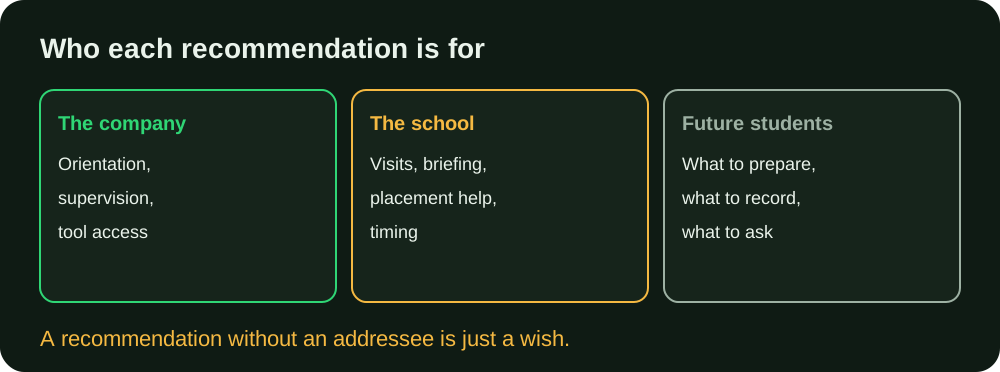
- To the host organisation. Examples that are specific: a short written orientation for new trainees in the first week; a named supervisor for each trainee; a simple rotation plan so trainees see each section; permission to take notes or permitted photographs; protective equipment for trainees.
- To the school. Examples: placement briefing before departure; clear written expectations for the logbook and the report; earlier notice of visits by the institution-based supervisor; a clear process for placement problems.
- To future students. Examples: begin the logbook on day one; obtain supervisor review and signatures on the schedule your institution requires; prepare basic skills for the placement beforehand; keep your own notes; be punctual and ask questions.
Phrase recommendations respectfully. "The company could consider..." lands better than "The company must...". Stay inside what you actually observed; if you did not see how the company trains staff, do not claim it fails to.
What the body of the report must already contain
The closing chapter depends on the chapters before it. If those are thin, the conclusion will be too. Before you write it, check that the body has:
- the dated activities with role labels,
- the host organisation described from what you saw,
- the skills you built, tied to weeks,
- safety and challenge sections where relevant.
The discipline guides show what that body looks like in different fields:
- Engineering: electrical and electronic and mechanical.
- Business and agriculture: accounting and business and agriculture.
- Sciences and the built environment: laboratory science and architecture, quantity surveying and estate management.
How closing chapters differ by discipline
The required structure may change; these are possible evidence areas to consider:
- Engineering and technical courses. Mention the equipment and processes you handled, your level of involvement, and recommendations on tool access and safety.
- Accounting, business and banking. Mention the records and procedures you worked with, confidentiality limits, and recommendations on training and supervision.
- Sciences and laboratories. Mention the methods you saw, quality control and biosafety, and recommendations on orientation and supervision.
- Media and communication. Mention the outputs you contributed to, with permission, and recommendations on access to editorial processes.
- ICT and computing. Mention the tools, languages or systems, and recommendations on mentorship and project exposure. The computer science logbook examples show specific entries.
Whatever your field, write from your own record.
Tone, tense and length
- Tense. Use the past tense for what happened and present for general judgements.
- Voice. First person ("I") is fine unless your department requires third person. Check your guide.
- Length. Aim for clarity, not volume. Padding the conclusion with repeated points is a common reason for a weak closing.
- Vocabulary. Plain, specific words. Avoid slogans such as "a worthwhile experience that broadened my horizon".
- Consistency. The conclusion must not contradict the body. If the body says you mostly observed, the conclusion cannot say you led the project.
Common mistakes supervisors flag
- A conclusion that could belong to anyone. No project, section or week is mentioned.
- New facts appearing for the first time. If it matters, it belongs in the body.
- Inflated skills. "I mastered" and "I can now independently" without evidence.
- Recommendations aimed at nobody. "Students should be serious" is not a recommendation.
- Recommendations that insult. Blaming named people or the company without evidence.
- Copied closing paragraphs. The same sentences as another student's report or a sample.
- A summary longer than the report's introduction. Keep it short.
- Contradiction between the closing and the body.
- Formatting slips. Heading levels, font and spacing that differ from the guide. The free formatting checker reads a .docx and flags mismatches.
Defence questions that come from this chapter
Use these original practice prompts to check the link between the conclusion and your evidence:
- What was the most important thing you learnt, and when did you learn it?
- What was your biggest challenge and how did you handle it?
- Which of your recommendations matters most, and why?
- Which part of your training was observation and which was practice?
- How does this experience connect to a course you took?
- What would you do differently if you started again?
The guide to defending your SIWES report covers how to answer, and how SIWES is graded explains why your department, not a forum, is the source of marking rules.
A short drafting routine
- Pull the facts. From the logbook, list the top five tasks, the top three skills and the two or three real problems.
- Write the summary in five or six lines from that list.
- Write the skills paragraph, one skill per sentence, each with a week.
- Write the problems paragraph, each with a response.
- Write the conclusion as your honest judgement in a few sentences.
- Write recommendations by addressee, two or three for each.
- Read it against the body. Remove anything the body cannot support.
If your supervisor returns the report with comments, managing IT report supervisor corrections explains how to track and close each one, and submitting a report that passes departmental review covers the final checks.
Before recommending a change, check your challenge-to-response evidence note. It should connect the real problem, your role, what remained unresolved and a permitted supporting record. Do not turn a restriction on independent work into a claim that you operated equipment yourself.
Pre-submission checklist
- The closing chapter follows your department's headings and length.
- Every skill and claim can be matched to a logbook week.
- Problems are real, with how you handled them.
- Recommendations have an addressee, a specific action and a reason.
- No new facts appear for the first time.
- The conclusion does not contradict the body.
- No wording is copied from a sample or another student.
Where UniDraft fits in
UniDraft builds the written IT/SIWES report as an editable Word (.docx) document from the placement facts you confirm, your supervisor's instructions, your department's format and your university's format, applied in that order of priority. It does not invent activities, skills, results or approvals, and it does not fill your logbook or Form 8 or produce slides. If your supervisor sends corrections, you provide them, confirm the changes, and a new version is created while earlier versions are kept. You still supply the real experience, because the conclusion and recommendations are only as good as the facts behind them.
Sources
- ITF: SIWES management: scheme description, objectives and logbook supervision.