A SIWES acceptance letter is the document a company gives you at the start of your attachment to confirm that it has agreed to train you. A completion letter is the document it gives you at the end to confirm that you did the attachment. Both come from the employer, not from you, and both are used by your school as evidence. This guide explains what each one is, who is responsible for it, what it must say, and gives you illustrative templates with placeholders so you can see the shape of a good one.
The short answer
- Acceptance letter: written and signed by the employer, usually on letterhead. It confirms your placement and gives your start date and duration. You hand it to your SIWES unit.
- Completion letter: written and signed (and often stamped) by the employer at the end. It confirms the dates you worked and, if the employer is willing, your department and conduct. It is not a national requirement, but some schools ask for it.
- They are not the same as the SCAF, ITF Form 8, the logbook or the employer's evaluation form. Each of those does a separate job.
- The student's job is to ask early, make the employer's task easy, check the facts and keep copies.
- Your school's rules decide which letters you need, what they must contain and when they are due. Where this guide and your SIWES coordinator disagree, follow your coordinator.
If you are also thinking ahead to the report you submit with these letters, UniDraft builds your written SIWES report as an editable Word document from your confirmed placement details and activities, your supervisor's instructions and your school's format. The company name, dates and supervisor you confirm can then match your letters. Start your SIWES report with UniDraft.
Where the two letters sit in the SIWES timeline
Think of the two letters as bookends. The acceptance letter closes the placement-hunting stage and opens the attachment. The completion letter closes the attachment and goes into the submission pack.
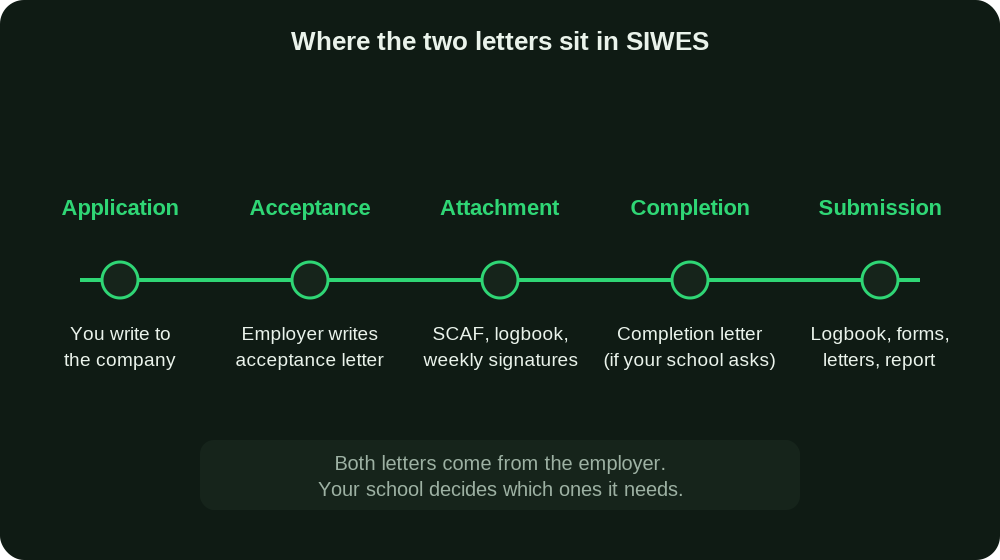
A rough order of events looks like this:
- You search for a company and send an application. If you have not yet written one, how to write a SIWES application letter shows the structure.
- The company replies with an acceptance letter.
- You give the acceptance letter to your SIWES unit, which approves the placement and enters it on the school's list.
- You start, get the SCAF endorsed, fill your logbook and collect supervisor signatures.
- At the end, the employer gives its input on Form 8 and any evaluation form your school uses, and, if your school requires it, issues a completion letter.
- You submit the logbook, forms, letters and report to your school by its deadline.
Steps 2 and 5 are the two letters. The rest of this article is about getting them right.
The SIWES acceptance letter
What it is
An acceptance letter is the employer's written answer to your application. It says, in effect: "We have agreed to take this student for industrial training from this date for this long." Your school uses it to confirm that a placement exists before approving it.
There is also a second meaning that can confuse you. Some institutions use a printed acceptance form instead of a free-form letter. The National Open University of Nigeria, for instance, tells its students on its SIWES instructions page that they must obtain a signed Acceptance of SIWES form from their employers, and describes it as the employer's reply to the placement letter. Same purpose, different packaging. If your school has a form, use the form. If it asks for a letter, use a letter. Do not guess: ask your coordinator which one your school expects.
Who writes it, and who signs
The employer does. That usually means the HR office, the training or admin manager, or the head of the department where you will work. The signature that matters is the company's.
What you can do is make their job easy. Many offices are busy, and a student who sends a polite email with the basic facts in a list tends to get a faster answer than one who just says "please accept me." Some employers will even ask you to draft the wording for them to check. That is acceptable as long as the company reads it, corrects it and signs it as its own, and the facts are true.
What you must not do is sign for the company, invent a signatory, or produce a "stamped" letter that the company never issued. Schools check these things, and a forged document is far more damaging than a late one.
What a good acceptance letter contains
There is no single national format, so the list below is what a typical school or employer expects. Check it against your school's instructions.
| Item | Why it matters |
|---|---|
| Company letterhead, address and contact details | Shows the letter really comes from the organisation |
| Date of the letter | Lets your school see it was issued before the attachment started |
| Addressee (your SIWES unit or "To whom it may concern") | Matches how your school receives it |
| Your full name, matric number, institution, programme and level | Identifies you exactly and avoids mix-ups with other students |
| Department or unit you will work in | Helps your coordinator judge whether the placement fits your course |
| Start date and end date, or start date and duration | Used to match the SIWES calendar and your logbook |
| Name, title and signature of the person issuing it, plus a stamp if the company uses one | Makes the letter checkable |
| Name and contact of your industry-based supervisor, if already known | Useful for your school's supervision visits |
If the letter is missing the dates, your school may send it back. If it is missing the signatory's name and title, it looks weak even if it is genuine.
Illustrative template: acceptance letter
This is a template with placeholders, not a real letter and not an official form. It is what an employer might issue; fill in square-bracket items only with facts that are true, and let the company produce, review and sign it.
[COMPANY LETTERHEAD: company name, address, phone, email]

[Date]

The Coordinator,
SIWES Unit,
[Name of institution],
[Address of institution].

Dear Sir/Madam,

ACCEPTANCE OF STUDENT FOR INDUSTRIAL TRAINING (SIWES)

We write to confirm that [Student's full name], with matriculation number
[Matric number], a [level] student of the Department of [Department],
[Name of institution], has been accepted for industrial training in our
organisation.

The student will be attached to our [department/unit] from [start date]
to [end date], a period of [number] months. During this period the
student will work under the supervision of [Supervisor's name and
title], who will serve as the industry-based supervisor.

We will complete the employer's sections of the student's logbook and
other SIWES forms as required by your institution and the Industrial
Training Fund.

Yours faithfully,

[Signature]
[Name of authorised officer]
[Position]
[Company stamp, if applicable]
Notice what is not in it: promises about pay, job offers or a guaranteed grade. A plain acceptance letter does not need any of those, and an employer who adds conditions you do not understand should be questioned before you accept.
A short email to request the acceptance letter
When a company has said yes verbally, or after an interview, the next step is to ask for the paper. A message like this works. Again, placeholders in brackets:
Subject: Request for SIWES acceptance letter: [Your full name], [Institution]

Dear [Mr/Ms Surname],

Thank you for agreeing to host me for industrial training. My school's
SIWES unit asks for a written acceptance letter before it approves
placements. Could you please issue one on company letterhead, addressed
to the SIWES Coordinator, [Institution], stating my name ([Full name]),
matric number ([Matric number]), the department I will join, and my
start date ([date]) and duration ([months]) of attachment?

I have attached my school's introduction letter and a short draft of the
wording in case it helps. Please feel free to edit it.

I can collect a signed copy from your office, or receive a scanned copy
by email.

Thank you.

[Full name]
[Programme, level]
[Phone number]
Two lines in that email do real work. "A short draft of the wording in case it helps" lowers the effort for the employer. "Please feel free to edit it" keeps the company in control of what it signs.
The SIWES completion letter
What it is, and why not every school asks for one
A completion letter is a short letter from the employer stating that you completed your attachment. Unlike the acceptance letter, it is not a national SIWES document. It does not come from the Industrial Training Fund, and many institutions never mention it. Where it exists, it is a school requirement.
One published example is Ifo Federal Polytechnic's SIWES and defence guidelines. They list a completion letter as the first item in the bound set of documents students submit, and say it must carry the official signature and stamp of the placement organisation. The same page lists the institutional and industry supervisors' details, the technical report and the logbook printout as the other items. A different school might call the same thing a letter of completion, a certificate of completion or an attachment certificate, or might not ask for it at all.
The point is: do not assume. Ask your SIWES coordinator two questions early. Do we need a completion letter, and does it go inside the report or as a separate document?
Completion letter versus the other end-of-attachment papers
Students often lump the end-of-attachment papers together. They are different.
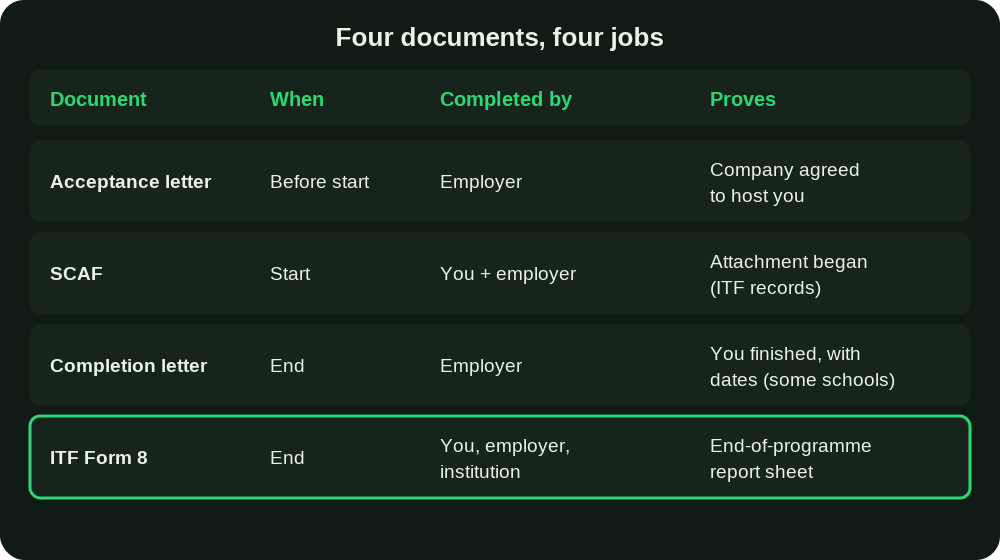
- Completion letter. A letter from the employer saying you did the attachment. Required only if your school says so.
- ITF Form 8. The end-of-programme report sheet completed by you, your employer and your institution. Read what SIWES Form 8 is and who fills it for the details.
- SCAF. A form at the start of the attachment used for ITF's records, covered in what the SIWES SCAF form is. It is not an acceptance letter, and an acceptance letter is not a SCAF.
- Employer evaluation form. Some schools give employers their own form. At NOUN, for example, the employer completes the SIWES Evaluation Form at the end and returns it under confidential cover to the study centre desk officer. The student does not complete it.
- Logbook. Your own daily record, signed by supervisors. See how to fill your SIWES logbook.
A completion letter does not replace any of these, and none of them replaces it if your school asks for it.
What a completion letter should contain
Keep it short. A completion letter is a statement of facts that the company can verify from its own records.
| Item | Notes |
|---|---|
| Company letterhead and contact details | As with the acceptance letter |
| Date of issue | Should be on or after your last day |
| Addressee | Your SIWES unit, department, or "To whom it may concern", whichever your school prefers |
| Your name, matric number, institution and programme | Exactly as on your school records |
| Department or unit where you worked | One line |
| Actual start and end dates, and total duration | These must match your logbook and Form 8 |
| Brief neutral statement of conduct or performance, if the employer is willing | Optional; the employer decides |
| Name, title, signature and, where required, company stamp | Required if your school says so |
The dates matter most. If the letter says three months and the logbook says six, your school will ask questions. Check that the dates agree across the acceptance letter, completion letter, logbook and Form 8 before you submit anything.
Illustrative template: completion letter
As before, this is a template with placeholders. It is not an official form, and the facts and signature must come from the employer.
[COMPANY LETTERHEAD: company name, address, phone, email]

[Date]

The Coordinator,
SIWES Unit,
[Name of institution].

Dear Sir/Madam,

COMPLETION OF INDUSTRIAL TRAINING (SIWES)

This is to confirm that [Student's full name], with matriculation number
[Matric number], a student of the Department of [Department],
[Name of institution], completed a period of industrial training in the
[department/unit] of this organisation from [start date] to [end date],
a total of [number] months.

During this period the student worked under the supervision of
[Supervisor's name and title].

[Optional, at the employer's discretion: one or two neutral sentences on
the student's attendance, conduct or the areas of work covered.]

This letter is issued at the student's request for the purpose of the
SIWES assessment.

Yours faithfully,

[Signature]
[Name of authorised officer]
[Position]
[Company stamp, where required]
The line "issued at the student's request for the purpose of the SIWES assessment" prevents the letter from being read as a general reference or recommendation, which many employers prefer to handle separately.
How to request the completion letter without chasing
Employers forget. The most common reason a student cannot submit a completion letter on time is that the person who would sign it was busy, travelling or no longer working there. Here is a sequence that avoids this.
- Ask at the start. In week one, confirm with your supervisor who issues the completion letter and what they need from you.
- Ask again about a month before the end. A single email or a brief word in person. Give them the dates and the form your school uses.
- Offer a draft. A short draft like the template above, with your details filled in, saves the office time. They may use it as is, edit it or write their own.
- Collect it on or before your last day. Check the dates, spelling, signature and stamp before you leave the premises. A typo is easy to fix while you are there and hard to fix after.
- Scan it and keep copies. Keep the original for your school and a scan for yourself.
If the company will not issue a letter at all, say so to your SIWES coordinator before the deadline and ask what your school accepts instead. Do not fabricate a replacement.
Check the facts across your documents
A surprising number of SIWES submissions are delayed not by missing papers but by inconsistent ones. Before you submit, lay the documents side by side and check these points.
- Your name and matric number are spelled identically everywhere.
- The company name is the same, including any "Ltd" or "Nigeria Limited" suffix.
- The start and end dates agree across the acceptance letter, SCAF, logbook, completion letter and Form 8.
- The supervisor's name and title are consistent.
- Any stamp is legible, and signatures are in place where your school needs them.
If you find a mismatch, fix it with the employer rather than altering the document yourself.
Common mistakes
- Writing and signing the letter yourself. A draft for the employer is fine. A letter you sign or stamp for the company is forgery.
- Collecting the acceptance letter too late. Some schools need it before approving your placement. Find out the deadline early; how to find a SIWES placement covers timing.
- Confusing the letters with the forms. The acceptance letter is not the SCAF, and the completion letter is not Form 8.
- Leaving dates vague. "A few months" is not a start and end date.
- Not keeping copies. Letters get lost between the company, the department and the SIWES unit.
- Putting promises in the letter. Pay, job offers and ratings are the employer's business and are not needed for SIWES.
- Assuming your school wants a completion letter, or does not. Check, because the answer differs by institution.
How the letters connect to your report
Neither letter is part of the report body, but the facts in them are. When you write your report, the company name, department, dates and supervisor details in your introduction and company profile should match the letters exactly. If you write about the placement in your report, how to write a SIWES report shows where those details belong, and submitting an IT report that passes departmental review explains the consistency checks reviewers run. If your school puts the completion letter inside the bound report, ask where it should be placed, since that varies. Your department's format also decides the front pages, which you can check in the free university format guides.
Once your documents are ready, a quick format check on the finished Word file with the free formatter helps before you print and bind.
Checklist before you submit
- Acceptance letter received, dated, signed and given to the SIWES unit
- Placement approved on your school's list
- SCAF endorsed and submitted as your school directs
- Logbook complete and signed by supervisors
- Completion letter issued, signed and stamped if your school requires it
- Form 8 and any evaluation form completed by the right people
- Dates, names and company details agree across all documents
- Copies scanned and kept
- Submission deadline confirmed with your coordinator
Where UniDraft fits in
Your letters come from your employer and your school. Once you have your placement details and activities together, UniDraft builds your written SIWES report as an editable Word document, following your supervisor's instructions first, then your department's and your university's format. The SIWES report costs ₦10,000, one-off.
Start your SIWES report with UniDraft
Sources
- National Open University of Nigeria: SIWES general instructions for the Acceptance of SIWES form, the employer's evaluation form and logbook instructions.
- Ifo Federal Polytechnic: SIWES and defence programme guidelines for the completion letter requirement and the list of items submitted.
- Federal Polytechnic Offa: SIWES page for the list of forms students complete, including a letter of acceptance and ITF Form 8.