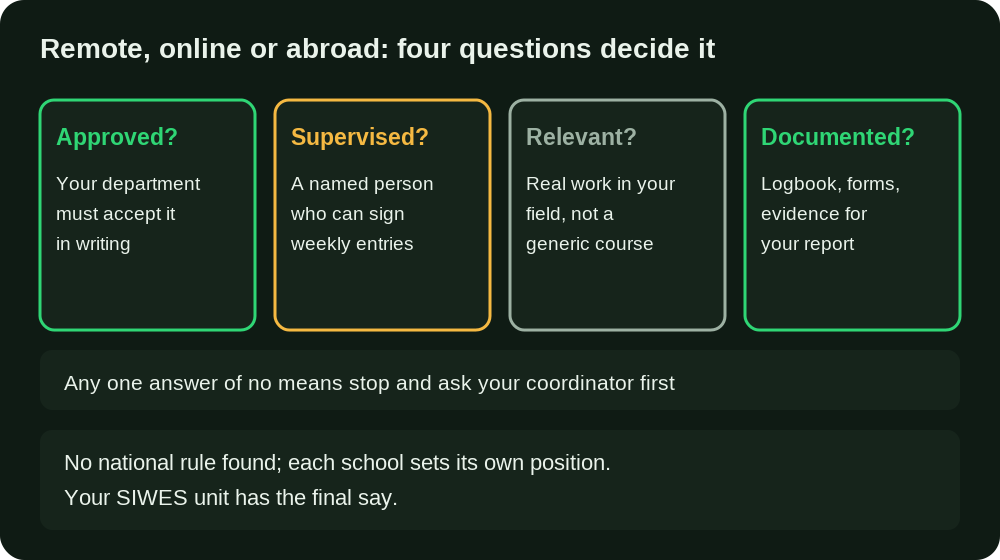
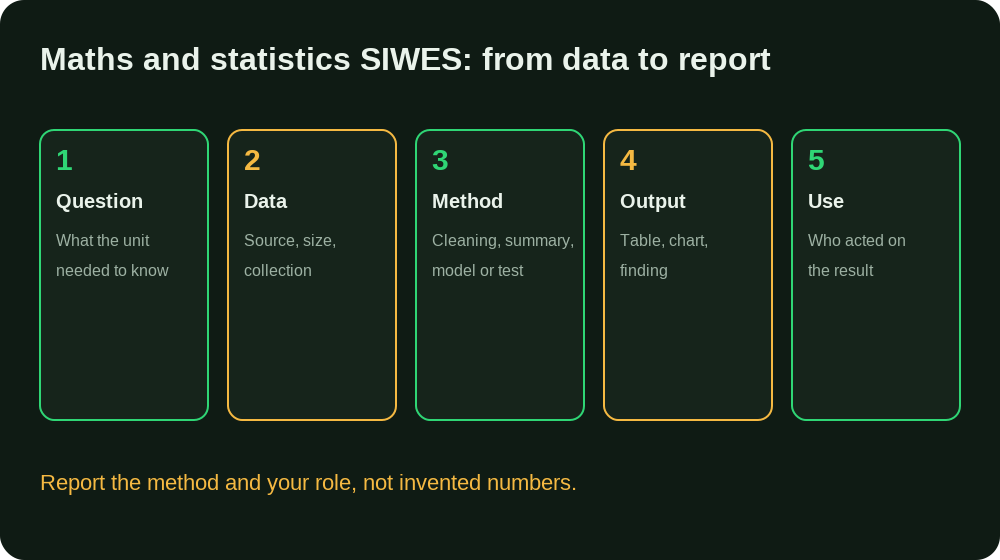
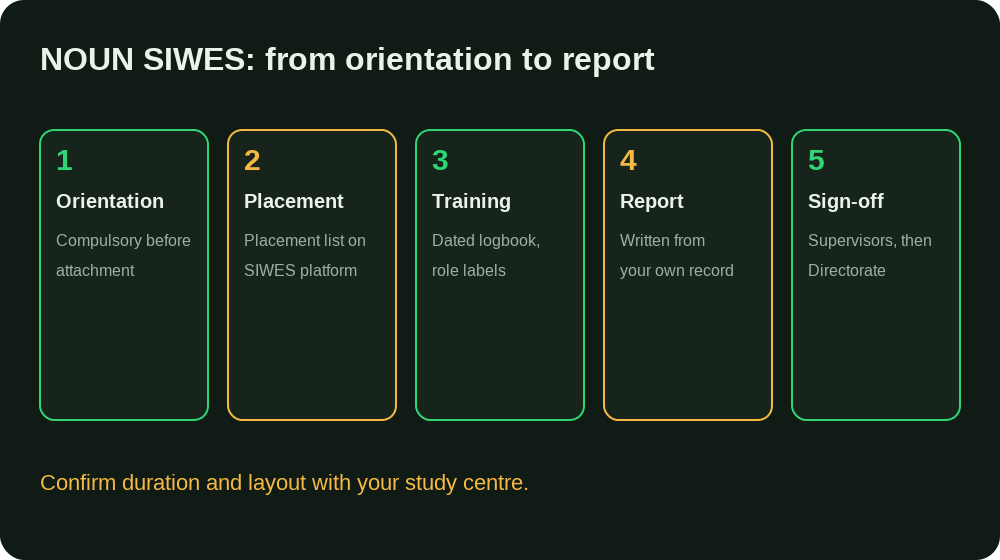
You can change your SIWES placement only through your school, not around it. The rules we found in published institutional guidelines are consistent on this: the University of Ibadan's centre says students must officially apply and that unauthorised changes are not allowed, and the National Open University says there should be no change of employer without written permission. Other schools are less explicit but discourage random moves. So the question is not "am I allowed" but "will my school approve, and how do I do it without damaging my assessment". This guide gives you the reasons that tend to be taken seriously, the order of steps that protects you, and a template for the request. If you have not yet been placed, start with how to find a SIWES placement.
The short answer
- Apply officially. Do not leave one host and join another before your school approves.
- Good reasons: unsafe conditions, no relevant work, closure, fee demands, no supervision.
- Weak reasons: a slightly better allowance, a shorter commute, a bigger name.
- Keep your records: first-placement logbook entries must stay signed by that supervisor.
- Check the weeks: changing can shorten the time available for training.
- Always tell your coordinator first, with dates and a written reason.
Where UniDraft fits, right at the start
Whatever happens with your placement, you will have a written report to produce from the work you actually did. UniDraft builds that report as an editable Word document from your confirmed work, your supervisor's instructions and your school's format, including placements that changed mid-way. Start your SIWES report with UniDraft when your logbook has real entries to build on.
What the published rules say
We opened the published guidance of several Nigerian institutions. Here is what each says on changing a placement, and what it does not.
- University of Ibadan, Industrial Training Coordinating Centre: students who want to change their placement must officially apply to the centre, and unauthorised changes are not allowed for any reason. The page also says the placement letter is the student's authority to report to the employer.
- National Open University: the instructions say there should be no change of employer unless the directorate gives written permission. They also tell students to contact the directorate immediately about any problem at their place of attachment.
- Federal University of Agriculture, Abeokuta: the FAQ says students are not encouraged to change training locations at random. It describes continuous training at one establishment as the expectation, allows training in two locations only for departments specified in the curriculum with authorisation endorsed by the head of department and the SIWES director, and says extensions mean an extra semester or session.
- University on the Niger: its guidelines make departments responsible for approving placements on programme relevance. We found nothing in them about changing placements.
- Edo State Polytechnic and others: the pages we checked did not mention changes.
Notice what this tells you. Where schools speak to the point, they all route a change through the institution. Where they are silent, the sensible reading is that the same principle applies, but you should confirm. We also looked for an ITF statement on changing placement and could not verify one from an official ITF source, so we do not quote one.
Is it worth changing at all?
Before you start the process, test your reason honestly. A change costs time and goodwill, and it can leave a gap in your weeks and your logbook. Many problems can be fixed without moving.
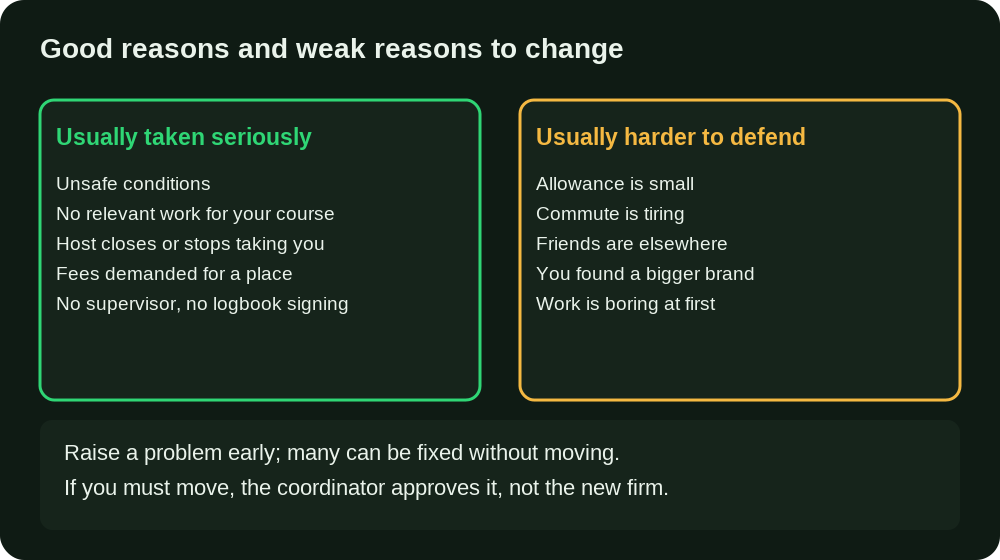
Reasons that tend to be taken seriously
- Unsafe conditions. Physical danger, harassment or being asked to do something illegal. Leave the situation if you are in immediate danger and tell your coordinator straight away.
- No relevant work. If you have been there for weeks and are only filing, running errands or doing tasks unrelated to your course, your logbook and report will be thin. Departments approve placements for relevance, so a placement that has stopped being relevant is a legitimate concern.
- The host closes, relocates or stops taking you. A business closing or a department refusing to supervise you is outside your control.
- Demands for payment. Being asked to pay for the privilege of staying, or to pay a supervisor to sign, is a red flag. Speak to your coordinator before sending any money.
- No supervisor and no signing. If nobody will guide you or sign your logbook, you cannot build the evidence your assessment depends on.
Reasons that are usually harder to defend
- A slightly higher allowance elsewhere. Allowances depend on your school and ITF processes, as described in what SIWES is.
- A long commute or tiredness, unless it makes attendance impossible.
- Friends being at another firm.
- A better-known brand name.
- Work that is simply dull in the first weeks. Early weeks are often observation and basic tasks.
If your reason is in the second list, try to fix the problem first: speak to your supervisor, ask to rotate to another unit within the same host, or agree a clearer task list. Many hosts will adjust when asked politely.
Try to fix it inside the placement first
An internal fix is almost always cheaper than a change. Here is a short sequence.
- Name the problem precisely. "I am not learning anything" is vague. "For three weeks I have only photocopied documents; I would like to join the network team" is something a supervisor can act on.
- Talk to your supervisor privately and politely. Ask for a specific change: a different unit, a project, shadowing a named person.
- Put the request in writing if the conversation does not help, briefly and politely.
- Tell your SIWES coordinator if it still does not improve. The National Open University, for instance, tells students to contact its directorate immediately about any problem at their attachment site.
- Record every step with dates in your own notes.
Only if this fails, or the situation is unsafe, move to the formal change.
The safe order of steps if you must change
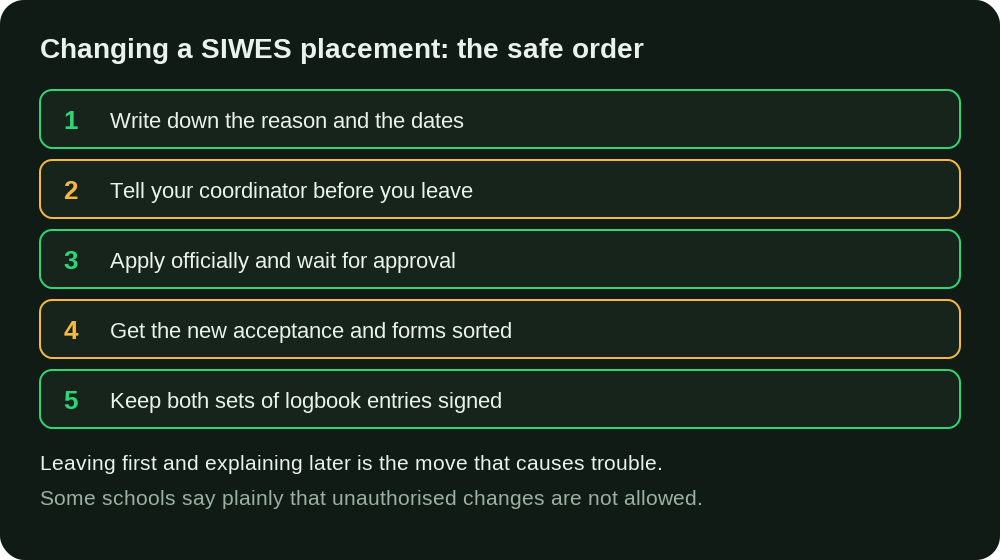
Step 1: write down the reason and the dates
Before you speak to anyone, write what happened, when, who was involved and what you tried. Keep copies of messages. If the case reaches your department, a factual timeline carries weight and an emotional account does not.
Step 2: tell your coordinator before you leave
Contact your SIWES coordinator or unit by email, and also in person if you can. Ask what the process is for your school, what forms exist and whether anything needs to be signed by the host. If the issue is safety, say so plainly and ask for urgent guidance.
Step 3: apply officially and wait for approval
Submit whatever your school requires. Where the rules are explicit, they ask for a formal application or written permission. Do not start at a new host until approval arrives, unless your coordinator tells you otherwise in writing. Starting early can leave you with weeks that your school will not count.
Step 4: get the new placement documented
You will normally need a new acceptance from the new host and whatever documents your school issues for a placement. The new host must also be one your department considers relevant. See how to write a SIWES application letter for how to ask for a place quickly and specifically, since you will be competing against time.
Ask your unit how the ITF paperwork should reflect the new employer and dates. In what the SCAF form is we noted that if your placement or dates change with approval, you should tell your coordinator and not quietly edit a submitted form. The same applies to Form 8 when your school uses it; see what Form 8 is.
Step 5: keep both sets of logbook entries signed
Your first placement's entries are evidence of work you actually did. Make sure the supervisor there signs the pages up to your last day before you leave, even if the relationship has soured. Then start the new entries with your new supervisor from day one. Ask your coordinator whether the two sets sit in one logbook or whether a new one is issued, and how the weeks add up.
Template: asking to change your placement (illustrative)
This is an illustrative template with placeholders. Keep it factual and short.
Subject: Request to change SIWES placement
Good day. I am [name], [matric number], [level] [course]. I began SIWES at [organisation] on [date]. I am writing to request approval to change my placement because [one-sentence factual reason]. Since [date] I have [what you tried, for example spoke to my supervisor on date X]. I have an offer from [new organisation] in [location], starting [date], with [supervisor's name or role] as supervisor. Please advise on the process for approval, the documents required and how the weeks completed so far will be counted. I can provide my logbook entries to date and the acceptance letter on request.
Send it from your school email if you have one, and keep the reply. If the answer is verbal, send a short follow-up summarising what was said and ask them to confirm.
What changes in your logbook and report
A change does not have to damage your report. A change handled openly and in order can show a student who dealt with a problem professionally.
- Logbook: keep the original entries as written. Do not rewrite them to look as though you were always at the second host. Your logbook is the source of truth, and corrections should follow the rules for corrections in your school's handbook.
- Report: state both organisations, the dates at each and the approval, in the section where your school asks about the training setting. Describe the activities at each host from your entries. You do not need to dwell on the reason for the change unless your department asks.
- Assessment: how SIWES is graded varies by school, and in general supervisors' evaluations and the logbook count heavily. If two supervisors are involved, ask your coordinator who evaluates what. How SIWES is graded explains the usual components.
For the structure of the final document, how to write a SIWES report covers the standard chapters, and your school's free format guide shows its specific rules.
Mistakes that make a change worse
- Leaving first and explaining later. This is the single most damaging move, because published rules treat unauthorised changes as not allowed.
- Not collecting the last signatures. Pages without a signature are hard to defend afterwards.
- Joining a new host before approval. Weeks you work before approval may not be counted.
- Choosing a replacement that your department will not accept. Check relevance first.
- Ignoring the duration. One university's FAQ expects continuous training at one establishment and says extensions mean an extra semester or session. A change can eat into the weeks you need.
- Going silent. If you hit a problem, tell your coordinator early. Coordinators help students who raised it in time.
- Paying someone to fix it. No legitimate process needs a payment from you to a stranger.
If you are in danger or being mistreated
Your safety comes first. If you are in immediate danger, leave, go somewhere safe and contact your coordinator or family at once. Keep any messages or records. Your school's SIWES unit and your department are the right places to report harassment or unsafe practice, and the National Open University's instructions, for example, tell students to contact the directorate immediately about problems at their attachment site. Do not wait for the next logbook signing to raise it.
Special cases
The host closes or sends you home
Ask the host for a short letter stating the date and reason, then take it to your coordinator. Your school may have a fallback list of hosts. Our general guide on finding a placement covers the search if you need to start again quickly, though with less time.
You are asked to move within the same company
A transfer to another unit of the same host is often easier than a change of employer. Tell your coordinator anyway and ask whether your logbook needs a note.
Two-location placements
The FUNAAB FAQ allows training in two locations only for departments specified in the curriculum, with authorisation forms endorsed by the head of department and the SIWES director. If your programme has this arrangement, the rules for forms are different, so follow your handbook and not the general advice here.
You are far from campus
Ask whether you can send documents by email. The FUNAAB FAQ says students in distant locations can email scanned acceptance letters to their department coordinator. Do not assume your school does the same.
A one-page checklist
- Reason written down with dates
- Supervisor spoken to, with what you asked
- Coordinator informed in writing
- Official application submitted
- Written approval received
- New acceptance letter obtained
- Old logbook pages signed to the last day
- New logbook started on day one
- Dates at each host recorded for the report
Where UniDraft fits in
When your placement ends, however many hosts it took, the report is built from the real entries in your logbook. UniDraft turns your confirmed activities, your supervisor's instructions and your school's format into an editable Word document. Start your SIWES report with UniDraft and keep your own work at the centre.
Sources
- University of Ibadan Industrial Training Coordinating Centre: commencement of industrial training: placement letter, application for change of placement, unauthorised changes not allowed.
- General instructions, National Open University SIWES: no change of employer without written permission; contact the directorate about placement problems.
- Students' SIWES FAQ, Federal University of Agriculture, Abeokuta: changes not encouraged at random, two-location rules, continuous training, extensions.
- SIWES guidelines and policy, University on the Niger: department approval of placements on relevance.