You can only do SIWES remotely, online or abroad if your own institution approves it, and the approval has to come before you start. We could not find a national rule that bans or allows remote SIWES. What the published school guidelines do show is that placements need departmental approval, a relevant host, a supervisor who signs your logbook, and the right paperwork. A remote or overseas placement can meet all of that, but only if you settle each point in writing first. This guide explains what we found, what we could not verify, and how to ask. For the general search, see how to find a SIWES placement, and for what SIWES involves, what SIWES is.
The short answer
- No national rule found. We looked for an ITF or similar statement on remote SIWES and found none. Each institution decides.
- Abroad is mentioned at one school. The Federal University of Agriculture, Abeokuta says in its FAQ that training outside Nigeria is permitted if the pocket-guide requirements are met.
- Approval comes first. Departments approve placements on relevance, so ask before you commit.
- Supervision and signatures are the sticking points. Your logbook entries need someone credible to authenticate them.
- Paperwork may change. ITF forms are tied to a place of training and an area office, so ask which apply to you.
- Never pay for a placement.
Where UniDraft fits, right at the start
Whether your placement is in an office, online or overseas, you still end with a written report that has to follow your school's rules. UniDraft builds that report as an editable Word document from your confirmed work, your supervisor's instructions and your school's format, so the writing stays organised wherever you worked. Start your SIWES report with UniDraft when your logbook is underway.
What we checked and what we could not find
We searched for official statements on remote, online and overseas SIWES and opened the published guidelines of several Nigerian institutions. Here is the honest summary.
- ITF national position: we could not find a published ITF statement on remote or virtual SIWES. We are therefore not claiming one exists in either direction.
- University of Ibadan's industrial training centre: its commencement page describes a placement letter that posts the student to a designated establishment, a job reporting form, and an application process for any change of placement. It does not discuss remote work.
- University on the Niger: its guidelines say the department approves placements on programme relevance, that industry supervisors authenticate logbooks weekly, and that the SIWES unit conducts at least two supervisory visits to each student's placement. They do not mention remote work.
- Federal University of Agriculture, Abeokuta: its FAQ states that training outside Nigeria is permitted if pocket-guide requirements are met. It also says the university does not expect students to fund supervisor visits to distant locations.
- National Open University: its general instructions describe a placement letter, acceptance form and job reporting form, and tell students to contact the directorate about any problem at their place of attachment. They do not specify location.
The pattern is clear. SIWES is built around a physical placement with a supervisor and forms linked to a place, but nothing we found forbids an approved alternative. That is why the answer is "ask, and get it in writing".
Why schools care about the mode of placement
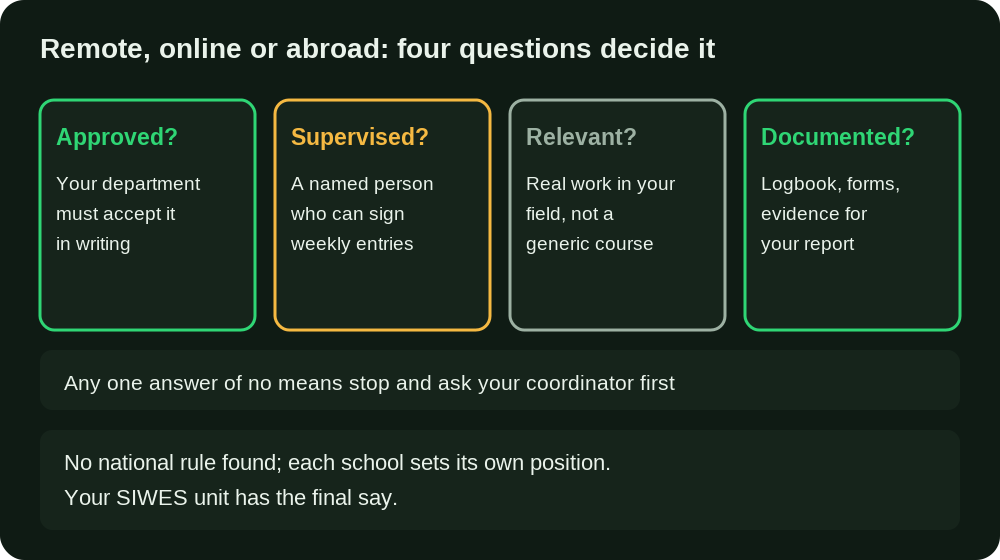
When your coordinator hesitates over a remote placement, the hesitation usually comes from four practical things, not from a love of rules.
- Supervision. SIWES has an academic supervisor who may visit and an industry supervisor who guides you daily. The University on the Niger's guidelines commit the unit to at least two supervisory visits per student. A remote placement makes visits harder, so the school needs another way to check that you are doing what you say.
- Authentication. Logbook entries need a signature or equivalent from someone who actually saw the work. That is straightforward on site and needs a clear method online.
- Relevance. Departments approve placements because the work must relate to your programme. A remote task list that is generic or unrelated to your course can fail this test even if the employer is real.
- ITF paperwork. Forms that go to an area office presuppose a place of training. One university describes the SCAF as going to the ITF area office nearest to each student's place of training, and describes Form 8 as the form ITF uses to pay the allowance. If there is no obvious place of training, the school has to decide how those forms work. See what the SCAF form is and what Form 8 is.
If you can answer all four before you ask, you will get a faster and better answer.
Remote, hybrid and online: what usually has to be true
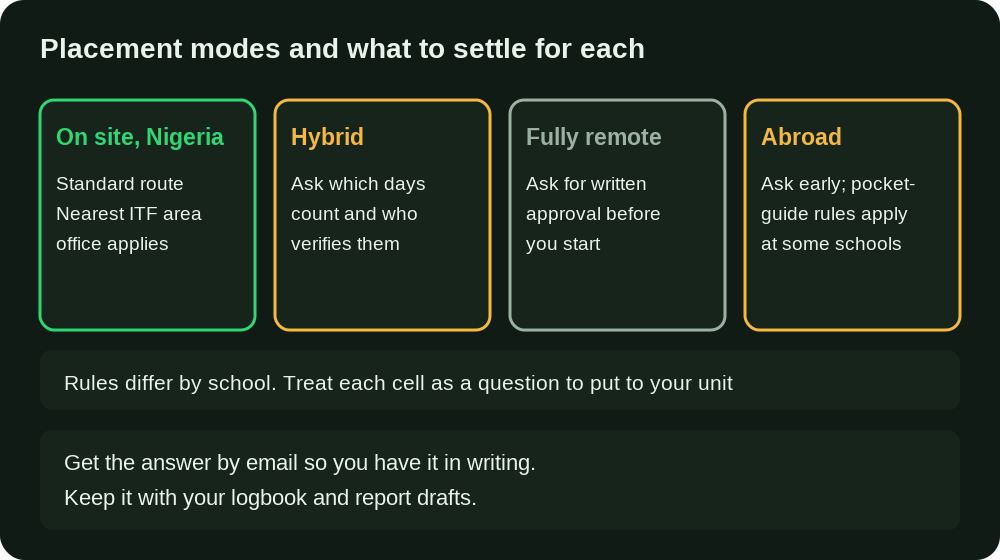
Remote is not one thing. Treat these three arrangements separately when you talk to your coordinator.
Fully remote with a Nigerian employer
You work from home for a company or organisation based in Nigeria. This is the version most likely to be accepted where a school allows remote placements at all, because the employer can be verified, a supervisor is reachable and the host may still have a local contact.
Things to settle: who the supervisor is, how you will report, how entries get signed, which ITF office the school will treat as relevant, and whether the school wants a visit or a video check-in instead of a physical one.
Hybrid
You are in the office on some days and remote on others. This is often the easiest to get approved, because the school can say you have a real place of training and some physical oversight. Ask which days count, who verifies the days you were on site, and how the logbook should mark the difference.
Online placement with a foreign or international employer
You work remotely for an organisation outside Nigeria. This is the hardest to approve, because verifying the host, the supervisor and the nature of the work is more difficult, and ITF-related forms may not map neatly. Some students pursue these in computing and design fields. If this is you, ask early and prepare to supply more evidence than an on-site student would.
Abroad: what we found and how to proceed
The only explicit statement we found is from the Federal University of Agriculture, Abeokuta, whose FAQ says training outside Nigeria is permitted if the SIWES pocket-guide requirements are met. That is a statement about one institution, not a national rule, and the pocket-guide was not available to us, so we do not know the exact requirements.
If you want to train abroad, treat these as the minimum questions to put to your coordinator in writing:
- Does our institution allow overseas SIWES, and where is that written?
- What does the department need from the host: an acceptance letter, a named supervisor, a description of tasks?
- How will supervision and logbook authentication work from a distance?
- Which ITF forms apply, and where do I submit them?
- How are the dates handled so that I complete the required number of weeks?
- Is there a deadline for approval?
Also consider the practical side: visa, cost, insurance and safety are your responsibility. A school can approve the placement and still not help with those. If you are being offered the opportunity through family or a contact abroad, make sure the work is real training in your field and not a favour that gives you nothing to log.
How to ask for approval
Write rather than phone. A short email creates a record. Here is an illustrative template with placeholders.
Subject: Request to approve [remote / hybrid / overseas] SIWES placement
Good day. I am [name], [matric number], [level] [course]. I have been offered a SIWES placement with [organisation] in [location], starting [date] for [number] weeks. The work is [one-line description relevant to the course]. My supervisor would be [name and role], who can be reached at [contact]. The proposed arrangement is [fully remote / hybrid with X days on site / based in country]. Please can you confirm in writing whether the department approves this placement, how my logbook should be authenticated, and which ITF forms apply to me. I can supply the acceptance letter and a task outline on request.
Attach the acceptance letter if you have it. If your coordinator says yes, ask them to confirm by email, and save the reply with your logbook. If they say no, ask whether a hybrid or on-site alternative would be accepted. Our general guide on writing a SIWES application letter also helps you make the host's offer specific and credible.
Evidence you should collect in a remote placement
The central risk with a remote placement is that nobody can see what you did, so you need to make the work visible. Everything below should be real and from your own work.
- A written offer or acceptance from the host, with dates, department and supervisor's name.
- A weekly task record in your logbook, written the same week, not rebuilt later. The principles in how to fill your SIWES logbook apply fully.
- Supervisor confirmation of each week, in whatever form your school accepts: signature, scanned page or email.
- Work artefacts, such as code commits, design files, reports or dashboards, where your host allows you to keep or describe them. Check confidentiality rules first.
- Meeting records, such as dates and topics of calls with your supervisor.
- A running log of hours, so the number of weeks and days is provable.
Computing students often have natural artefacts. The computer science logbook examples show how to describe technical work in a way a supervisor can verify without exposing anything confidential.
Common problems and how to avoid them
The host will not sign
A remote host may be unfamiliar with SIWES and unsure what signing involves. Explain that the signature confirms the week's activities, and offer to send the entries for review at a fixed time each week. If you agree this at the start, it rarely becomes an issue later.
The school rejects the logbook after the fact
This is the most damaging outcome and the easiest to avoid. If you start without written approval, you risk the school declining to count the placement. Get approval first, even if it delays your start by a few days.
The work is not relevant
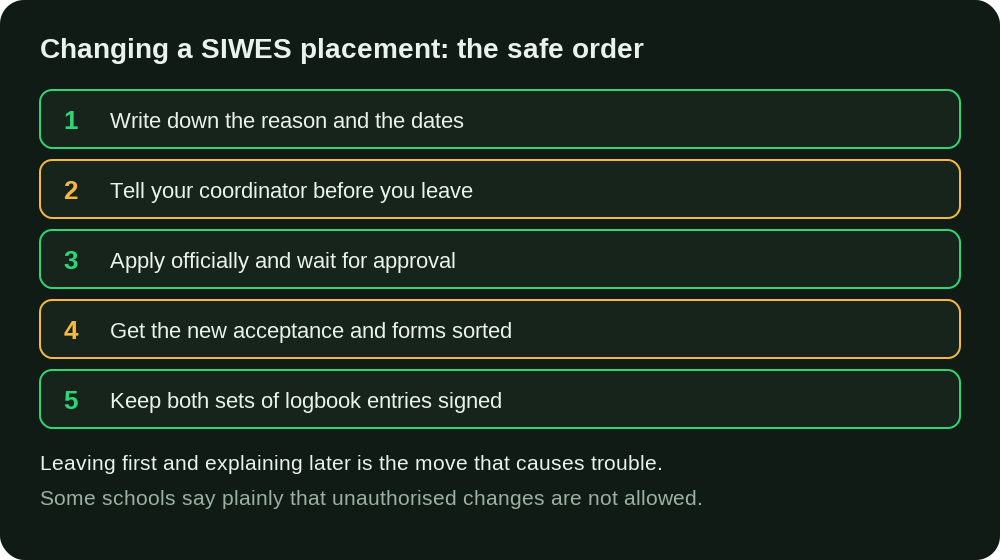
Online tasks can drift. A computer science student asked to do data entry or social media posting has little to write about. Agree the scope in advance, and if the work changes, tell your coordinator early. If the placement stops being suitable, read can I change my SIWES placement before you walk away.
You cannot show how much time you worked
Keep a simple daily record of start time, end time and what you did. If the school asks how you completed the required weeks, you will be able to show it.
Offers that look too good
Be wary of "remote SIWES" offers that appear in messages or social media, especially those that ask for a fee, ask you to move money, or promise a signed logbook without work. Check the organisation exists, speak to someone who works there, and show the offer to your coordinator before accepting.
How assessment fits in
How your SIWES is graded depends on your institution, and in general it combines your logbook, supervisor evaluations and report, sometimes with a seminar. The University on the Niger's guidelines, for example, list logbook completion, industry supervisor evaluation, university supervisor assessment, and a technical report with seminar. A remote placement does not change those components, but it does change how much evidence you must provide for each. To understand what graders look for, read how SIWES is graded.
Writing the report for a non-standard placement
Your report should say honestly how the placement was structured. State whether you worked remotely, in a hybrid arrangement or abroad, name the host as your school requires, and describe your activities from the logbook. Do not describe an office you never visited, equipment you never used or colleagues you never met. Your supervisor and any examiner can tell, and the report is only as credible as the log behind it.
Follow your department's format exactly: chapter structure, numbering and page order differ between schools. How to write a SIWES report gives the standard structure, and the free university format guides show what each school expects. If your school provides a template, use it over any general guide.
A decision path you can follow
- Ask your coordinator whether remote, hybrid or overseas placements are accepted and where that is written.
- Get the host's offer in writing with dates, department and supervisor.
- Send your request using the template above and wait for a written reply.
- Confirm the paperwork: acceptance letter, ITF forms, area office and deadlines.
- Agree supervision: how often, by what method and who signs.
- Start the logbook on day one, with evidence saved weekly.
- Keep your coordinator informed if anything changes.
Where UniDraft fits in
After the placement, your report is where the work gets assessed. UniDraft builds it as an editable Word document from your real logbook activities, your supervisor's instructions and your school's format. Start your SIWES report with UniDraft and keep your own record at the centre of it.
Sources
- Students' SIWES FAQ, Federal University of Agriculture, Abeokuta: training outside Nigeria permitted if pocket-guide requirements are met; distant-location supervision.
- University of Ibadan Industrial Training Coordinating Centre: commencement of industrial training: placement letter, SCAF and Form 8 descriptions.
- SIWES guidelines and policy, University on the Niger: placement approval, weekly authentication, supervisory visits, assessment components.
- General instructions, National Open University SIWES: placement process and contacting the directorate about placement problems.